



 (726) 233-6044
Bottom line upfront: An air conditioner does not consume refrigerant. It circulates the same charge in a sealed loop for the life of the equipment. So a system that keeps needing refrigerant usually has a physical failure somewhere in that loop — a fatigued copper line, a corroded coil, a bad braze, a worn valve seal, or damage from an earlier repair. Adding refrigerant is sometimes exactly the right thing to do. Adding it without finding out why the charge is low is the part that costs people money.
There is a sentence we hear in San Antonio homes almost every summer: “It just needs a little Freon, it does this every year.”
It is an understandable thing to believe. Cars need oil topped up. Printers need ink. It seems reasonable that an air conditioner would slowly use up the stuff that makes it cold. But that is not how the machine works, and the misunderstanding is expensive — because a homeowner who thinks refrigerant is a consumable will pay to refill it season after season while the actual failure gets worse underneath.
This guide covers what causes AC refrigerant leaks, why adding more is not a repair, and one thing about federal law that a lot of homeowners have been told incorrectly.
First: Refrigerant Is Not a Consumable
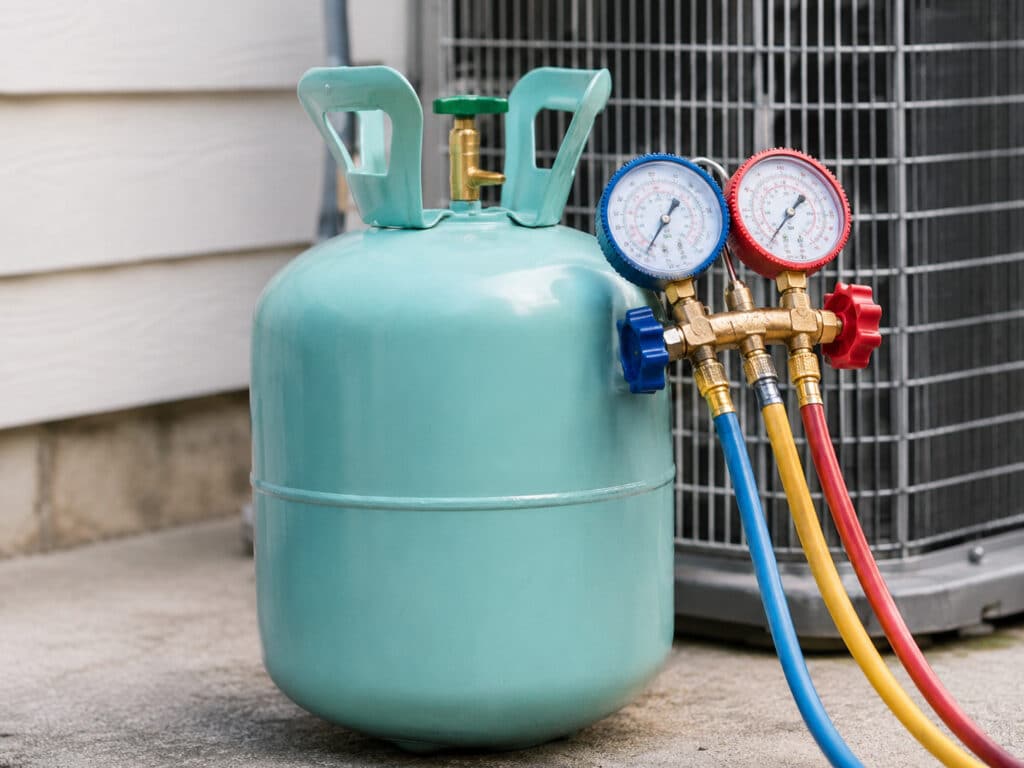
Refrigerant circulates in a sealed, closed loop. It changes between liquid and vapor to move heat out of your home, but it is never burned, used up, or worn out. A correctly installed and intact system holds the same charge for its entire service life. So a low charge always has a cause — most often a leak, occasionally something else. What it is never is normal consumption.
Your air conditioner has an indoor evaporator coil, an outdoor condenser coil, a compressor, a metering device, and copper lines connecting them. Refrigerant moves through that circuit continuously while the system runs, absorbing heat inside and releasing it outside. The same refrigerant comes back around and does it again.
Nothing in that process consumes refrigerant. It is a heat transfer medium, not a fuel.
This matters because of what it rules out. If a technician tells you the system was “a little low” and adds refrigerant without establishing why, you have not been given a diagnosis. You have been given a number and a refill.
A useful way to think about it: if your car needed a quart of coolant every August, nobody would call that normal maintenance. They would look for the reason. A sealed refrigerant circuit deserves the same logic — not because adding fluid is wrong, but because nobody should be doing it blind, year after year, without an explanation.
Three times a low charge is not a leak
It would be convenient for us to tell you that every low system is leaking. It is not true, and you should know the exceptions.
- It was never charged correctly. A system can leave the installation undercharged and simply stay that way. Nothing is leaking — the right amount was never in there. Correcting the charge genuinely fixes it.
- A one-time loss during service. A valve core left loose, or gauges disconnected carelessly, releases charge once. That is an event, not an ongoing defect. Once it is corrected, the system holds.
- A known slow leak on a system near the end of its life. If a 16-year-old unit loses a small amount each season and replacement is already planned, topping it off to get through one more summer can be a reasonable decision — provided the homeowner has been told that is what is happening and is choosing it with open eyes.
The difference in all three cases is that someone found out why. That is the thing worth insisting on — not a rule that refrigerant must never be added.
What Causes AC Refrigerant Leaks
Leaks come from a small number of physical failure mechanisms: mechanical fatigue from vibration, corrosion of the tubing, defective brazed or flared joints, stress built into the original installation, physical damage, worn valve and service port seals, and factory defects. Where the leak is tells you less than why it failed — and the why is what determines responsibility.
Most articles on this subject organize leaks by location: coil leaks, line set leaks, valve leaks. That is not very useful, because a brazed joint can be at a coil, at a line set, or at the metering device, and the fix and the responsibility are different in each case.
Here is the more useful organization — by what actually failed.
1. Mechanical fatigue from vibration
The compressor and the outdoor fan vibrate every minute the system runs. If a copper line is inadequately supported, rigidly clamped with no allowance for movement, or resting against another surface, that vibration concentrates stress at one point. Metal fatigues. Eventually a crack opens.
This is one of the most common failures we find, and it is also one of the most preventable — line sets that were properly supported and isolated at installation rarely fail this way.
2. Corrosion of the tubing
Corrosion thins the tube wall until it can no longer contain refrigerant pressure. There are several distinct corrosion mechanisms, and one of them — formicary corrosion — is common enough and strange enough to deserve its own section further down.
3. Defective brazed or flared joints
A brazed joint depends on a sound metallurgical bond. A flare connection depends on a correctly formed mating surface and the right torque. Contaminated surfaces, poor brazing technique, a badly formed flare, misalignment, or over-tightening all leave a joint that may hold at first and then open up after enough heating, cooling and pressure cycling.
A cause almost no article mentions: when copper is brazed without flowing dry nitrogen through the line, the inside of the tube oxidizes and forms a hard black scale. That scale breaks loose over time, circulates, and can both pit the tubing from the inside and foul the metering device. It is invisible from the outside and it is purely an installation practice issue — nitrogen purging is standard procedure, and skipping it saves a few minutes and costs the homeowner years later.
4. Stress built in at installation
Copper expands and contracts with temperature. A line that was bent too tightly, pulled into alignment, or constrained without room to move will concentrate that movement at a bend or a fitting. This overlaps with vibration fatigue, but the distinction matters: here the stress was designed in on day one.
5. Physical damage and abrasion
String trimmers and lawn equipment around the outdoor unit. Construction and remodeling work. A line rubbing against a sharp edge or a joist for years. Hail and debris on condenser coils. This category includes the only causes a homeowner can realistically prevent.
6. Worn valve cores, service ports and seals
Service ports have sealing elements that must hold refrigerant when no gauges are attached. A damaged valve core, a contaminated sealing surface, or a cap that was never seated properly will leak slowly for years. On many valve designs the cap itself is part of the seal — it is not decorative.
These are frequently found after a service visit, which is an uncomfortable fact but a real one.
7. Factory defects and premature component failure
A component can leave the factory with a weak braze, a porous casting, an inclusion in the material, or thin tube wall. It may hold pressure for a while before cycling opens it up. Early failure alone does not prove a manufacturing defect — but it is the first thing worth investigating, because it is the clearest path to a parts warranty claim.
8. Damage from previous service work
Refrigerant circuits can be damaged during repairs. Excessive force on a fitting, damaged threads, poorly executed brazing, or a valve core that was not reseated will all create a new leak. If a system started losing refrigerant shortly after someone worked on it, that sequence matters and should be documented.
One thing this list does not include: poor maintenance. A sealed system can develop a leak even when the filters were changed on schedule and the coils were kept clean. Maintenance protects airflow, capacity and the compressor. It does not keep a brazed joint from failing. Any contractor who tells you the leak is your fault for missing a tune-up is reaching.
Formicary Corrosion: The Cause Most Homeowners Have Never Heard Of
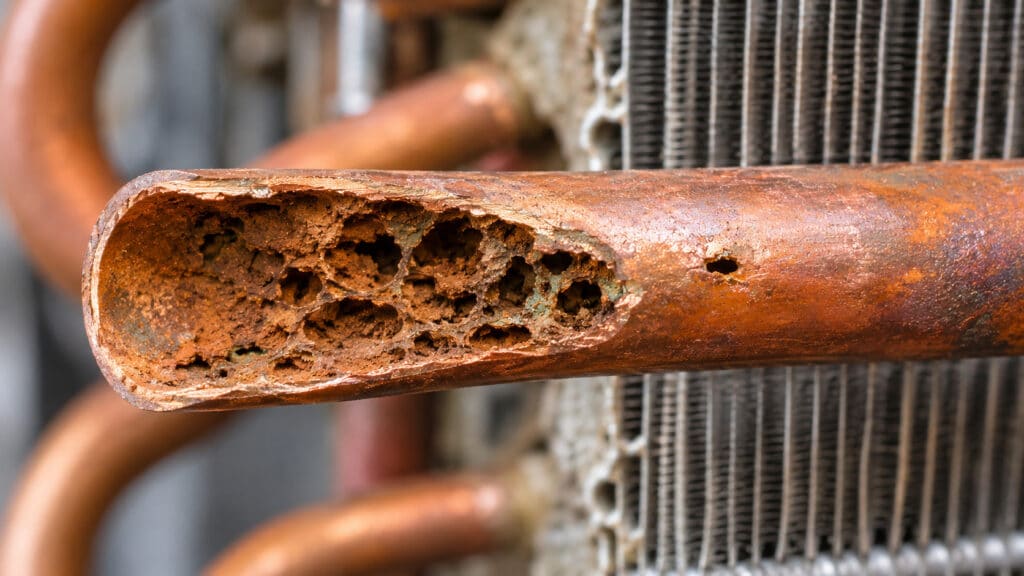
Formicary corrosion — also called “ant’s nest” corrosion — attacks copper tubing from the inside out, creating microscopic branching tunnels that eventually reach the surface as pinhole leaks. It requires three things: moisture, oxygen, and certain organic acids. Those acids come from ordinary indoor sources, not from heat or humidity alone. It is a copper tubing mechanism, which is why coil material matters.
If you look at a coil that has failed this way under magnification, the damage looks like an ant colony — a network of tiny tunnels branching through the wall of the tube. From the outside you may see nothing at all until refrigerant starts escaping.
Peer-reviewed research attributes roughly 10% of premature copper tube failures in the HVAC industry to ant-nest corrosion. The same research identifies the required conditions as moisture, oxygen, and a corrosive agent — usually a volatile organic acid — and names formic, acetic, propionic and butyric acid specifically.
Source: Revista de Metalurgia (CSIC), vol. 42 no. 5, 2006, “Ant-nest corrosion of copper tubing in air-conditioning units.” Note the denominator: premature copper tube failures, not all refrigerant leaks and not all installed systems.
Where the acids come from
This is the part that surprises people. The organic acids involved are produced by perfectly ordinary things inside a house. Industry research on indoor coil corrosion lists adhesives, cabinets, carpets, countertops, foam insulation, laminates, oil-based paints, paneling, particle board, plywood, silicone caulking, wallboard and wallpaper — along with cleaning solvents, vinegar, cosmetics, disinfectants, deodorizers, and tobacco or wood smoke.
In other words: new construction, a recent remodel, or a tightly sealed home with limited fresh air exchange can create conditions that are harder on a copper coil than an older, leakier house.
Being honest about what we do not know: there is no reliable timetable for this. One peer-reviewed study describes premature failures within months. A corrosion institute describes tunneling penetrating thin-walled tube in weeks under the right conditions. A manufacturer report puts the typical window at one to four years after installation. These do not agree, and none of them is a population study of residential coils in Texas. What is established is the mechanism — not a date you can mark on a calendar.
Why coil material matters here
Formicary corrosion is specifically a copper tubing phenomenon. That is why much of the residential HVAC industry moved toward all-aluminum evaporator coils.
Daikin, Amana and Goodman all publish all-aluminum evaporator coil models in their current residential documentation — the CAPTA series among them. That is a verifiable fact about the equipment.
What we will not claim: that aluminum coils leak less. No controlled field study comparing aluminum and copper coil failure rates — same age, same environment, same installation quality — appears to exist. Aluminum is not immune to other corrosion, to manufacturing defects, to connection leaks, or to physical damage. The honest statement is narrower: the formicary mechanism attacks copper, and all-aluminum coils are not made of copper. Anyone quoting you a percentage is making it up.
One more caution, and it cuts against the easy story: a pinhole leak does not by itself prove formicary corrosion. The characteristic branching tunnel structure is what distinguishes it, and other kinds of damage are routinely misidentified as formicary when a tech wants a quick explanation.
Does San Antonio’s Climate Actually Cause Refrigerant Leaks?
Not directly, and we are not going to tell you it does. No study establishes that hot climates cause refrigerant leaks. What the climate does establish is run time — a San Antonio system spends far more hours running than one in a mild climate, which means more vibration cycles and more pressure cycling over the same number of years. That is a plausible contributor to mechanical fatigue. It is not a proven cause, and we would rather say so.
Nearly every local HVAC article on this topic opens by blaming the Texas heat. It is an easy story and it sells repairs. We could not find research supporting it, so here is the version we can defend.
San Antonio’s August cooling degree day normal is 634. Across the full year, NOAA’s 1991–2020 normals for San Antonio International Airport put the annual total at roughly 3,148 cooling degree days, with meaningful cooling demand from April all the way through October.
Source: NOAA / National Weather Service climate normals, San Antonio International Airport. Cooling degree days measure climate-driven cooling demand — they are not a count of compressor run hours, and should not be read as one.
What that number means in practice: a cooling season that starts in spring and runs deep into fall, rather than three months of real demand. More operating hours means more starts, more stops, more vibration, and more thermal expansion and contraction of the copper.
Does that cause leaks? It does not create a defect that was not already there. What it plausibly does is bring forward the day an inadequately supported line, a marginal braze, or a stressed bend finally fails. A weak joint that might survive fifteen years in a mild climate may not survive as long here.
That is a reasonable inference from how metal fatigue works. It is not a statistic, and you should be skeptical of anyone who presents it as one.
The same goes for attic temperatures. You will see “Texas attics hit 140°F” quoted constantly. We could not find a Texas measurement study behind it. The strongest hot-climate field research we located is from the University of Central Florida, in Fort Myers, where a dark-shingle home’s attic air peaked at 135.6°F while the roof deck above it reached 143.5°F. Those are different measurements, and the number in circulation appears to blur them. Attics get brutally hot here — that part is true and obvious. But that study measured energy and temperature, not refrigerant leaks, and it does not establish that attic heat causes them.
Topping Off: When It Helps, and When It Hides a Problem
Adding refrigerant replaces what escaped. It does not close the opening it escaped through. That is the whole distinction. Recharging a system is correct and necessary after a repair, and it is the right call when the charge was simply wrong to begin with. What does not work is adding refrigerant as a substitute for finding out where it went — because the charge leaves again, and the system spends every hour in between running outside its design conditions.
“Top off” and “recharge” are not the same thing
These two terms get used interchangeably, including by technicians, and the difference is worth knowing before you approve any work.
| Term | What is actually done | When it is appropriate |
|---|---|---|
| Top off “adding Freon” | Refrigerant is added to a system that still holds some, usually judged by gauge pressure, without recovering what is in there. | Only with a known cause |
| Proper recharge | Remaining refrigerant is recovered, the system is evacuated to remove moisture and air, then the full charge is weighed in to the manufacturer’s specification. | After any repair |
A proper recharge is not something to be suspicious of. It is the correct finish to a leak repair, and it is how the system gets back to the charge it was designed around. The thing to question is a top-off offered instead of a diagnosis.
What running low actually does
An undercharged system is not just a system that cools less well. The refrigerant mass flowing through the circuit affects pressures, capacity, and the compressor itself.
- Suction pressure drops, and the evaporating temperature can fall below its intended range — which is why a low system often ices up rather than simply blowing warm.
- Capacity falls. There is not enough refrigerant mass moving to carry the expected amount of heat, so the system runs longer for less result.
- Compressor temperatures rise. Low suction pressure raises the compression ratio and the discharge temperature. In many compressor designs, the returning refrigerant is also what cools the motor windings — less mass flow means less cooling.
- Oil return becomes unreliable. Refrigerant velocity carries compressor lubricant back through the circuit. Prolonged abnormal operation can starve the compressor of its own oil.
None of these are certainties in every undercharged system. They depend on how much charge was lost, the compressor design, and how long it ran that way. But they are the reason the compressor — the single most expensive component in the system — is the thing most at risk from an unrepaired leak.
And guessing the charge creates a different problem
Adding refrigerant without finding the leak usually also means adding it without properly establishing the correct charge. Too little and the problems above continue. Too much and condensing pressure rises, the compressor works harder, efficiency drops, and depending on the metering device you can get liquid returning where it should not.
Pressure readings alone do not establish correct charge. Proper charging follows the manufacturer’s specified procedure using measured superheat or subcooling at known operating conditions. A gauge reading that “looks about right” on a 100°F afternoon is not a charge verification. If nobody measured, nobody knows.
The cycle this creates
Each top-off makes the problem look solved for a while. Cooling improves, the homeowner relaxes, and the leak keeps going. The next visit comes sooner than the last. If nobody is documenting how much refrigerant was added and when, even a good technician arriving later has no way to judge how fast the system is losing charge or how long it has been running compromised.
That documentation gap matters for a reason we will get to in the warranty section.
To be fair about it: a single top-off is not a scandal. Systems sometimes run slightly low for reasons that turn out to be minor, and a competent technician who adds charge and then measures whether it holds is doing reasonable work. The line we would draw is this — by the second visit for the same symptom, somebody should be looking for the leak rather than reaching for a cylinder. If you are on your third season of annual refrigerant, that line was crossed a while ago.
No, Federal Law Does Not Require You to Repair It
You may have been told that the EPA requires your refrigerant leak to be repaired. For an ordinary home air conditioner, that is not accurate. Federal leak-repair rules apply to larger appliances, and the EPA specifically exempts the residential and light commercial air conditioning and heat pump category. What federal rules do govern is how technicians handle refrigerant — not whether a homeowner must fix a leak.
This comes up often enough that it is worth being precise, because a homeowner who is told something is legally required and later finds out it was not tends to stop trusting everything else they were told.
What the rules actually say
The EPA’s Emissions Reduction and Reclamation rule, with compliance beginning January 1, 2026, sets leak repair requirements for appliances containing 15 pounds or more of HFC refrigerant or certain substitutes. Covered categories include industrial process refrigeration, commercial refrigeration, comfort cooling, refrigerated transport, chillers and certain variable refrigerant flow systems.
The EPA’s own fact sheet lists the residential and light commercial air conditioning and heat pump subsector as exempt from the leak repair requirements — defined as equipment cooling air in individual rooms, single-family homes, and small commercial buildings. A typical home split system falls squarely inside that definition.
The older Section 608 leak repair rule applies to appliances containing 50 pounds or more of ozone-depleting refrigerant. A residential system does not come close to either threshold.
What federal rules do apply to your home system
- Technician certification. Anyone whose work could release refrigerant — connecting gauges, adding or recovering refrigerant — generally must hold EPA Section 608 certification. This applies to residential work regardless of the leak-repair thresholds.
- The venting prohibition. Intentionally releasing refrigerant during service, repair or disposal is generally prohibited. A leak during normal operation is not the same thing as a technician venting a system.
- Sales restrictions. Refrigerant for stationary AC equipment generally can only be purchased by certified technicians. This is why you cannot simply buy a cylinder and handle it yourself.
So why repair it? Because the case for repair never depended on the law. It rests on three things: the compressor is at risk every hour the system runs undercharged, repeated top-offs cost more over a few seasons than finding the leak once, and a documented diagnosis is what makes a warranty claim possible. Those reasons stand on their own. We would rather give you the real ones than a legal requirement that does not exist.
The Cause Determines Who Pays
This is the part most articles skip. The physical cause of a leak points toward who is responsible for it: a factory defect points to the manufacturer’s parts warranty, a bad braze or unsupported line points to the installer’s workmanship warranty, and a leak that began right after a service visit points to whoever did that work. Ordinary corrosion and wear are usually excluded from everything.
A homeowner who understands this asks better questions, and gets better outcomes.
| If the cause is… | The avenue worth pursuing | Typical outcome |
|---|---|---|
| Factory defect or premature component failure | Manufacturer parts warranty | Often covered |
| Poor brazing, flaring, or line support | Original installer’s workmanship warranty | Often covered |
| Damage during a previous repair | That contractor’s responsibility | Depends on records |
| Installation stress or routing defect | Installer workmanship | Needs evidence |
| Formicary or environmental corrosion | Check parts warranty exclusions carefully | Often excluded |
| Accidental external damage | Homeowner’s insurance, possibly | Policy dependent |
| Ordinary wear on seals and valve cores | Usually none | Out of pocket |
The warranty detail that catches people out
Here is the thing nobody mentions until the invoice arrives: a manufacturer parts warranty covers the part. It does not generally cover the labor to remove and install it, the recovery of the remaining refrigerant, the nitrogen and vacuum work, or the new refrigerant charge.
On the equipment we install, the terms are a 10-year manufacturer parts warranty and a 2-year labor warranty, and we register the equipment and the warranties for you — which matters, because unregistered equipment often drops to a much shorter parts term. Those are two separate clocks. In year six, a failed part is covered and the labor is not.
So a “warranty coil replacement” is genuinely free in one sense — and still produces a real invoice. That is not a contractor being dishonest. It is how parts warranties are written, and the time to understand it is before the work is scheduled, not after.
What to ask for, on any leak diagnosis: a written diagnosis that states where the leak was found and what the technician believes caused it. Not “system low on refrigerant” — the actual location and the actual failure. That document is what makes a warranty claim possible. Without it you have an opinion, and manufacturers do not process opinions.
Keep your records too. Installation date, registration confirmation, every service visit, and how much refrigerant was added each time. A system with a documented history is in a far stronger position than one with a shoebox of receipts.
If You Think You Have a Leak
Get the leak located before anything is added to the system. A proper diagnosis uses electronic detection and, where needed, UV dye to confirm the location — then produces a documented finding. Any plan that starts with adding refrigerant and ends there is not a repair.
- Ask for the leak to be located and documented, not estimated.
- Ask what the technician believes caused the failure — the answer determines your warranty options.
- Ask whether the system has remaining manufacturer coverage, and get the registration status checked.
- Ask what the repair includes: recovery, the repair itself, evacuation, and recharge to the specified weight.
- Keep every invoice, including the amount of refrigerant added each visit.
- Do not accept a top-off with no leak search as a completed repair.
- Do not accept “it just needs Freon every year” as a diagnosis.
- Do not let anyone seal a recurring leak repeatedly without discussing why it keeps coming back.
- Do not run the system hard while significantly undercharged if you can avoid it — the compressor is what is at stake.
At Honeycomb, leak location comes before any refrigerant goes into a system. Our refrigerant leak repair process starts with electronic detection, moves to a UV dye search when the electronic detector cannot pinpoint it, and prices the repair by tier once we know what we are actually fixing. If the leak turns out to be in the coil itself and the coil is past saving, that is a different conversation — see evaporator coil replacement.
For the question of whether to keep running the system in the meantime, and the question of whether a leaking system is worth repairing at all, see our companion articles: can you run your AC with a refrigerant leak and repair the system or replace it. If your system is running but not cooling and you are not yet sure refrigerant is the issue, start with AC running but not cooling.
Related Services
Refrigerant Leak Repair
Electronic detection and UV dye location, then tiered pricing once the leak is found.
Evaporator Coil Replacement
When the coil itself is the source and sealing it again is not the answer.
AC Repair
Diagnosis first for cooling faults that may or may not turn out to be refrigerant.
AC Tune-Up
Maintenance will not prevent a leak, but it catches a lot of what it can.
Frequently Asked Questions
Sources & References
- Carrier / International Comfort Products. (2026). Indoor coil corrosion industry research report: Causes, environmental factors, and prevention (Publication No. 42106111203) [PDF file]. ICP Technical Documentation Library.
- Spanish National Research Council. (2006). Metallurgical and corrosion research publication (Article No. 34). Revista de Metalurgia, CSIC Open Access Archive.
- U.S. Environmental Protection Agency. (2026a, January). American Innovation and Manufacturing Act: Leak repair requirements for appliances containing hydrofluorocarbons and certain substitutes [PDF file]. EPA Stratospheric Protection Division.
- U.S. Environmental Protection Agency. (2026b). Frequent questions on the phasedown of hydrofluorocarbons (HFCs) under the AIM Act. EPA Stratospheric Protection Division.
- U.S. National Weather Service. (2026). San Antonio, TX August climate records, normals, and historical weather summary [PDF file]. National Oceanic and Atmospheric Administration, NWS Austin/San Antonio.
- Field observations on common failure points reflect Honeycomb Heating & Cooling’s own service records in San Antonio and the surrounding Hill Country.
Brandon Caputo
Owner & Founder · Honeycomb Heating & Cooling · San Antonio, TX · License TACLA140435E
Brandon came into HVAC the long way around. He started at a painting company in college in Virginia and worked his way up to manager, then moved to San Antonio and spent years in flooring and general contracting doing home remodels — which is where he began learning the mechanical trades from the inside out. He founded Honeycomb Heating & Cooling after seeing how few homeowners had a contractor they could actually trust to charge a fair rate and do the work right the first time. Telling a customer that federal law does not require the repair they are being quoted for is part of what that means.
Honeycomb serves San Antonio, Stone Oak, Alamo Heights, Helotes, Timberwood Park, Bulverde, Boerne, New Braunfels and the surrounding Hill Country communities. The company is BBB accredited, holds a 5.0 Google rating across 800+ reviews, and was voted 3rd Best HVAC Contractor in San Antonio by MySA.
The Question Isn’t How Much — It’s Where It’s Going
Adding refrigerant is the right finish to a repair. It is not a substitute for one. If your system has needed it more than once, the useful answer is where the charge is going — and what that tells you about who should be paying for the fix.
Serving San Antonio, Stone Oak, Helotes, Timberwood Park, Bulverde, Boerne and New Braunfels.