


 (726) 233-6044
Bottom line upfront: Stop calling for cooling and arrange service. Trane tells homeowners directly to shut the system off until the leak is repaired, and running undercharged risks the compressor. But there is one exception that matters enormously: if your system uses R-32 or R-454B, set the thermostat to Off and leave the power on. That equipment contains a leak detection sensor that needs electricity to do its job. Turning it off at the breaker disables the safety system, not the leak.
If you are reading this with a warm house and a technician on the way, here is the whole thing in four lines.
- Set the thermostat from Cool to Off.
- Leave the breaker on unless a professional or an emergency responder tells you otherwise.
- Put out any open flames nearby — candles, a gas stove burner, a pilot you can reach safely.
- If anyone in the house feels dizzy, short of breath or unwell, go outside for fresh air first and sort out the equipment second.
The rest of this page explains why, what to do about a hot house in the meantime, and how to tell whether you actually need to worry.
The Short Answer, and Who Actually Says So
No, you should not keep running it normally. Trane’s homeowner guidance is explicit: running an air conditioner with a refrigerant leak can do further damage to the system and to the environment, and the system should be shut off until repairs are made. The reason is the compressor — the most expensive single component in the system, and the one most at risk when the charge is low.
No. Running the air conditioner when you have a refrigerant leak can do further damage to the system as well as the environment. If you or an HVAC technician determines that your AC unit is leaking refrigerant, shut the system off until repairs can be made.
— Trane, homeowner guidance on AC refrigerant leak detection and repair
We are quoting Trane specifically because Trane is the manufacturer whose homeowner-facing guidance states this outright. Carrier recommends fixing a leak immediately to prevent compressor failure, which supports the same conclusion, but does not phrase it as a shutdown instruction — so we are not going to put words in their mouth.
What nobody tells you is what “shut the system off” means in practice on equipment built in the last couple of years. That is the next section, and if you skip the rest of this page, do not skip that one.
If Your System Uses R-32 or R-454B, Do Not Cut the Breaker
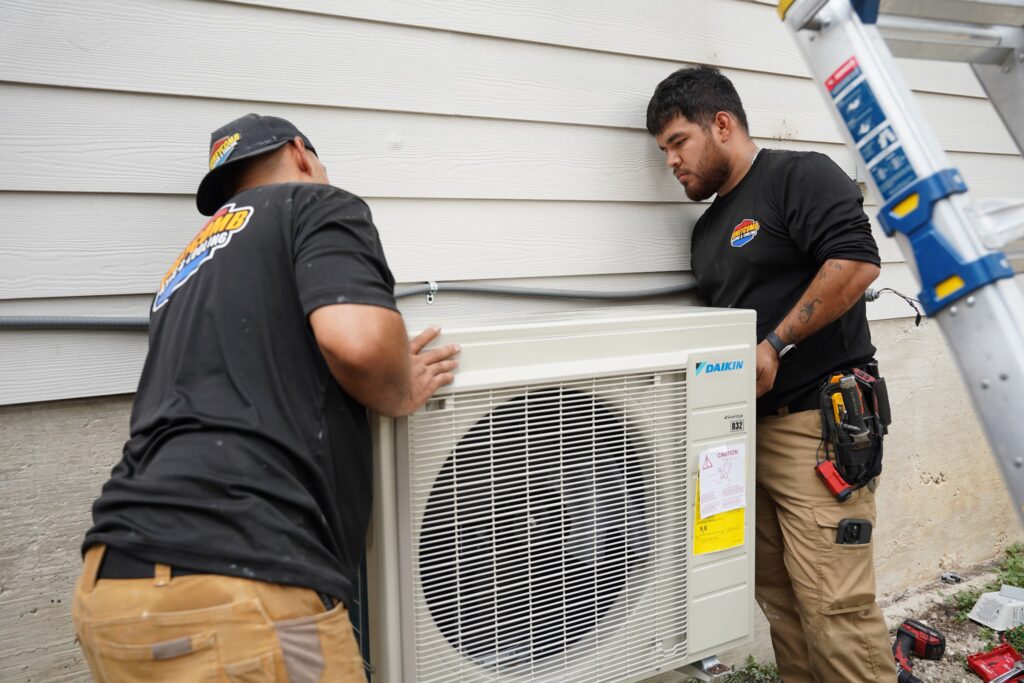
Newer residential systems use A2L refrigerants — R-32 or R-454B — and that equipment contains a refrigerant detection sensor. When it senses refrigerant, the system’s mitigation response is to run the indoor blower to disperse it, stop the compressor, and shut off potential ignition sources. Every one of those actions needs the equipment powered. Flipping the breaker does not stop the leak. It stops the response to the leak.
This is the most important thing on this page and almost nobody is saying it, so let us be precise about where it comes from.
From the installation manual for the coils we install
The Daikin, Goodman, and Amana CAPTA R-32 series coil installation instructions state that “The R32 Sensor must be installed and powered for service,” that the appliance “is equipped with a leak detection sensor” wired through the furnace control board, and plainly: “Do not bypass safety devices.”
The same document notes that “if the sensor is not functioning properly, mitigation mode will engage” — the system is designed to fail toward protection, which only works if it has power.
It also warns that “refrigerants may not contain an odor,” that “under no circumstances shall potential sources of ignition be used in the searching for or detection of refrigerant leaks,” and that “if a leak is suspected, all naked flames shall be removed/extinguished.”
So what actually happens when an A2L system detects a leak? Under the equipment safety standard that governs this category, the detection system has to call for mitigation within 15 seconds of detecting refrigerant, typically at a concentration of 25% of the lower flammability limit — which is to say, well before the air in the room becomes flammable.
The mitigation actions themselves, depending on the equipment, can include:
- Turning on the indoor air-circulating fan to dilute and disperse the refrigerant
- Signalling a zoning system to open all zone dampers
- Stopping the compressor
- De-energizing ignition sources such as electric resistance heat strips or electronic air cleaners
- Closing refrigerant shut-off valves where the equipment has them
- Sounding an alarm, if one is installed
Read that list again with a breaker in mind. Cut the power and the fan stops, the dampers stay where they are, the valves stay open, and the alarm goes quiet. The compressor does stop — but it would have stopped anyway as part of mitigation.
So the instruction is: thermostat to Off, breaker stays on. Those are two different actions and the difference is not cosmetic. If a professional or an emergency responder tells you to isolate power, do it — they are judging the specific situation in front of them. Do not do it because a blog post said “turn it off.”
How to find out which refrigerant you have
Go outside to the condenser — the big box with the fan on top — and read the metal data plate on the side. It names the refrigerant: R-22, R-410A, R-32 or R-454B. It takes about thirty seconds and it tells you which half of this page applies to you.
| If the nameplate says | Roughly | What it means for you right now |
|---|---|---|
| R-22 | Pre-2010 system | Not flammable. Thermostat off is enough. No longer produced, which affects repair economics. |
| R-410A | Roughly 2010–2024 | Not flammable. Thermostat off is enough. |
| R-32 or R-454B | Roughly 2025 onward | Leave power on A2L — mildly flammable, powered detection and mitigation. Thermostat off, breaker on, flames out. |
Is A2L actually a fire risk in a house?
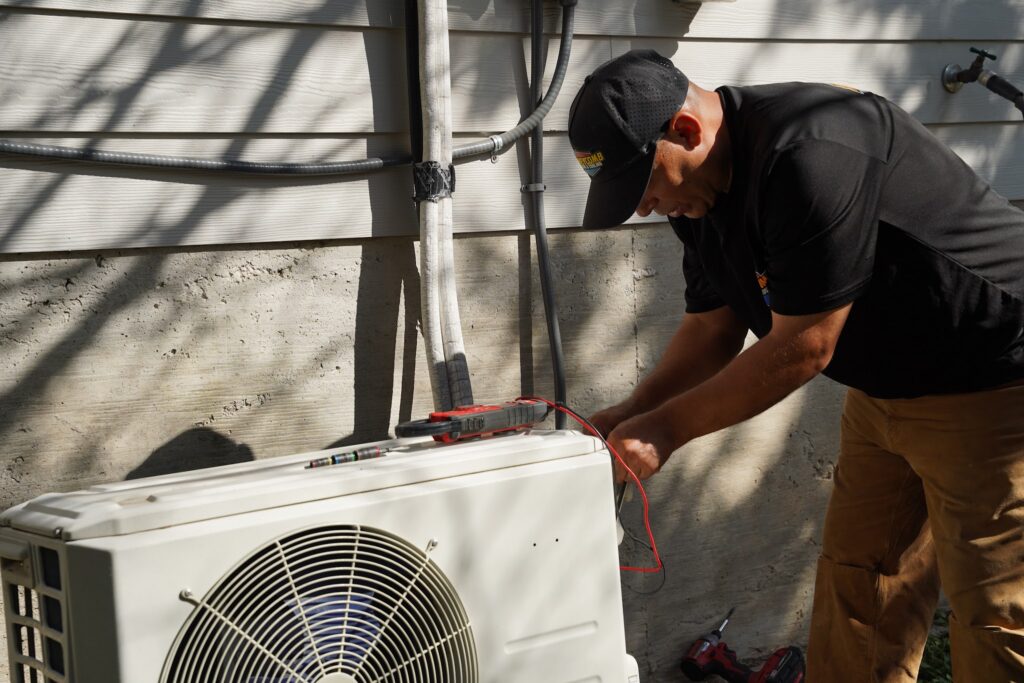
Honest answer: A2L means mildly flammable, not non-flammable. These refrigerants are harder to ignite and burn less readily than something like propane, but “harder” is not “cannot.” Daikin’s own end-user warnings describe the possibility of fire or harmful gas formation if leaked refrigerant reaches a flame from a burner, heater or cooker.
That is exactly why the equipment is built with charge limits, detection, mitigation airflow and ignition-source controls rather than simply being declared safe. The engineering assumes a leak is possible and plans for it.
What we will not do is give you a number. We could not find any published U.S. residential ignition rate for A2L systems, so we are not going to reassure you with a “one in a million” statistic and we are not going to claim there has never been an incident. The defensible statement is this: a leak does not mean a fire is coming, it does mean you should put out open flames, leave the safety system powered, and get it looked at.
The Decision Framework
You cannot tell how much refrigerant is left or how close the compressor is to failing by looking at your thermostat. What you can do is read the observable conditions and decide what to do while you wait. There are three tiers, and the first one is not negotiable.
Stop immediately — no exceptions
Not overridable, however hot the house is
- Smoke, sparks, a burning smell, or any sign of electrical overheating
- The breaker trips repeatedly — do not keep resetting it
- Ice on the indoor coil or on the refrigerant lines
- The compressor repeatedly tries to start and clicks off, or there is a new severe mechanical noise
- Anyone in the home develops dizziness, difficulty breathing, or other acute symptoms
For smoke or electrical signs, leave the area and call emergency services if warranted. For suspected refrigerant exposure, get to fresh air first. These conditions introduce hazards that have nothing to do with the cost of a compressor, which is why a hot house does not buy you an exception.
Limited temporary operation — a compromise, not a green light
Only when all four of these are true
- There is no ice
- There are no electrical, burning or severe mechanical warning signs
- The system is still delivering genuinely useful cooling
- Indoor heat is becoming a real health concern and no cooler location is immediately available
If all four hold, running the system for a limited period while you arrange urgent service can be a reasonable trade. Understand what you are trading: there is no guarantee this is harmless to the equipment. If cooling stops, the compressor starts short-cycling, or anything on the stop list appears, turn it off and reassess.
Not enough information yet
You suspect a leak but nothing is actually wrong
If you only suspect a leak — no ice, no odd behaviour, cooling is normal — there is not enough evidence to say the system must be shut down. Get it diagnosed. But once a leak is actually confirmed, unrestricted normal operation stops being the recommended choice.
One thing to be careful of in both directions: warm air alone does not prove your compressor is being damaged, and an air conditioner still blowing cold does not prove it is safe to run. Low charge changes compressor operating conditions well before anything obvious happens. Some systems have protective controls that shut the compressor down on their own — but you should not assume yours does, or that those protections eliminate the risk.
If There Is Ice, That Settles It
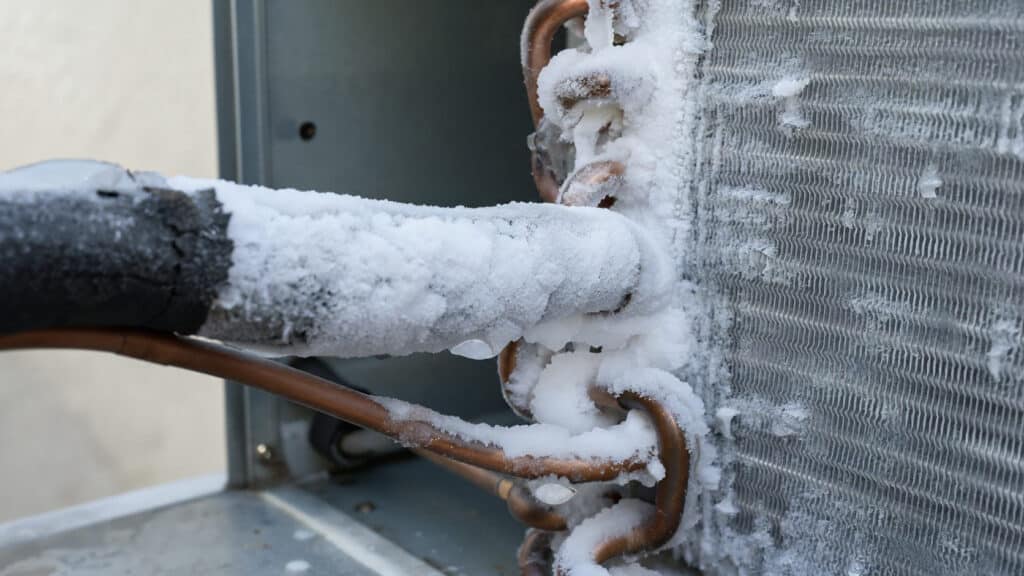
Ice on the indoor coil or the refrigerant lines moves you straight to the stop list. A frozen coil blocks the airflow that the coil needs in order to thaw, so running it makes the problem worse rather than better. Turn cooling off, consider running the fan alone, and let it melt on its own.
Here is the mechanism, because it explains why this one is not a judgment call.
The indoor coil absorbs heat from the air passing over it. Refrigerant pressure and temperature are tied together — when the charge drops, evaporator pressure drops, and the temperature at which the refrigerant boils drops with it. Push that below freezing while humid indoor air passes over the coil and moisture freezes onto it.
Then it compounds. The ice blocks airflow. Less warm air reaches the coil, so there is even less heat available to keep it above freezing, so more ice forms. A system in that state is not cooling your house — it is making a block of ice while the compressor runs under conditions it was not designed for.
What to do
- Thermostat from Cool to Off. Do not keep calling for cooling to see whether the ice clears. It will not.
- Consider Fan Only. If the indoor blower sounds normal and there are no electrical concerns, setting the fan to On with cooling Off moves room-temperature air across the coil and speeds up thawing. If the blower makes unusual noises or cannot move air, leave the whole thing off.
- Let it melt. Expect a few hours. Carrier puts a typical thaw in the range of one to four hours, and a heavily iced coil takes longer.
- Put towels down. Melting ice becomes water, and the drain pan has a capacity.
- Do not chip or scrape the ice — the coil tubing is thin and you will turn a leak into a bigger one.
- Do not pour hot water on it.
- Do not use a hair dryer or a heat gun.
- Do not restart cooling as soon as the ice is gone and assume it is fixed.
Thawing is not a repair. The ice melting only means the coil is no longer frozen. Whatever caused it — low charge, restricted airflow, something else — is still there. If it freezes again after you restart it, turn it off and stop repeating the cycle.
The San Antonio Problem: What If It Is 102° Outside?
“Just turn it off” is not a cost-free instruction in a Texas August. Protecting the people in your home matters more than protecting the equipment — but a struggling air conditioner is not a reliable way to protect them. The better answer is usually to get somewhere cool, not to keep a failing system running.
Every other article on this topic treats the thermostat like a light switch. In San Antonio it is not. If you shut the system down at two in the afternoon in August, you have a real problem for the next several hours, and anyone who does not acknowledge that is not actually helping you.
So here is the order of priority, and it is deliberate.
1. People first — and that means actual danger
If someone in the house is becoming confused, unusually weak, faint, or seriously unwell in the heat, that is a medical situation and it outranks everything else on this page.
🚨 Heat stroke is a medical emergency
Confusion, slurred speech, seizures, or loss of consciousness in a hot environment can indicate heat stroke. Do not wait for a thermometer reading.
Call 911 and begin cooling the person while you wait for help.
If anyone develops symptoms during a suspected refrigerant release — dizziness, marked drowsiness, headache, trouble breathing — get them outside to fresh air. For chemical exposure questions, Poison Control is 1-800-222-1222. Do not go back into a space to attempt an unprotected rescue.
2. Respect the stop conditions anyway
A hot house is not a reason to run a system that is frozen, smoking, or showing electrical faults. Those conditions carry their own hazards. If the system is on the stop list, it stays off and you protect the people some other way.
3. Get somewhere cool
This is the part the other articles leave out. If the system has to stay off, the answer is a cooler environment — a relative’s house, a public cooling centre, a library, a mall. In Texas you can dial 2-1-1 to find local cooling resources and assistance.
Pay particular attention to infants and young children, older adults, pregnant people, and anyone with a chronic medical condition. These are the groups public health agencies identify as being at higher risk in extreme heat, and they are also the people least able to just tough out an afternoon.
A fan stops protecting you before you expect it to. The EPA’s guidance is explicit — do not use electric fans for cooling when the room temperature is in the mid-90s or higher, because at that point “electric fans will not prevent heat-related illness.” Portable fans do not cool air; they move it. The CDC’s guidance is more conservative still, putting the limit at 90°F indoors. Source: U.S. Environmental Protection Agency, Extreme Heat and Indoor Air Quality.
Other things that genuinely help while you wait: cool showers or baths, drinking water steadily unless your doctor has restricted your fluids, keeping the stove and oven off, closing blinds on windows getting direct sun, and keeping windows shut when it is hotter outside than in.
4. Then, and only then, consider running it briefly
If nothing is on the stop list, the system is still genuinely cooling, and there is no cooler place you can reasonably get to, limited operation while you arrange urgent service is a defensible compromise. You are accepting an uncertain equipment risk to manage a real heat risk. That can be the right call. It is a trade you should make knowingly rather than because a website told you it was fine.
Is a Refrigerant Leak Dangerous to Breathe?
For a typical slow leak in a normally ventilated home, this is usually an equipment problem rather than a health emergency. That said, refrigerant vapours are heavier than air, can displace oxygen in enclosed spaces, and can cause dizziness. Symptoms during a suspected release mean go outside first and sort out the AC afterwards.
We want to be careful here, because the internet goes to both extremes on this question and neither one is accurate.
The reassuring version: the EPA accepts R-32 and R-454B for residential use subject to conditions, after evaluating toxicity, flammability and exposure potential. These are not substances that were waved through.
The cautious version: acceptance in properly designed equipment is not a finding that breathing an indoor release is harmless. Government chemical data for R-32 identifies it as colourless and odourless with vapours heavier than air, and warns that vapours may cause dizziness or asphyxiation particularly in closed or confined areas. Contact with escaping liquefied refrigerant can cause frostbite.
Do not try to find the leak by smell. R-32 is odourless, and the installation manual for the coils we fit explicitly warns that refrigerants may not contain an odour. Not smelling anything tells you nothing. Worse, the method requires putting your face next to a leak, which is the one place you should not put it.
What we are not going to give you is a number — a concentration threshold, a probability of illness, or a safe exposure time for a household leak. No government health source publishes one for this situation, and occupational exposure limits were written for workplaces with monitoring equipment, not for a homeowner standing in a hallway. Anyone quoting you a figure is extrapolating.
The practical rule: if someone in the home develops unexplained dizziness, marked drowsiness, headache or breathing difficulty while you suspect a leak, the guidance for an indoor chemical release is to go outside and get fresh air. Do that first. The air conditioner will still be broken in ten minutes.
How Long Can It Keep Running?
There is no reliable number of hours, and we looked for one. The risk depends on how much charge is gone, the actual operating pressures, the compressor design, the load on the system, and what protective controls it has — not on elapsed time. Anyone who tells you “you have about 48 hours” is guessing.
What is established is the mechanism rather than the timetable. Compressor engineering guidance is direct about it: low suction pressure causes overheating inside the compressor and can permanently damage the drive bearing. That is a real failure mode under real conditions.
What does not exist, as far as we could find, is any published study establishing how long an arbitrary residential system survives an arbitrary leak. We would rather tell you that than invent a countdown.
The useful reframe: stop thinking about hours and think about conditions. A system with a small leak that still has most of its charge and is cooling normally is in a different situation from one that has lost most of its charge and is icing up. Continued cooling is not evidence of safety, and the absence of an automatic shutdown is not a clean bill of health.
What to Do Right Now
In order: check the people, check for stop conditions, set the thermostat to Off, leave the power on, put out open flames, and call. Then deal with the heat.
- Check the people in the house. Anyone unwell in the heat, or showing symptoms during a suspected release, comes before the equipment. Emergency help if needed.
- Look for stop conditions. Smoke, burning smell, repeated breaker trips, ice, severe new noise. Any of these and the system goes off and stays off.
- Set the thermostat from Cool to Off. Not the breaker.
- Leave the power on — particularly on an R-32 or R-454B system, where the detection and mitigation system needs it. Only isolate power if a professional or responder tells you to.
- Put out open flames near the equipment and do not smoke near a suspected leak.
- Read the nameplate on the outdoor unit and note the refrigerant type. Have it ready when you call — it changes what the technician brings.
- Call for service. If the house is becoming unsafe, say so on the phone; that is scheduling information, not a complaint.
- Make a plan for the heat. Somewhere cool for the afternoon, water, cool showers, blinds closed, oven off. 2-1-1 if you need help finding a cooling location.
When you call us, our refrigerant leak repair in San Antonio starts with locating the leak rather than adding refrigerant and hoping. Booking is open 24 hours a day by phone or online, and emergency requests get priority scheduling — for the fastest route in, see emergency AC repair.
Once the immediate situation is handled, two things are worth reading. What causes refrigerant leaks explains why this happened and — importantly — whether the cause makes it somebody else’s responsibility to pay for. Repair the system or replace it covers the bigger decision if the leak turns out to be expensive. If this is the second or third time you have been through this, start with the causes article.
Related Services from Honeycomb Heating & Cooling
Refrigerant Leak Repair
Electronic detection and UV dye location, then tiered pricing once we know what we are fixing.
Emergency AC Repair
When the house is getting dangerous and it cannot wait for a routine appointment.
Evaporator Coil Replacement
If the coil itself is the source — the most common reason a system freezes repeatedly.
Book a Diagnostic
Online booking, any hour. Tell us the refrigerant type from the nameplate if you have it.
Frequently Asked Questions
Sources & References
- Carrier. (2026). How to fix a refrigerant leak in your AC unit: A step-by-step HVAC guide. Carrier Residential Home Comfort Resources.
- Daikin Comfort. (2026). Upflow/downflow evaporator coils installation instructions and R-32 sensor integration guidelines [PDF file]. Daikin Comfort Technologies Technical Documentation.
- Emerson Climate Technologies / Copeland. (2026). Application engineering bulletin: Compressor technical data and operating parameters (AE4-1365 R6) [PDF file]. Copeland Online Product Information Portal.
- National Oceanic and Atmospheric Administration. (2026). Difluoromethane (R-32) chemical safety profile and physical properties data sheet. NOAA Office of Response and Restoration, CAMEO Chemicals Database.
- Trane. (2026). AC refrigerant leak detection, signs, and professional repair options. Trane Residential Troubleshooting Guides.
- U.S. Environmental Protection Agency. (2026). Extreme heat and indoor air quality management guide. EPA Indoor Environments Division.
- UL Solutions. (2024). Inspecting refrigerant detection systems (RDS) in modern HVAC equipment. UL The Code Authority News.
Brandon Caputo
Owner & Founder · Honeycomb Heating & Cooling · San Antonio, TX · License TACLA140435E
Brandon came into HVAC the long way around. He started at a painting company in college in Virginia and worked his way up to manager, then moved to San Antonio and spent years in flooring and general contracting doing home remodels — which is where he began learning the mechanical trades from the inside out. He founded Honeycomb Heating & Cooling after seeing how few homeowners had a contractor they could actually trust to charge a fair rate and do the work right the first time. Telling a customer to leave the breaker on when every blog on the internet says to switch it off is part of what that means.
Honeycomb serves San Antonio, Stone Oak, Alamo Heights, Helotes, Timberwood Park, Bulverde, Boerne, New Braunfels and the surrounding Hill Country communities. The company is BBB accredited, holds a 5.0 Google rating across 800+ reviews, and was voted 3rd Best HVAC Contractor in San Antonio by MySA.
Thermostat Off. Power On. Then Call.
On a newer R-32 or R-454B system, the breaker is the one thing you should leave alone — the detection system needs it. Tell us the refrigerant type from your nameplate when you call and we will arrive with the right equipment.
Serving San Antonio, Stone Oak, Helotes, Timberwood Park, Bulverde, Boerne and New Braunfels.