



 (726) 233-6044
Bottom line upfront: Two-stage systems run at two fixed speeds. Inverter systems modulate continuously across a wide range. In San Antonio, where cooling runs roughly eight months a year, the deciding factors are how long you plan to stay in the home, whether humidity is a problem you already have, and whether your ductwork can support what you are buying. Not the SEER2 number on the box.
Nearly every comparison of these two technologies turns into a spec-sheet argument. One has a higher efficiency rating, therefore one is better. That framing falls apart here, and we can show you exactly where using a system we installed in a San Antonio home this year.
So this guide takes a different route for choosing two-stage vs inverter AC: how each one actually behaves, why the efficiency rating does not settle the question in this climate, what a real local install produced, and the specific conditions under which each is the right buy.
How Each One Actually Works
A two-stage compressor has two settings: a low stage around 65 to 70% capacity for mild conditions, and full capacity for peak heat. An inverter compressor modulates continuously, roughly 25 to 100%, matching output to what the home needs at that moment. Think of it as two gears versus a dimmer switch.
That difference matters most on the days nobody thinks about. A San Antonio summer is not 100 consecutive days of 100°F — it is a long stretch of mornings, evenings, and shoulder-season afternoons where the house needs a fraction of the system’s full capacity.
| Feature | Two-Stage | Inverter / Variable-Speed |
|---|---|---|
| Compressor operation | Two fixed speeds — low (~65–70%) and full | Continuous modulation, roughly 25–100% |
| Temperature stability | Noticeably better than single-stage | Most stable Narrow swings around setpoint |
| Humidity removal | Good — longer low-stage runtimes pull more moisture | Best Sustained low-speed operation |
| Noise | Quieter on low stage | Quietest overall |
| Electronics and controls | Simpler — fewer parts to fail | More complex — inverter board, specialized diagnostics |
| Repair complexity | Most techs carry common parts | Some components are manufacturer-specific special orders |
| Upfront cost | Moderate | Highest |
The complexity trade-off is real and most articles skip it. An inverter system has electronics a two-stage system does not. That is not a reason to avoid one, but it is a reason to care who installs it and whether they stock or can source the parts. We add surge protection to inverter installations as standard for exactly this reason — the control board is the expensive part, and Texas grid conditions are not gentle to electronics.
Why SEER2 Does Not Settle This in San Antonio
SEER2 is a seasonal average calculated against a standardized national test profile. San Antonio systems run roughly 3,000 hours a year — far more than that profile assumes. Two systems with identical SEER2 ratings can produce very different electric bills here, which is why the number on the box is a starting point rather than an answer.
Here is where the usual advice breaks down. You will read that inverters carry dramatically higher efficiency ratings than two-stage systems, and that this alone settles the question.
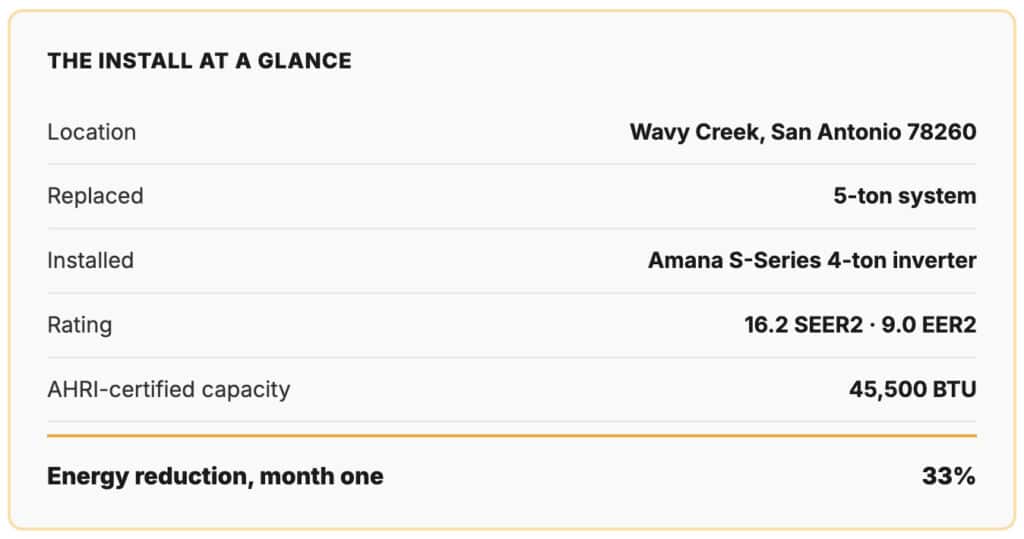
The Amana S-Series 4-ton variable-speed inverter we installed in a San Antonio home this year is rated 16.2 SEER2, with an EER2 of 9.0 and AHRI-certified capacity of 45,500 BTU. That is a genuinely good system. It is also a number that would look unremarkable next to a well-rated two-stage unit on a comparison chart.
For reference, the Department of Energy set the South region minimum at 14.3 SEER2 for split-system central air conditioners, effective January 2023. Texas falls in that region, so 16.2 sits above code without being extraordinary on paper.
And yet that system cut the homeowner’s bill by a third in month one. The rating did not capture what actually happened, because a seasonal average computed under standardized conditions cannot describe how a compressor behaves across 3,000 hours of a specific Texas climate.
⚠ What this means practically. If a contractor’s entire pitch is a SEER2 number, you are being sold a spec, not a solution. Ask instead what the system will do on a 78°F October afternoon — because in San Antonio you get a lot more of those than you get 105°F ones, and that is where modulation either earns its premium or does not.
What a Real San Antonio Inverter Install Produced
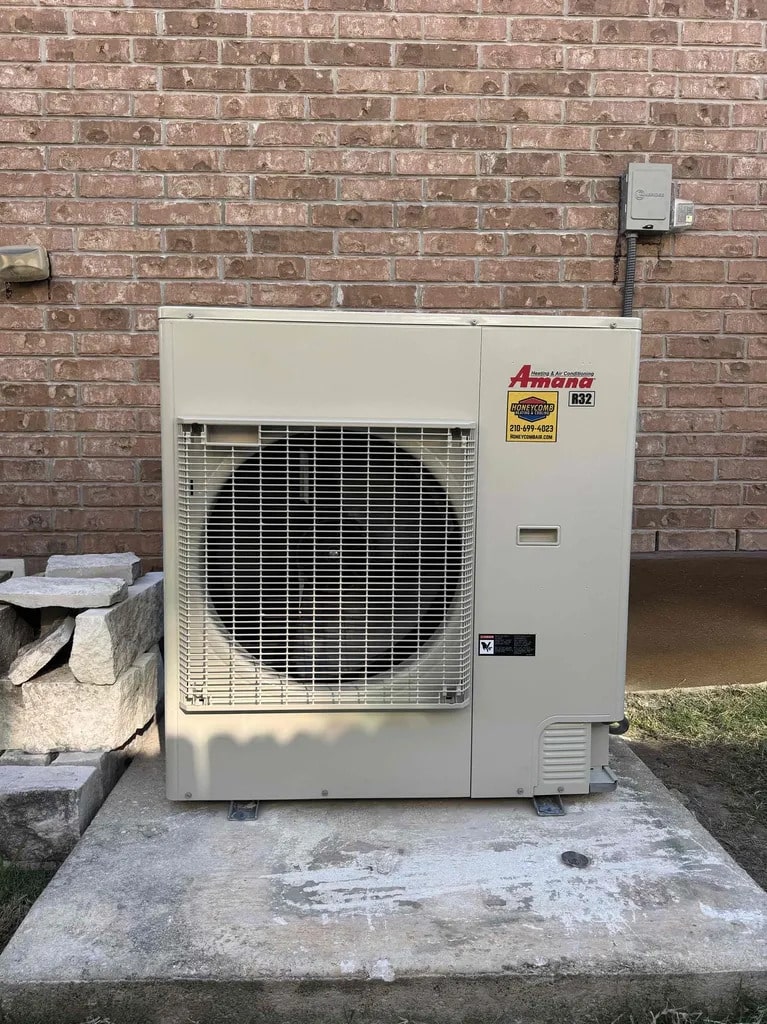
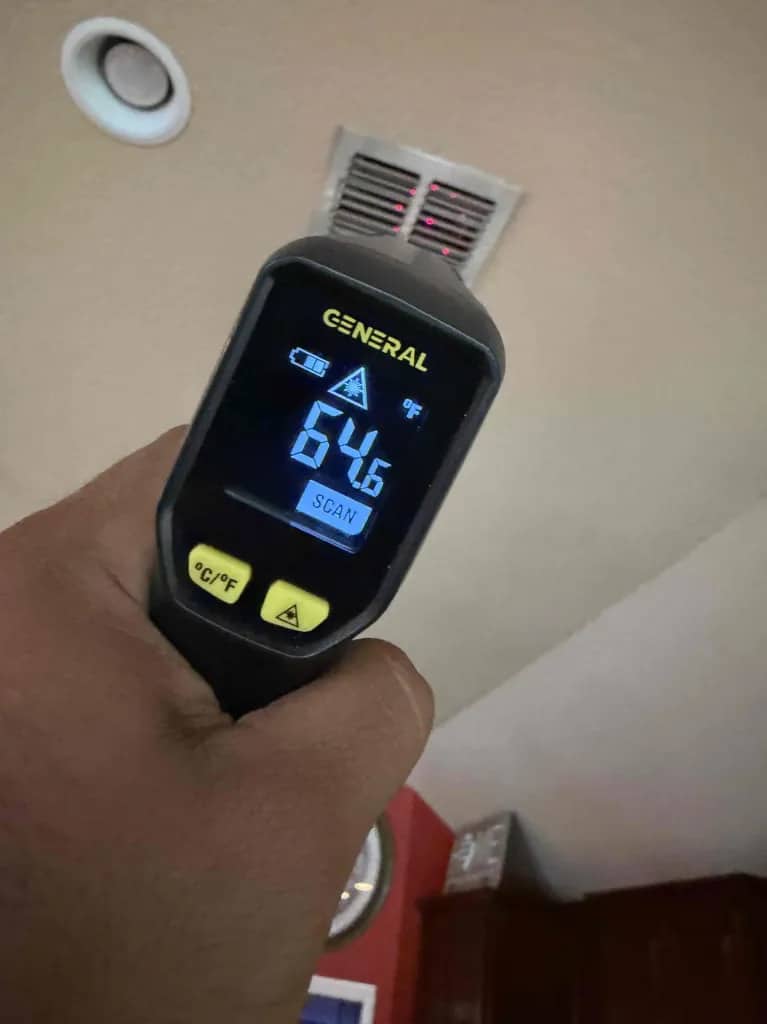
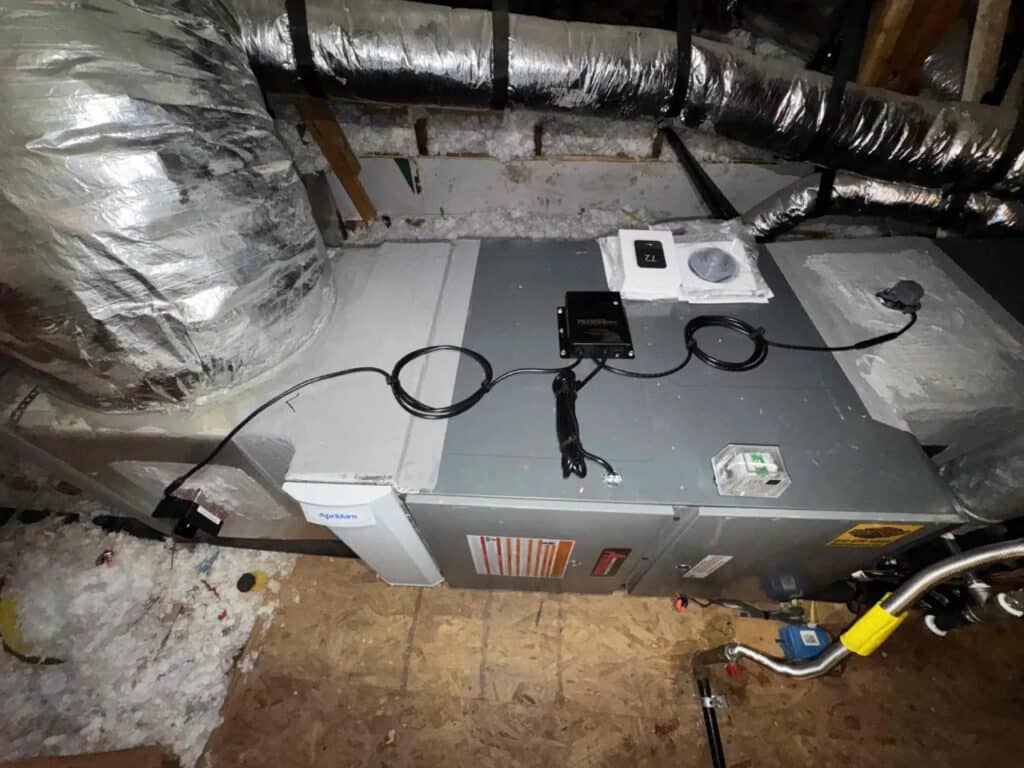
In a Wavy Creek home in north San Antonio, we replaced an aging 5-ton system with a 4-ton Amana S-Series variable-speed inverter. The homeowner’s energy use dropped 33% in the first month. The system is smaller than what came out, and that is not an accident.
Full details are in our variable-speed AC replacement case study, including the equipment and the process.
The part worth sitting with is the tonnage. We took out a 5-ton system and put in a 4-ton. That runs against the instinct almost every homeowner has, and against what a lot of the industry does.
Sizing Beats Technology, Every Time
A correctly sized two-stage system will outperform an oversized inverter system. An oversized unit short-cycles — it satisfies the thermostat fast, shuts off, and never runs long enough to pull humidity out of the air. You end up with a cold, clammy house and a high bill, regardless of what the compressor can technically do.
This is the single most important thing in this article, and it has nothing to do with which technology you pick.
Oversizing is common because it feels safe. Bigger system, hotter climate, more cooling — the logic seems sound. But cooling capacity and comfort are not the same thing. A system that blasts to setpoint in eight minutes and shuts off has not dehumidified anything. In a climate where summer humidity runs 65 to 70% from June through September, that is how you get a house that reads 74°F on the thermostat and still feels wrong.
The fix is a Manual J load calculation — an actual measurement of your home’s heat gain based on square footage, orientation, insulation, window area, ceiling height, and duct condition. Not a rule of thumb. Not matching whatever was there before.
What a proper assessment should include
- Manual J load calculation, not a square-footage estimate or a match to the old unit
- Static pressure measurement on the existing ductwork
- Duct condition and sizing review — an inverter cannot fix undersized ducts
- Discussion of what the current system actually does wrong, not just its age
- A written quote covering equipment, labor, permits, and inspection
18–36% — the estimated energy savings range between a quality HVAC installation and a poor one, for air conditioners and heat pumps, per the ENERGY STAR Quality Installation program. Texas is one of only five states with an active ENERGY STAR QI program. Source: U.S. Department of Energy
Read that number against the technology question. The gap between a good install and a bad one is comparable to the gap between equipment tiers. Buying an inverter from a contractor who skips the load calculation is spending premium money on a problem you have not solved.
When Two-Stage Is the Right Call
Two-stage makes sense when you are upgrading from single-stage, want meaningfully better comfort and humidity control, and would rather keep the system mechanically simpler. It delivers a large share of the comfort gain without the full inverter premium, and it is the practical middle ground for a lot of San Antonio homes.
Two-stage is likely your system if
- You may move within the next five years and will not recover a larger premium
- Your current system is single-stage and almost anything is an upgrade
- Your home is moderately sized with reasonably balanced load
- You value simpler repairs and more widely stocked parts
- Humidity is a mild annoyance rather than a persistent problem
- The budget is real and you would rather put the difference into duct sealing
That last point deserves emphasis. If your ductwork is leaking into a 140°F attic, sealing it will do more for your comfort and your bill than upgrading the compressor stage will. Spend there first.
When an Inverter Is Worth the Premium
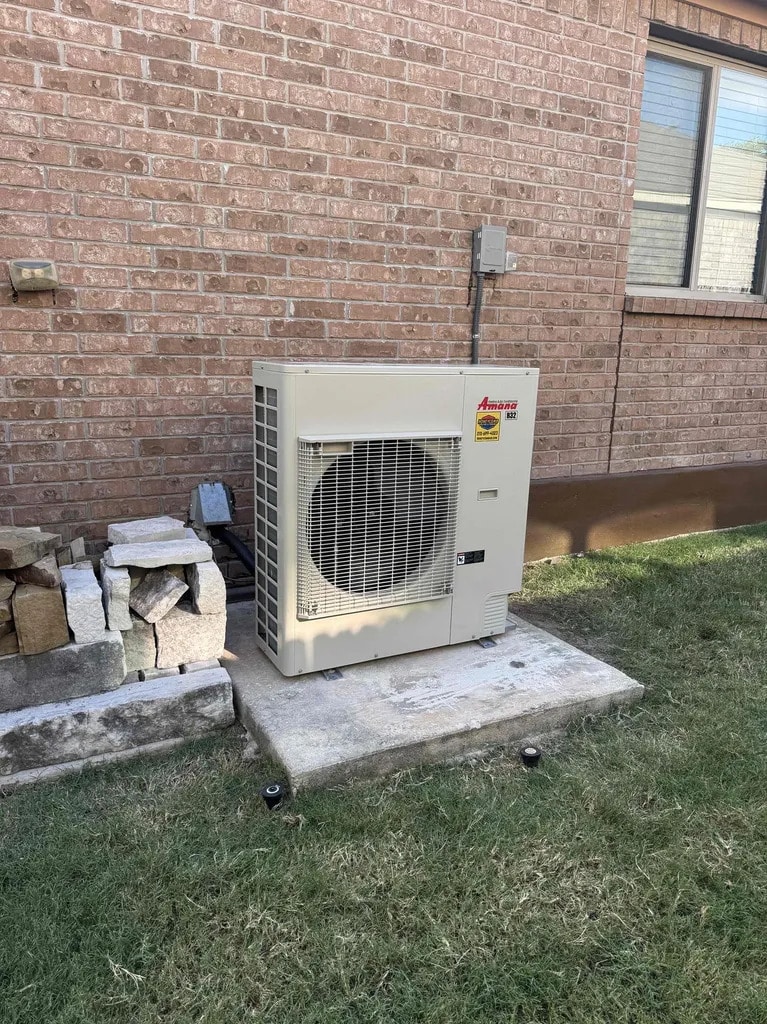
An inverter earns its cost when you are staying in the home long enough to recover it, when humidity or uneven temperatures are an existing complaint, or when the home is large enough that the system runs long hours. In San Antonio’s eight-month cooling season, that payback window is shorter than in most of the country.
An inverter is likely your system if
- You plan to stay five to ten years or more
- Your home already feels clammy, or rooms hold very different temperatures
- Someone in the house has allergy or asthma concerns where humidity control matters
- Noise matters — the outdoor unit sits near a bedroom or patio
- The home is larger, with long annual runtime
- You want the lowest achievable monthly bill and will pay upfront to get it
One thing worth knowing before you compare quotes. Honeycomb inverter systems include a one-time lifetime unit replacement warranty on top of the manufacturer’s standard coverage. If an inverter is on your shortlist, ask every contractor you are talking to what happens if the compressor or inverter board fails outside the standard term. The answers vary more than the equipment does.
If you are weighing a heat pump rather than a straight-cool system, the same logic applies and the modulation advantage carries into heating season — see our variable-speed heat pump options.
What Each One Costs in San Antonio
Honeycomb full system installations start at $10,800 for single-stage and $14,200 for two-stage. Variable-speed and inverter systems are quoted after an in-home assessment, because equipment selection and ductwork needs vary too much for a published figure to be honest. Permit and inspection fees are built into the written quote.
We would rather give you an assessment-based number than a range wide enough to be meaningless. What drives the difference between two quotes on the same house is usually not the compressor — it is tonnage, ductwork, electrical, and whether the contractor priced the job they are actually going to do.
If the right system is more than you planned to spend at once, financing is available with most application decisions returned in under five minutes. Military members, teachers, first responders, and seniors qualify for a $750 discount on new system installations.
Five Questions to Ask Any Contractor
The fastest way to tell a good HVAC quote from a bad one is to ask about process rather than product. These five questions surface whether a contractor measured your home or guessed at it — and the difference between those two shows up in your comfort for the next fifteen years.
- “Did you run a Manual J load calculation, and can I see it?” If the answer is a square-footage rule of thumb or a match to the existing unit, keep looking.
- “What did you measure on my ductwork?” Static pressure and duct sizing determine whether the equipment can deliver what it promises.
- “Why this tonnage?” There should be a reason tied to the calculation, not to what came out.
- “What happens if the inverter board fails in year seven?” Warranty terms on the expensive electronics vary a great deal between contractors.
- “What is included in the written quote?” Permits, inspection, electrical, duct modifications, and startup commissioning should all be named.
Ready to find out which one fits your home? AC installation in San Antonio starts with a free in-home assessment and a Manual J calculation, or you can book an assessment online.
Related Services from Honeycomb Heating & Cooling
AC Installation
Manual J sizing on every job. Single-stage from $10,800, two-stage from $14,200.
Heat Pumps
Variable-speed and inverter heat pumps, priced after a home assessment.
The Comfy Club
Scheduled maintenance that protects the system you just paid for.
Financing
Most application decisions returned in under five minutes.
Frequently Asked Questions
Sources & References
- U.S. Department of Energy. (2022, October 5). 2023 central air conditioner and heat pump energy conservation standards: Frequently asked questions [PDF file]. Office of Energy Efficiency & Renewable Energy.
- U.S. Environmental Protection Agency & U.S. Department of Energy. (2026). When is it time to replace your heating and cooling equipment? Energy Star Save at Home.
- Honeycomb Air. (2026). Variable-speed AC replacement in San Antonio: A case study. Honeycomb Air Case Studies.
- Installation pricing, warranty terms, and San Antonio field observations reflect Honeycomb Heating & Cooling’s own current service pricing and service records
Brandon Caputo
Owner & Founder · Honeycomb Heating & Cooling · San Antonio, TX · License TACLA140435E
Brandon came into HVAC the long way around. He started at a painting company in college in Virginia and worked his way up to manager, then moved to San Antonio and spent years in flooring and general contracting doing home remodels — which is where he began learning the mechanical trades from the inside out. He founded Honeycomb Heating & Cooling after seeing how few homeowners had a contractor they could actually trust to charge a fair rate and do the work right the first time. Every Honeycomb installation starts with a Manual J load calculation for the same reason.
Honeycomb serves San Antonio, Stone Oak, Alamo Heights, Helotes, Timberwood Park, Bulverde, Shavano Park, and the surrounding communities. The company is BBB accredited, holds a 5.0 Google rating, and was voted 3rd Best HVAC Contractor in San Antonio by MySA. Outside of work, Brandon is a fitness and basketball guy, and his son Grayson is — by his own account — Honeycomb’s biggest fan.
The Right Answer Starts With Measuring Your Home
Not a spec sheet, not a square-footage guess. We run the load calculation, check the ductwork, and show you what each option would actually do in your house.
Serving San Antonio, Stone Oak, Alamo Heights, Helotes, Timberwood Park, and Bulverde.


