



 (726) 233-6044
Bottom line upfront: AC running but not cooling in Bulverde homes? The most common causes are a clogged air filter, a frozen evaporator coil, a dirty condenser coil, low refrigerant, or a failed capacitor. In Bulverde specifically, cedar pollen and limestone construction dust cause the first three far more often than in central San Antonio. Start by checking your filter.
That is the short answer. What follows is the full diagnostic path our technicians use for AC running but not cooling Bulverde service calls — including which checks you can safely run yourself in the next ten minutes and the exact point where you should stop and pick up the phone.
One thing worth saying before we get into it: most articles on this topic are written for a national audience. Bulverde is not a national audience. Sitting on the Hill Country limestone shelf at higher elevation, with Trinity Aquifer hard water and constant construction, this area produces failure patterns a technician working mostly inside Loop 410 would not think to look for. Those get their own section below.
Start Here: The 10-Minute Homeowner Check
Before assuming the worst, run these five checks in order. A meaningful share of “not cooling” calls in the Bulverde area get resolved at step one or two — no parts, no repair, no invoice. It costs you nothing, and if you do end up needing a technician, it tells them exactly where to start.
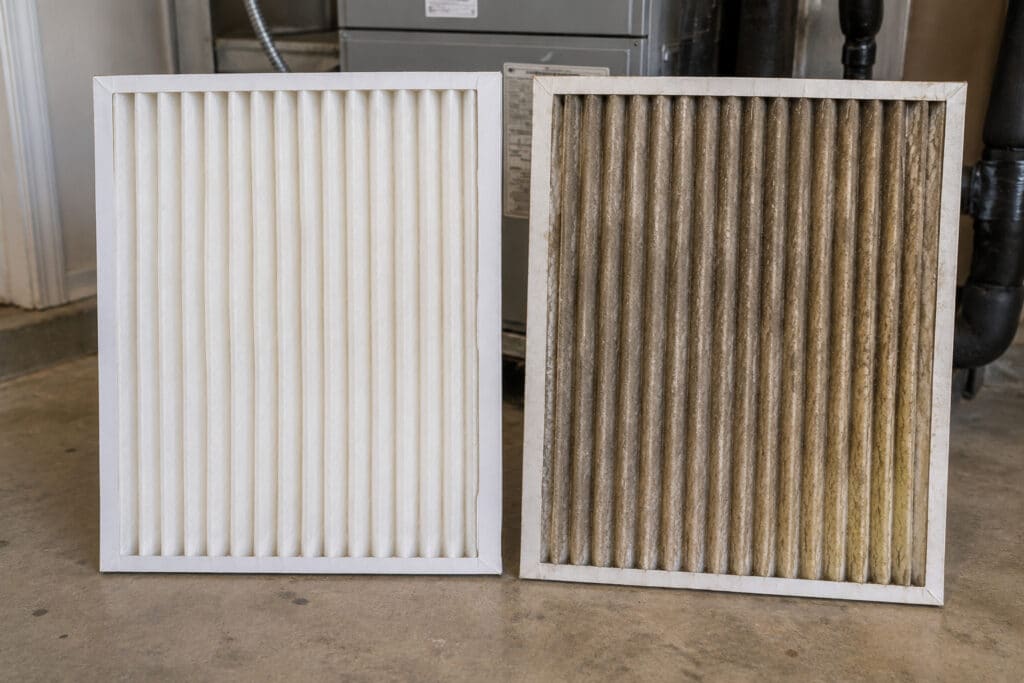
- Pull the air filter and hold it up to a light. If you cannot see light through it, you have very likely found your problem.
- Check the thermostat. Confirm it is set to COOL — not FAN, not HEAT — and that the setpoint is at least 3 degrees below the current room temperature.
- Walk outside to the condenser. Is the large outdoor fan spinning? If the unit is humming but the fan sits still, shut the system off at the thermostat and stop here.
- Look at the copper refrigerant line. If it is coated in ice, turn the system off and let it thaw completely. Do not keep running it.
- Check your breaker panel. A tripped breaker on the AC circuit is common. Reset it once. If it trips again, leave it off and call.
⚠ One safety rule that matters more than the rest: never reset a breaker twice. A breaker that trips repeatedly is doing exactly its job — telling you there is an electrical fault downstream. Forcing it back on is how a manageable repair turns into a dead compressor, or worse.
The 7 Reasons for an AC Running but Not Cooling in Bulverde Homes
An air conditioner running without cooling has almost always lost one of two things: airflow, or heat-transfer capacity. Seven failure points account for the overwhelming majority of these calls. They are listed here roughly in the order our technicians encounter them in Bulverde homes.
1. A Clogged Air Filter
A clogged filter starves the system of airflow. The blower keeps running and the thermostat keeps calling for cooling, but not enough air passes over the coil to actually pull heat out of your home. It is the single most common cause of an ac running but not cooling Bulverde homes during summer — and by a wide margin the cheapest to fix.
5–15% — the amount that replacing a dirty, clogged filter with a clean one can lower an air conditioner’s energy consumption, according to U.S. Department of Energy Energy Saver guidance. Source: U.S. Department of Energy
Bulverde makes this considerably worse. Cedar pollen season runs roughly December through March, and active construction across Johnson Ranch, Copper Canyon, and Rimrock Ranch puts fine limestone dust in the air year-round. We tell Bulverde homeowners to check filters every 30 days rather than the standard 60 to 90 — national guidance simply does not account for this environment.
2. A Frozen Evaporator Coil
If you have an AC Running but Not Cooling issue with ice on your indoor coil, airflow or refrigerant is restricted. The coil drops below freezing, condensation turns to ice, and that ice then blocks airflow entirely — so the system runs continuously while cooling less and less. Turn it off and let it thaw completely before running it again.
Here is the part homeowners miss: a frozen coil is a symptom, not a diagnosis. Something caused it — a dirty filter, a failing blower, a refrigerant leak, or blocked return vents. If it freezes again after thawing, the underlying cause is still sitting there.
3. A Dirty Condenser Coil
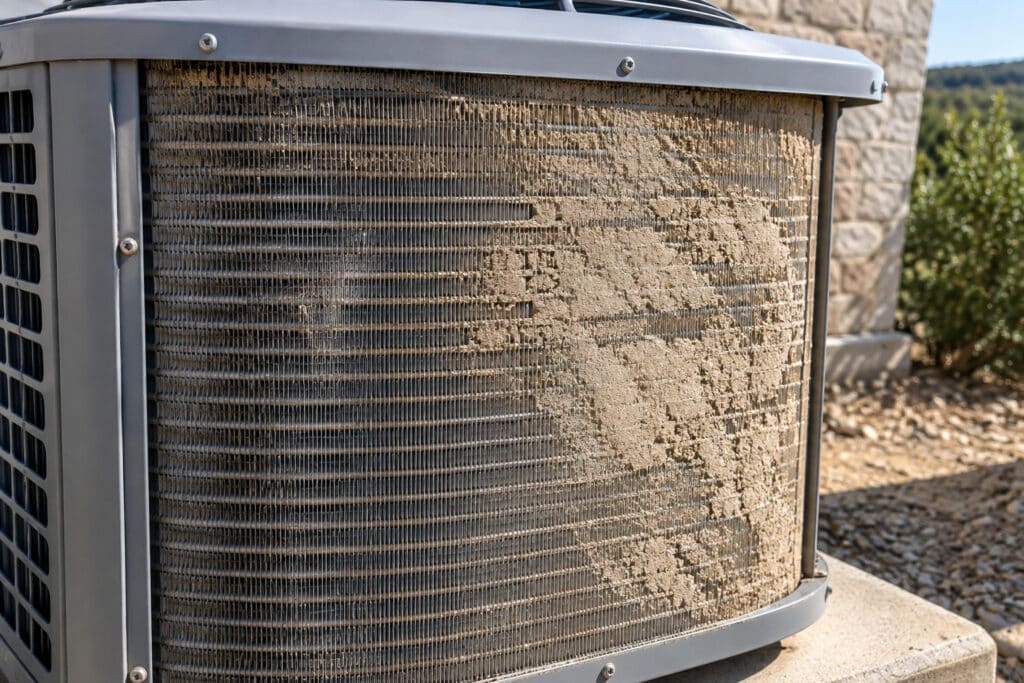
Your outdoor unit’s job is to reject heat from your home into the outside air. When the condenser coil is packed with pollen, grass clippings, or construction dust, it cannot release that heat — so refrigerant returns to the house still warm. The system runs, the compressor works harder, and your home stays hot.
This is the Bulverde failure mode our technicians flag most often, and it is routinely missed. Caliche dust from active construction is fine enough to pass between the coil fins and pack in behind them, where it is completely invisible from the outside. A quick visual check will not catch it — the unit looks clean and runs hot.
4. Low Refrigerant or a Refrigerant Leak
Refrigerant is not consumed like fuel. If your system is low, it is leaking. Adding refrigerant without finding the leak means paying for the same repair again next season, usually at a far worse time. A proper repair locates the leak first.
Signs include ice on the line set, a hissing or bubbling sound, and cooling that got gradually weaker over weeks rather than failing suddenly. Refrigerant handling requires EPA Section 608 certification, so this is not a homeowner repair under any circumstances.
5. A Failed Capacitor
The capacitor gives your compressor and fan motor the electrical jolt they need to start. When it fails, you will often hear a hum from the outdoor unit while the fan sits perfectly still. When summer heat hits, it becomes one of the top reasons we respond to ac running but not cooling Bulverde requests.
Heat kills capacitors. A Bulverde system running six-plus months of cooling season puts far more thermal stress on that component than the same unit would see in a moderate climate. Shut the system off if you hear humming without fan movement — running it in that state can take the compressor with it, and the compressor is in a completely different price bracket.
6. Leaking or Undersized Ductwork
Your system may be producing perfectly cold air that never reaches your rooms. Ducts running through an unconditioned attic lose cooling through every gap and unsealed seam, and Hill Country attics get brutally hot in summer. The air handler works fine; the cooling simply does not arrive.
The tell is uneven temperatures — upstairs stays hot while downstairs overcools, or one room never matches the rest. Two-story builds in Smithson Valley and Johnson Ranch show this pattern regularly. Duct sealing and repair often delivers a bigger comfort improvement than any equipment upgrade.
7. Thermostat Problems
A thermostat that is miscalibrated, losing power, or sitting in direct sun will misread your home’s actual temperature. The system then runs on bad information — either short-cycling before the house cools, or running endlessly while reading a temperature that is not real.
Check the batteries first. Then check what is near it: a lamp, a supply vent, or afternoon western sun hitting that wall will all skew the reading.
Why Bulverde Air Conditioners Fail Differently Than San Antonio Ones
Bulverde sits on the Hill Country’s limestone shelf at higher elevation than central San Antonio, and that changes how systems fail here. Hard water, cedar pollen, construction dust, and ground settling create four failure accelerators that a technician working mostly inside Loop 410 will not be looking for.
This is the part almost every AC troubleshooting article misses, because they are written for everywhere and therefore for nowhere. Here is what actually differs on this side of US-281:
| Bulverde Condition | What It Does to Your AC | What to Watch For |
|---|---|---|
| Hard water from Trinity Aquifer wells | Calcium and “white slime” build up inside condensate drain lines far faster than in city-treated water areas | Ceiling water stains below the air handler; system shutting itself off |
| Cedar pollen, roughly Dec–March | Overwhelms filter capacity and coats condenser coils | Filters visibly loaded in under 30 days |
| Active construction caliche dust | Fine limestone particulate packs in behind condenser coil fins | Outdoor unit that looks clean but runs hot |
| Limestone shelf and ground settling | Condenser pads shift, putting steady stress on copper refrigerant lines | Visibly tilted outdoor unit; gradual loss of cooling |
| Extended cooling season | Six-plus months of runtime accelerates capacitor and motor wear | Systems failing earlier than the 10–15 year expectation |
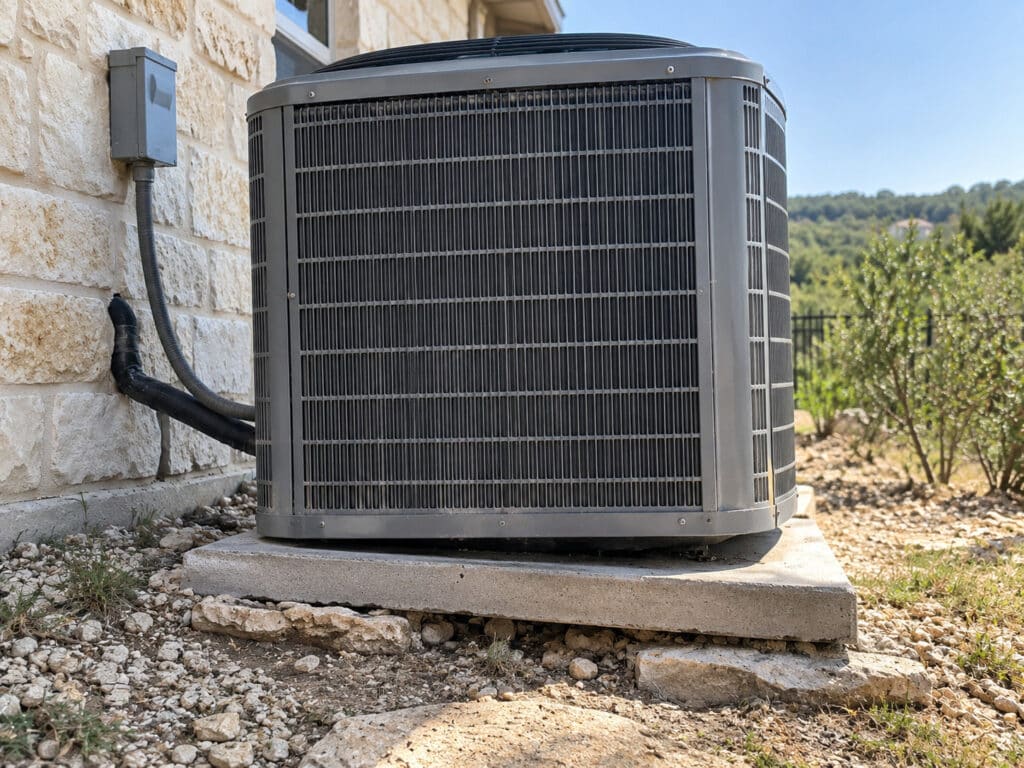
The one nobody checks. That fourth row deserves its own paragraph. When a condenser pad settles unevenly on limestone, the outdoor unit tilts. That tilt puts constant mechanical stress on the copper line set, and over time it produces exactly the slow refrigerant leak described in cause #4 above. So the homeowner gets diagnosed with “low refrigerant,” pays for a recharge, and the actual cause is still sitting in the yard at a three-degree angle — quietly setting up the next leak. This is why our technicians check pad level and stability on every Bulverde inspection, and why getting the pad right at installation matters far more here than in flatter parts of the county.
18–36% — the estimated energy savings range from a quality HVAC installation versus a poor one, for air conditioners and heat pumps, per the ENERGY STAR Quality Installation program. Texas is one of only five states with an active ENERGY STAR QI program. Source: U.S. Department of Energy
What You Can Safely Do Yourself
Homeowners can safely handle airflow and thermostat issues. Anything involving refrigerant, electrical components, or opening the sealed system requires EPA certification and a licensed technician. The dividing line is simple: if it requires tools or removing a panel, stop.
Safe to do yourself
- Replace the air filter
- Open all supply vents and clear furniture away from returns
- Rinse the outdoor unit gently with a garden hose — power off at the disconnect first
- Clear leaves and vegetation to maintain about two feet of clearance
- Replace thermostat batteries
- Reset a tripped breaker once
Requires a licensed technician
- Anything involving refrigerant — adding, recovering, or leak detection. EPA Section 608 certification is federally required.
- Capacitor replacement — capacitors hold a dangerous charge even with power off
- Any repair inside the electrical panel or at the contactor
- Compressor or blower motor diagnosis
- A breaker that trips more than once
If your problem falls in the second list, you need a licensed technician in Bulverde rather than another afternoon of troubleshooting.
When to Stop Troubleshooting and Call
Turn the system off and call immediately if you smell burning, see smoke, hear grinding or screeching, notice water pooling around the indoor unit, or if a breaker trips repeatedly. These are not wait-until-Monday problems. Continuing to run the system in these conditions turns a repair into a replacement.
Honeycomb technicians — including Aaron Botts, Steven Leon, and Gil Mompaz — run service across Bulverde, Timberwood Park, and Stone Oak daily. You can book a request 24/7 by phone or online, and emergency requests get priority scheduling. If your system is down in peak heat, see our AC repair service for Bulverde homeowners or call (726) 233-6044.
What Does This Repair Usually Cost?
AC repairs in the Bulverde area are priced from a fixed seven-level schedule, starting at $105 and running to $2,194 per repair. A capacitor or contactor — the most common failure in Texas — starts at $285.
That distinction matters more than it sounds. With hourly billing, the meter runs while a technician figures out what is wrong, and you find out the total after the work is finished. Upfront pricing works the other way around: we diagnose first, quote you a fixed price for the specific repair, and you decide before anyone opens a panel. No hourly games, no surprise line items on the invoice.
Related Services from Honeycomb Heating & Cooling
If your system needs more than a filter change:
AC Repair
Warm air, strange noises, or a system that will not start. Diagnosis first, fixed price second.
AC Tune-Up
Catch the coil fouling and drain-line buildup behind most Bulverde breakdowns. $89 standard, $58 promotional.
The Comfy Club
Scheduled maintenance, priority dispatch, and no service call fees.
Duct Repair & Sealing
For uneven temperatures and cooling that never reaches the upstairs rooms.
Frequently Asked Questions
Sources & References
- Building Science Education Solution Center. (2026). HVAC quality installation basics. U.S. Department of Energy.
- Pacific Northwest National Laboratory. (2026). Air conditioning resource guide. Building America Solution Center.
- U.S. Department of Energy. (2016). Energy Saver 101 infographic: Home cooling [PDF file]. Office of Energy Efficiency & Renewable Energy.
- U.S. Environmental Protection Agency. (2026). Stationary refrigeration and air conditioning (Section 608). U.S. Environmental Protection Agency.
- Bulverde field observations — cedar pollen loading, caliche dust coil fouling, and Trinity Aquifer drain-line scaling — drawn from Honeycomb Heating & Cooling service records
Brandon Caputo
Owner & Founder · Honeycomb Heating & Cooling · San Antonio, TX · License TACLA140435E
Brandon came into HVAC the long way around. He started at a painting company in college in Virginia and worked his way up to manager, then moved to San Antonio and spent years in flooring and general contracting doing home remodels — which is where he began learning the mechanical trades from the inside out. He founded Honeycomb Heating & Cooling after seeing how few homeowners had a contractor they could actually trust to charge a fair rate and do the work right the first time.
Honeycomb serves Bulverde, Timberwood Park, Stone Oak, Helotes, Shavano Park, Converse, and the surrounding Hill Country communities. The company is BBB accredited, holds a 5.0 Google rating across 800+ reviews, and was voted 3rd Best HVAC Contractor in San Antonio by MySA. Outside of work, Brandon is a fitness and basketball guy, and his son Grayson is — by his own account — Honeycomb’s biggest fan.
Learn more about the technicians who service your neighborhood.
Still Running, Still Not Cooling?
Skip the guesswork. We inspect the system, explain exactly what we find, and give you the price upfront before any work starts. You decide from there.
Serving Bulverde, Timberwood Park, Spring Branch, Stone Oak, and the surrounding Hill Country.


