


 (726) 233-6044
Bottom line upfront: If your home has usable ductwork, a Daikin FIT or Amana S-Series will serve it well — and those two are closer relatives than the branding suggests. If your home has no ducts, or you need genuinely different temperatures in different rooms, Mitsubishi is the stronger answer and we will say so. And if your budget is tight, a correctly sized two-stage system may beat all three. Understanding these differences makes the Daikin FIT vs Mitsubishi vs Amana comparison simple to navigate.
Before any of that, there is a question worth asking first.
First: Do You Actually Need an Inverter?
Single-stage systems run at one speed, full output, on and off. Two-stage systems have a low and a high setting. Inverter systems modulate continuously to match the home’s load. Each is a step up in comfort and cost, and the right question is not which is most advanced but whether the extra cost solves a problem you actually have.
| System type | How it runs | Best fit |
|---|---|---|
| Single-stage | One speed, full output, on/off | Lowest upfront cost, simplest system, shortest expected stay in the home |
| Two-stage | Low stage around 65–70%, plus full capacity | Meaningfully better comfort and humidity control without the full inverter premium |
| Inverter / variable-speed | Continuous modulation, roughly 25–100% | Best humidity control Precise comfort, quietest operation, longest stay |
| Ductless multi-zone | Inverter, per-zone control | No ducts, bad ducts, or rooms that genuinely need different temperatures |
In San Antonio, with roughly 3,148 cooling degree days a year against 1,438 heating degree days, the cooling season is long enough that modulation has a lot of hours to pay for itself. That is a real argument for inverter equipment here that does not apply in most of the country.
But it is not a universal one. We cover the full trade-off in two-stage vs inverter for San Antonio homes. If your ductwork is leaking into a hot attic, fixing that will do more for your comfort than any compressor upgrade.
The Thing Neither Brand Advertises: Daikin Owns Amana
Daikin, Amana, and Goodman are all part of Daikin Comfort Technologies North America. All three use R-32 refrigerant. Comparing a Daikin FIT against an Amana S-Series is not comparing rival manufacturers — it is comparing two product lines from the same parent company, built on closely related platforms.
This reframes the whole question, and almost no comparison article mentions it.
When a homeowner asks us whether Daikin or Amana is more reliable, the honest answer is that the question is closer to asking whether a Toyota or a Lexus is more reliable. They are not independent engineering programs competing against each other. They are tiers within one organization, sharing refrigerant strategy, compressor technology, and in several cases very similar hardware.
Practically, that means the real comparison in this article is not three-way. It is Daikin-family ducted inverter versus Mitsubishi versus a conventional system — and the choice between Daikin and Amana within that family comes down to specific model, available tier, dealer access, and warranty terms rather than a fundamental difference in engineering philosophy.
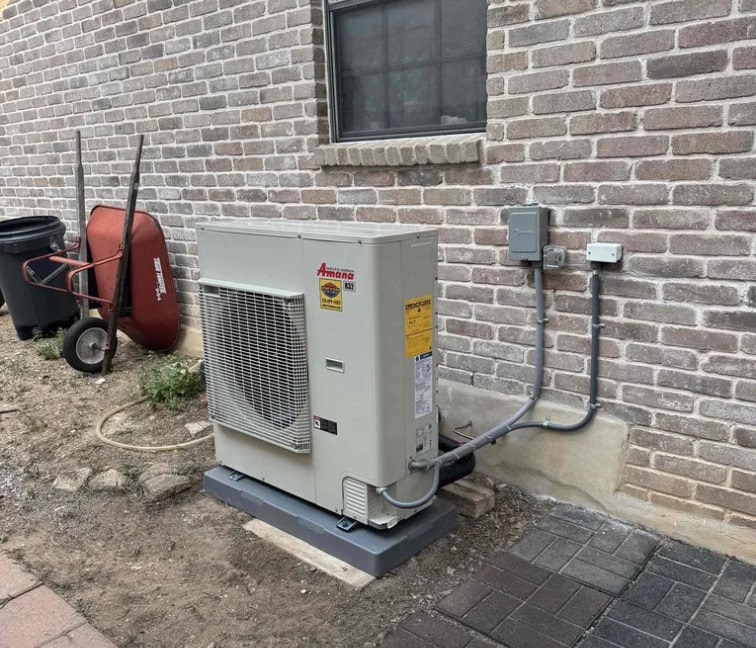
One correction worth making. You will read that Daikin FIT’s advantage is a compact side-discharge cabinet for tight side yards, while Amana is a large conventional cube. That is not accurate for current equipment. Amana describes its AXV9S S-Series as a slim-profile system designed for small backyard space, and the equivalent Goodman model is explicitly side-discharge. If outdoor space is your constraint, both families have an answer for it.
daikin fit vs mitsubishi vs amana: What Each One Is Actually Good At
Rather than crowning a winner, it is more useful to match each system to the problem it solves best. Daikin FIT and Amana S-Series are whole-home ducted inverter systems. Mitsubishi’s strength is zoning and operating without ducts. Those are different products for different houses.
Amana S-Series (AXV9S)
A variable-speed, inverter-driven R-32 split system rated up to 19 SEER2, available from 2 to 5 tons, in a slim cabinet. Amana’s step-up ASXV9 reaches up to 22.5 SEER2 on the same refrigerant. Amana also offers a lifetime unit replacement provision on select models with registration inside a limited window — worth asking about specifically, because it is unusual.
Best for: whole-home ducted replacement where you want genuine variable-speed performance without stepping into a premium brand tier.
Daikin FIT
A compact ducted inverter system from the parent company, also on R-32, designed around a low-profile cabinet. Same underlying technology family as above, positioned a tier up.
Best for: the same job as the Amana, where the specific model, available tier, or warranty terms work out better for your situation.
Mitsubishi
Primarily known for ductless and multi-zone systems, where each indoor head is controlled independently. This is a genuinely different proposition from replacing a central system.
Best for: homes with no ductwork, homes where the ductwork is beyond economic repair, additions and converted garages, or households where one person wants a bedroom at 68°F while the rest of the house sits at 74°F. For those situations Mitsubishi is not just competitive — it is the right answer, and a ducted system of any brand is the wrong tool.
⚠ Be careful comparing these three on SEER2 alone. A ductless multi-zone system and a ducted central system are not measured against the same job. The ductless number does not include duct losses because there are no ducts; the ducted number assumes a duct system that may or may not resemble yours. Comparing the headline figures side by side tells you very little about which will cost less to run in your specific house.
The Warranty Detail That Changes the Math
Mitsubishi’s advertised 12-year parts and compressor warranty is not automatic. Standard coverage is 5 years on parts and 7 years on the compressor. The full 12 years requires installation by a certified Diamond Contractor plus timely registration. Who installs your system changes your coverage by five to seven years.
This is the most financially significant thing in this article and it rarely appears in brand comparisons.
| Installer | Parts | Compressor |
|---|---|---|
| Standard contractor | 5 years | 7 years |
| Certified Diamond Contractor, registered | 12 years | 12 years |
Think about what that means in practice. An inverter control board is one of the more expensive components on a modern system. If one fails in year nine, a Diamond-installed system is covered and a standard-installed system is not. Same equipment, same house, same brand — different outcome, decided entirely by who held the certification on installation day.
Where that leaves us
We are a licensed Texas HVAC contractor and we can source and install equipment from manufacturers we do not stock. But we are not currently a Mitsubishi Diamond Contractor, which means a Mitsubishi system we installed would carry the standard 5-year parts coverage rather than the 12-year coverage the brand advertises.
So if your situation genuinely calls for Mitsubishi — no ducts, serious zoning needs — the right move is a certified Diamond Contractor, not us. We would rather tell you that now than have you find out in year nine.
Ask any contractor quoting you a Mitsubishi system whether they hold that certification. It is a fair question and the answer is worth real money.
Why “Up to 19 SEER2” Is Not What Your System Will Be Rated
Manufacturer efficiency ratings are published as “up to” figures, which represent the best-performing combination in the product line — usually a specific tonnage paired with a specific indoor coil. Your actual system, in your actual tonnage, will almost always rate lower. That is normal and not a sign anyone misled you.
We can show you this with a real install rather than describing it in the abstract.
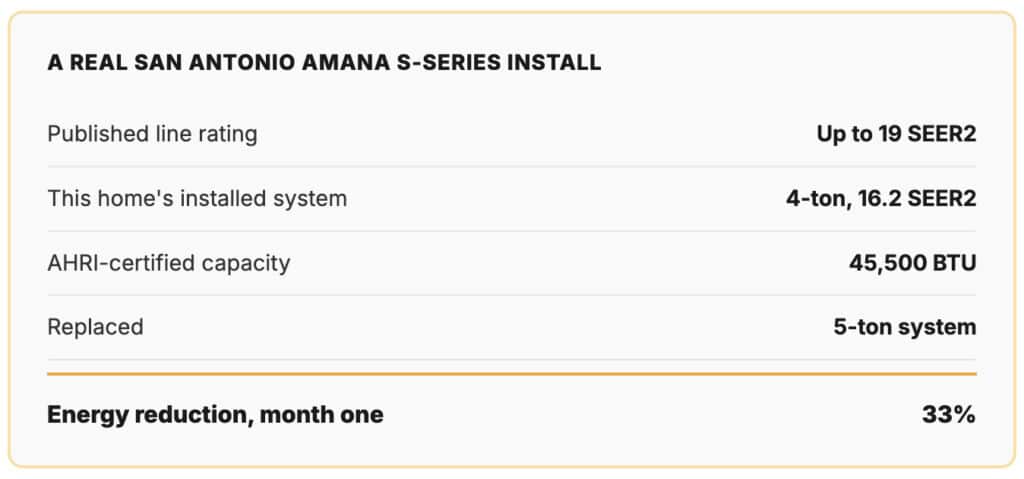
The system rated 16.2 SEER2, not 19. And it still cut the homeowner’s energy use by a third, because the previous system was oversized and the new one was correctly sized. Details are in our variable-speed AC replacement case study.
For context, the Department of Energy set the South region minimum at 14.3 SEER2 for split-system central air conditioners effective January 2023. A 16.2 rating is comfortably above code.
The lesson is that chasing the brochure number is the wrong approach. Getting the size right moved this homeowner’s bill far more than another two points of SEER2 would have.
The Repair Reality Nobody Mentions at the Quote Stage
Inverter systems have electronics and controls that conventional systems do not. That does not make them unreliable, but diagnosing one is a different job from replacing a capacitor on an older unit, and some components are manufacturer-specific special orders rather than stock parts.
This matters more than brand loyalty when something goes wrong on a Saturday in August.
Worth asking before you buy any inverter system
- Does the contractor stock or have fast access to inverter boards for this brand?
- Does the system require a proprietary communicating thermostat? Most inverter systems do.
- What is the warranty on the inverter board specifically, not just “the system”?
- Is surge protection included? Control boards are the expensive casualty of a grid event.
- Who services it if the installing company is unavailable?
We install surge protection on inverter systems as standard, because the board is the costly part and Texas grid conditions are not gentle to electronics. That is a small line item that protects a large one.
Which One Fits Your House
Match the system to the house, not to the brochure. Usable ducts point toward a ducted inverter. No ducts or genuine zoning needs point toward ductless. A tight budget or a short expected stay points toward a correctly sized two-stage system, which will outperform a poorly sized premium one.
| Your situation | What usually fits |
|---|---|
| Ducts in usable condition, staying 5+ years, humidity complaints | Ducted inverter — Daikin FIT or Amana S-Series |
| No ductwork, or ducts beyond economic repair | Mitsubishi ductless via a Diamond Contractor |
| Rooms genuinely need different temperatures | Multi-zone ductless |
| Addition, converted garage, or single problem room | Single-zone ductless mini-split |
| Moving within five years, or budget is the constraint | Correctly sized two-stage |
| Ducts are leaking badly | Fix the ducts first — before any equipment decision |
18–36% — the estimated energy savings range between a quality HVAC installation and a poor one, per the ENERGY STAR Quality Installation program. That gap is comparable to the gap between equipment tiers, which is why installation quality outranks brand choice.Source: ENERGY STAR / U.S. EPA
That statistic is the honest conclusion of this entire article. The difference between a careful install and a careless one is roughly the same size as the difference between a mid-tier and a premium system. Which means a well-installed Amana will beat a badly installed Daikin, and a correctly sized anything will beat an oversized everything.
If you are ready to find out what your house actually needs, AC installation in San Antonio starts with a load calculation, or you can book an assessment online. What it costs is covered in our inverter pricing guide.
Related Services from Honeycomb Heating & Cooling
AC Installation
Manual J load calculation on every job, whichever system you choose.
Heat Pumps
Variable-speed and inverter heat pumps for year-round comfort.
Duct Repair & Sealing
Often the better investment before any equipment upgrade.
The Comfy Club
Scheduled maintenance that protects the system you just invested in.
Frequently Asked Questions
Sources & References
- Amana Heating & Air Conditioning. (2026). AVXS side-discharge inverter air conditioner product specifications. Amana Brand HVAC Products.
- Honeycomb Air. (2026). Variable-speed AC replacement in San Antonio: A case study. Honeycomb Air Case Studies.
- U.S. Department of Energy. (2022, October 5). 2023 central air conditioner and heat pump energy conservation standards: Frequently asked questions [PDF file]. Office of Energy Efficiency & Renewable Energy.
Brand specifications, warranty terms, and dealer programs change. Verify current terms with the manufacturer before making a purchase decision. Honeycomb Heating & Cooling is not affiliated with Mitsubishi Electric.
Brandon Caputo
Owner & Founder · Honeycomb Heating & Cooling · San Antonio, TX · License TACLA140435E
Brandon came into HVAC the long way around. He started at a painting company in college in Virginia and worked his way up to manager, then moved to San Antonio and spent years in flooring and general contracting doing home remodels — which is where he began learning the mechanical trades from the inside out. He founded Honeycomb Heating & Cooling after seeing how few homeowners had a contractor they could actually trust to charge a fair rate and do the work right the first time. Telling a customer that a brand we do not install is the better fit for their house is part of what that means.
Honeycomb serves San Antonio, Stone Oak, Alamo Heights, Helotes, Timberwood Park, Bulverde, Shavano Park, and the surrounding communities. The company is BBB accredited, holds a 5.0 Google rating, and was voted 3rd Best HVAC Contractor in San Antonio by MySA. Outside of work, Brandon is a fitness and basketball guy, and his son Grayson is — by his own account — Honeycomb’s biggest fan.
The Brand Matters Less Than the Install
We measure the house, run the load calculation, and recommend what fits — including telling you when the right answer is something we do not sell.
Serving San Antonio, Stone Oak, Alamo Heights, Helotes, Timberwood Park, and Bulverde.


