



 (726) 233-6044
Bottom line upfront: An oversized air conditioner cools your home to the thermostat setting too quickly, then shuts off before it has removed meaningful humidity. The result is a house that reads 72°F and still feels clammy. In San Antonio’s humid climate that is not a minor annoyance, and buying a bigger system makes it worse rather than better.
This is the most common comfort complaint we get about equipment that is working exactly as designed. The system is new. Nothing is broken. The thermostat says the right number. And the house feels wrong.
The reason is almost never the brand, and usually not the efficiency rating. It is the size.
What AN OVERSIZED AC Actually Does
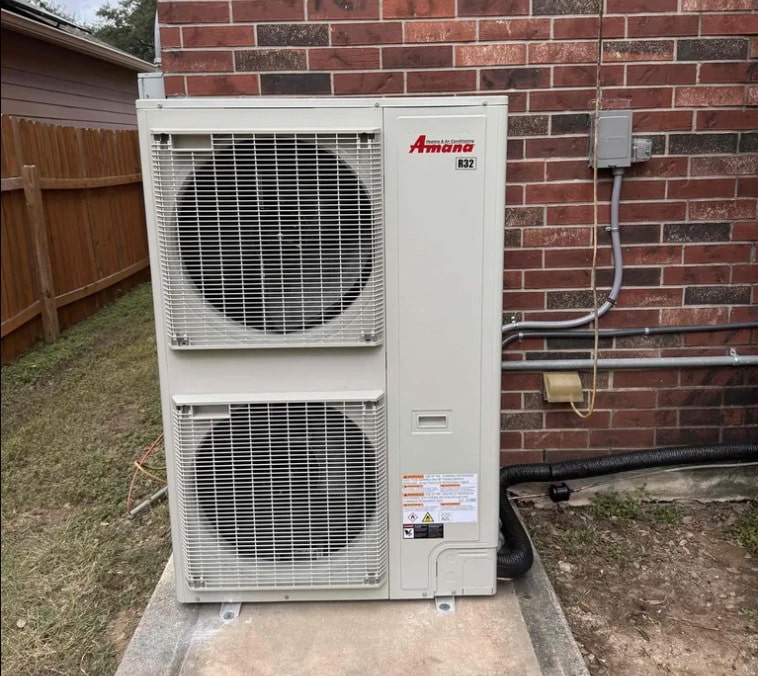
Air conditioning does two jobs: it lowers temperature and it removes moisture. Temperature drops quickly. Moisture removal takes sustained runtime, because air has to pass over a cold coil long enough for water to condense out of it. An oversized system finishes the first job before it has started on the second.
Picture what happens on a July afternoon. The thermostat calls for cooling. An oversized AC system delivers far more capacity than the house actually needs, drops the temperature to setpoint in a short burst, and shuts off.
During that short cycle, the coil barely got cold enough long enough to condense water out of the air. So the air in your home is now cooler, but it is carrying nearly as much moisture as before. Repeat that all afternoon and you get the signature result: a cold, damp house.
A correctly sized system behaves differently. It runs longer, steadier cycles, because it is not wildly overpowered for the load. Those longer cycles are what pull humidity out. The house reaches the same temperature and feels dramatically better doing it.
This is why “it cools fine, it just feels humid” is so common. Homeowners describe it as a mystery because the thermostat is hitting its target. But hitting the target fast is the problem, not the proof that everything is working. Comfort is temperature and moisture, and only one of those is displayed on your wall.
How to Tell If Your System Is Oversized
The clearest signs are short run cycles, a house that feels damp at a comfortable temperature, uneven room temperatures, and higher-than-expected bills despite the system seemingly running very little. Symptoms are usually worst in spring and early summer, not on the hottest days.
Signs pointing to an oversized system
- The system cycles on and off frequently rather than running in long, steady stretches
- The house feels clammy or sticky even when the thermostat reads 72–74°F
- You notice musty smells, or condensation on windows and vents
- Rooms farther from the air handler never catch up to the thermostat
- Bills seem high relative to how little you hear the system running
- Discomfort is worst in spring and early summer, not during peak August heat
That last point is the most diagnostic and the least intuitive. On a 102°F August afternoon, even an oversized AC system has to run long cycles, because the load is finally close to its capacity. The house feels fine. On a 86°F May afternoon with high humidity, the same system blasts to setpoint in minutes and shuts off, leaving moisture behind. If your worst comfort weeks are the mild humid ones, that is a strong signal.
Why This Hurts More in San Antonio
San Antonio averages 3,148 cooling degree days a year against 1,438 heating degree days, with 122 days above 90°F. A long cooling season in a humid subtropical climate means an oversized system mishandles moisture for most of the year rather than a few weeks.
3,148 cooling degree days versus 1,438 heating degree days annually in San Antonio, based on NOAA 30-year climate normals for 1991–2020. The city also averages 122 days a year above 90°F and 18 days above 100°F. Source: NOAA U.S. Climate Normals, 1991–2020
Compare that to a northern climate where cooling runs for perhaps ten weeks. There, an oversized system produces a few uncomfortable afternoons a year. Here, with summer humidity commonly running 65 to 70% from June through September, the same mistake shapes how your house feels for most of the calendar.
There is a second cost. Every start draws more current than steady running does, and frequent starting and stopping puts more wear on a compressor than continuous operation. A system doing that for eight months a year rather than two accumulates that wear considerably faster.
The Part Most Homeowners Do Not Know: It Is a Code Issue
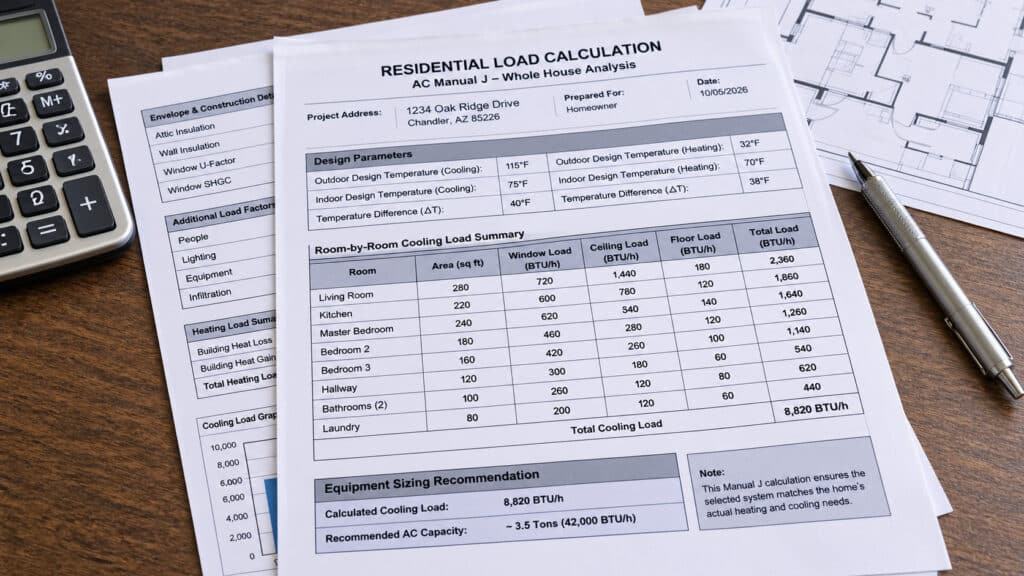
In Texas, HVAC equipment is required to be sized using an actual load calculation, not a square-footage rule of thumb. The residential building code adopted statewide requires equipment to be selected per ACCA Manual S based on loads calculated per ACCA Manual J. This applies to replacement equipment in existing homes, not only new construction.
This surprises almost everyone, so it is worth laying out plainly.
Residential Building Code · Section M1401.3
“Heating and cooling equipment and appliances shall be sized in accordance with ACCA Manual S or other approved sizing methodologies based on building loads calculated in accordance with ACCA Manual J or other approved heating and cooling calculation methodologies.”
The Texas Department of Housing and Community Affairs notes that the 2015 International Residential Code was approved by the Texas Legislature in 2016, effective September 1, 2016, statewide. The sizing requirement reads substantively the same in later editions.
Two things follow from that, and both matter to you as a homeowner.
First, sizing by square footage does not satisfy it. “Your house is 2,400 square feet, so you need a four-ton system” is not a load calculation. Neither is “you had a four-ton before, so you need a four-ton now.” A load calculation accounts for insulation levels, window area and orientation, ceiling height, air leakage, duct condition, and internal heat gains. Two houses of identical square footage can have genuinely different loads.
Second, it applies when you replace equipment. Most people assume building code only governs new construction. The sizing requirement applies to new equipment installed in an existing home. Like-for-like replacement is extremely common in the field, but matching the old unit is not the same as sizing the new one — and if the old unit was oversized, matching it just repeats the mistake for another fifteen years.
ACCA Manual S also sets limits on how much oversizing is acceptable once the load is known — generally in the range of 115% for heating and 115 to 125% for cooling, with tighter provisions where humidity control matters. That is a meaningful margin, not a blank cheque.
⚠ What to do with this, practically. Ask any contractor quoting you a system for a copy of the load calculation. Not a promise that they did one — the document. A contractor who sized your home properly will have it and will be glad to walk you through it. If the answer is a square-footage rule or a reference to what you already have, you now know enough to ask a better second question.
A Real San Antonio Example: Smaller System, Lower Bill
In a Wavy Creek home in north San Antonio, we replaced an aging 5-ton system with a 4-ton Amana S-Series variable-speed inverter after a load calculation showed the house needed four tons, not five. The homeowner’s energy use dropped 33% in the first month.
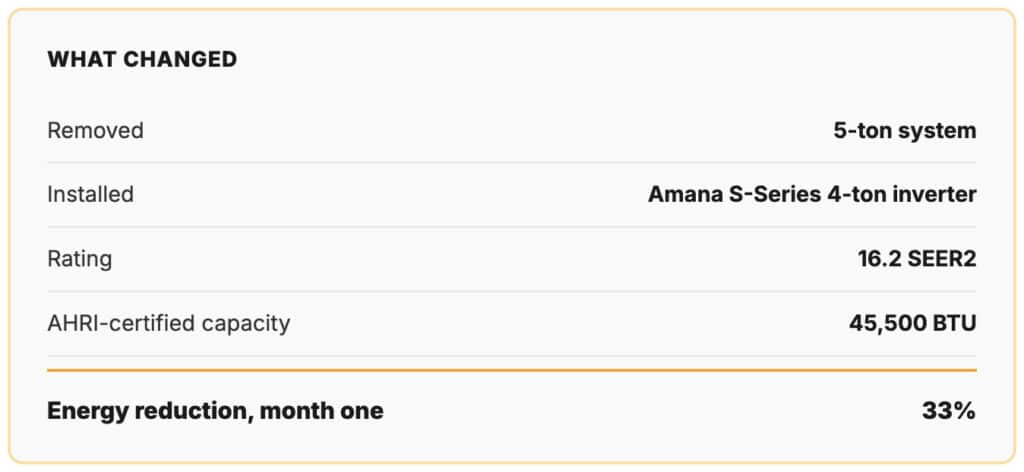
We lead with this one because it runs against the instinct almost every homeowner has. Less capacity, less energy, better comfort. The previous system was not broken in any dramatic way — it was simply too big for the house, and had been quietly doing the thing described at the top of this article for years.
Full equipment and process details are in our variable-speed AC replacement case study.
Oversizing Is Not the Only Possible Cause
A clammy house with uneven temperatures can also come from leaking or undersized ductwork, restricted airflow, air infiltration, thermostat placement, or a system that was never properly commissioned. Several of these produce symptoms close enough to oversizing that guessing is a bad idea.
We want to be straight about this, because an article arguing one cause for everything is usually wrong.
| Possible cause | How it shows up | How it differs from oversizing |
|---|---|---|
| Leaking duct work | Uneven rooms, high bills, poor delivery to far rooms | Run cycles are usually long, not short |
| Restricted airflow | Weak output, possible coil freezing | Often traceable to a clogged filter or closed returns |
| Air infiltration | Humidity stays high, system runs constantly | Opposite pattern long runtimes, not short cycles |
| Thermostat placement | One zone comfortable, rest of house not | Check for sun exposure, a nearby vent, or a lamp |
| Poor commissioning | Incorrect refrigerant charge or airflow from day one | Present on a brand-new install that never worked right |
| Oversizing | Cold but damp, short cycles, worst in mild humid weather | Distinguishing sign short run times with high humidity |
If your ducts are the issue, no equipment change will fix it — duct sealing and repair will do more for comfort than a bigger compressor ever could. A proper assessment measures static pressure before anyone recommends equipment.
18–36% — the estimated energy savings range between a quality HVAC installation and a poor one, for air conditioners and heat pumps, per the ENERGY STAR Quality Installation program. Correct sizing is one of the core elements that program measures. Source: ENERGY STAR / U.S. EPA
What to Do If You Think Yours Is Oversized
You do not need to replace a working system to improve the situation. Start by confirming the diagnosis with a load calculation and some basic measurements, then address airflow and ductwork. Replacement is the last step, not the first — and when it comes, it may well be a smaller system.
- Get a load calculation on your actual home. This tells you what the house needs, independent of what is installed. Without it you are guessing.
- Measure the humidity. An inexpensive hygrometer next to your thermostat will tell you more about your comfort problem than the thermostat does.
- Time a cycle. Note how long the system runs once it starts on a mild, humid afternoon. Short bursts with a damp house is the pattern.
- Check airflow and ductwork before equipment. Static pressure testing and duct inspection often reveal a cheaper fix.
- If replacement is warranted, size from the calculation. Not from the old unit, and not from square footage.
If you are already planning a replacement, the related question is which technology fits — we cover that in two-stage vs inverter for San Antonio homes, and what it costs in what an inverter AC costs here. Either way, AC installation in San Antonio should begin with measuring the house.
Related Services from Honeycomb Heating & Cooling
AC Installation
Every install starts with a Manual J load calculation, not a square-footage guess.
Duct Repair & Sealing
For uneven rooms and cooling that never reaches the far end of the house.
Heat Pumps
Variable-speed systems that modulate rather than short-cycle.
The Comfy Club
Scheduled maintenance that catches airflow problems before they become comfort problems.
Frequently Asked Questions
Sources & References
- Texas Department of Housing and Community Affairs. (2026). Weatherization assistance program: Manual J residential load calculations technical guide [PDF file]. TDHCA Community Affairs Division.
- Honeycomb Air. (2026). Variable-speed AC replacement in San Antonio: A case study. Honeycomb Air Case Studies.
- International Residential Code, Section M1401.3, Equipment and Appliance Sizing — equipment sized per ACCA Manual S based on loads calculated per ACCA Manual J
- NOAA U.S. Climate Normals, 1991–2020 — San Antonio cooling and heating degree days, and days above 90°F and 100°F
- San Antonio field observations drawn from Honeycomb Heating & Cooling service records
Building code adoption and enforcement vary by jurisdiction. Confirm the applicable code edition and any local amendments with your city or county building department.
Brandon Caputo
Owner & Founder · Honeycomb Heating & Cooling · San Antonio, TX · License TACLA140435E
Brandon came into HVAC the long way around. He started at a painting company in college in Virginia and worked his way up to manager, then moved to San Antonio and spent years in flooring and general contracting doing home remodels — which is where he began learning the mechanical trades from the inside out. He founded Honeycomb Heating & Cooling after seeing how few homeowners had a contractor they could actually trust to charge a fair rate and do the work right the first time. Running a Manual J load calculation on every installation, even when it points to a smaller system than the one coming out, is part of what that means in practice.
Honeycomb serves San Antonio, Stone Oak, Alamo Heights, Helotes, Timberwood Park, Bulverde, Shavano Park, and the surrounding communities. The company is BBB accredited, holds a 5.0 Google rating, and was voted 3rd Best HVAC Contractor in San Antonio by MySA. Outside of work, Brandon is a fitness and basketball guy, and his son Grayson is — by his own account — Honeycomb’s biggest fan.
Bigger Is Not Better
We measure the house, run the load calculation, and tell you what it actually needs — even when that means recommending a smaller system than the one you have.
Serving San Antonio, Stone Oak, Alamo Heights, Helotes, Timberwood Park, and Bulverde.