



 (726) 233-6044
Bottom line upfront: At Honeycomb, full system installations start at $10,800 for single-stage and $14,200 for two-stage. Inverter and variable-speed systems sit above that, with the final number set after an in-home assessment. The spread between two quotes on the same house is usually driven by tonnage, ductwork, and electrical work — not by the compressor.
If you have been searching this question, you have probably seen national averages that do not match the quotes you are getting, and lists of rebates that include at least one that no longer exists. Both of those are worth sorting out before you compare numbers.
So this guide covers four things: the actual price ladder here, what portion of a quote is equipment versus installation, which incentives survived into 2026, and why a quote today is higher than the one you got two years ago.
Inverter AC Cost: The Price Ladder in San Antonio
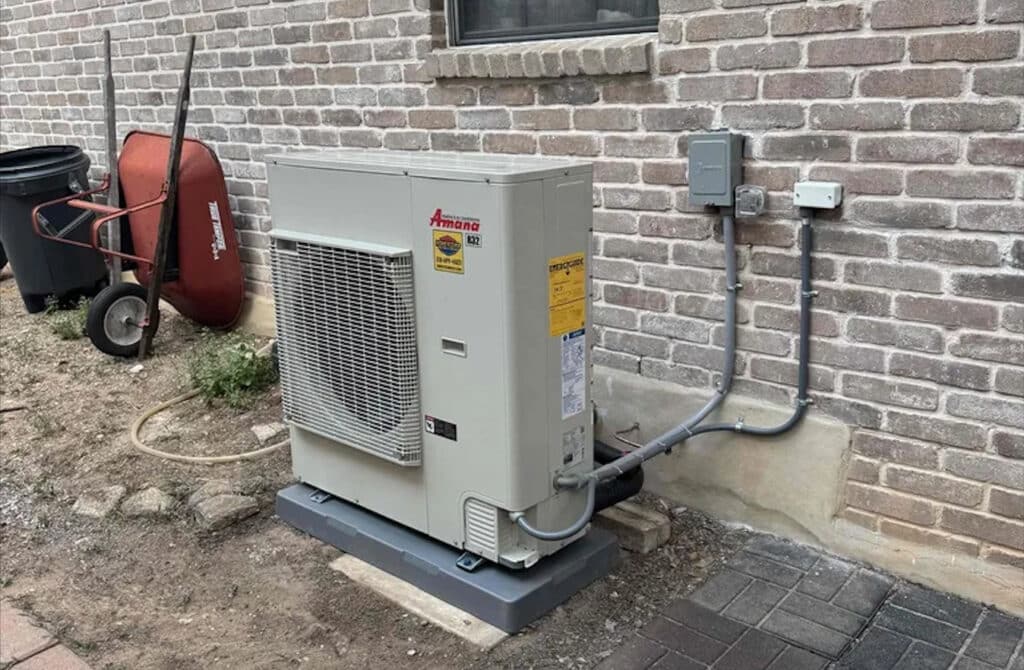
Equipment tiers stack predictably. Single-stage is the entry point, two-stage is the middle, and inverter or variable-speed is the premium. At Honeycomb that means installations starting at $10,800, $14,200, and above $14,200 respectively — with the inverter AC number finalized after we have measured the home.
| System Type | Honeycomb Installed Price | What You Get |
|---|---|---|
| Single-stage | From $10,800 | One speed, full output every cycle. Lowest entry cost, least humidity control. |
| Two-stage | From $14,200 | Low and high stages. Noticeably better comfort and moisture removal. |
| Inverter / variable-speed | Above $14,200 quoted after assessment | Best humidity control Continuous modulation, quietest operation, lowest running cost. |
We publish the first two floors and assess the third, and the reason is not evasion. Inverter quotes vary more than the other tiers because the systems are more sensitive to what they are connected to. A 4-ton inverter in a home with sound ductwork and adequate electrical service is a different job from the same equipment in a 1970s house with undersized returns and a full panel.
⚠ Be careful with national average pricing. You will find pages quoting inverter installations in the $9,000 range. Those numbers generally describe equipment-only pricing, different markets, or smaller systems than a San Antonio home needs. If a published figure sits below what a basic single-stage install costs here, it is not describing a complete installed job. Compare written local quotes, not web averages.
What You’re Actually Paying For
The condenser and air handler are only part of a quote. Load calculation, ductwork modifications, line set, electrical, refrigerant, permits, inspection, and commissioning all carry real cost. Two contractors quoting the same equipment can differ by thousands based on how much of that work they included.
This is the part homeowners rarely see broken out, and it is where most of the confusion between quotes comes from.
What belongs in a complete installation quote
- Manual J load calculation— the measurement that sets tonnage
- Equipment— condenser, air handler or furnace, evaporator coil
- Line set— replaced or flushed, depending on refrigerant compatibility
- Ductwork— modifications, sealing, or return sizing where the assessment calls for it
- Electrical— disconnect, whip, breaker sizing, and panel capacity
- Thermostat and controls— inverter systems often require a compatible communicating thermostat
- Refrigerant and evacuation— deep vacuum before charging
- Permits and inspection— built into our written quote
- Commissioning— static pressure, charge verification, airflow balancing
The cheapest quote is usually cheapest for a reason. Most of the items above are invisible on a finished job. A contractor can leave out duct modifications, skip the load calculation, reuse a line set that should have been replaced, and never commission the system — and the house will still get cold on day one. You find out in year three.
18–36% — the estimated energy savings range between a quality HVAC installation and a poor one, per the ENERGY STAR Quality Installation program. Texas is one of only five states with an active ENERGY STAR QI program. Source: ENERGY STAR / U.S. EPA
Read that against the price ladder. The gap between a good install and a bad one is comparable to the gap between equipment tiers — which means a cheap installation of premium equipment can perform worse than a careful installation of mid-tier equipment.
What Moves Your Number Up or Down
Six factors account for most of the variation between quotes: tonnage, ductwork condition, electrical capacity, equipment access, line set compatibility, and whether a communicating thermostat is required. None of them are negotiable away — they are conditions of your house.
| Factor | Why it changes the price |
|---|---|
| Tonnage | Larger homes need larger equipment. Capacity is the single biggest equipment cost driver. |
| Ductwork condition | Undersized returns or leaking trunk lines must be addressed or the system cannot deliver rated performance. |
| Electrical capacity | Older panels sometimes need a breaker change or a service evaluation before a new system lands. |
| Access | An attic air handler with low clearance takes longer than a garage unit at working height. |
| Line set | Refrigerant changes mean some existing line sets must be replaced rather than reused. |
| Controls | Inverter systems frequently require a compatible communicating thermostat, not a basic replacement. |
Notice that four of the six have nothing to do with the equipment you picked. That is why AC installation in San Antonio starts with a measurement of your home rather than a price list.
Rebates and Tax Credits: What Still Exists in 2026
The federal 25C tax credit expired December 31, 2025 and does not apply to any system installed in 2026. CPS Energy rebates are still available inside the CPS service area, currently ranging from $90 to $310 per cooling ton for qualifying central A/C and heat pump systems, on a first-come basis while funding lasts.
This section matters more than it should, because a lot of what you will read about HVAC incentives is out of date.
The federal credit is gone
The Section 25C Energy Efficient Home Improvement Credit — which offered up to $2,000 toward a qualifying heat pump and smaller amounts for other equipment — was terminated by the One Big Beautiful Bill Act, signed July 2025. It applies only to equipment placed in service on or before December 31, 2025, roughly seven years earlier than originally scheduled.
If your system was installed and running by that date, you could still claim it on your 2025 return. For anything installed in 2026, there is no federal credit. We are stating that plainly because, while checking current figures for this article, we found pages still presenting the $2,000 credit as available. If a contractor includes it in your projected savings, that is a reason to look more carefully at the rest of their numbers.
CPS Energy rebates are real and still running
CPS Energy continues to offer HVAC rebates through its SaveNow program, currently listed at $90 to $310 per ton for central air conditioners and heat pumps, with the amount tied to the system’s efficiency rating. Here is roughly what that means by system size:
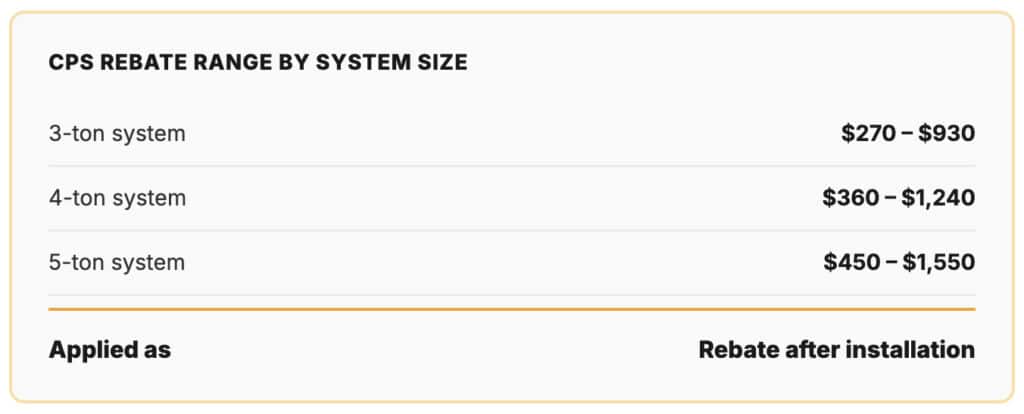
Conditions apply and they matter: the work must be done by a Texas-licensed HVAC contractor, equipment must meet minimum efficiency requirements, existing equipment has age limits, rebates are first-come and first-served, and the program ends when funding is depleted. CPS states that amounts are subject to change without notice. Honeycomb handles the rebate paperwork as part of the installation.
⚠ CPS rebates apply only inside the CPS Energy service area. If your home is in Bulverde, Boerne, Canyon Lake, Spring Branch, or another Hill Country community served by a different utility, CPS rebates do not apply to you. Check with your own electric provider — many have their own efficiency programs, but the terms and amounts are different. Do not budget for a CPS rebate until you have confirmed you are a CPS customer.
Why Your Quote Is Higher Than It Was in 2024
The HVAC industry changed refrigerants. New residential equipment now uses A2L refrigerants such as R-454B instead of R-410A, under federal rules phasing down high global warming potential refrigerants. New equipment designs, new handling requirements, and new tooling raised costs across the industry — not just at one contractor.
If you got a quote two years ago, set it aside and ask for a current one. Comparing them will mislead you.
This transition is the single most common reason homeowners feel they are being overcharged right now, and almost nobody explains it. Equipment manufactured for the new refrigerant required redesign. Contractors needed new recovery equipment, new leak detection, and updated training. Some existing line sets are not suitable for reuse with the new refrigerant and must be replaced, which adds labor and materials to jobs that would previously have reused them.
None of that is a reason to delay a replacement you need. It is a reason to compare current quotes against each other rather than against a number you remember from before the change.
What One Real San Antonio Inverter Install Looked Like
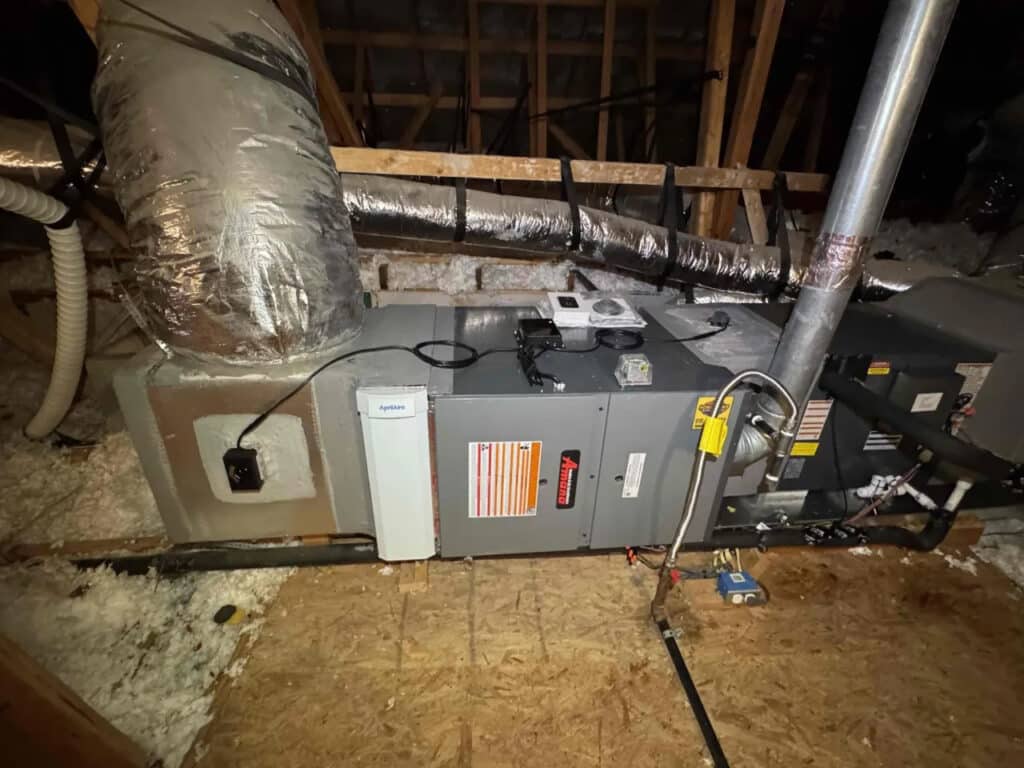
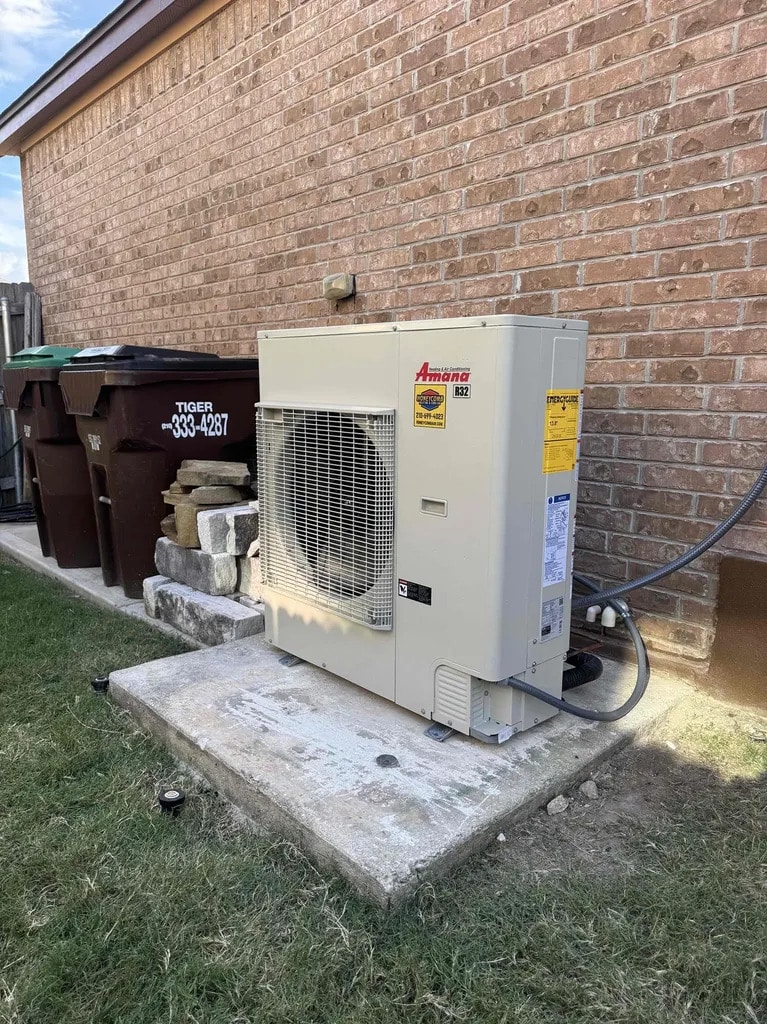
In a Wavy Creek home in north San Antonio, we replaced an aging 5-ton system with a 4-ton Amana S-Series variable-speed inverter rated 16.2 SEER2, with an AHRI-certified capacity of 45,500 BTU. The homeowner’s energy use dropped 33% in the first month — with a system smaller than the one that came out.
That downsize is the part worth noticing. The previous system was oversized for the home, which meant it cooled quickly, shut off before removing humidity, and consumed more energy through frequent starts. The Manual J calculation showed the house needed four tons, not five.
Full details, including equipment and process, are in our variable-speed AC replacement case study.
It is also a useful reminder that a bigger quote is not automatically a better outcome. If a contractor is quoting more tonnage than you currently have without showing you a load calculation that justifies it, ask why.
When the Inverter Premium Is Worth Paying
An inverter earns its cost when you are staying in the home long enough to recover it, when humidity or uneven temperatures are an existing complaint, or when the home is large enough to run long hours. San Antonio’s roughly eight-month cooling season shortens that payback window compared to most of the country.
The premium usually pays off if
- You plan to stay five to ten years or more
- Your home already feels clammy, or rooms hold different temperatures
- The outdoor unit sits near a bedroom or patio and noise matters
- The home is larger with long annual runtime
- Someone in the house has allergy or asthma concerns tied to humidity
Consider two-stage instead if
- You may move within five years
- Your ductwork needs work — fix that first, it will do more for comfort per dollar
- You prefer simpler electronics and more widely stocked parts
- The budget is tight and the difference would come out of installation quality
We cover the full comparison in two-stage vs inverter: which one actually makes sense for your San Antonio home. If you are weighing a heat pump rather than straight cool, see variable-speed heat pump options.
If the right system costs more than you planned to spend at once, financing is available with most application decisions returned in under five minutes. Military members, teachers, first responders, and seniors qualify for a $750 discount on new system installations.
Five Questions Before You Accept Any Quote
The fastest way to compare contractors is to ask about process, not product. These five questions surface whether a quote was measured or guessed — and that difference shows up in your comfort and your bills for the next fifteen years.
- “Can I see the Manual J load calculation?” If the tonnage came from square footage or from matching the old unit, that is not a calculation.
- “What did you measure on my ductwork and electrical?” Both affect whether the equipment can deliver what it promises.
- “Is the line set being reused or replaced, and why?” With the refrigerant change, this is no longer a given.
- “What incentives are you including, and are they current?” If a federal tax credit appears in the projection, that is a problem.
- “What is explicitly included — permits, inspection, electrical, duct work, commissioning?” Vague quotes get expensive after the contract is signed.
Related Services from Honeycomb Heating & Cooling
AC Installation
Manual J sizing on every job. Single-stage from $10,800, two-stage from $14,200.
Heat Pumps
Variable-speed and inverter heat pumps, priced after a home assessment.
Financing
Most application decisions returned in under five minutes.
The Comfy Club
Scheduled maintenance that protects the system you just paid for.
Frequently Asked Questions
Sources & References
- CPS Energy. (2026). Residential HVAC rebates and equipment incentives portal. CPS Energy SaveNow Program.
- Honeycomb Air. (2026). Variable-speed AC replacement in San Antonio: A case study. Honeycomb Air Case Studies.
- U.S. Department of Energy. (2022, October 5). 2023 central air conditioner and heat pump energy conservation standards: Frequently asked questions [PDF file]. Office of Energy Efficiency & Renewable Energy.
- Section 25C Energy Efficient Home Improvement Credit expiration — One Big Beautiful Bill Act, Public Law 119-21, signed July 4, 2025, terminating the credit for property placed in service after December 31, 2025
- Installation pricing, warranty terms, and field observations reflect Honeycomb Heating & Cooling’s own current pricing and service records
Rebate amounts, program availability, and tax rules change. Verify current terms with CPS Energy or your own utility, and consult a tax professional regarding any credit. Pricing is subject to change — call for a current quote.
Brandon Caputo
Owner & Founder · Honeycomb Heating & Cooling · San Antonio, TX · License TACLA140435E
Brandon came into HVAC the long way around. He started at a painting company in college in Virginia and worked his way up to manager, then moved to San Antonio and spent years in flooring and general contracting doing home remodels — which is where he began learning the mechanical trades from the inside out. He founded Honeycomb Heating & Cooling after seeing how few homeowners had a contractor they could actually trust to charge a fair rate and do the work right the first time. That is also why Honeycomb publishes installation price floors publicly instead of making people call to find out.
Honeycomb serves San Antonio, Stone Oak, Alamo Heights, Helotes, Timberwood Park, Bulverde, Shavano Park, and the surrounding communities. The company is BBB accredited, holds a 5.0 Google rating, and was voted 3rd Best HVAC Contractor in San Antonio by MySA. Outside of work, Brandon is a fitness and basketball guy, and his son Grayson is — by his own account — Honeycomb’s biggest fan.
Stop Comparing Web Averages
We measure your home, run the load calculation, and hand you an itemized written quote with permits and inspection included. Then you decide.
Serving San Antonio, Stone Oak, Alamo Heights, Helotes, Timberwood Park, and Bulverde.