



 (726) 233-6044
Quick Answer: What Does Duct Repair Cost in 2026?
Standard duct repair — mastic sealing at accessible joints or single-section flex duct replacement — runs $300 to $700 for most homes. Full-system pressurized sealing (Aeroseal) runs $1,500 to $4,000. Labor accounts for 60–70% of most invoices, making access difficulty a larger cost driver than the size of the leak. If your repair quote exceeds 35% of a full replacement estimate on a system over 15 years old, replacement wins on 10-year total cost — a field-derived threshold called the Repair Ratio Rule.
The average duct repair figure circulating on most home improvement sites — typically a single number between $300 and $700 — is the equivalent of quoting “the average cost of car repair” without specifying whether the job is an oil change or an engine rebuild. It’s accurate for one specific repair type, and misleading for every other scenario.
What determines your actual duct repair cost isn’t your home’s square footage. It’s the repair method required, the duct material involved, how physically accessible the damaged section is, and how many zones of your system are affected. Each variable can shift your final quote by several hundred to several thousand dollars — and none are visible from a phone estimate.
This guide separates the variables that actually drive duct repair pricing from the ones that don’t, gives you a repair-vs.-replacement decision rule you can apply before calling anyone, and tells you what a legitimate duct repair scope of work should include so you can verify a quote covers what it claims to.
What Actually Drives Duct Repair Costs
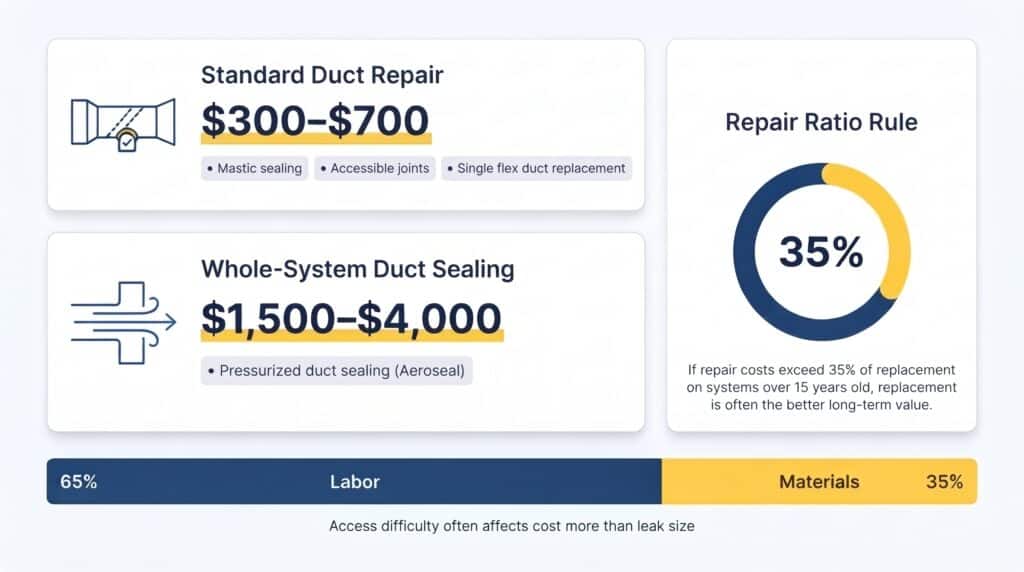
Four variables set duct repair costs more than any other: repair method, duct material type, access difficulty, and number of affected zones. Labor accounts for 60–70% of total cost in most residential repairs — making how hard it is to reach the damaged section a larger cost factor than the size of the leak itself.
Here’s how each variable plays out in practice:
Repair method creates the widest cost spread. Applying mastic sealant at a disconnected boot or accessible joint is a 1–2 hour job with $30–$60 in materials. Aeroseal pressurized injection requires specialized equipment, a full system pressure test before and after, and 4–8 hours of technician time — the same home, an order of magnitude more expensive. The correct method is determined by where the leaks are located, not what you prefer to spend.
Duct material affects both labor time and parts cost. Flexible duct — the silver corrugated tubing found in most post-1990 attics — is cheaper to replace section-by-section than rigid sheet metal but degrades faster, particularly the inner liner, which separates from the outer insulation jacket in high-humidity environments over time. Sheet metal repair requires fabrication or pre-formed components; flex duct replacement is cut-to-length and clamped.
Access difficulty is the variable most homeowners underestimate. A disconnected flex duct section 6 feet from the attic hatch costs meaningfully less to fix than the same repair 40 feet in, around a bend, in a low-clearance section above batt insulation. Technician time — not materials — drives that difference.
Number of zones affected scales cost roughly linearly until it doesn’t. Repairing a single zone is priced per job. Repairing three or four zones on the same visit typically includes some labor efficiency because the mobilization cost is already paid — but each additional zone still adds 30–60 minutes of labor plus parts.
About 20 to 30% of the air that moves through a typical home’s duct system is lost due to leaks, holes, and poor connections — reducing heating and cooling efficiency by as much as 20%.
Source: ENERGY STAR, U.S. Environmental Protection Agency
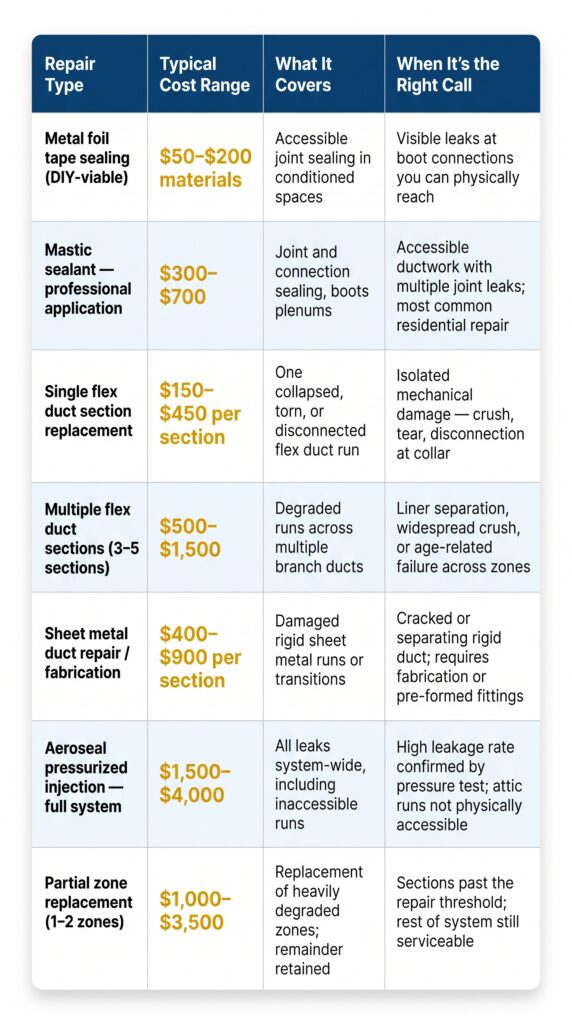
Duct Repair Cost by Repair Method — 2026 Price Ranges
Duct repair costs range from under $200 for DIY-viable accessible joint sealing to $4,000+ for full-system Aeroseal injection. The correct method — and therefore the correct cost — is determined by where the leaks are located and whether they’re physically reachable, not by what the homeowner prefers to spend.
Source: Angi
Note on Aeroseal: Aeroseal is a proprietary pressurized injection technology — not a generic service category. Any quote for “pressurized duct sealing” that doesn’t come with pre- and post-treatment leakage documentation (CFM25 or CFM50 at specified pressure) is not a complete Aeroseal scope of work. The before/after pressure test is what separates a legitimate Aeroseal job from sealant application with no verified outcome.
Heating and cooling account for approximately 43% of a typical U.S. home’s utility bills — making HVAC efficiency, and the duct system that distributes it, the single largest lever on residential energy costs.
Source: U.S. Energy Information Administration
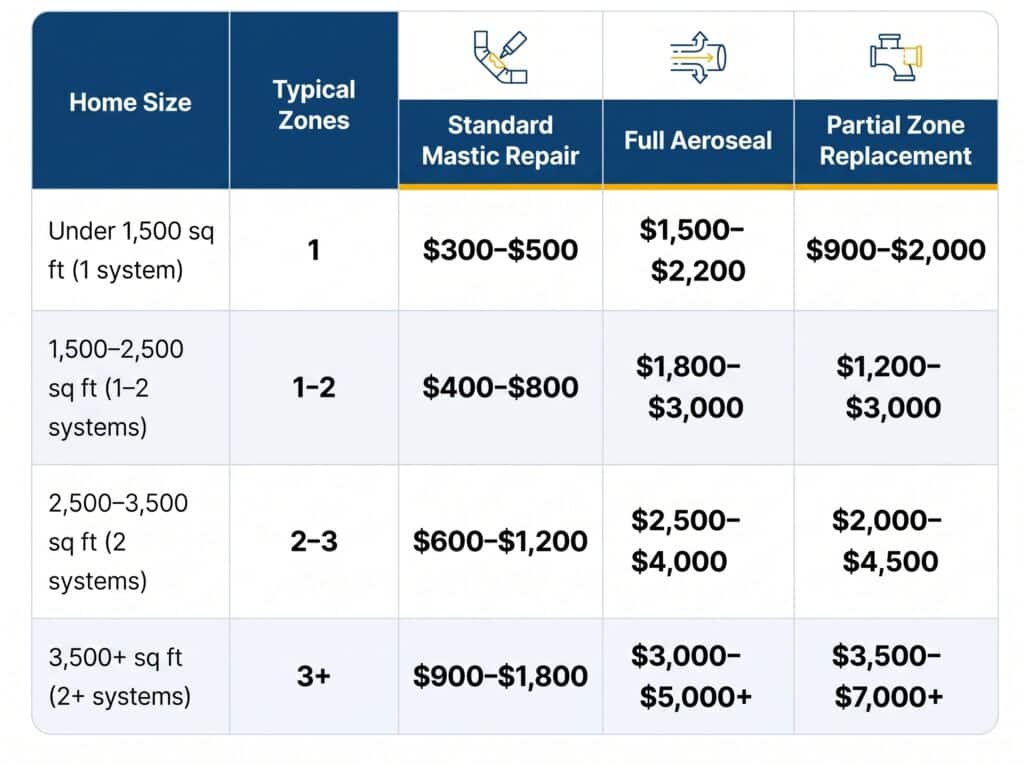
Duct Repair Cost by Home Size
Duct repair cost scales with home size primarily because larger homes have more zones, longer duct runs, and greater total leakage area — not because larger homes cost proportionally more per linear foot to seal. A two-zone home doesn’t cost exactly twice a single-zone repair, but it costs meaningfully more.
Source: Angi
In San Antonio, Bulverde, and Boerne, attic access conditions add cost pressure that national averages don’t fully reflect. Attic temperatures in the San Antonio metro regularly exceed 140°F during June through September. Technician time in those conditions is physically limited under OSHA’s heat exposure guidelines — meaning access time is compressed and jobs that run long in summer cost more than the same job in October or November.
Indoor air pollutant levels run two to five times higher than outdoor levels in a typical home — and occasionally more than 100 times higher, according to EPA human-exposure studies. Leaky duct systems are among the primary pathways that move contaminants from attic and wall cavities into living spaces with every blower cycle.
Source: U.S. Environmental Protection Agency, Indoor Air Quality (IAQ)
Signs Your Ducts Need Repair — Not Replacement
Ducts need repair, not replacement, when damage is localized to fewer than two zones, the system is under 15 years old, there’s no history of moisture intrusion or pest activity, and a pressure test shows leakage under 15% of total system airflow. All four conditions should hold — not just one.
Repair is the right scope when:
- Rooms are unevenly cooled despite a functioning thermostat and properly sized equipment — a classic sign of localized leakage or a disconnected flex run at a specific zone rather than system-wide failure
- Visible dust discharges at one or two supply registers on system startup but not others — suggests a nearby disconnection pulling unconditioned attic air into the supply side
- Utility bills increased without a change in behavior or rate — leakage-driven efficiency loss is measurable, and a pressure test will confirm whether duct leakage is the cause
- A physical inspection finds isolated mechanical damage — one crushed section, a collar pulled free from a boot, or liner separation in a single run that’s otherwise in serviceable condition
- The duct system is under 12–15 years old with no moisture damage history — material degradation at this age is typically localized, not systemic
Repair becomes the wrong scope when any of the following applies: mold or moisture damage is present anywhere in the duct system; pest activity has compromised insulation or liner integrity across multiple runs; the ductwork predates 2000 and was installed without modern flex duct liner standards; or pressure testing confirms total leakage above 25–30% of system airflow, which indicates system-wide failure rather than isolated damage.
Construction and remodeling work generates dust and particulates that can be drawn into open ducts and mechanical equipment even when the HVAC isn’t running. New equipment installation is also among the most common events that introduce new leak points into an otherwise intact duct system.
Source: Building America Solution Center, Pacific Northwest National Laboratory (U.S. Department of Energy)
The Repair Ratio Rule — The Field Heuristic for When Repair Stops Making Sense
Original heuristic: Divide your duct repair quote by the full duct replacement estimate for your home. If the ratio exceeds 0.35 (35%) and the ductwork is already over 15 years old, replacement delivers better 10-year total cost. Below 0.35 on a system under 15 years old, repair wins on cost. The ratio doesn’t override moisture damage, mold, or pest findings — those make replacement non-negotiable regardless of the math.
This rule is field-derived — not a published NADCA or DOE formula. It compresses the decision logic experienced technicians apply when a homeowner asks “should I repair or replace?” It produces a single number to test a quote against rather than a range to guess from.
Here’s how to apply it in four steps:
- Get a repair quote with a written scope — not a verbal estimate. You need a number tied to a specific component list.
- Get a replacement estimate for the same visit or from a second company. For a typical San Antonio area home, full duct replacement runs $1,600–$5,500 for a 1,500–2,500 sq ft single-system home and $3,000–$7,000 for homes around 3,000 sq ft, per Angi’s 2026 data. Sheet metal ($15–$25/LF) runs higher than flex duct ($10–$18/LF), meaning material type significantly affects where in the range a quote lands. Source: Angi
- Divide repair by replacement. A $1,200 repair quote on a home where replacement is $5,000 = a ratio of 0.24. Repair wins. A $2,200 repair quote on the same home = 0.44. Replacement wins on 10-year total cost.
- Apply the age modifier. A ratio of 0.32 on a 10-year-old system = repair. The same ratio on a 20-year-old flex duct system = replacement — because the remaining serviceable life is shorter than the payback window on the repair investment.
An inspection finding that contradicts the Repair Ratio Rule — contamination heavier or lighter than the ratio predicts — takes precedence over the calculated result. The rule sets your starting position; the inspection confirms or overrides it.
What Duct Repair Actually Fixes — and What It Doesn’t
Duct repair fixes air leakage at joints, disconnections, and mechanically damaged sections. It does not fix undersized ductwork, incorrect duct layout design, equipment-to-duct size mismatches, or material degradation that has progressed past the point where sealing holds. Knowing the difference prevents paying for repair when the underlying problem is design or sizing.
What duct repair addresses:
- Air leakage at poorly sealed or separated joints, boots, and plenums
- Disconnected flex duct runs where the collar has pulled free from the register boot or trunk fitting
- Crushed or kinked flex duct sections with an intact inner liner (liner isn’t torn, just deformed)
- Minor sheet metal separations at straight-run joints
- Pressure leakage in inaccessible runs — via Aeroseal injection only
What duct repair cannot address:
- Undersized duct runs — a duct too small for the airflow a zone requires will continue delivering inadequate conditioning regardless of how well it’s sealed. Pressure testing will confirm high static; sealing leaks doesn’t solve restriction.
- Advanced flex duct inner liner separation — when the metallized interior liner has separated from the outer jacket across more than 30–40% of a run, re-securing the liner is a temporary fix that the physics of pressurization and humidity cycling will reverse within 1–3 years.
- Mold or active moisture intrusion — sealing a duct run with an active moisture pathway seals the problem in rather than out. Any moisture finding must be resolved and dried before sealing proceeds.
- Equipment-to-duct sizing mismatches — if the duct system was designed for a 3-ton unit and the current equipment is a 4-ton, sealing leaks will modestly improve airflow but won’t resolve the static pressure imbalance driving the core comfort complaint.
Original insight: In high-humidity climates like San Antonio, flex duct inner liner separation is consistently underdiagnosed because it’s visually indistinguishable from intact flex duct on a surface inspection — the outer insulation jacket holds its shape even when the inner metallized liner has fully separated and collapsed to one side of the run. The only reliable diagnostic is a pressure test combined with an internal camera inspection at suspect sections. A visual-only attic walkthrough misses this failure mode on nearly every job.
Sealing ducts can reduce energy bills and improve comfort — ENERGY STAR estimates that sealing and insulating ducts in unconditioned spaces, including attics, can reduce heating and cooling costs by up to 20% in a typical home.
Source: ENERGY STAR, U.S. Environmental Protection Agency
The Hidden Utility Cost of Delaying Duct Repair in San Antonio
In San Antonio’s climate, leaky ducts cost more per year in wasted energy than national averages imply — because systems run more hours. At roughly 2,000 annual cooling hours versus the U.S. average of approximately 1,200, a duct system losing 25% of conditioned air to leakage is running that efficiency loss for 67% more hours per year than a comparable home in a moderate climate.
Here’s what that compounds to in practice:
A 3-ton HVAC system running at a typical efficiency rating draws approximately 3,000–3,500 watts at full load. At CPS Energy’s current residential rate of approximately $0.12 per kilowatt-hour (the all-in rate including fuel adjustment and regulatory charges is ~$0.125/kWh as of June 2026, per NuWatt Energy’s CPS Energy rate tracking), a 25% leakage-driven efficiency loss adds roughly $180–$260 in wasted energy per year on a single-system home — before accounting for added wear on the blower and compressor from operating at elevated static pressure.
Over a 5-year deferral period, that’s $900–$1,300 in pure waste — against a repair bill that, for many accessible leaks, runs $300–$700. The math on deferral doesn’t hold up once you run it against actual cooling hours rather than national averages.
The compounding factor most duct repair content skips: elevated static pressure caused by leakage restriction forces the blower motor to operate consistently near its upper load range. That accelerates motor wear and can shorten blower service life by 2–4 years on systems already running at San Antonio’s cooling hour volume. Blower motor replacement averages $560 and runs $300–$2,400 depending on motor type, horsepower, and access difficulty, per Angi’s 2026 cost data — a future cost that doesn’t show up in the utility bill but appears in repair frequency. Source: Angi
In Bulverde and Boerne, where homes run the same approximate cooling load as San Antonio proper, this efficiency-loss math applies identically — the ~2,000 annual cooling hour figure covers the entire metro, not just the city limits, based on National Weather Service data for KSAT (San Antonio International Airport).
What to Watch Out For When Getting a Duct Repair Quote
The duct repair market has a defined set of patterns that inflate costs, underdeliver scope, or both. Knowing them before you request a quote is the most effective protection — not reading reviews afterward.
- “Whole house duct sealing” at a flat low price without a written component list — what “whole house” means to a company charging $199 often means applying tape at the 3–4 accessible joints near the air handler, not sealing the full run of branch ducts, boots, and return connections. Ask for a written scope listing every component to be accessed. If they can’t or won’t provide one, it’s not a whole-house job.
- No pressure test before or after — legitimate duct sealing that claims to address system-wide leakage should include a duct leakage test (CFM25 or CFM50) before work begins and after completion. Without before/after documentation, you have no verified evidence that leakage was reduced — only that a technician was in your attic.
- Aeroseal offered without pre-treatment documentation — Aeroseal’s value is verified leakage reduction from a confirmed baseline. Companies that offer “Aeroseal-style” injection without a documented pre-test cannot demonstrate what the injection accomplished. A genuine Aeroseal job includes a computerized report showing pre- and post-treatment CFM leakage numbers.
- Scope growth after access is open, with no documentation or approval — scope growth is sometimes legitimate when damage isn’t visible from the hatch. But a reputable company documents the additional finding, shows you the evidence, and gets written approval before proceeding. A verbal scope addition while a tech is already in the attic is a red flag.
- Full replacement recommended on a system under 10 years old without a pressure test — full replacement may be warranted on older systems or those with moisture damage, but on a system installed within the last decade, a pressure test finding should precede any replacement recommendation. A recommendation without test data is a revenue decision, not a diagnostic conclusion.
- Unusually short job times quoted for whole-house work — legitimate multi-zone mastic sealing takes 3–6+ hours. Any company quoting a “whole house” job under 1–2 hours either has a very small system or is not sealing the entire system.
DIY vs. Professional Duct Repair — Where the Line Is
Two duct repairs are genuinely DIY-viable for a competent homeowner: UL 181-rated metal foil tape at accessible boot connections in conditioned spaces, and mastic sealant at visible joints you can physically reach without entering an attic. Everything else — pressure testing, attic flex duct work, Aeroseal injection, and any repair involving moisture findings — requires a licensed HVAC technician.
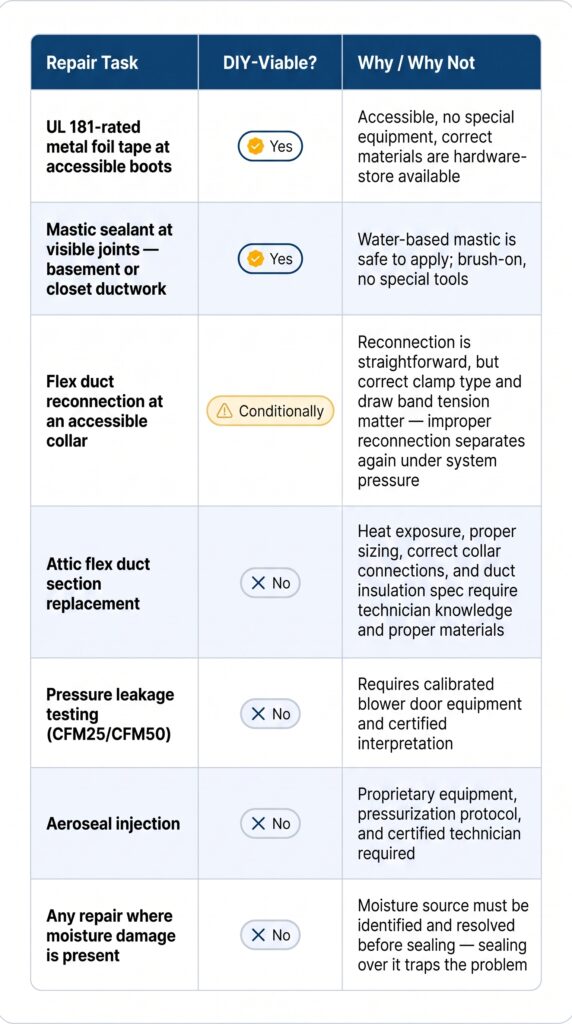
Materials note: The product marketed as “duct tape” — the silver fabric-backed tape found in every hardware store — is not rated for HVAC duct applications. It fails at the temperature cycling ducts experience in unconditioned attic spaces, typically within 1–3 years. Use UL 181-rated metal foil tape or mastic sealant for any repair intended to last.
Construction and remodeling generates dust and particulates that can be drawn into open duct runs even when the HVAC system isn’t operating — and a new system’s first startup can distribute that debris system-wide if ducts aren’t inspected and vacuumed beforehand.
Source: Building America Solution Center, U.S. Department of Energy
How Honeycomb Handles Duct Repair Assessments
If you’re evaluating a duct repair cost for your home in San Antonio, Bulverde, or Boerne, here’s exactly how Honeycomb Heating & Cooling approaches the assessment — documented and pressure-tested, not a default-to-replacement recommendation.
- Pre-inspection system history review: document duct material, installation age, prior repairs, equipment changes, and any reported events — moisture, pests, renovation work — that are known to introduce new leak points regardless of duct age
- Visual inspection at the air handler, accessible returns, and attic entry: photographed and documented — check for obvious disconnections, liner condition, collar integrity, and any moisture staining at transitions or near boots
- Pressure leakage test (CFM25): establishes the baseline leakage rate as a percentage of system airflow before any recommendation is made — this number drives the repair vs. replace recommendation, not a visual impression or system age alone
- Apply the Repair Ratio Rule: run the repair quote against a documented replacement estimate for the same system; if the ratio exceeds 0.35 on a system over 15 years old, replacement is the written recommendation even if repair is mechanically possible
- Written scope before scheduling: every component to be sealed or replaced is listed by name, location, and repair method — no “we’ll handle everything” verbal scope language
- Post-repair pressure test: CFM25 leakage rate documented after repair with before/after numbers on the invoice — the outcome is verified, not assumed
- Written interval note: any finding that didn’t meet the repair threshold — liner wear approaching end of service life, age-related degradation currently below the replacement threshold — is documented with a recommended follow-up window so the homeowner isn’t surprised 18 months later
Frequently Asked Questions
How much does duct repair cost on average?
Standard duct repair — mastic sealing at accessible joints or a single flex duct section replacement — typically runs $300 to $700. Full-system pressurized sealing (Aeroseal) runs $1,500 to $4,000 depending on home size and leakage severity. Labor accounts for 60–70% of most repair invoices, making access difficulty the dominant cost variable rather than the size of the leak itself.
Is it cheaper to repair or replace air ducts?
Repair is cheaper when damage is localized to one or two zones and the system is under 15 years old. When a repair quote exceeds roughly 35% of a full replacement estimate on a system already past 15 years, replacement delivers better 10-year total cost — that’s the Repair Ratio Rule applied. Moisture damage, mold, or pest findings make replacement non-negotiable regardless of where the ratio lands.
How do I know if my ducts need repair?
Key signs: uneven room temperatures despite a functioning thermostat, visible dust at supply registers on system startup, higher-than-expected utility bills, musty odors from vents, rooms that never reach setpoint, and visible crushed or disconnected flex duct in accessible attic sections. A pressure leakage test (CFM25) is the only way to confirm leakage rate and locate non-visible leak sources.
How long does duct repair take?
A single-section flex duct repair or accessible joint sealing takes 1–3 hours. Multi-section repairs across 2–4 zones take 3–6 hours. Full Aeroseal pressurized injection on an average home takes 4–8 hours including pressurization, injection, and post-test verification. Any company quoting a whole-house duct repair in under an hour is not performing a complete scope of work.
Does duct repair reduce energy bills?
Yes, measurably. ENERGY STAR data shows 20–30% of conditioned air in a typical home is lost to duct leaks, cutting efficiency by up to 20%. In San Antonio’s approximately 2,000 annual cooling hours — roughly 67% more than the U.S. average of 1,200 — that annual waste compounds faster than national estimates imply. Sealing confirmed leaks eliminates the majority of that loss.
What is Aeroseal duct sealing and how much does it cost?
Aeroseal is a pressurized injection method that introduces aerosolized sealant into the duct system under positive pressure, finding and sealing leaks from the inside — including inaccessible runs that mastic cannot reach. Cost ranges from $1,500 to $4,000 for an average residential system. Any Aeroseal quote that doesn’t include documented before-and-after CFM leakage numbers is an incomplete scope of work.
Can I repair air ducts myself?
UL 181-rated metal foil tape at accessible boot connections and mastic sealant at visible joints you can physically reach are genuinely DIY-viable. Standard “duct tape” — the silver fabric-backed tape — fails at attic temperature cycling within 1–3 years and is not an HVAC-rated material. Anything in an unconditioned attic, any repair requiring a pressure test, and any repair where moisture is present requires a licensed HVAC technician.
How much does duct repair cost per linear foot?
Angi’s 2026 cost data puts duct repair at $5–$45 per linear foot depending on duct type, repair method, and access difficulty. Flex duct replacement runs $10–$18 per linear foot for materials; sheet metal runs $15–$25 per linear foot. These per-foot figures are most useful for estimating partial-section work — full-system or Aeroseal quotes are priced by zone or system size, not linear footage. Source: Angi
Does homeowners insurance cover duct repair?
Standard homeowners insurance covers duct damage from a sudden covered peril — fire, certain water events, or named storms. It does not cover normal wear and tear, age-related material degradation, pest damage, or gradual leakage. Get a documented inspection report noting the cause of damage before filing any claim — without it, an adjuster has no factual basis to approve coverage.
How often do air ducts need to be repaired?
Flex duct systems in high-humidity climates typically show liner degradation requiring repair or spot replacement within 10–15 years. Sheet metal systems with properly sealed joints can last 20–25 years before meaningful leakage develops. HVAC equipment changes, added zones, or attic renovations frequently introduce new leak points regardless of duct age — inspect after any of these events, not just on a calendar schedule.
Get a Documented Duct Repair Assessment for Your Home
Honeycomb Heating & Cooling performs pressure-tested duct repair assessments across San Antonio, Bulverde, and Boerne — written scope before work begins, before/after leakage documentation on every job, no default upsell to replacement.
📞 Call or Text (210) 750-6725
Upfront Flat-Rate Pricing · Zero-Pressure Options · Background-Checked Pros · 5.0 Stars on Google (600+ Reviews)
Brandon Caputo
Owner · Honeycomb Heating & Cooling
Brandon Caputo founded Honeycomb Heating & Cooling to bring system-driven reliability and customer-first transparency to the San Antonio HVAC market. Grounded in the principle of proactive, preventative care rather than reactive crisis management, Honeycomb specializes in high-efficiency AC and heating installations, advanced diagnostic repairs, and localized indoor air quality solutions. Brandon infuses empathy into every service call, ensuring his team actively listens to homeowners to deliver clear, value-based comfort solutions.
About Honeycomb Heating & Cooling
San Antonio’s trusted specialist in residential air conditioning installation, swift repairs, and energy-saving preventative maintenance. Founded with a commitment to upfront flat-rate pricing and reliable home comfort.
600+ Completed Projects · 5.00-star Google Rating · Open 24/7 for Emergency Support · Founded by Brandon Caputo.
- Upfront Flat-Rate Pricing — No Hidden Fees
- Zero-Pressure Repair & System Options
- Background-Checked & Certified Technicians
- Amana Authorized Elite Partner
- Goodman High-Efficiency System Specialists
- Comprehensive “Comfy Club” Maintenance Programs
- 600+ 5-Star Reviews Across San Antonio
- Fully Licensed & Insured · Texas · License # TACLA140435E
- Free Estimates & Online Booking
- Zero Interest Financing Available
- Office: 26995 US Highway 281 Suite C, San Antonio, TX 78260
Sources & Citations
- ENERGY STAR. (2026). Duct Sealing — Benefits of Duct Sealing. U.S. Environmental Protection Agency. energystar.gov/saveathome/heating-cooling/duct-sealing
- U.S. Environmental Protection Agency. (2026). Indoor Air Quality (IAQ) — Human Exposure Studies. epa.gov/report-environment/indoor-air-quality
- U.S. Environmental Protection Agency. (2026). Should You Have the Air Ducts in Your Home Cleaned? epa.gov/indoor-air-quality-iaq/should-you-have-air-ducts-your-home-cleaned
- Building America Solution Center. (2026). Removing Construction Debris from Ducts. Pacific Northwest National Laboratory, U.S. Department of Energy. basc.pnnl.gov/resource-guides/removing-construction-debris-ducts
- U.S. Energy Information Administration. (2026). Residential Energy Consumption Survey (RECS) — End Uses. eia.gov/consumption/residential/
- U.S. Department of Energy. (2026). Ducts — Energy Saver. energy.gov/energysaver/ducts
- ENERGY STAR. (2026). Duct Sealing and Insulation. U.S. Environmental Protection Agency. energystar.gov
- U.S. Environmental Protection Agency. (2026). Controlling Indoor Humidity and Mold. epa.gov/mold/brief-guide-mold-moisture-and-your-home
- National Air Duct Cleaners Association (NADCA). (2026). HVAC System Assessment Standards — Cost & Time Estimates. breathingclean.com
- Air Conditioning Contractors of America (ACCA). (2026). Manual D — Residential Duct Systems. acca.org
- Angi. (2026). How Much Does Ductwork Repair Cost? [2026 Data]; How Much Does Air Duct Sealing Cost? [2026 Data]; How Much Does Duct Replacement Cost? [2026 Data]; How Much Does a Blower Motor Replacement Cost? [2026 Data]. angi.com
- NuWatt Energy. (2026). CPS Energy Rates 2026: ~12.5¢/kWh. nuwattenergy.com
- Aeroseal. (2026). How Aeroseal Works. Aeroseal LLC. aeroseal.com


