



 (726) 233-6044
Quick Answer — What Does an AC Tune-Up Checklist Include?
A professional AC tune-up in San Antonio covers 15 inspection and measurement points: refrigerant charge verification, capacitor microfarad testing, condenser coil cleaning, condensate drain clearing, thermostat calibration, electrical connection tightening, blower wheel check, supply/return temperature split measurement, and more. Items requiring calibrated instruments not just visual inspection are the ones that catch failing parts before they strand your system in July. The optimal time to schedule in San Antonio is March through early May, before peak-demand pricing and 48–72 hour wait times kick in.
22+ Days above 100°F per year in San Antonio (NOAA avg) | 15% Max efficiency loss from a dirty filter alone (U.S. DOE) | 3–10× Cost of reactive vs. preventive maintenance over equipment life (WorkTrek) |
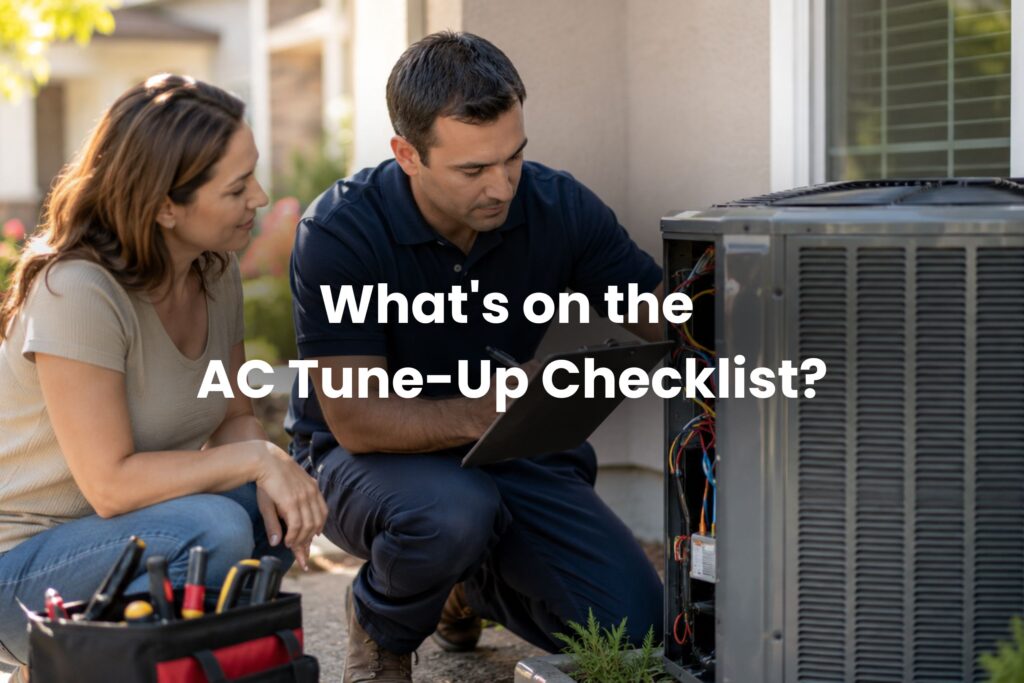
The 15-Point AC Tune-Up Checklist
What’s on the AC Tune-Up Checklist?
A legitimate AC tune-up checklist has 15 items, 5 of which require calibrated instruments (marked ★). Those 5 refrigerant charge, capacitor microfarad test, thermostat calibration, temperature split, and full runtime test are the items most often skipped during “visual-only” visits. If your invoice has no numbers, those weren’t done.
Every Honeycomb technician works through all 15 points on every visit. Items marked ★ require calibrated instruments they cannot be completed visually.
| # | Checklist Item | Method | What We’re Looking For |
|---|---|---|---|
| 1 | Air filter condition | Visual | Replace if grey/clogged dirty filters cut efficiency 5–15% (DOE) |
| 2 | Thermostat calibration ★ | Thermometer | Displayed temp vs. actual tolerance ±1°F |
| 3 | Refrigerant charge ★ | Gauges | Superheat (TXV) or subcooling (fixed orifice) in spec |
| 4 | Evaporator coil condition | Visual | No ice, no fouling, no mold growth |
| 5 | Condenser coil cleaning | Hose/rinse | Remove dirt, debris, grass fouled coils cut efficiency 2–5% |
| 6 | Capacitor microfarad test ★ | Multimeter | Within ±6% of rated value weak caps = most common summer failure |
| 7 | Contactor inspection | Visual + meter | No pitting on contacts; correct amperage draw |
| 8 | Electrical connections | Torque check | All terminals tight loose wiring is an arc risk and efficiency loss |
| 9 | Blower wheel condition | Visual | Clean blades dirty blower reduces airflow up to 15% (ENERGY STAR) |
| 10 | Supply/return temperature split ★ | Thermometer | 14–22°F differential at normal operating conditions |
| 11 | Condensate drain clearing | Flush | Clear line blocked drain = water damage and humidity spike |
| 12 | Disconnect and safety controls | Test | Correct voltage; safety switches functional |
| 13 | Outdoor unit clearance | Visual | Minimum 2 ft clearance all sides remove vegetation and debris |
| 14 | Ductwork visible inspection | Visual | Check accessible sections for gaps, tears, disconnected joints |
| 15 | Full system runtime test ★ | Timer + meter | 15+ min runtime confirms stable readings before sign-off |
What to Ask For
Request a printed or digital invoice with the actual measured values from items 2, 3, 6, and 10. If the invoice has no numbers only “OK” checkboxes those measurements were not taken.
→Related Service See What Honeycomb Includes in Every Tune-Up Visit
Pass/Fail Guide — What Each Reading Actually Means
What Do the Readings on an AC Tune-Up Invoice Mean?
The five measurable items on an AC tune-up refrigerant charge, capacitor microfarads, temperature split, thermostat calibration, and blower airflow each have a pass range, a warning zone, and a fail threshold. A refrigerant charge more than 15% off spec indicates a leak. A capacitor more than 15% below rated value should be replaced before summer. A temperature split below 10°F points to a coil or charge problem. Any reading in the fail column warrants immediate action — not a “let’s watch it” response.
| Checklist Item | ✓ Pass | ⚠ Warning Zone | ✗ Fail — Act Now |
|---|---|---|---|
| Refrigerant charge | Within ±5% of spec | 5–15% low or high | >15% off — leak likely |
| Capacitor (µF) | Within ±6% of rated | 6–15% below rated | >15% below — replace before summer |
| Temperature split | 14–22°F differential | 10–13°F differential | <10°F — coil or charge issue |
| Thermostat calibration | ±1°F of actual temp | 2–3°F off | >3°F off — recalibrate or replace |
| Blower airflow | 350–450 CFM per ton | 300–350 CFM | <300 CFM — major restriction |
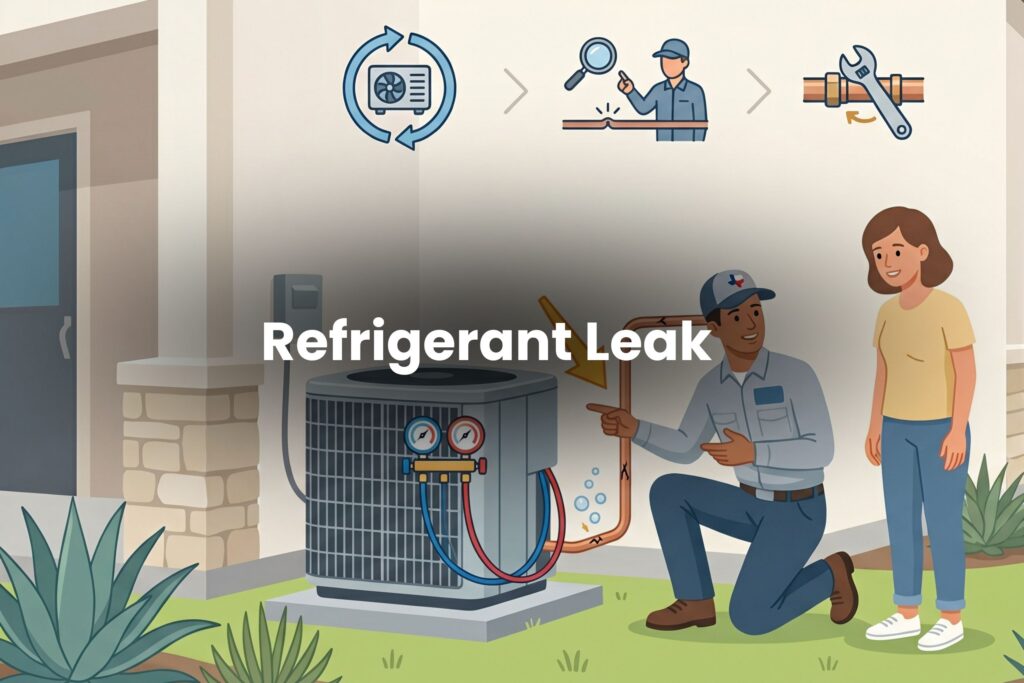
Red Flag — Refrigerant
A system that needs refrigerant added at every tune-up has a leak, not a consumption issue. Refrigerant does not get “used up.” Adding refrigerant without finding and fixing the source is a temporary patch. EPA Section 608 requires licensed technicians to handle all refrigerant. (Source: U.S. EPA)
When to Schedule Your AC Tune-Up in San Antonio
When Is the Best Time to Schedule an AC Tune-Up in San Antonio?
March through early May is the optimal window. This gives 60–90 days of lead time before peak summer heat, when technician availability is highest and pricing is at its seasonal low. Emergency-season pricing (June–August) runs 50–100% higher than the same service booked in spring. San Antonio’s 2023 summer included 75 consecutive days above 100°F the longest streak on record making pre-season prep more critical here than in most U.S. cities.
San Antonio’s cooling season is longer and more demanding than the national average. Average summer highs top 95°F from June through August, with August averaging 96.6°F. The city recorded 75 consecutive days of 100°F+ temperatures in 2023 — the longest streak on record. (Source: NOAA / 2CollegeBrothers)
75
Consecutive days of 100°F+ in San Antonio’s record 2023 summer
San Antonio averages 22+ days per year above 100°F nearly double the U.S. average. More runtime hours = faster component wear = narrower margin for deferred maintenance.
Sources: NOAA via Current Results; 2 College Brothers San Antonio Climate Data
| Month | Demand | Pricing | Availability | Recommendation |
|---|---|---|---|---|
| Jan–Feb | Very Low | Lowest | High | ✓ Good ideal if you missed spring |
| Mar–Apr | Low | Low | High | ★ Best window book now |
| May | Rising | Moderate | Moderate | ✓ Still smart beats summer prices |
| Jun–Aug | Peak | 50–100% higher | Very Limited | ⚠️ Book early expect a wait |
| Sep–Oct | Declining | Moderate | Moderate | ✓ Good for second system or post-season |
| Nov–Dec | Low | Low | High | ✓ Good for winter prep and heat pumps |
What Happens If You Skip the Tune-Up
What Happens If You Skip Your Annual AC Tune-Up?
Skipping an annual AC tune-up in San Antonio costs most homeowners $180–$420 in avoidable energy waste per cooling season plus exposure to emergency repair rates that run 50–100% above standard pricing for the identical repair. The three compounding mechanisms: dirty filter and coil efficiency loss (5–20% combined), undetected capacitor failure (the #1 cause of summer no-cool emergencies), and emergency repair labor premiums that run 3–10× the cost of a preventive visit. (Sources: DOE, WorkTrek 2026)
1. Dirty Filter and Coil Efficiency Loss
A clogged air filter alone can reduce AC efficiency by 5–15%, according to the U.S. Department of Energy. Fouled condenser and evaporator coils add another 2–5% drain. San Antonio ranked 20th worst in the U.S. for ozone pollution in the American Lung Association’s 2025 State of the Air report — Bexar County earned a failing grade and a six-year upward trend. High-ozone air accelerates coil fouling, and San Antonio’s extended season compounds the exposure. (Sources: DOE; American Lung Association; Lawrence Berkeley National Laboratory)
2. Capacitor Failure — The #1 Summer Breakdown Cause
Capacitors are inexpensive to test and replace during a tune-up ($20–$60 part). Left unchecked, a failing capacitor strands a compressor — an emergency call running $200–$600, often on a 48–72 hour wait during peak heat weeks. Capacitor failure is the single most common cause of no-cool emergencies during summer months.
3. Emergency Repair Premium
Reactive maintenance costs 3–10× more than preventive maintenance over equipment life, according to WorkTrek’s 2026 HVAC maintenance statistics. Emergency calls during June–August carry a 50–100% labor premium above standard rates for identical work.
Industry Data
A 2025 DuraPlas survey reported by ACHR News found 50% of homeowners planned to skip HVAC maintenance entirely. The same population statistically bears the majority of emergency repair costs three months later. (Source: ACHR News, 2025)
→Related Service Need AC Repair After a Breakdown? Honeycomb San Antonio
The San Antonio Factor — Why This City Is Harder on AC Systems
Why Is AC Maintenance More Important in San Antonio Than Other Cities?
Three local conditions make San Antonio harder on AC systems than most U.S. markets: (1) a cooling season of roughly 180 days — producing 1,400–2,200 annual runtime hours per system, nearly double northern markets; (2) Bexar County’s “F” air quality grade from the American Lung Association, which accelerates coil fouling; (3) a CPS Energy grid that hit an all-time demand record of 5,858 MW in August 2024, meaning an inefficient AC costs more per hour during peak weeks than ever before.
Longer Runtime Hours
San Antonio’s cooling season runs approximately late April through October roughly 180 days. A typical residential system runs 8–12 hours daily during peak weeks. That’s 1,400–2,200 annual runtime hours, compared to 800–1,200 in northern markets. More hours means faster component wear, more coil fouling cycles, and a narrower window between “working fine” and “failed at midnight in August.”
Air Quality and Coil Fouling
Bexar County’s “F” grade from the American Lung Association means more airborne particulates hitting condenser coils more often. Fouled coils reduce efficiency and force the compressor to run hotter and longer the exact conditions that accelerate capacitor and contactor degradation.
Grid Stress During Peak Hours
CPS Energy set an all-time demand record of 5,858 megawatts during the August 2024 heat wave. An inefficient AC running longer cycles during peak grid hours costs more and contributes to demand spikes. A tune-up that recovers 10–15% efficiency directly reduces runtime and peak-hour exposure. (Source: San Antonio Report)
“In San Antonio, your AC isn’t just fighting the heat — it’s fighting poor air quality, a long season, and a stressed grid all at once. A tune-up here isn’t optional maintenance. It’s risk management.”
— Honeycomb Heating & Cooling
→Related Service Indoor Air Quality Services in San Antonio — Protect Your System and Your Family

DIY Checklist — What You Can Do Between Professional Visits
What AC Maintenance Can I Do Myself Between Tune-Ups?
Five tasks homeowners can do between professional visits: replace air filters every 60–90 days, clear 2 ft of space around the outdoor condenser monthly, pour distilled white vinegar into the condensate drain monthly, check that all vents are open and unobstructed, and compare the thermostat reading to a standalone thermometer each season. None replace a professional tune-up — but all five reduce the rate at which your system degrades between visits.
| Task | Frequency | Why It Matters |
|---|---|---|
| Replace air filter | Every 60–90 days | Single biggest DIY efficiency lever — 5–15% efficiency impact (DOE) |
| Clear condenser area | Monthly in summer | Maintain 2 ft clearance; remove grass clippings, leaves, debris |
| Check condensate drain | Monthly | Pour 1 cup distilled white vinegar to prevent algae buildup |
| Inspect supply/return vents | Monthly | Ensure vents are open and unobstructed by furniture |
| Test thermostat accuracy | Seasonally | Compare thermostat reading vs. standalone thermometer in same room |
Do Not DIY
Refrigerant handling, electrical connection work, capacitor testing, and coil chemical cleaning require licensed technicians. EPA Section 608 makes refrigerant handling a legal requirement for certified professionals only.
Comfy Club vs. One-Time Tune-Up — Which Makes Sense?
Should I Get a One-Time Tune-Up or Join the Comfy Club?
Both include the same 15-point measurement-based tune-up. The difference: the Comfy Club waives service call fees, gives member discounts on repairs, and puts you at the front of the scheduling queue which matters in July when wait times stretch 48–72 hours. One-time visits are ideal for systems under 5 years old. The Comfy Club makes more financial sense for systems 5+ years old or any household that can’t afford a mid-summer breakdown wait. Most Amana and Goodman warranties also require documented annual maintenance both options satisfy that requirement.
| One-Time Tune-Up | Comfy Club Membership | |
|---|---|---|
| Annual cost | Starting at $58 | Flat annual fee (call for current rate) |
| Tune-ups included | 1 per booking | Annual tune-up included |
| Service call fee | Standard rate | Waived |
| Repair discount | None | Member discount on all repairs |
| Scheduling priority | Standard queue | Priority skip the line |
| Best for | Systems under 5 years old | Systems 5+ years or high-use households |
| Warranty documentation | Invoice satisfies requirement | Automatic annual documentation |
Manufacturer Warranty Note
Most Amana and Goodman warranties require documented annual professional maintenance to remain valid. A one-time tune-up with a written invoice satisfies this requirement. The Comfy Club provides automatic annual documentation with no scheduling effort required.
→Learn More Comfy Club Membership — Annual Tune-Ups, Priority Service, No Service Call Fees
Frequently Asked Questions
What does an AC tune-up checklist include?
A complete AC tune-up checklist covers 15 points: air filter inspection, thermostat calibration, refrigerant charge measurement, evaporator coil check, condenser coil cleaning, capacitor microfarad test, contactor inspection, electrical connection tightening, blower wheel check, supply/return temperature split measurement, condensate drain clearing, safety control testing, outdoor unit clearance check, visible ductwork inspection, and a full system runtime test with documented readings. Per ENERGY STAR’s official maintenance checklist, a legitimate visit documents measured values — not just visual checkboxes. (Source: ENERGY STAR)
How often should I get an AC tune-up in San Antonio?
Once per year at minimum, ideally in March–April before peak summer heat. San Antonio systems log significantly more runtime hours than the U.S. average due to the extended cooling season making annual service more critical here than in northern climates. Systems over 10 years old benefit from twice-yearly service: spring and fall. Heat pumps that handle both heating and cooling also warrant bi-annual visits.
How do I know if my AC tune-up was real or just a visual inspection?
Ask for the invoice with measured values. A legitimate tune-up records refrigerant superheat or subcooling readings, capacitor microfarad readings, and a supply/return temperature split. If the invoice shows only checkboxes or the word “OK” with no numbers, the visit was a visual inspection it did not verify refrigerant charge or capacitor health. A real tune-up takes 60–90 minutes. A visit under 25 minutes cannot include all ENERGY STAR-specified measurement tasks.
What is the most common reason AC units fail in the summer?
Capacitor failure is the most common cause of no-cool emergencies during summer peak weeks. Capacitors degrade gradually throughout the season and often test within acceptable range in spring but fail under the sustained load of a July heat wave. A capacitor microfarad test during a pre-season tune-up catches degraded caps before they strand the compressor.
Can a dirty air filter cause my AC to stop working?
Yes. A severely clogged filter restricts airflow so severely that the evaporator coil can freeze stopping cooling entirely. The U.S. Department of Energy reports that dirty filters reduce AC efficiency by 5–15%. In San Antonio’s climate, where systems run 8–12 hours daily during peak weeks, a neglected filter compounds wear at an accelerated rate. Filters should be replaced every 60–90 days during high-use periods.
Is refrigerant added during a tune-up?
No — and be cautious of any company that automatically adds refrigerant as part of every tune-up. A tune-up measures refrigerant charge; it does not automatically add it. If the measured charge is low, that indicates a leak. Adding refrigerant without finding and fixing the source is a temporary patch. All refrigerant handling legally requires EPA Section 608 certification.
How much does Honeycomb charge for a tune-up?
Honeycomb currently offers AC tune-ups starting at $58 in San Antonio. Every visit is measurement-based: refrigerant charge verification, capacitor microfarad testing, coil cleaning, condensate drain service, and documented readings on every invoice. Upfront flat-rate pricing — the price quoted is the price paid. Call (726) 233-6044 or visit honeycombair.com to schedule.
What is included in the Comfy Club maintenance plan?
The Comfy Club is Honeycomb’s annual membership program. It includes annual AC tune-ups, no service call fees, priority scheduling ahead of non-members, and repair discounts. It is designed for homeowners who want to eliminate the annual scheduling task and protect manufacturer warranty documentation automatically. Contact Honeycomb for current membership pricing.
Schedule Your Pre-Summer Tune-Up Today
Measurement-based service. Documented readings on every invoice. No sales pressure — just facts and a fair price.
Brandon Caputo
Founded Honeycomb Heating & Cooling to bring measurement-driven, customer-first HVAC service to the San Antonio market. Under his leadership, Honeycomb has grown to 622+ five-star Google reviews, an exclusive Amana Elite Partner relationship, and recognition as one of San Antonio’s top HVAC companies. Every Honeycomb tune-up follows the same 15-point protocol Brandon developed from two decades of field experience in South Texas heat.
Sources & Citations
- U.S. Department of Energy. Air conditioner maintenance.
- ENERGY STAR. Maintenance checklist.
- American Lung Association / Texas Public Radio. State of the Air 2025.
- Current Results / NOAA. San Antonio average temperatures.
- 2CollegeBrothers. San Antonio climate — 100°F day records.
- Siegel, Walker & Sherman. Dirty Air Conditioners: Energy Implications of Coil Fouling. ACEEE, 2002.
- WorkTrek. 25+ HVAC Maintenance Statistics, 2026.
- ACHR News. 50% of homeowners avoiding HVAC maintenance.
- San Antonio Report. CPS Energy, ERCOT hit new demand records.
- U.S. EPA. Section 608 — Refrigeration and Air Conditioning.


