



 (726) 233-6044
Quick Answer: Why Get an AC Tune-Up Before Peak Summer Heat?
An AC tune-up before peak summer heat restores 5% to 15% of lost cooling efficiency, catches failures that surface during the first 100°F week, and costs $75 to $200, compared with emergency repairs that run 50% to 100% more. Roughly 80% of peak-season breakdowns are predictable from inspection data collected 60-90 days earlier. The window to act is before sustained triple-digit heat arrives, not after.
Here’s the part of the AC business nobody explains to homeowners: your air conditioner rarely fails on a mild day. It fails during the first sustained stretch of 100°F heat — the exact week when every HVAC company in San Antonio is booked solid, parts are backordered, and “emergency” pricing kicks in.
That timing isn’t bad luck. It’s physics. A system carrying a marginal capacitor, a fouled condenser coil, or a slightly low refrigerant charge will run fine at 88°F. Push it to 14+ hours of continuous runtime at 103°F and the weak link snaps. The breakdown happened in June, but the cause was sitting there in March — visible to anyone who looked.
This guide explains exactly what a pre-season tune-up catches, what the math says about skipping it, and how to time it so you’re not competing with half the city for a service slot.
What Is an AC Tune-Up and What Does It Include?
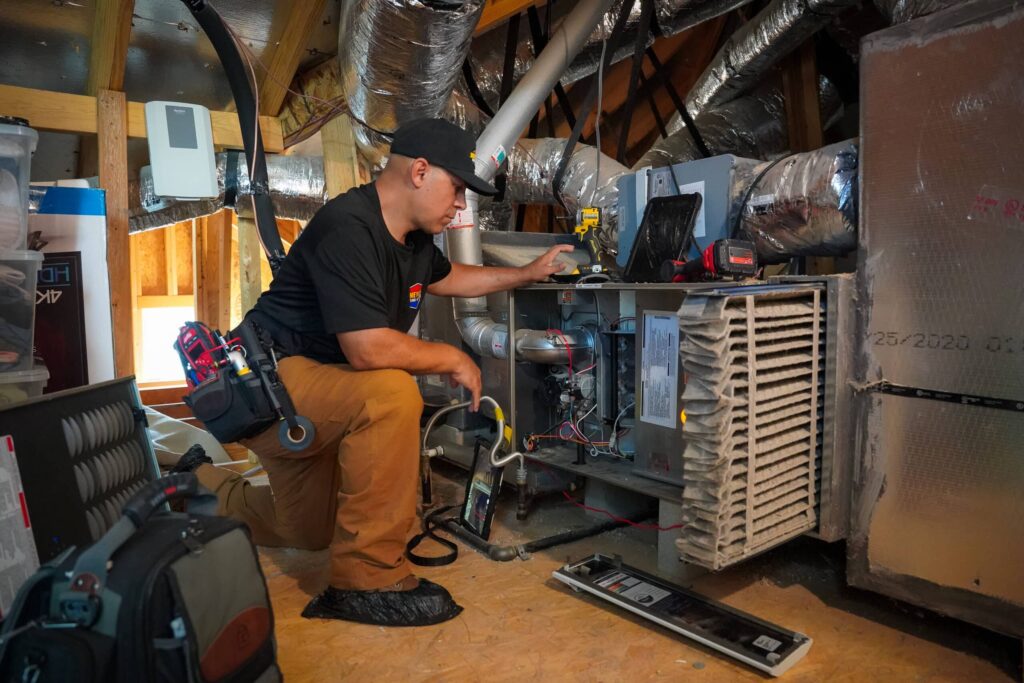
An AC tune-up is a professional inspection and maintenance service — typically 60-90 minutes — in which a technician cleans the condenser and evaporator coils, verifies refrigerant charge, tests capacitors and electrical connections, measures airflow, clears the condensate drain, and calibrates the thermostat. It restores the system to near-rated efficiency and identifies components likely to fail under sustained load.
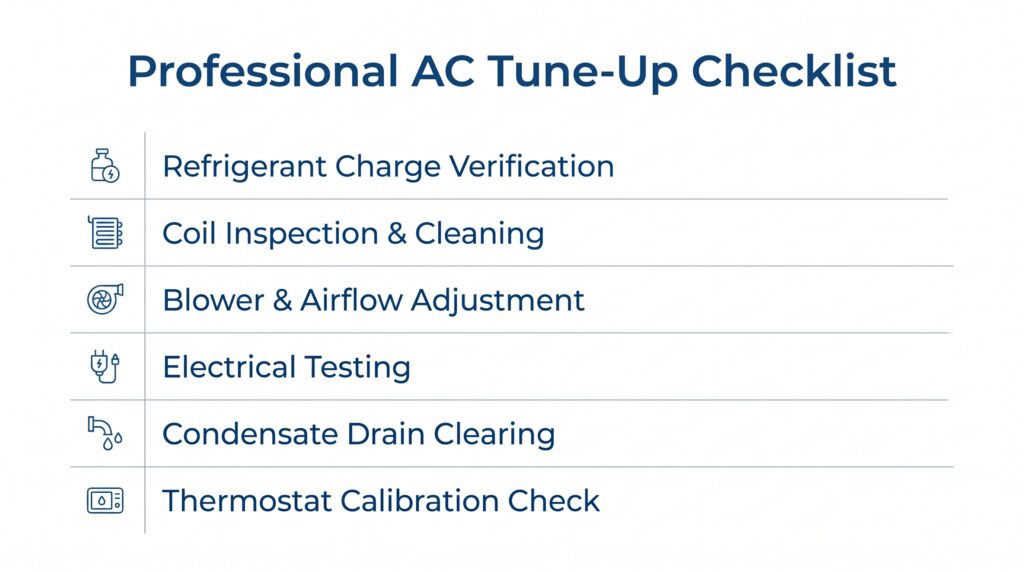
A legitimate tune-up is a measurement-driven service, not a visual once-over. ENERGY STAR’s maintenance checklist specifies the core items:
- Refrigerant charge verification — Too much or too little refrigerant reduces efficiency and shortens equipment life. Charge is measured after the system runs for at least 15 minutes, using superheat or subcooling readings — not guessed at by touch.
- Coil inspection and cleaning — Fouled condenser and evaporator coils force the compressor to work harder against degraded heat transfer.
- Blower and airflow adjustment — Per ENERGY STAR, airflow problems alone can reduce system efficiency by up to 15%.
- Electrical testing — Capacitor microfarad readings, contactor condition, and connection tightness. The run capacitor is the single most common heat-triggered failure point.
- Condensate drain clearing — A clogged drain line trips the float switch and shuts the system down, usually on the hottest day, because that’s when condensate volume peaks.
- Thermostat calibration check — A sensor reading 2-3°F off forces unnecessary runtime around the clock.
Source: ENERGY STAR
If a “tune-up” takes 15 minutes and no gauges come out, you bought an inspection-shaped sales call. Ask for the measured readings — superheat/subcooling, capacitor microfarads, temperature split — on your invoice.
How Much Efficiency Does a Neglected AC Actually Lose?
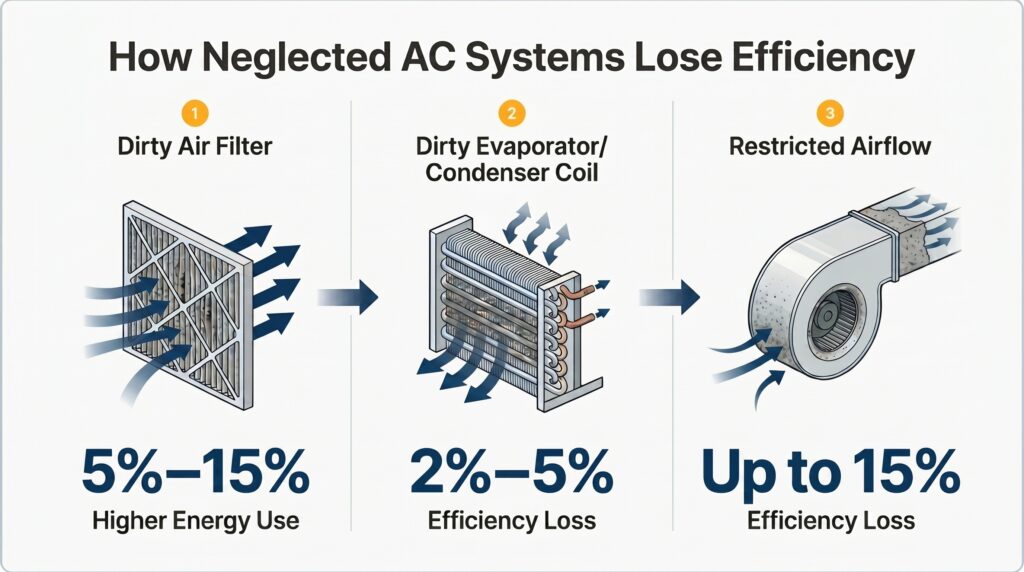
A neglected air conditioner loses efficiency through three compounding mechanisms: dirty filters (the U.S. Department of Energy reports that replacing a clogged filter can cut AC energy consumption by 5% to 15%), fouled coils (2% to 5% capacity and efficiency loss per Lawrence Berkeley National Laboratory research, more for marginal systems), and airflow restrictions (up to 15% per ENERGY STAR). These losses stack — and you pay for all of them every hour the system runs.
Sources: U.S. Department of Energy, Lawrence Berkeley National Laboratory, ENERGY STAR
The numbers worth knowing:
- The U.S. Department of Energy states that replacing a dirty, clogged filter can lower your air conditioner’s energy consumption by 5% to 15%. A dirty filter also lets dust bypass onto the evaporator coil, compounding the loss.
- Lawrence Berkeley National Laboratory research on coil fouling found typical efficiency and capacity degradation of 2% to 5% from fouled coils, with significantly worse results for marginal systems or extreme conditions — and a San Antonio August is the definition of extreme conditions.
- Heating and cooling account for roughly 43% of a typical U.S. home’s energy bill (U.S. Department of Energy). Every percentage point of cooling inefficiency is a direct, recurring charge against the largest line item in your home’s energy budget.
Here’s the insight most homeowners miss: efficiency loss is invisible until it isn’t. A system down 10% to 15% still cools the house in May. It just runs longer cycles. You don’t see a symptom — you see a CPS Energy bill that’s $40 higher and a system aging in fast-forward. The breakdown is merely the last chapter of a decline that was measurable months earlier.
Why Do Air Conditioners Fail During Heat Waves Specifically?
Air conditioners fail during heat waves because sustained triple-digit heat converts marginal components into failed ones. Extended runtime overheats weak run capacitors, high head pressure exposes low refrigerant charge and dirty condenser coils, and peak condensate volume clogs neglected drain lines. The defect existed for months; the heat wave is just the stress test it finally fails.
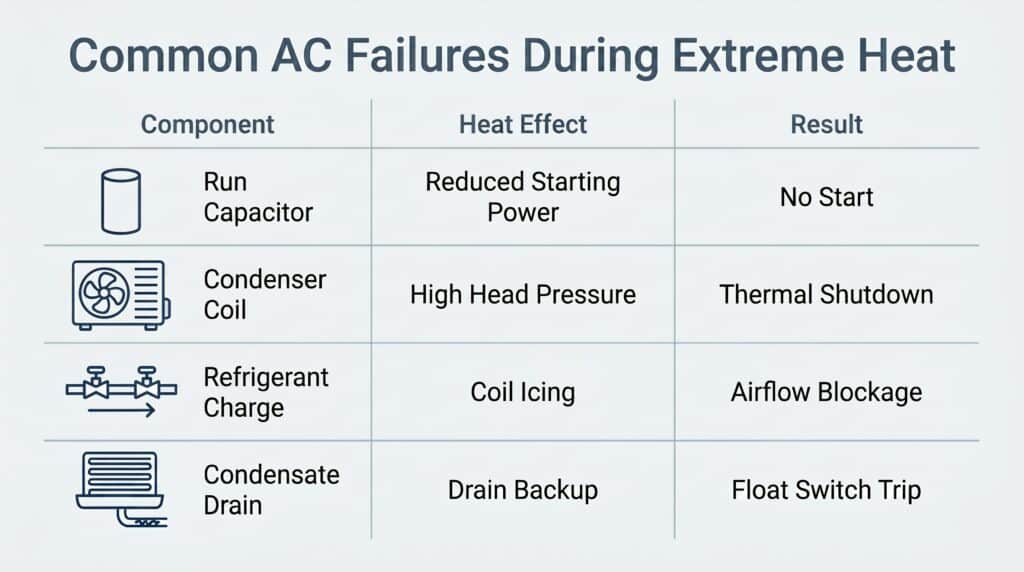
The mechanism, component by component:
- Run capacitors degrade with heat exposure. A capacitor reading 10% below its rated microfarads will still start the compressor on a mild day. At 103°F ambient, with the unit baking in afternoon sun and running near-continuously, it can’t deliver — and the compressor hums without starting or trips the breaker.
- Dirty condenser coils raise head pressure. The condenser rejects heat outdoors. When ambient temperature climbs and the coil is matted with dust and cottonwood, head pressure spikes, amp draw climbs, and the compressor’s thermal overload trips — typically mid-afternoon, over and over.
- Low refrigerant charge shows up as ice. A mildly undercharged system limps through spring. Under sustained load, the evaporator coil drops below freezing, ices over, blocks airflow entirely, and the house warms up while the system runs nonstop.
- Condensate volume peaks with humidity and runtime. More runtime means more condensate. A drain line that’s been slowly growing algae since last fall finally backs up and trips the safety float switch on the first 100°F weekend.
This is why the failure data is so lopsided toward predictability: an analysis by facilities-management firm Vixxo found that 80% of peak-season HVAC failures are predictable from inspection data collected 60-90 days earlier. Four out of five summer breakdowns announce themselves in advance — to anyone who measures.
Source: Vixxo
The 90-Day Rule: When Should You Schedule Your AC Tune-Up?
Schedule your AC tune-up 60-90 days before sustained peak heat, that means March through early May. This timing follows directly from the failure data: if 80% of peak-season failures are visible in inspections done 60-90 days early, the tune-up only delivers its full predictive value when it happens inside that window. A tune-up in July is a repair call with a nicer name.
We call this the 90-Day Rule, and it’s the single piece of advice from this article that most changes outcomes. Three reasons the window matters:
- Parts lead time. A marginal capacitor found in April is a $20 part replaced on the spot. A failed compressor discovered in July can mean days without cooling while equipment ships — during the hottest week of the year.
- Scheduling reality. When the first heat wave hits, every HVAC dispatcher’s board fills within hours. Industry service-call data shows HVAC call volume during peak summer weeks runs 2-4x the annual daily average, with the first heat wave of the season driving spikes of 200% to 300% above baseline, according to 2026 trade service-call statistics — a pattern ACHR News traces directly to failures that began, undetected, in spring. That matches what we see on Honeycomb’s own dispatch board: same-day availability disappears market-wide within the first 100°F week. Source: ACHR News
- Compounding grid pressure. San Antonio’s grid is running hotter every year. CPS Energy set an all-time demand record of 5,858 megawatts during an August heat wave, and the utility now projects annual peak-demand growth of 260 megawatts — more than double its earlier forecast. An inefficient AC isn’t just expensive for you; it’s running its longest cycles exactly when electricity demand (and your rate exposure) peaks. Source: CPS Energy
Already past the window? Schedule anyway. A tune-up in June still catches the same defects — you’ve just spent the spring paying for inefficiency you could have recovered earlier.
Tune-Up Cost vs. Breakdown Cost: The Math
A professional AC tune-up costs $75 to $200 in 2026, with most homeowners paying $100 to $150, according to HomeGuide’s 2026 cost data. Emergency repairs cost 50% to 100% more than the same repair performed as standard service, and running equipment to failure costs 3-10 times more than a maintenance program over the equipment’s life, per industry maintenance statistics compiled by WorkTrek.
Source: WorkTrek
| Scenario | Typical Cost | When You Pay It |
|---|---|---|
| Pre-season tune-up | $75-$200 (Honeycomb’s current special: $58) | On your schedule, in spring |
| Standard repair found during tune-up (capacitor, contactor, drain clear) | $100-$400 | Same visit, no urgency premium |
| Same repair as an emergency call in July | 50%-100% more than standard rates | Hottest week of the year, after waiting in queue |
| Compressor failure from prolonged strain | $1,500-$3,000+ | Whenever the weak link snaps — usually peak heat |
| Full system replacement (premature, strain-accelerated) | $6,000-$12,000+ | Years earlier than a maintained system would need |
Despite this math, the maintenance gap is widening, not closing. Only about 42% of homeowners invest in annual HVAC maintenance, and a 2025 DuraPlas survey reported by ACHR News found 50% of homeowners planned to skip HVAC maintenance entirely, citing economic pressure. That’s the false economy in one statistic: the homeowners skipping a $100 service to save money are the same population funding the emergency-repair premium three months later.
Source: ACHR News
What You Can Do Yourself vs. What Requires a Pro
Homeowners can handle filter changes, condenser cleaning, vent checks, and drain-line flushes — roughly the maintenance that protects airflow. Refrigerant charge verification, electrical component testing, coil deep-cleaning, and combustion or amp-draw measurements require licensed tools and training. The DIY layer keeps efficiency from degrading; the professional layer catches the failures-in-waiting.
Do yourself (this weekend, ~45 minutes):
- Replace the air filter. Check it monthly during cooling season — the DOE’s 5% to 15% consumption figure starts here.
- Clear 2 feet of vegetation around the outdoor condenser and gently rinse the coil fins with a garden hose (power off at the disconnect first; no pressure washers).
- Confirm every supply vent is open and unblocked — closing vents raises duct pressure and hurts efficiency, it doesn’t save energy.
- Pour a cup of distilled vinegar into the condensate drain access to slow algae growth.
- Run a 15-minute thermostat accuracy check against a reference thermometer (a chronic 3°F error costs roughly 1% in energy per degree per 8-hour period, per DOE estimates).
Leave to a licensed technician: refrigerant charge measurement and adjustment (EPA Section 608 certification is legally required to handle refrigerant), capacitor and contactor testing under load, evaporator coil cleaning, blower assembly cleaning and balancing, amp-draw and temperature-split measurement, and ductwork leakage assessment.
The honest framing: DIY maintenance is necessary but not sufficient. Every component that actually strands homeowners in a heat wave — capacitor, charge, compressor amp draw — is on the professional side of the line.
The Bottom Line: Buy the Inspection, Not the Emergency
The case for a pre-season tune-up isn’t really about efficiency percentages, although those alone repay the cost. It’s about which version of the transaction you want: a scheduled $75 to $200 visit in April where problems are found at standard prices, or an unscheduled failure in July where the same problems are found at emergency prices, in a queue, in a 100°F house.
Four out of five summer failures are visible 60-90 days out. The equipment tells you what’s coming — if someone measures. Schedule an AC tune-up before the first sustained triple-digit stretch, ask for the measured readings on your invoice, and turn peak season back into a season instead of an event.
Frequently Asked Questions
Is an AC tune-up really worth it?
Yes, in directly measurable terms. A tune-up costs $75 to $200; recovering even the DOE’s lower-bound 5% filter-related efficiency loss on a typical cooling season repays much of that, and catching one failing capacitor before July avoids an emergency call billed at 50% to 100% above standard rates. The tune-ups that aren’t worth it are the ones without measurements — always ask for recorded readings.
How often should an air conditioner be serviced?
Once per year for cooling, ideally 60-90 days before peak heat (March to early May in South Texas). Systems over 10 years old, homes with pets or heavy dust, and heat pumps that also handle winter heating benefit from twice-yearly service. Filters are separate: check monthly during cooling season regardless of professional service schedule.
What happens if I skip AC maintenance for a year?
Usually nothing visible — which is the trap. Expect a 5% to 15% efficiency penalty from filter and coil fouling that you pay invisibly on every bill, plus accumulating wear on the compressor from longer cycles. Skip multiple years, and you’ve moved into the population where Lawrence Berkeley’s “marginal systems” caveat applies: degradation accelerates well beyond the typical 2% to 5%, and minor defects mature into peak-season failures.
How long does an AC tune-up take?
A legitimate, measurement-based tune-up takes 60-90 minutes for a single system. Significantly shorter visits generally indicate a visual inspection rather than actual testing of refrigerant charge, capacitors, amp draw, and temperature split.
Can a tune-up fix an AC that’s already struggling?
Sometimes. If the cause is a dirty coil, clogged filter, blocked drain, or mild charge deviation, a tune-up resolves it on the spot. If the diagnosis reveals a failing compressor or major refrigerant leak, the tune-up converts a future emergency into a planned repair — which is still the cheaper version of that repair.
When is the cheapest time to get an AC tune-up?
Spring and fall shoulder seasons, when HVAC demand is lowest, and companies run tune-up specials to fill schedules. In San Antonio, March and April combine the lowest pricing with the correct 60-90-day pre-heat timing — the financial optimum and the mechanical optimum are the same window.
What should be included in an AC tune-up checklist?
Per ENERGY STAR’s maintenance checklist: refrigerant charge check, coil inspection and cleaning, blower component cleaning and airflow adjustment, electrical connection tightening and component testing, condensate drain clearing, thermostat calibration verification, and lubrication of moving parts. Insist on documented measurements — superheat/subcooling, capacitor microfarads, supply/return temperature split.
What temperature should I set my AC in a SAN ANTONIO summer?
The DOE recommends 78°F when home, 85°F when away, and 82°F sleeping as the efficiency baseline. Each degree above 78°F saves roughly 1% per 8-hour period. Ceiling fans permit a ~4°F higher setpoint with no perceived comfort loss — but only in occupied rooms, since fans cool people, not air.
Need a Pre-Season AC Tune-Up in SAN ANtonio?
Honeycomb Heating & Cooling performs measurement-based AC tune-ups — refrigerant charge verification, capacitor testing, coil cleaning, and documented readings on every invoice — across San Antonio and the surrounding Hill Country area. Current special: $58 AC tune-up.
Upfront Flat-Rate Pricing · Zero-Pressure Options · Background-Checked Pros · 5.0 Stars on Google (600+ Reviews)
📞 Call or Text (210) 750-6725
Brandon Caputo
Owner · Honeycomb Heating & Cooling
Brandon Caputo founded Honeycomb Heating & Cooling to bring system-driven reliability and customer-first transparency to the San Antonio HVAC market. Grounded in the principle of proactive, preventative care rather than reactive crisis management, Honeycomb specializes in high-efficiency AC and heating installations, advanced diagnostic repairs, and localized indoor air quality solutions. Brandon infuses empathy into every service call, ensuring his team actively listens to homeowners to deliver clear, value-based comfort solutions.
About Honeycomb Heating & Cooling
San Antonio’s trusted specialist in residential air conditioning installation, swift repairs, and energy-saving preventative maintenance. Founded with a commitment to upfront flat-rate pricing and reliable home comfort.
600+ Completed Projects · 5.00-star Google Rating · Open 24/7 for Emergency Support · Founded by Brandon Caputo.
- Upfront Flat-Rate Pricing—No Hidden Fees
- Zero-Pressure Repair & System Options
- Background-Checked & Certified Technicians
- Amana Authorized Elite Partner
- Goodman High-Efficiency System Specialists
- Comprehensive “Comfy Club” Maintenance Programs
- 600+ 5-Star Reviews Across San Antonio
- Fully Licensed & Insured · Texas
- Free estimates & online booking
- Zero Interest with No Monthly Payment financing available
- Office Address: 26995 US Highway 281 Suite C, San Antonio, TX 78260
Sources & Citations
- U.S. Department of Energy. (2026). Air conditioner maintenance. Energy Saver. https://www.energy.gov/energysaver/air-conditioner-maintenance
- ENERGY STAR. (2026). Heating and cooling maintenance checklist. U.S. EPA. https://www.energystar.gov/saveathome/heating-cooling/maintenance-checklist
- Lawrence Berkeley National Laboratory / ACEEE. (2002). Dirty air conditioners: Energy implications of coil fouling. https://www.aceee.org/files/proceedings/2002/data/papers/SS02_Panel1_Paper23.pdf
- HomeGuide. (2026). AC tune-up, service & maintenance costs. https://homeguide.com/costs/ac-maintenance-tune-up-service-cost
- ACHR News. (2025). Report: 50% of homeowners avoiding HVAC maintenance. https://www.achrnews.com/articles/166301-report-50-of-homeowners-avoiding-hvac-maintenance
- Vixxo. (2026). Summer starts now: Why HVAC preparedness is mission-critical. https://www.vixxo.com/facilities-management-news/summer-starts-now-why-hvac-preparedness-is-mission-critical
- WorkTrek. (2026). HVAC maintenance statistics: What the numbers reveal. https://worktrek.com/blog/hvac-maintenance-statistics/
- San Antonio Report. (2024). CPS Energy, ERCOT hit new demand records as August heat wave bears down. https://sanantonioreport.org/cps-energy-ercot-hit-new-demand-records-as-august-heat-wave-bears-down/
- Axios San Antonio. (2026). CPS Energy eyes more natural gas as electricity demand soars. https://www.axios.com/local/san-antonio/2026/05/12/san-antonio-cps-energy-natural-gas-data-centers
- U.S. Department of Energy. (2026). Programmable thermostats. Energy Saver. https://www.energy.gov/energysaver/programmable-thermostats
- ACHR News. (2026). Why summer HVAC failures start in spring — and how contractors can help customers get ahead of them. https://www.achrnews.com/articles/166076-why-summer-hvac-failures-start-in-spring-and-how-contractors-can-help-customers-get-ahead-of-them
- Ainora. (2026). HVAC, plumbing and electrical service call statistics: Volume, value, missed calls. https://ainora.lt/blog/hvac-service-call-statistics-2026


