



 (726) 233-6044
Quick Answer: How Often Should You Get AC Service in San Antonio?
Schedule AC service at least once a year — ideally in March or April before peak demand. In San Antonio, where systems log roughly 2,000 annual cooling hours versus a national average closer to 1,200, annual AC service isn’t optional maintenance — it’s the minimum threshold. Homes with pets, allergy sufferers, or systems older than 10 years should add a mid-season check in July. Getting AC service on the right schedule, from a technician who documents measurements, is the highest-leverage maintenance decision a San Antonio homeowner can make.
Here’s what most HVAC maintenance articles won’t tell you: the “once a year” recommendation was written for climates that run AC four months out of twelve. San Antonio runs AC from March through October — sometimes beyond. That’s not an eight-month season; it’s a fundamentally different category of equipment demand. When your system logs 2,000 annual runtime hours instead of 1,200, the math on service intervals, coil fouling rates, and capacitor wear doesn’t scale down proportionally. It changes the calculation entirely.
The sections below cover the right service frequency for San Antonio’s climate, what a legitimate tune-up actually includes (most of the industry has watered this down), what most technicians skip, and how to tell whether you actually got what you paid for.
How Often Should You Service Your AC in San Antonio?
Most San Antonio homeowners need AC service once a year, minimum. Homes with pets, allergy or asthma sufferers, systems older than 10 years, or older flex ductwork benefit from a second mid-season visit.
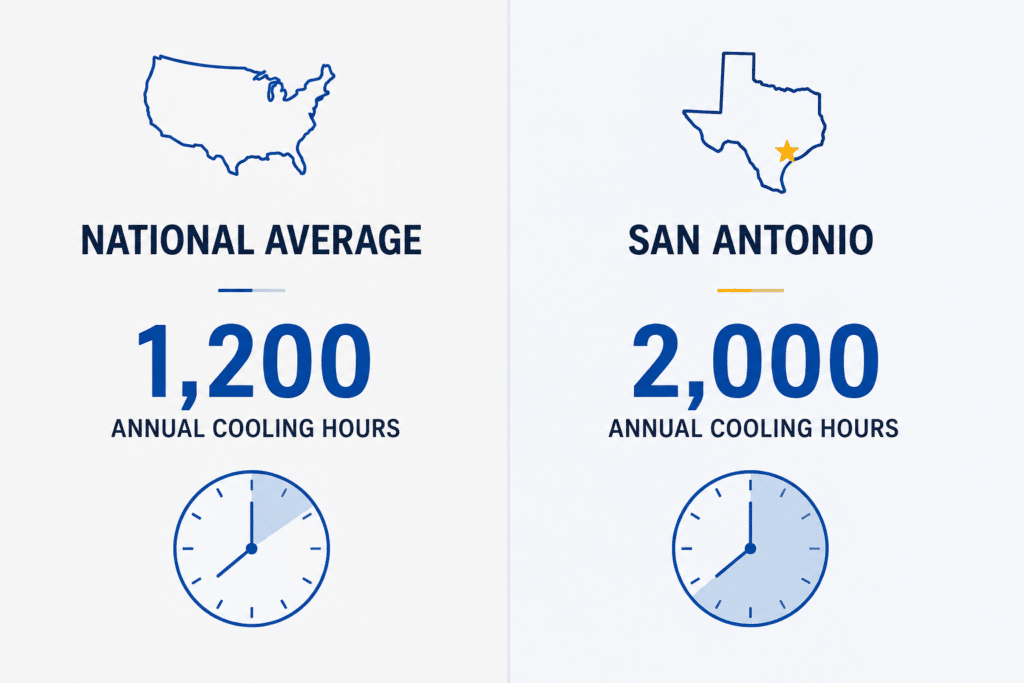
The national “once annually” standard assumes roughly 1,200 annual cooling hours. San Antonio systems run closer to 2,000.
The one-year interval holds for most homes under straightforward conditions: a system under 10 years old, no pets, no one with allergies or respiratory conditions, and ductwork in good shape. Add any one of the following conditions, and you should add a mid-season check:
- Pets with indoor access: Pet dander clogs filters and accumulates on evaporator coils faster than dust alone. A system in a two-dog household may hit the fouling threshold that degrades efficiency by mid-July — three months before the next annual visit.
- Allergy or asthma sufferers in the home: Higher air quality demand justifies more frequent filter replacement and coil inspection, independent of efficiency concerns.
- System aged 10–15 years: Capacitors, contactors, and refrigerant seals all have higher failure probability in this age range. A mid-season check catches borderline components before they fail mid-August.
- Flex duct systems: Flex duct degrades faster under high-cycle conditions. Annual inspection of the duct system is warranted alongside the AC service.
- Post-renovation or construction activity: Drywall dust and construction debris enters the duct system and loads onto evaporator coils faster than normal occupancy.
The Air Conditioning Contractors of America (ACCA) Quality Maintenance (QM) program was built specifically around the finding that the majority of residential AC systems operate below their rated efficiency — not because of age, but because of correctable maintenance deficiencies: improper refrigerant charge, restricted airflow, and fouled coils. A properly executed ACCA QM-compliant tune-up addresses all three in a single visit. Source: Air Conditioning Contractors of America (ACCA)
The 2,000-Hour Rule: Why San Antonio Changes the Maintenance Calculus
San Antonio AC systems log approximately 1,800–2,200 annual cooling hours — nearly double the 1,200-hour national average. At that runtime, you’re compressing what a northern-climate system experiences over 15 months into 12. Annual service is still the right minimum interval, but it’s a floor, not a ceiling. High-risk homes should treat mid-July as a second service trigger point.
Original Heuristic — The 2,000-Hour Rule: When a residential AC system exceeds 2,000 annual runtime hours, treat the annual tune-up interval as a minimum and add a mid-season inspection trigger at the 1,000-hour mark — roughly late June or early July in San Antonio. Below 1,500 annual hours (less common here but applies in smaller homes with newer systems), the annual-only interval is sufficient. Above 2,000 hours in a home with any of the risk factors listed above, the second visit is not optional — it’s insurance against a peak-season breakdown during the hottest week of summer. This is a field-derived rule based on observed component wear patterns in South Texas conditions, not a published ASHRAE or ACCA standard.
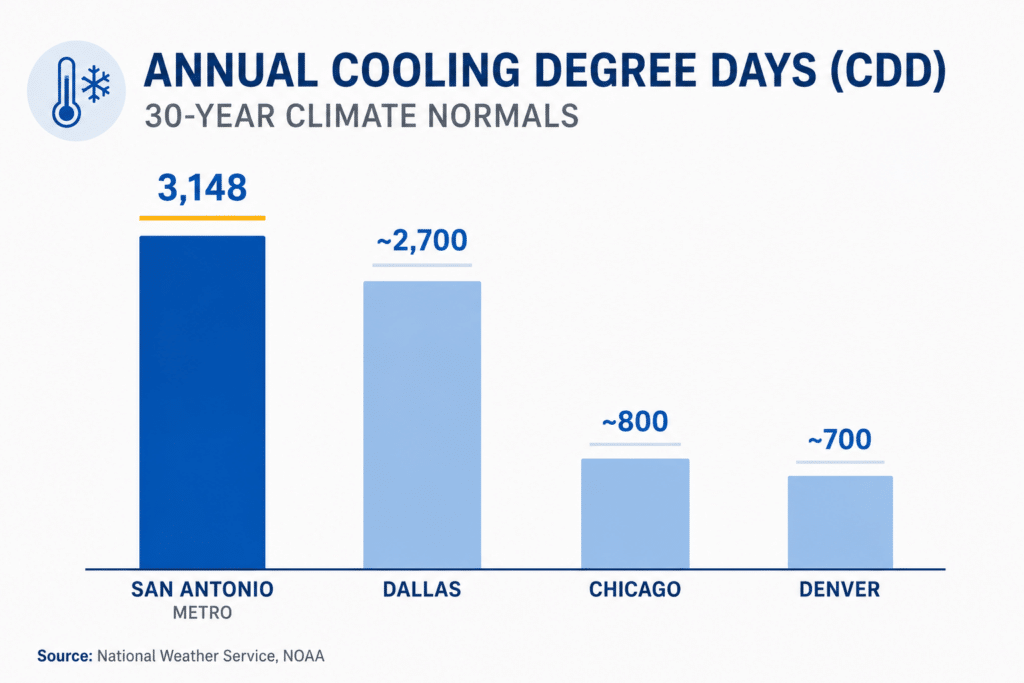
San Antonio’s National Weather Service office (EWX) records 3,148 annual cooling degree days in its 30-year climate normals — one of the highest figures of any major U.S. city. Compare that to Dallas at approximately 2,700 CDDs, Denver at around 700, or Chicago at under 800. The gap is not marginal. A system in San Antonio endures more thermal cycling per year than the same unit would in most of the country.
What this means mechanically:
- Capacitors cycle more often under load, which degrades microfarad output faster than calendar age alone predicts.
- Evaporator and condenser coils accumulate fouling at a faster rate — and South Texas dust, pollen, and humidity give debris more to stick to.
- Refrigerant seals and line connections experience more thermal expansion and contraction per year than in cooler climates.
- Contactor pitting (the electrical switch that cycles the compressor) happens faster under high-cycle conditions — and a worn contactor is among the most common causes of mid-season breakdowns.
What a Proper AC Tune-Up Actually Includes
A proper AC tune-up covers 12 documented checks — not a filter swap and a visual look-over. The four measurements that matter most: refrigerant superheat or subcooling, capacitor microfarad reading under load, compressor amp draw against nameplate spec, and supply/return temperature split. If those four values aren’t on your invoice with specific numbers, you didn’t receive a diagnostic tune-up.
The HVAC industry has diluted the definition of a “tune-up” considerably. Budget operators offer a $59 “full system inspection” that amounts to replacing the filter, hosing off the condenser, and checking that the system blows air. That’s not a tune-up. A legitimate AC tune-up is a diagnostic service that documents the current operating state of every major subsystem so you can compare it to the system’s spec — and to the readings from the previous visit.
Here is what a proper tune-up covers:
- Refrigerant superheat or subcooling measurement — confirms the system is operating within its designed charge. Requires 15+ minutes of runtime before measurement is valid. Recorded with specific values, not “refrigerant OK.”
- Capacitor microfarad reading under load — the single fastest predictor of near-term hard-start or compressor failure. A borderline capacitor looks fine at rest and fails under summer load. Must be measured under operating conditions.
- Compressor amp draw vs. nameplate rated spec — the most revealing single measurement for compressor health. A compressor drawing above its rated amperage is failing. One drawing well below is underperforming. Both warrant documentation.
- Supply/return temperature split — confirms the system is delivering its rated BTU output. Should be 15–20°F in most residential systems. A split below 10°F confirms the system is not cooling as designed.
- Condenser coil inspection and cleaning — outdoor coil fouled with dust, grass, or debris raises discharge pressure and forces the compressor to work harder. Should be cleaned with coil cleaner and rinsed, not just blown off.
- Evaporator coil inspection — indoor coil fouling restricts heat exchange from the air side. Cannot be fully cleaned without pulling the coil in many systems, but surface condition should be documented with the access panel removed.
- Blower wheel inspection and cleaning — the most commonly skipped step (covered in detail in the next section). Blower fouling reduces airflow without triggering obvious symptoms.
- Condensate drain line flush and flow test — a blocked drain causes water overflow, water damage, and system shutdown via the safety float switch. The flush should be confirmed by running water through and observing drainage, not just pouring bleach in.
- Thermostat calibration check — verifies the thermostat is reading actual room temperature accurately. A thermostat reading 2°F high makes the system short-cycle; one reading 2°F low runs it past setpoint.
- Electrical connection tightening — vibration loosens terminal connections over time. Loose connections cause resistance heating, which degrades insulation and creates fire risk at the component level.
- Contactor inspection — the high-voltage switch that cycles the compressor. Pitted or burned contacts increase start resistance and accelerate compressor wear. Should be documented as pass/fail with visual description.
- Filter replacement or confirmation of filter condition — baseline filter maintenance, documented on the invoice with the filter size and MERV rating installed.
ASHRAE research on heat exchanger fouling establishes that even a thin layer of accumulated contamination on AC coil surfaces measurably reduces heat transfer efficiency — with field data showing efficiency reductions of 20% or more from coil fouling alone. Coil contamination that builds over a San Antonio summer — accelerated by South Texas dust, pollen, and humidity — reaches the degradation threshold faster than in most U.S. climates. Source: ASHRAE (American Society of Heating, Refrigerating and Air-Conditioning Engineers)
What Most Tune-Ups Miss (And Why It Matters)
The most commonly skipped step in a residential tune-up is blower wheel cleaning. A dirty blower wheel reduces airflow without triggering any obvious symptom — the system runs, cools, and appears normal while operating below rated CFM output. It’s the highest-labor step on the checklist, which makes it the first one cut on a discounted or rushed visit.
Original Insight: Blower wheel fouling is the hidden efficiency thief in residential HVAC. Unlike a fouled condenser coil — which drives high discharge pressure that can trip a safety lockout — a dirty blower wheel degrades airflow silently. The system continues to cool (less effectively), run times grow longer (costs more), and no fault code appears. A technician checking return static pressure and comparing it to rated blower specs will catch it. A technician doing a visual walk-through will miss it entirely. This distinction is one of the clearest differentiators between a measured diagnostic service and an inspection-only visit.
Beyond the blower wheel, these are the four areas most frequently shortchanged on budget tune-ups:
- Refrigerant measured vs. estimated: “Your refrigerant looks good” is not a measurement. Refrigerant charge is confirmed by attaching gauge manifolds and recording superheat or subcooling values against the manufacturer’s specification table. A technician who didn’t attach gauges did not measure refrigerant.
- Drain line confirmed vs. treated: Pouring a bleach tablet in the drain pan is not a drain line flush. A confirmed flush involves running water through the line and observing it draining freely at the termination point — not assuming it’s clear.
- Capacitor tested under load vs. at rest: A failing capacitor often reads within acceptable range at startup, then drifts below spec under sustained load. Testing a warm, running system is the only way to catch a borderline capacitor before it fails at 4 PM on a 105°F afternoon.
- Documentation provided vs. verbal summary: Every measurement should appear on the invoice as a number — not a checkbox labeled “inspected.” An invoice without numbers isn’t a diagnostic record; it’s a receipt for showing up.
The Best Time of Year to Service Your AC in San Antonio
March and April are the optimal months for AC service in San Antonio — before peak cooling demand, before contractor schedules fill, and before emergency-rate pricing applies. The same service booked in July can cost 20–40% more and involves longer wait times. Scheduling in spring means any issues are caught before the system is needed daily, not mid-heatwave.
| Month Window | Availability | Cost Relative to Spring | Best For |
|---|---|---|---|
| January – February | High | At or below spring pricing | Best value; system prep before March warm-up |
| March – April ✓ | High (filling fast) | Standard | Optimal window — pre-season, maximum scheduling flexibility |
| May | Moderate | Standard to +10% | Acceptable; still ahead of peak demand |
| June – August | Low (peak demand) | +20–40% | Emergency and breakdown service; plan members get priority |
| September – October | High | Standard | Post-season tune-up; good for booking early next spring service |
| November – December | Very high | At or below spring pricing | Heating system service; lowest AC pricing of the year |
CPS Energy — the public utility serving San Antonio — set an all-time system demand record of 5,858 megawatts during an August 2024 heat wave. Peak-demand periods like this are when contractor availability tightens, emergency-rate premiums apply, and systems that skipped spring maintenance are most likely to fail at the worst possible moment. Source: CPS Energy
Signs You Need Service Before the Annual Visit
Four triggers warrant a mid-season service call regardless of when you last had a tune-up: energy bills up more than 15% from the same period last year, the system running longer cycles without reaching setpoint, visible ice on refrigerant lines or the air handler, and any grinding or hard-start noise during system startup or shutdown.
- Energy bills up 15%+ year-over-year: A 15% spike in the same billing period from last year, with no obvious explanation (new appliances, more occupants), almost always points to a correctable efficiency issue — fouled coil, refrigerant charge drift, or blower restriction. Not end-of-life degradation.
- Longer cycles without reaching setpoint: If the system runs for two or three hours without pulling the thermostat down to the set temperature during a typical afternoon, the system’s effective BTU output has dropped. The most common correctable causes: low refrigerant, dirty coils, or a failed refrigerant metering device.
- Ice on the refrigerant lines or air handler: Ice formation almost always indicates either low refrigerant charge or severely restricted airflow across the evaporator coil. Both are correctable. Both get worse, not better, if the system is left running.
- Hard-start or grinding noise: A struggling-to-start sound (the compressor hesitating before it kicks on) is the classic symptom of a failing capacitor. A grinding noise from the air handler suggests a blower bearing or motor issue. Both warrant a service call before a full failure — the parts are cheap; the emergency service call is not.
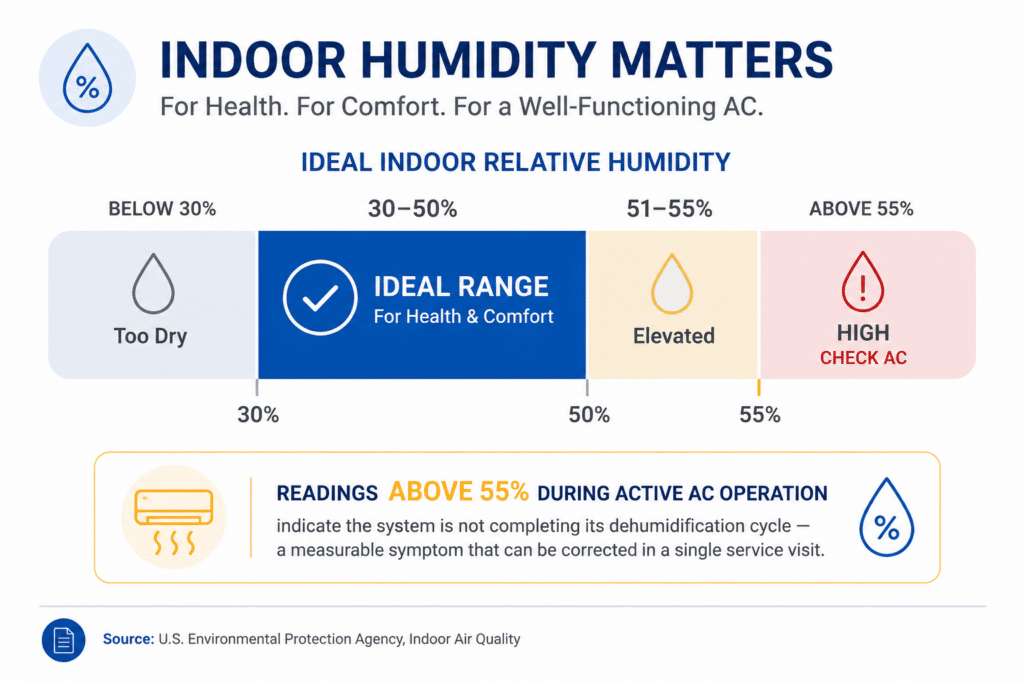
- Unusual humidity indoors during a cooling cycle: If indoor relative humidity is consistently above 55% while the AC is running, the system isn’t dehumidifying as designed. This can indicate low refrigerant (system running short cycles, not completing the dehumidification phase) or an oversized system that cools too quickly to pull moisture out of the air.
What AC Service Costs in San Antonio in 2026
A comprehensive AC tune-up in San Antonio runs $100–$200. Budget-tier visits run $75–$100 but typically skip the measured diagnostics that matter. Maintenance plan members typically pay $80–$150 per visit with priority scheduling included. The cost difference between a comprehensive tune-up and a filter-and-visual visit is $50–$100. The cost difference between catching a failing capacitor in April versus replacing a failed compressor in August is roughly $2,000.
| Service Type | Typical Cost | What’s Actually Included | Right For |
|---|---|---|---|
| Budget / promotional tune-up | $59–$99 | Filter swap, visual inspection, condenser rinse | Not recommended — lacks diagnostic value |
| Standard tune-up | $100–$150 | Core measurements + filter + coil check | Systems under 7 years with no prior issues |
| Comprehensive tune-up | $150–$250 | All 12 checklist items, documented on invoice | Systems 7+ years; homes with risk factors |
| Maintenance plan (annual) | $100–$200/yr | 1–2 comprehensive visits + priority scheduling + discounts | Best long-term value for most homeowners |
| Mid-season add-on visit | $75–$150 | Targeted follow-up on documented borderline readings | Homes flagged for mid-season follow-up |
Forbes Home’s 2026 HVAC cost analysis puts the national average AC tune-up at approximately $150, with a typical range of $75–$200 depending on scope, region, and contractor. Thumbtack’s 2026 San Antonio market data reflects a similar range locally, with comprehensive diagnostic visits trending toward the upper half of that range during peak season. Emergency service calls in summer consistently run $100–$200 more than the same service booked in spring. Sources: Forbes Home 2026; Thumbtack 2026
DIY Maintenance vs. What Requires a Pro
Three maintenance tasks are safe for homeowners to do themselves: filter replacement, clearing debris around the outdoor condenser, and checking that supply vents are open and unobstructed. Everything involving refrigerant, electrical testing, coil chemical cleaning, or blower service requires EPA certification or professional training.
| Task | DIY or Pro? | Why |
|---|---|---|
| Air filter replacement | DIY ✓ | No tools or training required; every 1–3 months |
| Clearing outdoor condenser area | DIY ✓ | Keep 2 ft clearance; remove leaves and debris |
| Checking vent openings | DIY ✓ | Ensure supply and return vents unobstructed |
| Coil cleaning (chemical) | Pro only | Improper chemicals or technique damages fins |
| Refrigerant check / recharge | Pro only (EPA 608) | Federal law requires certification to handle refrigerants |
| Capacitor / contactor testing | Pro only | 240V+ electrical; lethal if mishandled |
| Blower wheel cleaning | Pro only | Requires partial disassembly; improper reassembly causes damage |
| Drain line flush | DIY (partial) | Homeowner can pour vinegar/water monthly; full flow test requires pro |
How to Spot a Low-Quality Tune-Up (Red Flags)
A legitimate tune-up takes 60–90 minutes and produces a written invoice with specific measured values. If the technician was in and out in under 30 minutes, or the invoice shows only checkboxes labeled “inspected” with no numbers, you received a visual walk-through — not a diagnostic service.
- The visit lasted under 30 minutes. Completing all 12 checklist items — including letting the system run 15+ minutes before taking refrigerant and capacitor readings — takes 60–90 minutes minimum. A 25-minute visit, by physics, cannot include valid measured diagnostics.
- The invoice has no numbers on it. Checkboxes labeled “inspected” or “OK” are not measurements. Your invoice should show specific values: the microfarad reading, the superheat or subcooling figure, the amp draw, and the temperature split. If it doesn’t, those measurements weren’t taken.
- “Your refrigerant looks good” with no gauge reading shown. Refrigerant level is measured — not estimated visually or by feel. Ask for the superheat or subcooling value and the spec for your system. If the technician can’t provide both numbers, refrigerant was not measured.
- No blower service mentioned. Blower wheel inspection and cleaning is the most time-consuming step and the most frequently skipped. If the technician’s write-up makes no mention of the air handler blower, that step was almost certainly omitted.
- No written repair estimate before the upsell conversation. If a technician identifies a component issue and recommends replacement or a major repair, you should receive a written estimate before any work begins. Verbal estimates during a visit are not sufficient for cost-tracking or comparison.
- Urgency framing in July or August without documented data to back it. Heat creates pressure. “Your system is about to fail” in August without a specific measured value — an out-of-spec amp draw, a microfarad reading 20% below tolerance — is a prediction, not a diagnosis. Get the number before agreeing to anything.
How Honeycomb Handles AC Service in San Antonio
Honeycomb Heating & Cooling performs measurement-based AC service — not inspection-only visits. Every tune-up produces a written invoice with specific values for all four key diagnostic measurements. Here is exactly what a Honeycomb tune-up visit covers, in order:
- System startup and runtime period (15+ minutes) — the system runs under normal load before any measurements are taken. Cold readings are inaccurate. All refrigerant and capacitor measurements are taken on a warm, running system.
- Capacitor microfarad reading under load — recorded on the invoice with the nameplate spec and the measured value. Any reading more than 6% below spec is flagged for replacement discussion.
- Refrigerant superheat or subcooling measurement — gauges attached, values documented. If charge is outside spec, the technician identifies and repairs the leak source before any recharge.
- Compressor amp draw vs. nameplate spec — measured and recorded. A compressor drawing above nameplate is flagged; a compressor drawing significantly below is also documented as a performance concern.
- Supply/return temperature split — measured at the air handler and recorded. Readings outside the 15–20°F range prompt investigation of the specific cause.
- Blower wheel inspection — access panel removed, blower wheel condition documented with pass/fail and description. Cleaning performed when fouling is present and accessible.
- Condenser coil cleaning — coil treated with appropriate cleaner and rinsed. Fin condition documented.
- Drain line flush and flow confirmation — drain flushed and flow confirmed at the termination point, not assumed.
- Electrical connections, contactor, and thermostat — connections tightened, contactor inspected and documented, thermostat verified against actual room temperature.
- Written invoice with all values provided before departure — no verbal summaries, no paper left for later. You have the numbers before the technician leaves.
Frequently Asked Questions
How often should you service your AC in San Antonio?
At least once per year — ideally in March or April. Homes with pets, allergy or asthma sufferers, systems older than 10 years, or flex ductwork should add a mid-season visit in July. San Antonio’s 2,000+ annual cooling hours make the annual interval a minimum, not an ideal.
What does a proper AC tune-up include?
A proper tune-up covers 12 documented items: refrigerant superheat or subcooling, capacitor microfarad reading under load, compressor amp draw vs. nameplate, supply/return temperature split, condenser and evaporator coil inspection and cleaning, blower wheel inspection and cleaning, drain line flush and flow test, thermostat calibration, electrical connection tightening, contactor inspection, and filter replacement. Every measurement should appear on the invoice with a specific number.
How much does AC service cost in San Antonio in 2026?
A comprehensive tune-up runs $100–$250 depending on scope and contractor. Budget promotional visits run $59–$99 but typically omit the measured diagnostics. Maintenance plan memberships usually reduce per-visit cost while adding priority scheduling.
What happens if you skip AC maintenance in San Antonio?
Skipping maintenance accelerates coil fouling, refrigerant charge drift, and capacitor degradation. ACCA’s Quality Maintenance program was built around the documented finding that the majority of residential ACs already have improper charge or airflow problems — correctable deficiencies that cause systems to run 20%+ less efficiently than designed. In San Antonio’s 2,000-hour cooling season, that efficiency gap compounds faster than in most U.S. cities — and the most expensive breakdowns consistently happen to systems that skipped spring maintenance.
Is one tune-up per year enough for San Antonio’s climate?
It’s the minimum for most homes. Homes with pets, allergy sufferers, systems older than 10 years, or at-risk ductwork benefit from a second mid-season visit. San Antonio systems run roughly 2,000 annual cooling hours versus a national average closer to 1,200 — which accelerates wear on the specific components a tune-up catches: capacitors, coils, and refrigerant seals.
What is the best time of year to service your AC in San Antonio?
March and April. Contractor availability is high, pricing is at standard rates, and issues caught in spring can be resolved before the system is needed daily. The same service in July typically costs 20–40% more and involves longer wait times during the period when you need the system most.
How do I know if my AC tune-up was done correctly?
A properly performed tune-up takes 60–90 minutes and produces an invoice with specific numbers: capacitor microfarad reading, refrigerant superheat or subcooling, compressor amp draw, and temperature split. If the visit was under 30 minutes or the invoice has only checkboxes, you received a visual inspection — not a diagnostic tune-up.
Can I service my AC myself?
Three tasks are safe for homeowners: filter replacement (every 1–3 months), clearing debris around the outdoor condenser (2 ft clearance minimum), and confirming supply vents are unobstructed. Everything involving refrigerant, electrical components, coil chemical cleaning, or blower service requires EPA Section 608 certification or professional training.
Does AC maintenance actually save money?
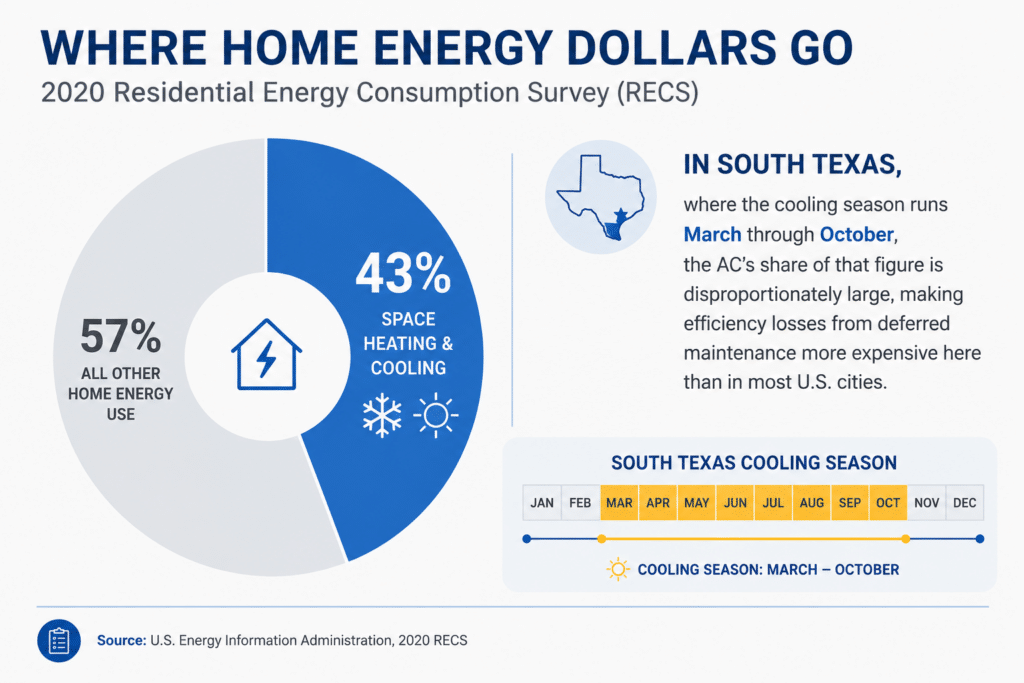
Yes — measurably. EIA’s 2020 RECS data puts space conditioning at ~43% of a typical home’s energy bill. ACCA’s Quality Maintenance research documents that correctable deficiencies — improper charge, fouled coils, restricted airflow — cause the average AC to run significantly below its rated efficiency. A $150 spring tune-up that closes a 20% efficiency gap on a system running 2,000 hours per year typically pays for itself in reduced utility costs within the same cooling season.
What’s the difference between an AC tune-up and AC repair?
A tune-up is preventive — performed on a functioning system to document its condition and correct minor deviations before they become failures. A repair is corrective — performed after a component has failed. Tune-ups reduce the frequency and cost of repairs. They don’t replace repairs, but the most expensive repairs are almost always preceded by deferred maintenance.
Need a Measured Tune-Up — Not a Visual Walk-Through?
Honeycomb Heating & Cooling performs full diagnostic AC service across San Antonio, Bulverde, Boerne, and the surrounding Hill Country — refrigerant charge verification, capacitor microfarad testing, compressor amp draw, and all measurements documented on your invoice before we leave.
Upfront Flat-Rate Pricing · Zero-Pressure Options · Background-Checked Pros · 5.0 Stars on Google (600+ Reviews)
📞 Call or Text (210) 750-6725
Brandon Caputo
Owner · Honeycomb Heating & Cooling
Brandon Caputo founded Honeycomb Heating & Cooling to bring system-driven reliability and customer-first transparency to the San Antonio HVAC market. Grounded in the principle of proactive, preventative care rather than reactive crisis management, Honeycomb specializes in high-efficiency AC and heating installations, advanced diagnostic repairs, and localized indoor air quality solutions. Brandon infuses empathy into every service call, ensuring his team actively listens to homeowners to deliver clear, value-based comfort solutions.
About Honeycomb Heating & Cooling
San Antonio’s trusted specialist in residential air conditioning installation, swift repairs, and energy-saving preventative maintenance. Founded with a commitment to upfront flat-rate pricing and reliable home comfort.
600+ Completed Projects · 5.00-star Google Rating · Open 24/7 for Emergency Support · Founded by Brandon Caputo.
- Upfront Flat-Rate Pricing—No Hidden Fees
- Zero-Pressure Repair & System Options
- Background-Checked & Certified Technicians
- Amana Authorized Elite Partner
- Goodman High-Efficiency System Specialists
- Comprehensive “Comfy Club” Maintenance Programs
- 600+ 5-Star Reviews Across San Antonio
- Fully Licensed & Insured · Texas
- Free estimates & online booking
- Zero Interest with No Monthly Payment financing available
- Office Address: 26995 US Highway 281 Suite C, San Antonio, TX 78260
Sources & Citations
- Air Conditioning Contractors of America (ACCA). (2026). ACCA Quality Maintenance (QM) Program: What a Proper HVAC Tune-Up Includes. https://www.acca.org/technical/quality-assurance/quality-maintenance
- ASHRAE (American Society of Heating, Refrigerating and Air-Conditioning Engineers). (2026). ASHRAE Journal: Heat Exchanger Fouling and HVAC System Efficiency. https://www.ashrae.org/technical-resources/ashrae-journal
- Bob Vila. (2026). AC Tune-Up Cost: What to Expect and How Much It Costs. https://www.bobvila.com/articles/ac-tune-up-cost/
- CPS Energy. (2024). CPS Energy Sets New All-Time Peak Demand Record. https://www.cpsenergy.com/en/about-us/news/news-releases.html
- ENERGY STAR. (2026). Central Air Conditioning: Maintenance Tips to Maximize Efficiency. https://www.energystar.gov/products/heating_cooling/central_air_conditioning
- Forbes Home. (2026). How Much Does an AC Tune-Up Cost in 2026? https://www.forbes.com/home-improvement/hvac/ac-tune-up-cost/
- National Weather Service, Austin/San Antonio Forecast Office (EWX). (2026). San Antonio Monthly Climate Normals. NOAA. https://www.weather.gov/media/ewx/climate/SATmonthlynormals.pdf
- NATE (North American Technician Excellence). (2026). Why Hire a NATE-Certified HVAC Technician? https://www.natex.org/consumers/find-a-nate-certified-technician/
- Texas Department of Licensing and Regulation (TDLR). (2026). Air Conditioning and Refrigeration Contractor Licensing. https://www.tdlr.texas.gov/air/airlaw.htm
- Thumbtack. (2026). Average Cost of AC Maintenance and Tune-Up. https://www.thumbtack.com/p/ac-tune-up-cost
- U.S. Energy Information Administration (EIA). (2020). 2020 Residential Energy Consumption Survey (RECS): Energy Consumption and Expenditures by End Use. https://www.eia.gov/consumption/residential/
- U.S. Environmental Protection Agency, Indoor Air Quality. (2026). Moisture Control and Indoor Humidity Guidance. https://www.epa.gov/mold/moisture-control
- U.S. Environmental Protection Agency, Section 608. (2026). Section 608 Technician Certification — Refrigerant Handling Requirements. https://www.epa.gov/section608


