



 (726) 233-6044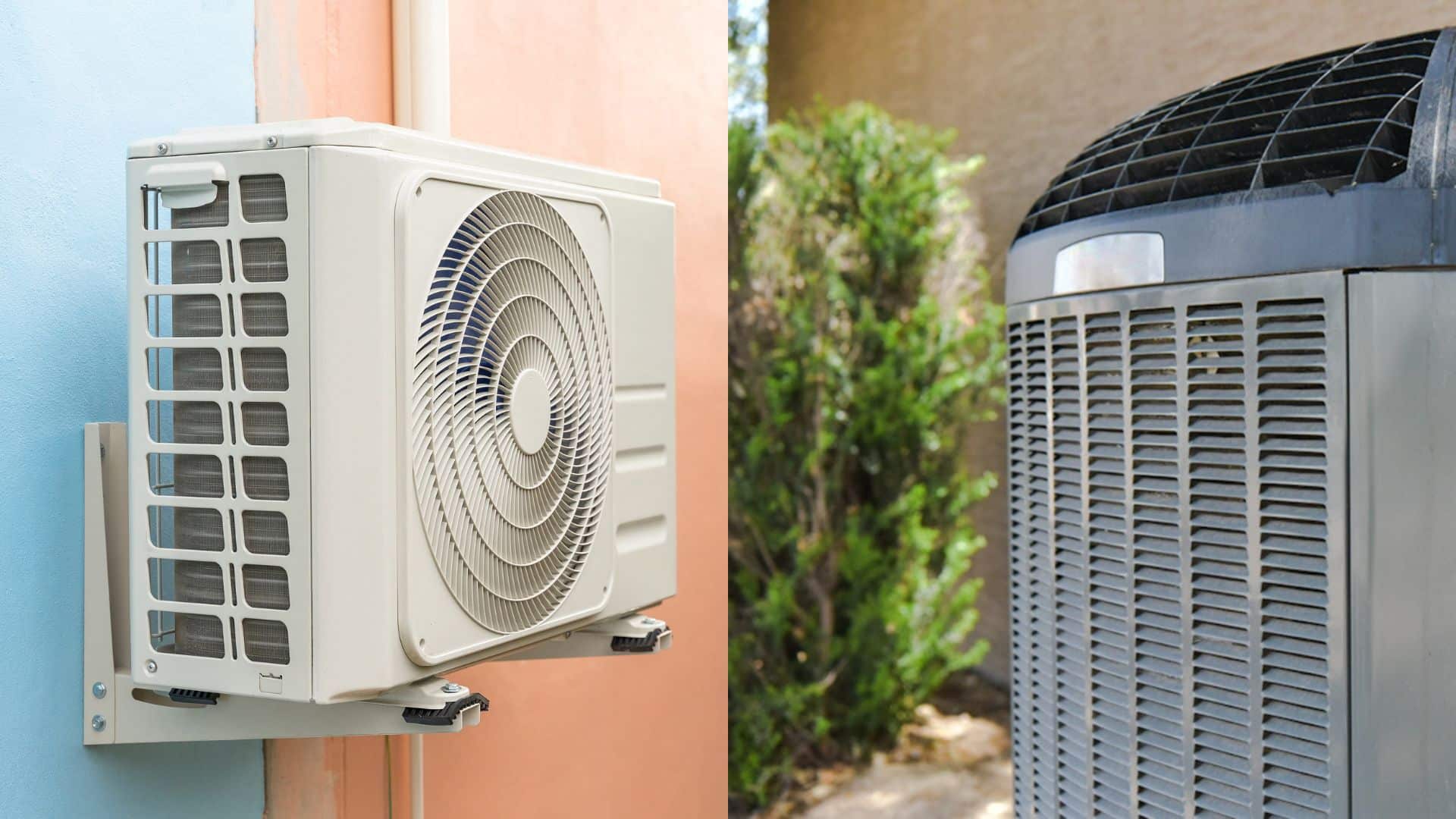
QUICK REVIEW
For most historic Boerne homes, a ductless mini-split is the better AC upgrade. It cools effectively without the invasive ductwork that damages original plaster, limestone walls, and period woodwork. Central air only wins when usable ducts already exist or a full renovation is already underway.
At a glance:
- Choose ductless mini-splits if your home has no ducts, thick masonry walls, or rooms you want to zone individually.
- Choose central air if you already have sound ductwork or you’re gutting the home anyway.
- Either way, sizing matters more than brand—an oversized system short-cycles and never controls Boerne’s summer humidity.
Both options qualify as a comfort and efficiency upgrade. If you’re weighing a full system swap, our team handles AC replacement Boerne projects in both historic and new construction across the Hill Country.
Why Historic Boerne Homes Need a Different AC Approach
Historic Boerne homes need a tailored AC strategy because their solid limestone and plaster construction leaves little room for ductwork, and Boerne’s humid-subtropical heat puts heavy cooling demand on the system. Retrofitting ducts into these walls often means tearing into irreplaceable 19th-century materials—a cost most owners don’t want to pay.
94°F
Boerne sits in the Texas Hill Country and has a humid subtropical climate: August averages a high of 94°F. That’s a long, humid cooling season, and homes settled by 1800s German immigrants were built for thermal mass and shade, not for ducted central air.
Source: City of Boerne
The preservation challenges that shape the decision:
- Thick masonry & plaster walls have no stud cavities to run ducts through.
- Original woodwork, trim, and flooring are easily damaged by chases and soffits.
- Limited attic and crawlspace clearance in older floor plans restricts duct routing.
- Historic district guidelines may limit exterior changes, so equipment placement matters.
The instinct to “just add central air” usually backfires here. In Boerne’s older housing stock, the ductwork, not the equipment, is the expensive, destructive part of the project. Solve the duct problem first, and the right system choice becomes obvious.
Ductless Mini-Splits: How They Work and Why They Fit Older Homes
A ductless mini-split pairs an outdoor compressor with one or more wall- or ceiling-mounted indoor units, delivering cooled air directly into each room through a 3-inch wall penetration—no ducts required. That makes it the least invasive way to add modern AC to a home that was never designed for it.
The efficiency case is strong. The U.S. Department of Energy notes that a typical duct system loses 20–30% of conditioned air to leaks, holes, and poor connections, and losses can exceed 30% when ducts run through hot, unconditioned attics. Mini-splits eliminate that loss because there are no ducts. Top-tier ductless units reach well above 30 SEER2, versus roughly 15–25 SEER2 for ducted systems.
Source: Department of Energy
Why they suit historic Boerne homes:
- Minimal structural impact — one small wall penetration per indoor unit.
- True room-by-room zoning — cool the rooms you use, skip the ones you don’t.
- Excellent humidity control — variable-speed compressors run low and long, wringing out moisture during Boerne’s sticky summers.
- Quiet operation that preserves the calm of an older home.
The trade-off is visual: indoor heads are visible on the wall, which some owners of period interiors dislike. Ceiling-cassette and low-wall units soften that, but it’s the honest downside.
Central Air Conditioning: When It Still Makes Sense
Central air is the better choice when your historic home already has sound, properly sized ductwork, or when you’re mid-renovation, and the walls are already open. In those cases, central air delivers even, whole-home cooling from a single thermostat and keeps all equipment out of sight.
It’s also worth remembering that central air is what buyers expect. According to the newly released U.S. EIA RECS dataset, air conditioning is now standard in up to 90% of U.S. households, but the extreme cost of cooling in hot-humid regions has pushed one-third (33%) of all families into severe energy insecurity, so an efficient central system can be a strong resale signal in a market full of move-in-ready listings.
Source: U.S. EIA RECS
Central air makes sense when:
- Usable ductwork already exists and only needs sealing or minor modification.
- A full renovation is underway, so duct chases can be hidden during construction.
- You want zero visible indoor equipment and uniform whole-home temperatures.
- The home is large enough that many mini-split heads would be needed anyway.
The catch: if ducts have to be retrofitted into solid walls, central air becomes the most expensive and most destructive path—the exact scenario most Boerne historic homes fall into.
Ductless Mini-Splits vs. Central Air: Side-by-Side Comparison
Mini-splits win on installation disruption, zoning, and efficiency in homes without ducts; central air wins on whole-home uniformity and hidden equipment when ducts already exist. The table below summarizes the trade-offs for a typical historic Boerne home.
| Factor | Ductless Mini-Split | Central Air |
|---|---|---|
| Best for | Homes with no/unusable ducts, masonry walls | Homes with existing sound ductwork |
| Install disruption | Low — small wall penetrations | High if ducts must be retrofitted |
| Efficiency (SEER2) | Up to 30+ SEER2; no duct loss | ~15–25 SEER2; loses 20–30% to ducts |
| Zoning | Room-by-room standard | Whole-home; zoning costs extra |
| Humidity control | Excellent (variable-speed) | Good, depends on sizing |
| Visible indoor equipment | Yes — wall/ceiling heads | No — vents only |
| Typical installed cost | ~$3,000–$12,000 (single to multi-zone) | ~$4,500–$12,000 (plus ductwork if needed) |
| Expected lifespan | ~20 years | ~15–20 years |
Cost ranges: Angi, EnergySage. SEER2/duct-loss figures: DOE. Lifespan: central air ~15–20 years (DOE); ductless mini-splits ~20 years (Carrier).
Cost Comparison for the Boerne Area
Expect roughly $3,000–$12,000 installed for a ductless mini-split and $4,500–$12,000 for central air, but if a historic home needs new ductwork, central air can cost the most of any option. The hidden variable is always the ductwork, not the equipment.
National installed-cost benchmarks for 2025–2026:
- Central AC: national average about $5,860, typically $3,500–$7,000 (Angi).
- Single-zone mini-split: roughly $500–$5,000 installed (Angi).
- Multi-zone mini-split: roughly $1,400–$12,000 depending on the number of indoor heads (Angi).
One important 2026 update on incentives: the federal 25C Energy Efficient Home Improvement Credit, worth 30% of cost up to $2,000 on qualifying heat-pump systems, expired December 31, 2025. Systems installed by that date can still be claimed on a 2025 return, but new 2026 installs no longer qualify for that federal credit. Check current utility and state rebates before you buy.
Source: ENERGY STAR
Efficiency and Energy Savings in a Boerne Summer
In a long, humid Boerne cooling season, eliminating duct losses is the single biggest efficiency lever, which is why ductless systems often outperform central air in older homes. Cooling already accounts for about 19% of all electricity used in U.S. homes, so cutting waste pays off fast here.
Source: U.S. EIA
The math is direct: the DOE attributes 20–30% of conditioned-air loss to ductwork in a typical home, as mentioned previously. Run a central system through a hot attic, and you can pay to cool air that never reaches the room. A ductless system skips that loss entirely.
Whatever you install, mind the standard. Since January 1, 2023, split-system ACs in the southern region (including Texas) must meet a minimum of 14.3 SEER2 for units under 45,000 BTU. A right-sized, high-SEER2 system controls humidity better than an oversized one—critical when Boerne hits 70%+ humidity in late spring.
What We See Installing AC in Historic Boerne Homes
From our field work across Boerne’s historic district and the surrounding Hill Country, the homes that struggle most are those where someone forced ducts into solid walls or oversized the equipment to “cool faster.” Neither works in 1800s construction.
A few patterns we see repeatedly on older Boerne homes:
- Oversized units short-cycle—they hit temperature fast but never run long enough to pull humidity, leaving rooms cold and clammy.
- Mini-split heads placed for airflow, not just convenience, cool dramatically more evenly in homes with closed-off period floor plans.
- Sealing what little duct exists often recovers more comfort per dollar than upsizing the condenser.
Many of the pre-1950 Boerne homes we assess have no duct pathway worth saving, which tips the recommendation toward ductless more often than not. That matches the national picture: pre-1950 homes were built with plaster-and-lath walls and no provisions for ductwork, and older housing stock still trails newer homes in air-conditioning adoption.
Source: U.S. EIA, 2020 RECS
How to Choose: A 5-Step Decision Guide
To decide between ductless and central air, work from your home’s ducts and walls first, then your budget and resale goals. Follow these steps in order:
- Inspect existing ductwork. Sound, properly sized ducts? Central air is viable. None or unusable? Lean ductless.
- Assess wall construction. Solid limestone/plaster with no chases strongly favors ductless.
- Map your usage. Cool only certain rooms? Zoning makes ductless cheaper to run.
- Get a load calculation (Manual J). Proper sizing, not bigger, controls Boerne humidity.
- Compare total installed cost, including any ductwork, not just equipment price.
If the answer points to a full system swap, a licensed local contractor should run the load calculation and preservation assessment together. Our team handles AC replacement Boerne projects with both historic-home care and Hill Country climate sizing in mind.

Keep Your Historic Boerne Home Cool and Protected
Whether you want to preserve your home’s 19th-century craftsmanship with a low-profile mini-split or completely overhaul an old ducted system, getting an AC replacement Boerne project done right requires a team that understands local architectural history.
Honeycomb Heating & Cooling specializes in Hill Country climate sizing and historic home preservation. We offer free in-home installation and replacement consultations, comprehensive structural assessments, and flexible payment plans to fit your project.
Book Your Free Consultation
Or Call Us via (210) 750-6725
Same-day service | Licensed #TACLA140435E
Frequently Asked Questions
Are ductless mini-splits good for historic homes?
Yes, ductless mini-splits are often the best AC option for historic homes because they need only a small wall penetration instead of full ductwork. That preserves original plaster, masonry, and woodwork while still delivering modern, efficient, room-by-room cooling.
Is central air or a mini-split cheaper for a Boerne home?
It depends on ductwork. Central air averages about $5,860 installed, and single-zone mini-splits run roughly $500–$5,000. But if a historic home needs new ducts cut into solid walls, central air usually becomes the most expensive option overall.
How much energy do ducts waste?
The U.S. Department of Energy estimates that 20–30% of the air moving through a typical duct system is lost to leaks, holes, and poor connections, and more in hot attics. Ductless mini-splits avoid this loss entirely because they have no ducts.
Do mini-splits still qualify for a federal tax credit in 2026?
No. he federal 25C Energy Efficient Home Improvement Credit expired December 31, 2025. Qualifying systems installed by that date can still be claimed on a 2025 tax return, but 2026 installs no longer qualify for that federal credit. State and utility rebates may still apply, so check locally.
What SEER2 rating do I need for an AC in Texas?
Texas falls in the southern region, where split-system ACs under 45,000 BTU must meet at least 14.3 SEER2 (effective January 1, 2023). Higher SEER2 ratings cut operating cost and improve humidity control during Boerne’s long cooling season.
Sources & References
- Angi. (2024, May 15). How much does it cost to install a ductless mini-split air conditioner? https://www.angi.com/articles/how-much-does-it-cost-install-ductless-mini-split-ac.htm
- Angi. (2024, May 22). How much does installing a new air conditioner cost? https://www.angi.com/articles/how-much-does-installing-new-ac-cost.htm
- Carrier. (n.d.). How long do mini-splits last? https://www.carrier.com/residential/en/us/products/ductless-mini-splits/mini-split-maintenance/how-long-do-mini-splits-last/
- City of Boerne. (n.d.). Climate and demographics. https://www.ci.boerne.tx.us/2101/Climate-and-Demographics
- EnergySage. (2024, February 21). How much does a mini-split cost? https://www.energysage.com/heat-pumps/how-much-does-a-mini-split-cost/
- U.S. Department of Energy. (n.d.-a). Central air conditioning. Energy Saver. https://www.energy.gov/energysaver/central-air-conditioning
- U.S. Department of Energy. (n.d.-b). Ductless mini-split air conditioners. Energy Saver. https://www.energy.gov/energysaver/ductless-mini-split-air-conditioners
- U.S. Energy Information Administration. (2022, June 14). More than half of U.S. households use central air conditioning. Today in Energy. https://www.eia.gov/todayinenergy/detail.php?id=52558
- U.S. Energy Information Administration. (2024). Residential Energy Consumption Survey (RECS): 2024 housing characteristics data. https://www.eia.gov/consumption/residential/data/2024/index.php?view=characteristics#household
- U.S. Energy Information Administration. (n.d.). How much energy is used for cooling in U.S. residential buildings? https://www.eia.gov/tools/faqs/faq.php?id=1174&t=1
- U.S. Environmental Protection Agency & U.S. Department of Energy. (n.d.). Air-source heat pumps. Energy Star. https://www.energystar.gov/about/federal-tax-credits/air-source-heat-pumps


