



 (726) 233-6044
QUICK REVIEW
- Average Cost: Expect $9,000–$11,000 for most homes; prices are up ~15% due to new 2025 federal mandates.
- New Standards: All new systems now use R-454B refrigerant and must meet a minimum 14.3 SEER2 efficiency rating.
- Sizing & Comfort: Demand a Manual J calculation; oversized units cool too fast, leaving Boerne homes humid and “clammy.”
- Available Incentives: Combine CPS Energy rebates with Federal Tax Credits (up to $2,000) to lower upfront costs.
- Best Timing: Install during shoulder seasons (Spring/Fall) for better rates and more precise technician labor.
- Boerne Essentials: Prioritize surge protection for Hill Country storms and elevated pads for local flood zones.
If you’re searching for an AC installation in Boerne, you’re either staring at a dead 12-year-old condenser in 100°F heat, or you’re being smart and planning a replacement before the next system fails. Either way, the rules of buying a new AC in 2026 are not the same as they were in 2023. New refrigerants, new federal efficiency standards, new tax credits, and Hill Country soil conditions all matter, and most homeowners only learn this after the install goes sideways.
How Much Does AC Installation Cost in Boerne, TX in 2026
A new central AC installation in Boerne, Texas, costs between $6,500 and $14,500 in 2026, with most homeowners spending around $9,000-$11,000 for a properly sized 3- to 4-ton system. Costs are 10-18% higher than 2023 figures due to the federally mandated transition from R-410A to R-454B refrigerant, which began January 1, 2025.
The final price depends on six variables: system tonnage, SEER2 rating, refrigerant type, ductwork condition, electrical upgrades, and whether the indoor coil and air handler are also being replaced (they almost always should be).
| Installation Type | Typical 2026 Cost (Boerne) | Notes |
|---|---|---|
| 2-ton split system, 14.3 SEER2 (R-454B) | $6,500-$8,500 | Smaller homes (under 1,400 sq ft) |
| 3-ton split system, 15.2 SEER2 (R-454B) | $8,500-$11,000 | Most common Boerne home size |
| 4-ton split system, 16+ SEER2 (R-454B) | $11,000-$14,500 | Larger homes, higher efficiency |
| Heat pump conversion (3-ton) | $10,500-$15,000 | Eligible for federal tax credit up to $2,000 |
| Ductless mini-split (single zone) | $4,500-$7,500 | Per zone; great for additions/garages |
| Full ductwork replacement (add-on) | $3,500-$9,000 | Often needed in pre-2000 Hill Country homes |
Pricing reflects Boerne and northwest San Antonio market rates as of Q2 2026 and includes equipment, labor, refrigerant, basic electrical, permits, and standard warranty. Prices vary by contractor.
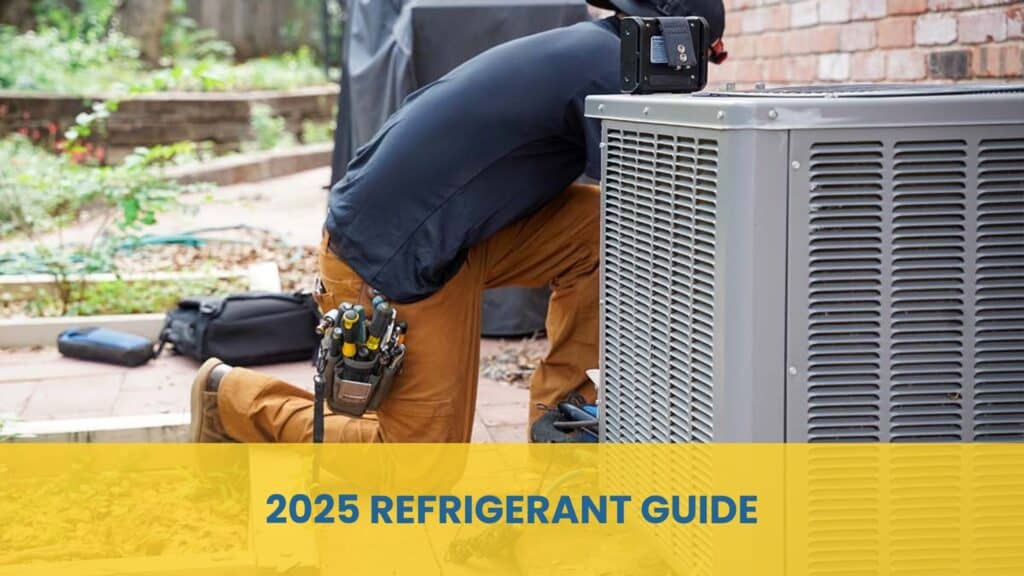
The 2025 R-454B Refrigerant Transition: What Every Boerne Homeowner Needs to Know
As of January 1, 2025, U.S. manufacturers can no longer produce new residential AC systems that use R-410A refrigerant. Under the Environmental Protection Agency (EPA)’s American Innovation and Manufacturing (AIM) Act of 2020, all new systems must use a low-GWP A2L refrigerant, most commonly R-454B. This affects every Boerne homeowner installing a new AC in 2026.
Here’s what this means in practice:
- You cannot buy a new R-410A system anymore. Existing R-410A inventory was largely cleared by mid-2025. Any new R-410A unit being sold today is either old stock or a misrepresentation.
- R-454B is mildly flammable (A2L classification). This is safe when handled correctly, but installation requires updated leak-detection sensors, line set materials, and technician certification. Not every Boerne contractor has caught up.
- You can still service an existing R-410A system with reclaimed or stockpiled R-410A refrigerant, but supply will tighten, and prices will climb the same way R-22 did from 2020 onward.
- Mixing refrigerants is illegal and dangerous. If your old system was R-410A, you cannot simply drop in R-454B. The compressor, expansion valve, and often the entire indoor coil must be replaced.
According to the EPA, the AIM Act requires an 85% phasedown of HFC production and consumption by 2036, with R-454B and similar A2L refrigerants having a global warming potential roughly 78% lower than R-410A.
Source: EPA
Why “Bigger Isn’t Better”
— The Manual J Sizing Problem in Hill Country Homes
The single biggest mistake in residential AC installation is oversizing. An AC that’s too large for a Boerne home will short-cycle, fail to remove humidity, wear out its compressor years early, and leave you with hot/cold spots even though the thermostat reads 72°F. Proper sizing requires an ACCA Manual J load calculation, and most installers skip it.
The “rule of thumb” most contractors still use, 1 ton of AC per 500-600 square feet, was developed for 1970s housing stock with R-11 insulation and single-pane windows. A modern Boerne home with 2×6 walls, radiant barrier sheathing, and Low-E windows often needs 30-40% less tonnage than the rule of thumb suggests.
65%+
According to the U.S. Department of Energy’s Center for Manufacturing Efficiency & Innovation, more than 65% of residential HVAC systems have been improperly installed, causing equipment to consume 20-30% more energy than necessary and wasting up to 1.6 quadrillion BTU annually. A National Renewable Energy Laboratory field study separately documented a 9% increase in annual cooling electricity use for systems oversized by 50% or more.
Sources: U.S. Department of Energy
Why this matters specifically in Boerne: our summers combine high outdoor temperatures with intermittent spikes in humidity from Gulf moisture surges. An oversized AC cools the air to the setpoint in 5 minutes and shuts off before it has run long enough to dehumidify the space. The result is a 72°F house that feels clammy at 65% relative humidity. A properly sized system runs longer cycles, pulls moisture out, and feels noticeably more comfortable at the same thermostat setting.
What to demand from your installer:
- A written Manual J load calculation based on your home’s actual square footage, insulation, window orientation, and infiltration rate.
- A Manual S equipment selection for the chosen unit matches the load.
- A Manual D duct design if any ductwork is being modified or replaced.
If a contractor refuses or says “we don’t do that,” they are guessing with your $10,000.
SEER2 vs SEER: Understanding 2026 Efficiency Ratings
Since January 1, 2023, all new residential AC systems are rated using SEER2 instead of the old SEER scale. The new test conditions are tougher (more realistic static pressure), so a SEER2 number is roughly 4.5% lower than the equivalent SEER rating. In the federal South region, which includes all of Texas, the minimum legal efficiency for a new split-system AC installed in 2026 is 14.3 SEER2 (about 15 SEER).
Here’s how SEER2 ratings translate to real-world Boerne energy use:
| SEER2 Rating | Equivalent SEER | Estimated Annual Cooling Cost (3-ton, Boerne) | Best For |
|---|---|---|---|
| 14.3 SEER2 | ~15 SEER | $1,250-$1,400 | Tight budgets, short-term ownership |
| 15.2 SEER2 | ~16 SEER | $1,150-$1,300 | Most homeowners best value |
| 16.0 SEER2 | ~17 SEER | $1,050-$1,200 | 10+ year ownership, eligible for tax credit |
| 17.0+ SEER2 (variable speed) | ~18+ SEER | $900-$1,100 | High-end comfort, humidity control priority |
Annual cost estimates assume CPS Energy’s 2026 average residential rate of $0.12/kWh and ~1,296 cooling hours per year.
Source: NuWatt Energy
The Best Time to Install a New AC in the Texas Hill Country
The best time to install a new AC in Boerne is March-April or October-November, the shoulder seasons. During these windows, contractor availability is high, scheduling is flexible, manufacturers run promotions, and your installer can take the time to do a proper Manual J sizing and quality install rather than racing to the next emergency call.
Installing in mid-July is the worst-case scenario for three reasons:
- Lead times stretch from 2 days to 2+ weeks. Reputable Boerne contractors are booked solid by Memorial Day.
- Quality drops. A 14-hour summer workday in a 130°F attic produces installation mistakes sloppy braze joints, missed leak checks, and rushed commissioning.
- You pay a premium. Emergency replacements cost 8-15% more than planned installs.
From the field: in 2024 we installed a 4-ton variable-speed system in a Fair Oaks Ranch home in late October. Total job time: 6 hours, full Manual J done in advance, ducts inspected and resealed, customer in their finished install before lunchtime the next day. The same job in July would have been a 9-hour rush with at least one corner cut. Time of year is one of the few things you fully control as a homeowner.
CPS Energy Rebates and Federal Tax Credits for Boerne AC Installations
Boerne homeowners can stack two major incentive programs in 2026: CPS Energy SaveNow rebates (for service-territory residents) and the federal 25C Energy Efficient Home Improvement Tax Credit. Combined, these programs can reduce a qualifying high-efficiency installation by $1,200-$3,000+.
CPS Energy SaveNow Residential Rebates
If your home is on CPS Energy service (most of Boerne and the surrounding Kendall County corridor is), the SaveNow program offers per-ton rebates for qualifying high-efficiency central AC, heat pump, and ductless mini-split installations. As of 2026:
- Central AC (16+ SEER2): approximately $200-$400 per ton
- Heat pumps (15.2+ SEER2 / 8.5+ HSPF2): approximately $300-$500 per ton
- Ductless mini-splits: approximately $250-$450 per ton
Equipment must be installed by a licensed Texas contractor. Existing equipment must be under 25 years old (20 for heat pumps); and city of San Antonio permits are required where applicable. Rebate amounts and eligibility refresh annually; verify current figures at the CPS Energy SaveNow portal.
Federal 25C Tax Credit (Inflation Reduction Act)
Under the 25C Energy Efficient Home Improvement Credit, homeowners can claim 30% of qualifying equipment and installation costs up to annual caps:
- $600/year for a qualifying central AC (must meet ENERGY STAR Most Efficient standards)
- $2,000/year for a qualifying heat pump
According to IRS data on 2023 tax-year returns processed through May 2024, approximately 3.4 million U.S. households claimed at least one of two tax breaks, one of which is the Energy Efficient Home Improvement Credit, with an average credit of $882 per household, and a combined $8.4 billion in Inflation Reduction Act home energy credits claimed for that single tax year.
Source: CNBC
How to Choose an AC Installation Contractor in Boerne
The right Boerne AC installer holds a current TACL license from the Texas Department of Licensing and Regulation, performs a written Manual J load calculation before quoting equipment, pulls required permits, and provides itemized pricing in writing. Skipping any of these four is the most common cause of a bad installation.
Use this six-point checklist before signing any contract:
- Verify the TACL license number at tdlr.texas.gov. Texas requires licensure for all HVAC contractors. Unlicensed work voids your manufacturer warranty and is illegal.
- Demand a written Manual J load calculation with the proposal. If they balk, walk.
- Confirm A2L (R-454B) certification. The technician installing your system should be trained on A2L refrigerant handling per the latest EPA Section 608 guidance.
- Get an itemized written estimate showing equipment model numbers, line set length, refrigerant type, electrical work, permit fees, and warranty terms. Verbal estimates are not binding in Texas.
- Ask about the labor warranty. Industry standard is 1-2 years on labor; the best Boerne contractors offer 5-10 years on installations.
- Check Google reviews for recency. A company with 500+ reviews averaging 4.8+ over multiple years is a stronger signal than a flood of recent 5-stars.
70-90%
Research published by the American Council for an Energy-Efficient Economy (ACEEE) found that 70-90% of residential HVAC systems have at least one performance-compromising fault from improper installation or insufficient maintenance, climbing to 90-100% when duct leakage is included. The contractor you choose has more impact on long-term performance than the brand of equipment.
Source: ACEEE
Honeycomb Heating & Cooling holds TACL license #TACLA140435E, performs Manual J calculations on every replacement quote, is fully A2L-certified for R-454B installations, and maintains a 5.0-star Google rating across 500+ reviews.
Boerne-Specific Installation Considerations Most Contractors Miss
Hill Country homes have installation quirks that contractors trained in flat South Texas often overlook. Limestone soils, cedar pollen loads, propane-tank-fed properties, and rapid storm-driven voltage spikes all change how a quality install should be specified in Boerne specifically.
Limestone & Caliche Soils
Trenching for a new line set or condensate drain on a Hill Country property often hits caliche or solid limestone within 12 inches. This affects line-set routing, pad placement, and condensate drainage strategy. Insist your installer either trenches properly or specifies an above-ground line set with UV-protected insulation.
Cedar & Oak Pollen Load
Boerne’s heavy cedar and live oak pollen seasons (December-March) clog condenser coils and air filters faster than urban San Antonio. Specify a unit with easily accessible coil grilles for cleaning, and budget for filter changes every 30-45 days during peak pollen.
Whole-Home Surge Protection
Hill Country thunderstorms cause voltage spikes that destroy capacitors and control boards. The roughly $300-$500 cost of a whole-home surge protector at the panel has prevented many $1,200+ control board failures we’ve seen in Boerne, Bulverde, and Fair Oaks Ranch homes. This is the single highest-ROI add-on we recommend at install.
Pad Elevation for Flash-Flood Zones
Properties near Cibolo Creek, Frederick Creek, or low-lying Tapatio Springs lots should have condensers installed on raised pads (4-8 inches above grade minimum) to survive heavy rain events. We’ve replaced multiple condensers in 2024 alone that drowned because they were set at grade.
What a Professional AC Installation Actually Looks Like (Step-by-Step)
A complete, code-compliant residential AC installation in Boerne should take a qualified two-person crew 6-10 hours for a like-for-like replacement, or 1.5-2 days if ductwork or electrical upgrades are involved. Anything significantly faster is cutting corners.
Here’s what you should see on install day:
- Site protection — as drop cloths, shoe covers, and attic walkboards.
- EPA-compliant refrigerant recovery from the old system. (Releasing refrigerant is a federal violation.)
- Removal and disposal of the old condenser, air handler, and indoor coil.
- Inspection of existing line set — replace if the old system was R-22 or if the line set is undersized for the new equipment.
- New equipment placement — pad leveled, condenser set with proper service clearances.
- Brazing line-set joints under nitrogen flow to prevent oxidation inside the lines.
- Triple evacuation to 500 microns verifies the system is dry and leak-free before charging.
- Refrigerant charge by weight per manufacturer specification, not “by feel.”
- Electrical and disconnect inspection, breaker sized to nameplate, surge protection installed if specified.
- Commissioning & static pressure measurement verify airflow, superheat, subcooling, and that the system is delivering rated capacity.
- Permit closeout and final walkthrough with the homeowner.
If your contractor skips steps 6, 7, or 10, the system will limp along but never deliver its rated efficiency.
Repair vs. Replace: When New Installation Makes More Sense
In 2026, the calculus has shifted toward replacement for Boerne homeowners with 10+ year-old systems. The R-454B transition makes major R-410A repairs (compressor, coil, full recharge) significantly more expensive than they were in 2023, while new-install costs have only risen modestly. The traditional “50% rule” still applies, but the threshold tips toward replacement faster now.
Lean toward a new installation if:
- Your system is 10+ years old and the major repair quote exceeds $1,500.
- Your system uses R-22 refrigerant (any unit installed before ~2010).
- You’ve had two or more major repairs in the past 24 months.
- Your current system is SEER 12 or below. A new 16 SEER2 will pay back the upgrade premium in 4-7 years through lower bills.
- You’re noticing humidity issues, hot/cold spots, or rising bills alongside age.
Facing the Texas Heat Together
Whether you’re planning a strategic shoulder-season upgrade or replacing a system that finally gave out, getting an AC installation Boerne done right means working with a contractor who does the math, pulls the permits, and stands behind the work.
Honeycomb Heating & Cooling offers free in-home installation consultations, written Manual J load calculations, A2L-certified R-454B installs, and zero-interest financing for qualifying customers.
Book Your Free Consultation
Or Call Us via (210) 750-6725
Same-day service | Licensed #TACLA140435E
Frequently Asked QuestionS
How long does a new AC installation take in Boerne?
A standard like-for-like replacement (same tonnage, existing ductwork in good shape) takes a qualified two-person crew 6-10 hours in one day. If ductwork, electrical upgrades, or a heat pump conversion are involved, plan for 1.5-2 days. Same-day completion is normal; same-day promised in 4 hours is a red flag.
Do I have to replace my AC because of the R-454B refrigerant change?
No. You can continue running and repairing an existing R-410A system as long as it’s mechanically sound. R-410A is no longer manufactured for new equipment, but reclaimed refrigerant remains available for service. You only need to convert to R-454B when you’re installing a brand-new system.
What size AC do I need for my Boerne home?
The honest answer is: only a Manual J load calculation can tell you. As a very rough starting point, well-insulated Boerne homes typically need 1 ton of cooling per 700-900 square feet, significantly less than the old “500 sq ft per ton” rule. A 2,400 sq ft modern Boerne home usually needs a 3-ton, not a 4-ton system.
Is a heat pump worth it in Boerne, Texas?
Increasingly, yes. Hill Country winters are mild enough that a modern heat pump operates at high efficiency 95% of the heating season, and the federal 25C tax credit (up to $2,000 for qualifying heat pumps) plus CPS Energy rebates can offset the higher upfront cost. For homes currently using electric resistance heat or aging furnaces, the payback is often under 7 years.
Should I replace my ductwork when I install a new AC?
If your ducts are 20+ years old, visibly damaged, or have ever had moisture/rodent intrusion, yes. ENERGY STAR estimates the average home loses 20-30% of conditioned air through leaky ducts. Installing a brand-new high-efficiency AC on leaky ducts is the HVAC equivalent of putting premium fuel in a car with a hole in the gas tank.
Can I install a new AC myself in Texas?
Legally, no. Texas requires a TACL-licensed contractor for any work involving refrigerant. Beyond the legal issue, EPA Section 608 prohibits handling refrigerant without certification, manufacturer warranties are voided by DIY installation, and improper sizing/charging will destroy a $10,000 system within a few years.
What brands of AC are best for Boerne homes?
Brand matters less than installation quality. That said, in our 2,000+ install experience across the Hill Country, we’ve seen the most reliable long-term performance from Trane, Carrier, Lennox, and American Standard systems. Mid-tier brands like Goodman and Rheem are perfectly serviceable when installed properly. The single biggest predictor of system lifespan is installation quality, not brand.
How much can I save with a high-efficiency AC in Boerne?
Upgrading from a 10 SEER unit (typical pre-2006) to a 16 SEER2 system reduces cooling energy use by approximately 30-40%, per the U.S. Department of Energy. For an average Boerne home spending $1,800/year on cooling, that’s roughly $540-$720 in annual savings, or $5,400-$7,200 over a 10-year ownership period.
Does Honeycomb offer financing for new AC installations?
Yes. Honeycomb Heating & Cooling offers zero-interest financing for qualifying customers, plus longer-term options through GreenSky and other HVAC financing partners. Combining financing with CPS Energy rebates and the federal 25C tax credit often makes a high-efficiency upgrade more affordable than continuing to repair an aging system.
SOURCES & RESOURCES
- American Council for an Energy-Efficient Economy. (2024). Increasing uptake of residential HVAC commissioning with advanced technologies [PDF]. https://www.aceee.org/sites/default/files/proceedings/ssb24/pdfs/Increasing%20Uptake%20of%20Residential%20HVAC%20Commissioning%20with%20Advanced%20Technologies.pdf
- Dickler, J. (2024, August 7). American households claimed billions in clean energy credits in 2023, Treasury Dept. says. CNBC. https://www.cnbc.com/2024/08/07/american-households-claimed-billions-in-clean-energy-credits-in-2023.html
- NuWatt Energy. (n.d.). CPS Energy electricity rates. https://nuwattenergy.com/en/electricity-rates/texas/cps-energy
- U.S. Department of Energy. (n.d.). Optimizing the installed performance of residential HVAC systems. Office of Cybersecurity, Energy Security, and Emergency Response. https://www.energy.gov/cmei/buildings/articles/optimizing-installed-performance-residential-hvac-systems
- U.S. Environmental Protection Agency. (2023). Phasedown of hydrofluorocarbons: Allowance allocation and trading program under the American Innovation and Manufacturing Act [PDF]. https://www.epa.gov/system/files/documents/2023-07/8838-02%20OAR%20Allocation%20Rule_pre-pub_0.pdf


