



 (726) 233-6044
Quick Answer: Why is my AC blowing warm air?
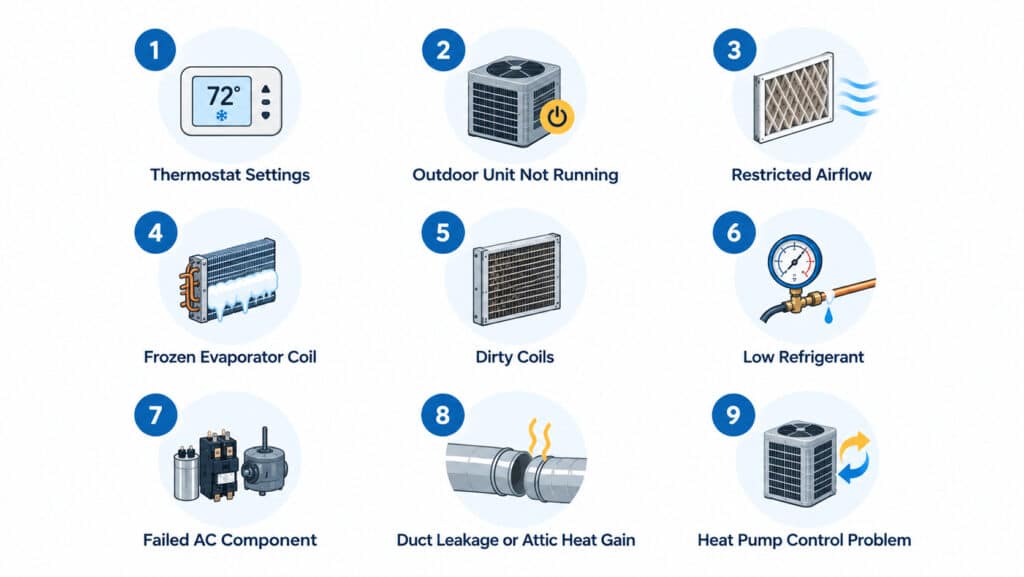
Warm air from your vents falls into one of several categories: an incorrect thermostat mode or fan setting, the indoor blower running while the outdoor unit is off, a tripped breaker, a dirty or clogged filter, a frozen evaporator coil, dirty coils, a refrigerant leak or incorrect charge, a failed capacitor or contactor, or in heat pump systems, a reversing-valve or control problem. Homeowners can safely verify thermostat settings, check the filter, confirm the outdoor unit is running, inspect for ice, and reset a tripped breaker once. Everything else requires instrument-based testing.
Key Takeaways
- Airflow from the vents does not confirm the cooling system is active. The indoor fan can run while the outdoor unit is completely off.
- The thermostat fan set to On circulates unconditioned, room-temperature air during off-cycles—a free fix before scheduling service.
- Ice on the coil or refrigerant line, repeated breaker trips, burning odors, and a silent outdoor unit are reasons to turn the system off and call for same-day help.
- Warm air from one room or one vent usually points to a duct or zoning issue, not a refrigeration failure.
- Refrigerant, electrical, and mechanical failures require instrument-based testing—safe visual checks eliminate simple causes but cannot confirm a charge problem, failed capacitor, or compressor fault.
First, Determine What “Warm Air” Means
Warm air is a symptom, not a diagnosis. The pattern—which vents, at what time of day, constant or intermittent—points toward different causes and helps a technician test the right section of the system first.
Not all warm-air complaints come from the same source. Consider what you’re actually observing:
- Room-temperature air between cycles. The system may be functioning normally. During the off-cycle, an indoor fan set to On continues moving air that hasn’t been cooled.
- Air that starts cool and becomes warm. The system may be losing capacity during the run—a coil freezing over, an outdoor fan cycling off on thermal protection, or a low-charge condition under load.
- Consistently warm air during an active cooling call. The outdoor unit may not be operating at all, or a refrigerant or coil problem is preventing heat transfer.
- Weak airflow that feels less cool than expected. A restricted filter, a blower problem, or duct leakage can reduce the volume of conditioned air reaching the room.
- Warm air from every vent. Points toward a system-wide cooling failure—outdoor unit, refrigerant circuit, or coil.
- Warm air from one room or one vent. More likely a duct, zoning, or airflow problem specific to that branch of the system.
Document the pattern before calling for service. Note which vents are affected, what time of day the problem appears, whether it’s constant or intermittent, and whether the outdoor unit sounds and looks normal. That information reduces diagnostic time.
Original Heuristic — The Pattern-Before-Parts Rule
Recording the warm-air pattern—every vent or one room, constant or intermittent, worse in the afternoon or all day, recent thermostat change or no change—before calling a technician is not a substitute for diagnostics, but it narrows the starting point. A technician who knows the pattern tests the right section of the system first rather than working through a full checklist from the beginning.
What to Check Before Calling a Technician
The following checks are safe for homeowners. They do not require opening equipment panels, touching electrical components, or adding refrigerant.
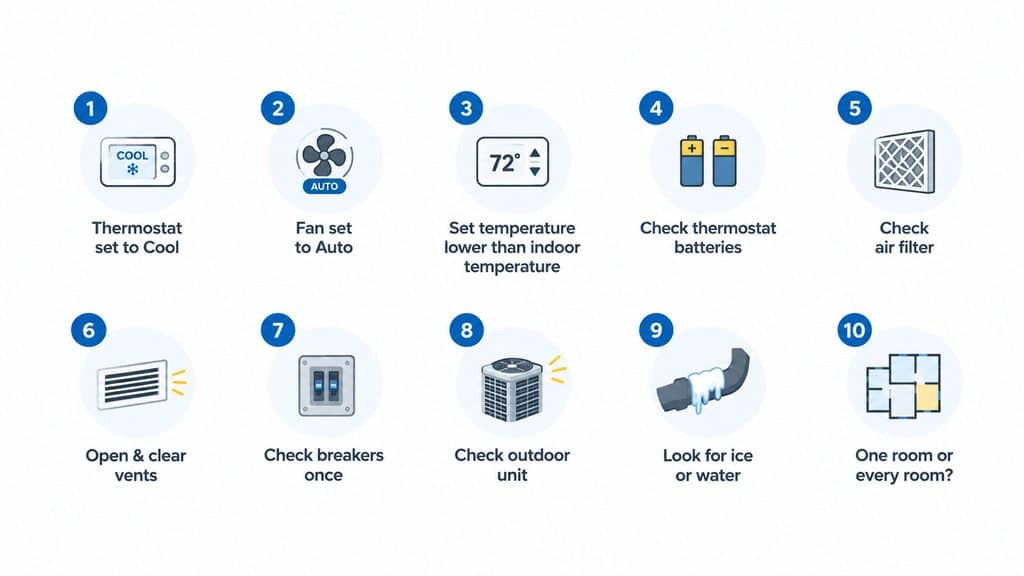
- Confirm the thermostat is set to Cool. Verify the mode is not set to Heat, Off, or Fan Only. A misset mode is the most common non-issue on warm-air service calls.
- Switch the fan to Auto. When the fan is set to On, the indoor blower runs continuously—including during off-cycles when the compressor is not operating. Air circulating without active cooling feels warm. Switching to Auto takes ten seconds and resolves many warm-air complaints at no cost.
- Confirm the setpoint is below the current indoor temperature. The system will not cool if the thermostat’s set temperature equals or exceeds the room temperature. Lower the setpoint by 3–5°F and wait 10–15 minutes. Do not set an extreme low temperature expecting faster cooling—it does not work that way.
- Check thermostat batteries (battery-powered models only). Low batteries can cause display errors or prevent the thermostat from sending control signals to the outdoor unit.
- Inspect the air filter. A heavily clogged filter severely restricts airflow across the evaporator coil. Reduced airflow limits the heat the coil can absorb and can cause the coil surface temperature to drop below freezing, leading to ice formation and further blockage. Replace or clean the filter if it is visibly loaded.
- Check supply and return vents. Confirm all supply grilles are open and unobstructed by furniture, rugs, or curtains. Make sure return grilles are not blocked. Closing supply vents does not redirect air effectively and can raise system static pressure.
- Check the HVAC breakers—once. Indoor and outdoor equipment are typically on separate breakers. If either is tripped, reset it once. If the breaker trips a second time, do not reset it again. A second trip indicates an electrical or mechanical problem requiring professional diagnosis, not a repeated manual reset.
- Observe the outdoor unit from a safe distance. Is the condenser fan spinning? Does the unit sound like it normally does? Are there unusual noises, vibration, or odors? A completely silent outdoor unit while the indoor fan is running is a meaningful finding. Do not remove access panels, reach through the grille, or touch any part of the outdoor unit.
- Look for visible ice or unusual water accumulation. Check the accessible refrigerant line (the insulated copper line running to the outdoor unit) and the area around the indoor air handler without opening any panels. Ice on the line or equipment is a reason to turn the system to Fan Only or Off and allow it to thaw naturally before calling for service.
- Determine whether the problem affects every room. Walk through the house. If one room or zone is receiving warm air while others are comfortable, the cause is more likely a duct or zoning problem than a system-wide refrigeration failure. Internal link: Why Is One Room Hotter Than the Rest? → room-hot-spots page
Common Reasons an AC Blows Warm Air
This section covers causes in detail. For a broader overview of AC diagnosis, see The Complete AC Repair Guide for San Antonio Homeowners.
Incorrect Thermostat Mode or Fan Setting
What you may notice: Warm or room-temperature air despite the system appearing to run normally.
Why the air is warm: The system is in Heat mode, the fan is set to On (circulating between cooling cycles), a scheduling error has set an incorrect temperature for this time of day, or a smart thermostat is miscommunicating with the outdoor unit after a software or compatibility issue.
What to check safely: Verify the mode, fan setting, and schedule on the thermostat display.
What a technician should test: Control-signal output at the thermostat terminals, wiring at the air handler, and firmware or compatibility settings on smart thermostat installations.
Original Insight — The Fan-Setting Trap
The thermostat fan set to On is the single most common source of warm-air complaints that do not require a service visit. During the off-cycle, the blower distributes room-temperature air—which feels warm to a hand held near a supply vent. The fix is a setting change, not a repair. If a service call is scheduled and the cause turns out to be the fan setting, the diagnostic fee is not refundable. Check this first.
Indoor Fan Running While the Outdoor Unit Is Off
What you may notice: Airflow from the vents feels strong but is room-temperature or warmer. The outdoor unit appears silent or the fan is not spinning.
Why the air is warm: The indoor blower and the outdoor condensing unit are controlled independently. If the outdoor unit is not running—due to a tripped breaker, a failed run capacitor, a failed contactor, a failed condenser fan motor, a high-pressure or low-pressure lockout, a wiring fault, or a control-board issue—the indoor fan continues circulating unconditioned air.
What to check safely: Confirm the outdoor breaker has not tripped. Observe whether the outdoor fan is spinning from a safe distance.
What a technician should test: Voltage at the outdoor disconnect, capacitor microfarads against rated tolerance, contactor coil resistance and contact condition, condenser fan motor amp draw, and control-signal continuity from the thermostat to the outdoor unit.
Dirty Filter or Restricted Airflow
What you may notice: Airflow from the vents feels weak and less cool than usual. The indoor unit may be louder or quieter than normal.
Why the air is warm: A clogged filter forces air through a restriction that reduces the volume flowing across the evaporator coil. Less air means less heat removal. The coil surface temperature can drop low enough to form ice, which further blocks airflow and progressively eliminates cooling capacity.
DOE finding: The U.S. Department of Energy notes that a dirty air filter is one of the most common causes of reduced system efficiency and equipment failure—consistent filter maintenance is among the highest-return homeowner actions for HVAC performance. [1]
What to check safely: Pull the filter and inspect it. A filter so loaded that daylight is no longer visible through it should be replaced before any other diagnostic step.
What a technician should test: Static pressure against ACCA Manual D design values to confirm whether airflow is within the design range after the filter is clean.
Frozen Evaporator Coil
What you may notice: Air from vents starts cool, then weakens and becomes warmer over the next hour. Ice may be visible on the refrigerant line near the indoor unit.
Why the air is warm: Ice forming on the coil surface progressively blocks airflow. The most common contributing conditions are severely restricted airflow (dirty filter, blocked return), a failing blower motor, low refrigerant charge, or operating conditions outside the equipment’s design range. Ice is a symptom, not a root cause.
What to do safely: Switch the thermostat to Fan Only or turn the system off at the thermostat. Allow ice to thaw naturally—typically 2–4 hours. Do not attempt to chip or melt ice manually. Thawing does not repair the cause. If the coil re-freezes after cooling resumes, the system needs diagnosis.
⚠ Turn the System Off — Do Not Continue Operating
Ice on the coil or refrigerant line indicates a problem that will worsen with continued compressor operation. Switch to Fan Only or turn the system off and allow full thaw before requesting service.
Dirty Evaporator or Condenser Coil
Why the air is warm: The evaporator coil absorbs heat from indoor air; the condenser coil rejects that heat outdoors. Dirt on either coil surface acts as insulation, reducing the rate of heat transfer. A dirty condenser coil in a hot San Antonio attic or outdoor yard installation can cause the refrigerant to remain too warm, reducing the system’s ability to cool the indoor air effectively.
What a technician should do: Inspect and clean coils using appropriate equipment and approved coil cleaner with the system de-energized. Panel removal and chemical cleaners are not safe homeowner tasks.
Refrigerant Leak or Incorrect Charge
Why the air is warm: Refrigerant is the medium that carries heat from indoors to outdoors. A leak or an incorrect prior charge reduces the system’s heat-transfer capacity. Refrigerant is not consumed—if the charge is low, a leak or a prior service error is the cause.
Refrigerant note (2026): Under the EPA’s Technology Transitions Program, manufacturers stopped producing new R-410A equipment on January 1, 2025. R-410A service refrigerant remains legal for maintaining existing systems with no end date established. New equipment uses lower-GWP refrigerants such as R-454B. Service costs have increased 40–70% since 2022 due to reduced R-410A production. [4]
What a technician should test: Refrigerant superheat and subcooling—not pressure alone—to confirm proper charge. Pressure readings are affected by outdoor temperature, indoor load, airflow rate, and refrigerant type; they are not sufficient to confirm correct charge.
Failed Capacitor, Contactor, Fan Motor, or Compressor
Why the air is warm: These electrical and mechanical components are required for the outdoor unit to operate. A failed run capacitor may prevent the compressor or condenser fan motor from starting. A worn contactor may not close reliably under load. A failed compressor cannot move refrigerant regardless of charge level. In all cases, the indoor blower continues running, delivering unconditioned air.
What a technician should test: Capacitor microfarads against rated tolerance (±5–6% is typical), contactor contact condition and coil draw, motor amp draw against nameplate rating, and compressor amp draw and compression ratio.
Duct Leakage, Disconnection, or Attic Heat Gain
Why the air is warm: Supply ducts in a San Antonio attic can run through spaces where temperatures regularly exceed 130°F during summer afternoons. A loose connection, a collapsed duct section, or gaps at joints allow either conditioned air to escape into the attic (reducing what reaches the room) or hot attic air to enter the return duct stream. Either condition reduces the temperature difference between supply and room air.
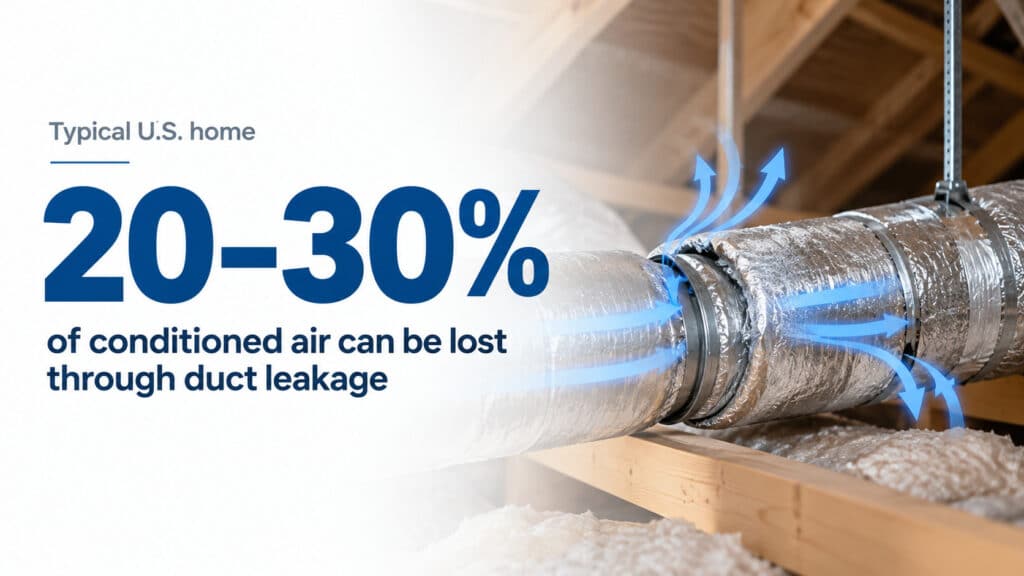
DOE estimate: The typical U.S. home loses 20 to 30 percent of conditioned air through duct leakage—a major source of energy waste and comfort problems that standard pressure testing can quantify. [2]
What a technician should test: Duct leakage using a blower door or duct pressurization test, or a visual inspection of accessible duct connections in the attic and air handler cabinet.
Heat Pump Reversing-Valve or Control Problem
Why the air is warm: A heat pump moves heat in two directions depending on the reversing-valve position. If the valve is stuck in heating mode, or if the thermostat sends an incorrect signal to the reversing valve, the system may deliver warm air during a cooling call. This is distinct from—and less common than—the electrical and refrigerant failures above.
What a technician should test: Reversing-valve solenoid voltage and mechanical operation, thermostat O/B terminal configuration, and manufacturer fault codes. A stuck reversing valve is not the default assumption for warm-air complaints on a heat pump—all other causes should be ruled out with measurements first.
Symptom Guide
The table below lists common observations, their possible causes, safe checks, and what a technician should test. These are possibilities, not confirmed diagnoses—a single observation rarely points to one exclusive cause.
| What you notice | Possible causes | Safe check | Technician should test | Urgency |
|---|---|---|---|---|
| Warm air from every vent | Outdoor unit off, refrigerant issue, dirty coil, frozen coil, failed capacitor or compressor | Thermostat mode, fan setting, outdoor unit status, filter, breaker | Control signals, capacitor, contactor, refrigerant superheat/subcooling, coil condition | Same-day if persists |
| Warm air from one room only | Duct leak or disconnection, closed damper, blocked grille, zoning fault | Confirm grille is open and unobstructed; check other rooms | Duct leakage, damper operation, static pressure in affected branch | Schedule service |
| Indoor fan running, outdoor unit silent | Tripped breaker, failed capacitor, failed contactor, wiring fault, high-pressure lockout | Check outdoor breaker—reset once only; observe outdoor unit safely | Outdoor circuit voltage, capacitor µF, contactor coil and contacts, control signal output | Same-day |
| Outdoor fan running, air remains warm | Failed compressor, low refrigerant charge, dirty condenser coil, failed compressor start capacitor | Confirm thermostat and fan settings; no safe homeowner test beyond this | Compressor amp draw, refrigerant superheat/subcooling, condenser coil condition | Same-day |
| Air starts cool, becomes warm over time | Coil freezing progressively, condenser cycling off on thermal protection, low charge under load | Check for ice on refrigerant line; turn system off if ice is present | Airflow, static pressure, coil temperature, refrigerant readings under load | Turn off if ice; schedule soon |
| Ice on the refrigerant line | Restricted airflow, blower problem, low refrigerant charge, operating conditions | Switch to Fan Only or Off; allow full thaw before restarting | Airflow, static pressure, blower operation, refrigerant charge after thaw | Turn off; same-day |
| Weak and warm airflow | Clogged filter, failing blower motor, frozen coil, collapsed duct | Inspect and replace filter; check vents for obstruction | Static pressure, blower amp draw, coil condition, duct inspection | Schedule service |
| Breaker trips when cooling starts | Failed capacitor causing motor overcurrent, compressor locked rotor, wiring fault | Reset breaker once; do not reset if it trips again | Compressor amp draw and lockout test, capacitor, wiring insulation resistance | Same-day; do not reset repeatedly |
| Burning or electrical odor | Motor winding fault, wiring insulation failure, overheated contactor | Turn system off at thermostat | Motor windings, contactor, wiring insulation integrity | Turn off immediately; call same-day |
| Warm air after thermostat replacement | Wiring error, incorrect heat pump setting, incompatible thermostat | Compare new wiring to old thermostat photo if available | Terminal wiring verification, control-signal output, O/B configuration for heat pumps | Schedule service |
When to Turn the AC Off
Most warm-air problems do not require shutting the system down immediately. The following conditions are exceptions—continued operation can damage equipment or create a safety hazard.
Turn Off the System
- Ice visible on the refrigerant line or indoor unit
- Breaker trips a second time after one reset
- Burning or electrical odor
- Smoke or visible sparking
- Severe vibration or mechanical grinding noise from outdoor unit
- Water pooling near electrical components
- Floodwater affecting any part of the HVAC system
- Outdoor condenser fan visible as stopped while the unit appears energized
- Heat pump delivering warm air continuously during a cooling call
Request Same-Day Service
Indoor temperatures continuing to rise during extreme weather, or when occupants with heat-sensitive medical conditions are present, warrants same-day professional assistance. Notify the technician of any safety symptoms observed so they can respond with appropriate equipment.
What a Technician Should Measure
A warm-air diagnosis is only as reliable as the measurements behind it. No single reading proves the entire system is operating correctly—a complete evaluation tests the controls, airflow, refrigerant circuit, and electrical components together.
A properly conducted diagnosis of a warm-air complaint may include:
- Thermostat input signals and control-terminal voltage output
- Supply and return air temperatures and indoor relative humidity
- Static pressure or verified airflow against ACCA Manual D design values
- Filter condition, blower operation, and evaporator coil condition
- Capacitor microfarads compared with manufacturer-rated tolerance (typically ±5–6%)
- Contactor coil draw and contact condition under load
- Condenser fan motor and compressor amp draw against nameplate ratings
- Refrigerant superheat or subcooling—not pressure alone—to confirm charge
- Duct leakage or accessible duct damage inspection
- Heat pump reversing-valve operation and O/B terminal configuration
- Manufacturer fault codes where available
Ask Your Technician
“What measurement confirms the diagnosis, and what specification are you comparing it with?” A technician who can answer this question specifically—citing a manufacturer rating, an ACCA standard, or a measured value—is working from data. A diagnosis offered without measurement is an opinion.
Why Warm-Air Problems Are Harder to Dismiss in San Antonio
An AC system that underperforms anywhere can be uncomfortable. In San Antonio, Bulverde, and Boerne, the consequences of an undiagnosed warm-air problem are compressive. The San Antonio area runs one of the longest cooling seasons in Texas—the National Weather Service Austin/San Antonio office records an average of over 100 days per year at or above 90°F based on the 1991–2020 climate normals. [2]
Several local conditions interact to expose equipment weaknesses that might go unnoticed in a milder climate:
- Long cooling season and extended runtime. Equipment that operates nine or more months of the year has less opportunity to rest, and marginal capacitor or contactor condition degrades faster under continuous use.
- High outdoor temperatures. Condenser coils reject heat less efficiently when outdoor air is hot. A coil that is marginally dirty performs adequately in spring but may fail to maintain cooling capacity in July or August.
- Humidity. High indoor humidity increases the latent load on the system. Equipment that is correctly sized for a dry day may struggle to maintain both temperature and comfort on a humid afternoon.
- Hot attic conditions. Unconditioned attics in San Antonio can exceed 130°F on summer afternoons. Supply ducts running through those spaces gain heat continuously. Even well-insulated ducts in poorly insulated attics deliver warmer air than design intent.
- Dust and filter loading. Construction, landscaping, and wind conditions in the greater San Antonio area can load filters faster than many homeowners expect, increasing the frequency of airflow-related problems.
None of these conditions cause equipment to fail on their own, but they accelerate the consequences of marginal components and deferred maintenance. An outdoor unit running below capacity in April may deliver warm air in July under the same thermostat setting.
Warm Air vs. Running but Not Cooling
These symptoms can overlap, but they describe different observations and lead to different diagnostic starting points.
| Symptom | What it describes | Common starting point |
|---|---|---|
| AC blowing warm air | The air leaving the supply vents feels warm or room-temperature rather than cool | Thermostat mode and fan setting, outdoor unit status, coil condition, refrigerant circuit |
| AC running but not cooling | The home is not reaching or maintaining the thermostat setpoint, even if some cooling is occurring | Airflow, equipment capacity, heat gain from the building envelope, ductwork performance, and overall system output |
A system can blow warm air without the home temperature rising sharply—if the outdoor unit just stopped, the indoor temperature may be fine temporarily. A system can also fail to cool the home while still delivering air that is slightly cooler than room temperature. The two symptoms often appear together, but each focuses attention on a different part of the system.
Frequently Asked Questions
Why is my thermostat set to Cool but the AC blows warm air?
Several independent failures can produce warm air even with the thermostat correctly set to Cool. The outdoor unit may not be running due to a tripped breaker, failed capacitor, or contactor problem. The evaporator coil may be frozen and blocking heat transfer. A refrigerant leak or incorrect charge reduces cooling capacity. A dirty coil or a miscommunication between the thermostat and control board can also produce this result. Each requires a different measurement to confirm.
Can the fan setting make an AC blow warm air?
Yes. When the thermostat fan is set to On rather than Auto, the indoor blower runs continuously—including during the off-cycle when the compressor is not operating. Air moving through the ducts between cooling cycles has not been conditioned and feels warm or room-temperature compared to what you expect. Switching from On to Auto is a free fix that resolves this complaint in many service calls.
Why is the inside unit running but the outside unit is not?
The indoor blower and the outdoor condensing unit are controlled separately and can fail independently. A tripped outdoor breaker, a failed run capacitor, a worn contactor, a failed condenser fan motor, a high-pressure lockout, or a wiring or control-board problem can all prevent the outdoor unit from operating while the indoor fan continues running. A technician should test the circuit, capacitor, contactor, and control signals before replacing any component.
Can a dirty filter cause warm air?
A severely restricted filter reduces airflow across the evaporator coil, which limits the heat the coil can absorb from indoor air. In some cases, reduced airflow causes the coil temperature to drop low enough to form ice, which further blocks airflow and eliminates cooling. Replacing a clogged filter is one of the first steps to take before calling a technician—but a dirty filter alone rarely explains all warm-air complaints.
Should I turn off an AC that is blowing warm air?
Not necessarily—unless you notice ice on the refrigerant line or indoor unit, repeated breaker trips, a burning or electrical odor, smoke or sparking, severe mechanical noise, water near electrical components, or an outdoor fan that appears stopped while the unit is energized. Simple warm-air causes like an incorrect thermostat setting or a dirty filter do not require shutting the system down.
Does warm air always mean the AC needs refrigerant?
No. Refrigerant loss is one of many possible causes and should not be assumed without measurement. A failed capacitor that prevents the compressor from starting, a frozen coil from restricted airflow, a dirty condenser coil, a failed outdoor fan motor, or a duct leak in a hot attic can all produce warm air. Pressure readings alone are insufficient to confirm refrigerant charge; superheat or subcooling measurements are required.
Why does my AC blow warm air from only one vent?
Warm air limited to one vent or room usually points to a localized problem rather than a refrigeration failure. A disconnected, crushed, or leaking duct in a hot attic can allow attic heat to enter the supply stream. A closed grille, a zoning damper stuck in the wrong position, or a room-specific return air problem can reduce flow to one area. A system-wide cooling failure would typically affect all rooms.
Can a thermostat replacement cause an AC to blow warm air?
Yes, more often than most homeowners expect. Wiring errors during a thermostat swap—incorrect terminal assignments, a disconnected common wire, or an improperly configured heat pump setting—can prevent the outdoor unit from receiving the correct control signal. A heat pump thermostat installed on a conventional system, or vice versa, may produce heating during a cooling call. A technician should verify wiring terminal by terminal and confirm control-signal output after any thermostat replacement.
Next Steps for San Antonio Homeowners
The correct sequence when your AC is blowing warm air:
- Confirm the thermostat mode, fan setting, and setpoint. These take under two minutes and resolve a substantial number of warm-air complaints without any service visit.
- Inspect the filter, vents, breaker, outdoor unit, and visible refrigerant line. Document what you find before calling—pattern information improves diagnostic efficiency.
- Turn the system off if safety symptoms appear. Ice, electrical problems, burning odors, or a silent outdoor unit while the system is energized are reasons to stop operating the equipment.
- Request a measurement-based diagnosis if cooling does not return. Warm air alone does not confirm the cause. Do not approve refrigerant addition or component replacement without instrument readings that support the recommendation.
Schedule an AC Diagnostic with Honeycomb
Honeycomb serves San Antonio, Bulverde, Boerne, and other surrounding areas, with diagnostic appointments that document findings in writing before any repair is recommended.
Available 24/7 for emergency AC repair in San Antonio and surrounding areas
📞 Call or Text (210) 750-6725
Brandon Caputo
Owner · Honeycomb Heating & Cooling
Brandon Caputo founded Honeycomb Heating & Cooling to bring system-driven reliability and customer-first transparency to the San Antonio HVAC market. Grounded in the principle of proactive, preventative care rather than reactive crisis management, Honeycomb specializes in high-efficiency AC and heating installations, advanced diagnostic repairs, and localized indoor air quality solutions. Brandon infuses empathy into every service call, ensuring his team actively listens to homeowners to deliver clear, value-based comfort solutions.
About Honeycomb Heating & Cooling
San Antonio’s trusted specialist in residential air conditioning installation, swift repairs, and energy-saving preventative maintenance. Founded with a commitment to upfront flat-rate pricing and reliable home comfort.
600+ Completed Projects · 5.00-star Google Rating · Open 24/7 for Emergency Support · Founded by Brandon Caputo.
- Upfront Flat-Rate Pricing—No Hidden Fees
- Zero-Pressure Repair & System Options
- Background-Checked & Certified Technicians
- Amana Authorized Elite Partner
- Goodman High-Efficiency System Specialists
- Comprehensive “Comfy Club” Maintenance Programs
- 600+ 5-Star Reviews Across San Antonio
- Fully Licensed & Insured · Texas
- Free estimates & online booking
- Zero Interest with No Monthly Payment financing available
- Office Address: 26995 US Highway 281 Suite C, San Antonio, TX 78260
Sources & Citations
- U.S. Department of Energy — Maintaining Your Air Conditioner: energy.gov/energysaver/maintaining-your-air-conditioner
- U.S. Department of Energy — Ducts: energy.gov/energysaver/ducts
- ENERGY STAR — Duct Sealing: energystar.gov/campaign/heating_cooling/duct_sealing
- U.S. EPA — SNAP Regulations (Refrigerant Transitions): epa.gov/snap/snap-regulations
- National Weather Service Austin/San Antonio — Climate Data: weather.gov/ewx/climate
- ACCA — Manual D: Residential Duct Systems (referenced for static pressure standards): acca.org/standards/manuals
- ASHRAE — Handbook of Fundamentals (heat transfer and refrigerant charge principles): ashrae.org/technical-resources/ashrae-handbook
- CPS Energy — Home Energy Efficiency Resources: cpsenergy.com
- ENERGY STAR — Heating and Cooling: energystar.gov/products/heating_cooling


