



 (726) 233-6044
Quick Answer: Why is my AC running but not cooling?
An AC that runs but fails to cool is one of nine common problems: an incorrect thermostat setting, a clogged air filter, a blocked supply or return, dirty evaporator or condenser coils, a frozen coil, an outdoor fan or compressor fault, a refrigerant leak, duct leakage, or a sizing issue. Homeowners can safely check thermostat settings, the filter, vents, the breaker, visible ice, and outdoor-unit clearance. Refrigerant, electrical, motor, coil, and airflow problems that require opening the equipment must be confirmed through professional measurement before any repair is approved.
Key Takeaways
- A running indoor blower does not mean every part of the system is working. The outdoor unit can be completely idle while the air handler circulates unconditioned air.
- “Running but not cooling” is a symptom with several possible causes—not a diagnosis. The same symptom can result from a $20 capacitor failure or a refrigerant leak that requires finding and repairing the source.
- Airflow should be verified before any refrigerant diagnosis is pursued. A restriction in the duct or at the coil affects refrigerant readings and can lead to a misdiagnosis.
- Continuing to run the system with a frozen coil or a tripping breaker can damage the compressor—the most expensive single component in the system.
- Any recommendation to add refrigerant or replace a major component should be backed by documented measurements, not symptom observation alone.
Is the AC Actually Running?
The indoor blower and the outdoor unit are separate components. The blower can run—and move air through every register in the house—even when the outdoor unit is completely idle. Confirming which parts are operating is the first step, and it can be done safely without opening any panels.
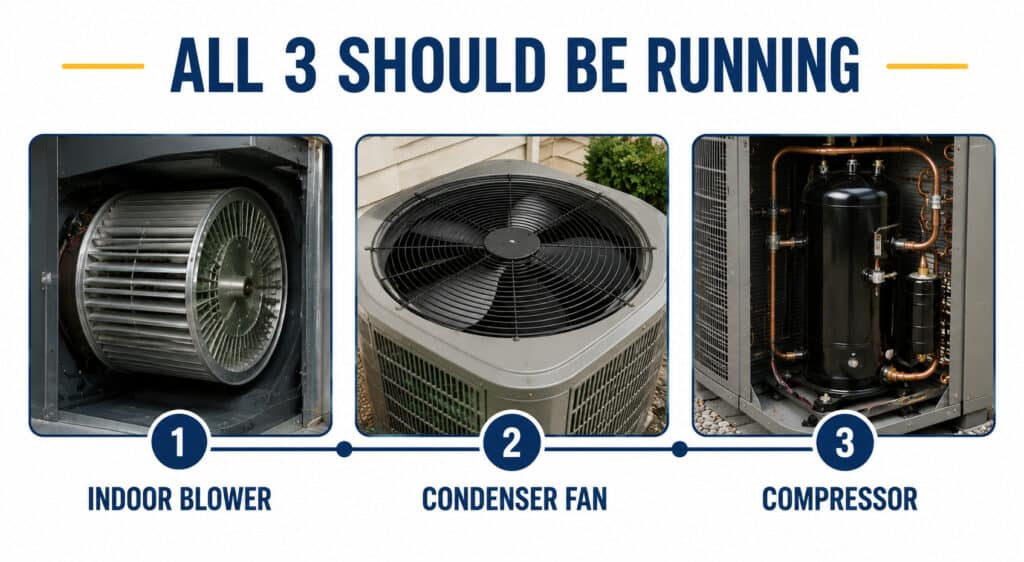
When a central AC system calls for cooling, three things should happen simultaneously: the indoor blower starts, the outdoor condenser fan starts, and the compressor engages. If only the blower is running, the system is circulating air without removing heat from it. The air at the registers will feel lukewarm or only slightly cool—not the 15–20°F temperature drop across a normally functioning evaporator coil.
Original Insight — The Silent Outdoor Unit
One of the most commonly misread situations in a residential service call: the homeowner hears the indoor blower and assumes the whole system is working. Stand outside near the condenser and listen. A running outdoor fan produces a clear airflow sound; the compressor adds a low, distinct hum beneath it. A unit that is completely silent—no fan, no compressor—while the indoor air handler runs is a specific pattern that narrows the cause significantly. It typically points to a failed run capacitor, a tripped contactor, a high-pressure lockout, or a wiring fault at the outdoor unit.
Observe from a safe distance only. Do not open the outdoor unit access panel, touch the fan blade, or place your hand near any moving part or electrical component.
Safe Checks to Perform First
Before calling a technician, ten checks take five minutes and resolve a meaningful percentage of no-cool calls. They also provide useful information when they don’t resolve the problem.
- Confirm the thermostat is set to COOL. A thermostat in FAN or HEAT mode moves air without activating cooling.
- Set the fan to AUTO. FAN ON runs the blower continuously—including between cooling cycles—which can make the air feel less cold and cause indoor humidity to rise.
- Verify the temperature setpoint is below the current room temperature. The system will not cool if the setpoint is at or above indoor temperature.
- Replace thermostat batteries if applicable. Low batteries can cause missed calls, blank screens, or erratic behavior.
- Inspect the air filter. A gray, matted filter restricts airflow and is one of the most common contributors to reduced cooling. Replace it if it is visibly dirty.
- Confirm supply and return vents are open and unobstructed. Check that furniture, rugs, and curtains are not blocking registers or return grilles.
- Check the breaker. Find the AC breaker in your electrical panel. If it has tripped to the center position, switch it fully off and then fully on—once. Note whether it trips again.
- Look for visible ice or water. Ice on the refrigerant lines or indoor coil means the system should be switched off. Water near the indoor unit may indicate a blocked condensate drain.
- Check the outdoor unit. Remove any leaves, debris, or materials that are blocking airflow around the condenser. Verify there is at least 18–24 inches of clearance on all sides.
- Note whether the indoor blower, outdoor fan, and compressor appear to operate. Write down what you observe—it helps the technician narrow the diagnosis before they arrive.
⚠ Safety Limits — Stop Here
- Do not reset a tripping breaker more than once. Repeated tripping indicates a fault that resetting cannot correct.
- Do not open electrical panels, disconnect boxes, or the outdoor unit access panel.
- Do not touch capacitors, contactors, wiring, motors, or refrigerant lines. Capacitors store a lethal charge even when power is disconnected.
- Do not add refrigerant. EPA Section 608 requires certification to purchase and handle regulated refrigerants.
- Do not scrape or chip ice from a frozen coil or refrigerant line.
- Turn the system off at the thermostat—and at the breaker if needed—if you observe smoke, burning, sparking, severe vibration, flooding, or a breaker that trips immediately after reset.
Common Reasons an AC Runs but Does Not Cool
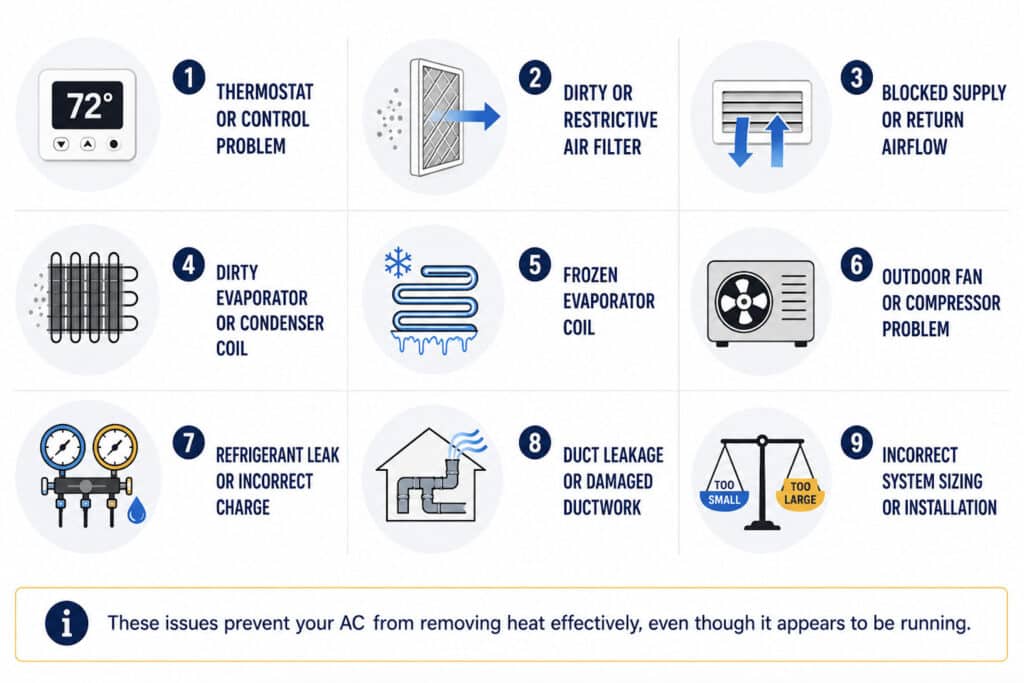
1. Thermostat or Control Problem
An incorrect mode setting (FAN instead of COOL, or HEAT instead of COOL) is the simplest explanation and the first thing to rule out. Beyond mode and setpoint errors, a thermostat may have a calibration drift that causes it to misread room temperature, a sensor positioned near a heat source, wiring corrosion, or a communication fault with variable-speed equipment. A technician should verify voltage at the thermostat terminals and confirm correct signal delivery to both the indoor and outdoor units before condemning the thermostat itself.
2. Dirty or Restrictive Air Filter
A clogged filter reduces the volume of air passing over the evaporator coil, which limits the system’s ability to absorb heat. The result is longer runtime, a smaller temperature drop across the coil, and—under sustained restriction—a coil that drops below freezing. Replacing the filter is a safe first check. If cooling does not improve after a filter change, or if the coil was frozen, a technician should verify that coil condition and refrigerant charge were not affected during the restriction period.
3. Blocked Supply or Return Airflow
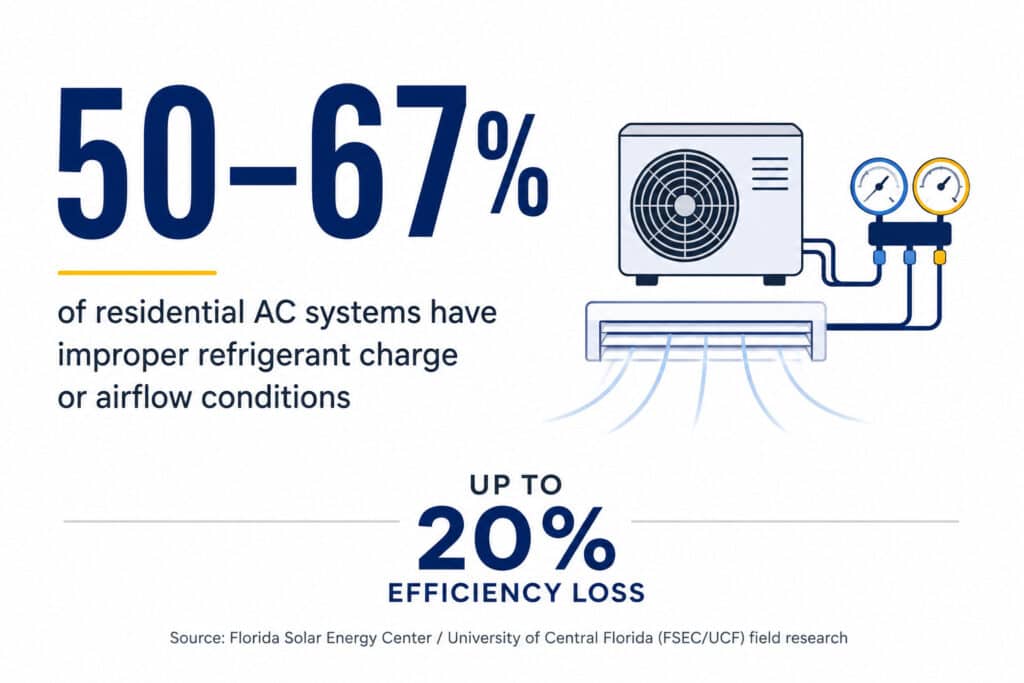
Closed registers, furniture blocking return grilles, a dirty blower wheel, or a collapsed flex duct section all reduce the air volume the system can move. Restricted airflow reduces the rate at which the system removes heat from the space. According to FSEC/UCF field research, 50–67% of residential AC systems have improper airflow or refrigerant charge conditions that contribute to efficiency losses of up to 20%.[4] A technician measures external static pressure to quantify airflow restriction—this should be done before any refrigerant diagnosis is pursued. → The Complete AC Repair Guide
4. Dirty Evaporator or Condenser Coil
The evaporator coil (indoors) absorbs heat from the air; the condenser coil (outdoors) releases that heat outside. Dirt on either coil acts as insulation, reducing heat transfer efficiency. A dirty evaporator coil produces air that is less cold than it should be; a dirty condenser coil causes the outdoor unit to run hotter and work harder to reject the same amount of heat. Coil cleaning is professional work—do not apply household chemicals to the coils. A technician can assess coil condition visually and by comparing operating temperatures against expected values.
5. Frozen Evaporator Coil
Ice on the evaporator coil or refrigerant line is a symptom, not a standalone diagnosis. It occurs when the coil surface drops below freezing—most commonly because of restricted airflow (dirty filter, blocked return, failing blower) or low refrigerant charge, though other operating conditions can contribute. A completely iced-over coil blocks airflow through the system, which is why an AC with a frozen coil often blows air that is only slightly cool or barely moving.
Switch the thermostat to FAN ONLY to circulate air across the coil and speed the thaw. Do not chip or scrape the ice. Once the coil is fully thawed, check the filter and restore cooling. If the coil freezes again, turn the system off and call for service—continued operation can damage the compressor.
6. Outdoor Fan or Compressor Problem
If the outdoor unit is silent while the indoor blower runs, the system is moving air but not removing heat. A failed run capacitor is the most frequent cause—National HVAC Parts’ 2026 analysis of more than 45,000 service orders found that run capacitors account for 31% of all AC repair part orders, with demand spiking 340% above the January baseline in July.[3] A failed contactor, wiring fault, control board problem, or compressor fault can produce the same pattern. Each requires a different repair—visual observation alone cannot confirm which component is responsible.
7. Refrigerant Leak or Incorrect Charge
Refrigerant is not a consumable—it does not deplete under normal operation. If the charge is low, there is a leak that must be located and repaired before recharging. Adding refrigerant without finding the leak is a temporary measure that delays the next failure. Pressure alone is not enough to establish correct charge; the technician must measure superheat (for fixed-orifice systems) or subcooling (for TXV systems) under operating conditions, following the manufacturer’s specified procedure. Airflow must be verified first—restricted airflow affects refrigerant readings and can produce a false low-charge indication.
Original Heuristic — The Airflow-First Rule
Before any refrigerant diagnosis is pursued, airflow must be verified: filter condition, static pressure, blower operation, and coil condition. A system with restricted airflow produces refrigerant pressure and temperature readings that may suggest a charge problem even when none exists. Correcting the airflow restriction first—and retesting—prevents misdiagnosis and avoids unnecessary refrigerant work.
8. Duct Leakage or Damaged Ductwork
ENERGY STAR estimates that 20–30% of conditioned air in a typical home is lost to duct leakage, reducing system efficiency by up to 20%.[6] In San Antonio’s climate, ducts running through an unconditioned attic lose cooled air directly into a space that may exceed 140°F on a summer afternoon—a significant efficiency penalty. Flex duct inner liners can separate from their fittings while the outer insulation jacket remains intact, making the leak invisible to surface inspection. Duct leakage is confirmed through pressure testing and airflow measurement, not visual inspection alone.
9. Incorrect System Sizing or Installation
An undersized system runs continuously without reaching setpoint. An oversized system cycles off before adequately dehumidifying the space, which can make the home feel warmer and more humid even when the temperature setpoint is met. Neither symptom alone confirms a sizing problem—the system may be sized correctly but degraded by a dirty coil, low refrigerant, or duct losses. Sizing is confirmed through a Manual J load calculation, not by comparing equipment tonnage to square footage. Do not recommend replacing equipment based on square footage or equipment age without a load calculation. → AC Repair San Antonio
Symptom-to-Diagnosis Reference
This table identifies possibilities, not confirmed diagnoses. Professional measurement is required to determine the actual cause.
| What you notice | Possible causes | Safe check | Professional test needed | Urgency |
|---|---|---|---|---|
| Air moving but not cold | Silent outdoor unit, frozen coil, low refrigerant, failed compressor, thermostat mode error | Thermostat mode; feel air temperature at register | Outdoor unit operation, capacitor reading, refrigerant charge, compressor amp draw | High |
| Weak or reduced airflow | Clogged filter, blocked return, dirty blower wheel, collapsed duct, failing blower motor | Filter condition, vents and returns unobstructed | Static pressure, blower amp draw, duct inspection | Moderate |
| Indoor fan runs, outdoor unit is silent | Failed capacitor, tripped contactor, wiring fault, high-pressure lockout, compressor fault | Listen from safe distance; check breaker once | Voltage at disconnect, capacitor reading, contactor continuity, compressor amp draw | High |
| Ice on the refrigerant line or coil | Restricted airflow, low refrigerant charge, other operating conditions | Switch to FAN ONLY; replace filter if clogged | Refrigerant charge after full thaw, airflow measurement, blower condition | Moderate — turn off first |
| AC runs constantly without reaching setpoint | Low refrigerant, dirty coil, duct leakage, undersized equipment, extreme outdoor load | Filter condition, all registers open | Refrigerant charge, coil condition, static pressure, duct leakage test, load review | Moderate |
| Some rooms remain warm | Duct imbalance, duct leakage, undersized return, zoning issue | Confirm all supply and return registers are open | Static pressure, room-by-room airflow, duct leakage test | Low–Moderate |
| Cooling worsens in the afternoon | Marginal refrigerant charge, dirty condenser coil, degraded capacitor, duct losses amplified by attic heat | Outdoor-unit clearance, filter condition | Refrigerant charge under peak-load conditions, condenser coil inspection, capacitor reading | Moderate |
| Water near the indoor unit | Clogged condensate drain, cracked drain pan, frozen coil thawing | Turn system off; look for visible drain blockage | Drain inspection and flush, coil condition, refrigerant charge | Moderate–High — water damage risk |
| Breaker trips when AC operates | Electrical fault, compressor drawing excessive current, short circuit, ground fault | Reset breaker once; note if it trips immediately | Voltage, compressor amp draw, winding resistance, disconnect inspection | High — do not keep resetting |
| Electric bill rises unexpectedly | Dirty coil reducing efficiency, low refrigerant, duct leakage, failing compressor, thermostat issue | Filter condition, thermostat settings | Refrigerant charge, coil condition, duct leakage, efficiency measurements | Low urgency — ongoing cost impact |
Why the Problem May Be More Apparent in San Antonio
San Antonio’s long cooling season doesn’t cause AC failures—but it exposes existing weaknesses faster than a milder climate would. A marginal refrigerant charge, a slightly undersized return, or a degraded capacitor that might go unnoticed in a shorter season becomes a daily problem when the system runs close to 2,000 hours a year.
National Weather Service data for the EWX forecast area covering San Antonio, Bulverde, and Boerne shows approximately 3,148 annual cooling degree days—roughly 2.5 times the national average.[1] The hot season runs from late May through mid-September, with average highs of 92–95°F and muggy conditions persisting for nearly 6.7 months of the year, according to WeatherSpark climate data.[8]
Attic temperatures in the metro regularly exceed 140°F during summer afternoons. Flex ductwork running through an unconditioned attic loses a portion of its cooling capacity to the surrounding heat before the air ever reaches the registers—and the loss is larger on the hottest days, which is why some homes cool adequately in the morning but fall short in the afternoon.
San Antonio’s humidity adds a latent cooling demand—the system must remove moisture from the air, not just lower its temperature. An oversized system that short-cycles may keep the temperature close to setpoint while failing to reduce indoor humidity, leaving the home feeling warmer than the thermostat shows. CPS Energy recorded a system-wide demand peak of 5,858 MW in August 2024, reflecting how uniformly the city’s homes rely on mechanical cooling through the summer months.
What a Technician Should Measure
A diagnosis based on symptom alone—without recorded measurements—is not a diagnosis. Before any part is replaced or condemned, a technician should document the readings that support the recommendation.
A credible diagnostic for an AC that runs but does not cool should include:
- Supply and return air temperatures — confirms whether the system is producing a temperature difference across the coil
- Indoor relative humidity — relevant to comfort diagnosis and to latent versus sensible cooling evaluation
- External static pressure — quantifies airflow restriction against ACCA Manual D standards before refrigerant work begins
- Filter and coil condition — visual and operational assessment of both evaporator and condenser coils
- Capacitor microfarad reading under load — confirmed cause of 31% of all AC repair orders in 2026 industry data[3]
- Motor and compressor amp draw — compared against nameplate rated-load amperage to detect overloading or failure
- Voltage at the disconnect and at the equipment
- Refrigerant superheat or subcooling — measured after airflow is verified, using the appropriate manufacturer procedure for the metering device type
- Duct leakage or visible duct damage — where airflow symptoms point to the duct system
- Manufacturer fault codes — retrieved from the control board where supported
No single reading proves the entire system is healthy. Ask the technician: “What measurement confirms this diagnosis, and what manufacturer specification are you comparing it with?” If that question cannot be answered with a specific number, the diagnosis is not yet confirmed.
When to Turn the AC Off
Turn the System Off Immediately — Call for Service
- Burning smell or visible smoke from any component
- Sparking from the outdoor unit, indoor unit, or disconnect
- A breaker that trips immediately after a single reset
- Severe grinding, clanking, or sudden loud mechanical noise
- Water near electrical components
- Chemical odor that intensifies when the system runs
Turn the System Off and Arrange Same-Day Service
- Visible ice on the coil or refrigerant lines — switch to FAN ONLY to thaw, then call
- Outdoor fan is not running while the system appears energized
- Indoor temperature is rising and vulnerable occupants are present (infants, elderly, individuals with heat-sensitive conditions)
- Floodwater has reached any part of the equipment
San Antonio summer temperatures can cause indoor heat to rise quickly in an unconditioned home. If professional service cannot be arranged promptly, evening ventilation, ceiling fans, and public cooling centers operated by the City of San Antonio and Bexar County can provide a temporary buffer.
Should I Repair or Replace?
Keep this question brief for now—a dedicated supporting article covers the decision in detail. Equipment age alone is not a diagnosis, and a repair-or-replace recommendation should be supported by documented system condition, not a single observation.
When a technician identifies the cause of an AC that runs but does not cool, the repair-or-replace decision should weigh the confirmed failure, the overall system condition, repair history, refrigerant type, warranty status, duct and airflow condition, and the complete repair cost compared against the installed cost of an equivalent, correctly sized replacement—not an advertised entry-level price. A capacitor failure in a system with clean coils, a proper refrigerant charge, and solid ductwork is a different conversation from a compressor failure in a system with a refrigerant leak, high static pressure, and a pattern of prior repairs.
Frequently Asked Questions
Why is my AC running but the house is getting warmer?
The indoor blower can circulate air even when the outdoor unit—the part that actually removes heat—is not operating. A failed capacitor, tripped contactor, or compressor fault can leave the outdoor unit idle while the air handler continues running. If the air from the registers is not noticeably cooler than room temperature, the outdoor unit may not be rejecting heat properly. Observe from a safe distance whether the outdoor fan is spinning when the system calls for cooling.
Why is air coming from the vents but not cold?
Air that moves without being cold usually means the indoor blower is operating while one or more cooling stages is not. Common causes include a failed outdoor-unit capacitor, a thermostat set to FAN rather than COOL, low refrigerant charge, a completely iced-over evaporator coil, or a compressor that is not engaging. Each cause requires a different repair—measurement identifies which one is present.
Can a dirty filter stop an AC from cooling?
Yes. A severely clogged filter restricts return airflow enough to reduce how much heat the evaporator coil can absorb. Under sustained restriction, the coil can ice over, blocking airflow further. Replacing the filter is the first safe check. If the system was running with a frozen coil before you changed the filter, a technician should verify coil and refrigerant condition after the thaw.
Should I turn off an AC with a frozen coil?
Yes. Switch the thermostat to FAN ONLY so the blower circulates air across the coil and speeds the thaw. If FAN ONLY is not available, switch to OFF. Do not chip or scrape the ice. Once fully thawed, replace the filter if clogged, restore cooling, and monitor. If the coil freezes again, turn the system off and call for service—continued operation risks compressor damage.
Why does my AC cool at night but not during the afternoon?
Afternoon performance failures reflect a marginal problem becoming apparent under peak load. Outdoor temperatures peak, solar heat gain adds to the home’s cooling demand, and a weakness that was manageable at lower loads—slightly low refrigerant, a degraded capacitor, a dirty condenser coil—becomes a visible symptom. A system that struggles in the afternoon but performs adequately in the morning has a measurable underlying problem that warrants professional evaluation.
Does an AC running constantly mean it is undersized?
Not necessarily. Constant operation on an extreme-heat day may simply reflect the system working at its rated capacity—normal behavior. A system that never reaches setpoint under any conditions, or that runs continuously even at moderate outdoor temperatures, warrants professional evaluation. Low refrigerant, a dirty coil, duct leakage, and incorrect sizing can all produce this symptom—measurement distinguishes between them.
How can I tell whether the outdoor unit is working?
From a safe distance, observe whether the outdoor fan blade is spinning when the thermostat calls for cooling. A running fan produces a clear airflow sound; the compressor adds a low hum beneath it. If the unit is completely silent while the indoor blower runs, the outdoor unit is not operating—call for service. Do not open the access panel, touch the fan blade, or attempt to check the compressor directly.
Should I add refrigerant if my AC is not cooling?
No. Refrigerant does not deplete under normal operation. If the charge is low, there is a leak that must be located and repaired before recharging. Adding refrigerant without finding the leak delays the next failure. EPA Section 608 also requires technicians to be certified to purchase and handle regulated refrigerants. Refrigerant work is professional territory—and the diagnosis should confirm that refrigerant is actually the problem before any is added.
The Right Sequence When Your AC Runs but Doesn’t Cool
When an AC runs but fails to lower the indoor temperature, follow this path before approving any repair:
- Confirm what part of the system is actually operating. Check whether the outdoor fan and compressor are running, or only the indoor blower.
- Perform only the safe checks described above. Thermostat, filter, vents, breaker (once), visible ice, outdoor clearance.
- Turn the equipment off if ice, electrical problems, or severe mechanical symptoms appear. Switch to FAN ONLY to thaw a frozen coil.
- Request a measurement-based diagnosis. Ask the technician what specific readings confirm the cause and what the manufacturer’s specification is for comparison.
- Approve repairs only after the cause and supporting measurements are explained. “Running but not cooling” is a symptom. The repair should address the confirmed cause—not just the most visible one.
For a broader look at AC problems, diagnostics, and what to expect during a service appointment, see the → Complete AC Repair Guide for San Antonio Homeowners.
Schedule an AC Diagnostic with Honeycomb
Honeycomb serves San Antonio, Bulverde, Boerne, and other surrounding areas, with diagnostic appointments that document findings in writing before any repair is recommended.
Available 24/7 for emergency AC repair in San Antonio and surrounding areas
📞 Call or Text (210) 750-6725
Brandon Caputo
Owner · Honeycomb Heating & Cooling
Brandon Caputo founded Honeycomb Heating & Cooling to bring system-driven reliability and customer-first transparency to the San Antonio HVAC market. Grounded in the principle of proactive, preventative care rather than reactive crisis management, Honeycomb specializes in high-efficiency AC and heating installations, advanced diagnostic repairs, and localized indoor air quality solutions. Brandon infuses empathy into every service call, ensuring his team actively listens to homeowners to deliver clear, value-based comfort solutions.
About Honeycomb Heating & Cooling
San Antonio’s trusted specialist in residential air conditioning installation, swift repairs, and energy-saving preventative maintenance. Founded with a commitment to upfront flat-rate pricing and reliable home comfort.
600+ Completed Projects · 5.00-star Google Rating · Open 24/7 for Emergency Support · Founded by Brandon Caputo.
- Upfront Flat-Rate Pricing—No Hidden Fees
- Zero-Pressure Repair & System Options
- Background-Checked & Certified Technicians
- Amana Authorized Elite Partner
- Goodman High-Efficiency System Specialists
- Comprehensive “Comfy Club” Maintenance Programs
- 600+ 5-Star Reviews Across San Antonio
- Fully Licensed & Insured · Texas
- Free estimates & online booking
- Zero Interest with No Monthly Payment financing available
- Office Address: 26995 US Highway 281 Suite C, San Antonio, TX 78260
Sources & Citations
- National Weather Service Austin/San Antonio Forecast Office (EWX). Climatological data — approximately 3,148 annual cooling degree days for the San Antonio metro area. forecast.weather.gov
- U.S. Energy Information Administration. Residential energy use — HVAC accounts for approximately 43% of typical home energy bills. eia.gov
- National HVAC Parts. (2026). 2026 HVAC Parts Failure Index — run capacitors account for 31% of all AC repair orders; July demand 340% above January baseline. Analysis of 45,000+ service orders. nationalhvacparts.com
- Florida Solar Energy Center / University of Central Florida (FSEC/UCF). Evaluation of Air Conditioning Performance Degradation — 50–67% of residential systems have improper refrigerant charge or airflow issues causing up to 20% efficiency loss. publications.energyresearch.ucf.edu
- U.S. EPA. Technology Transitions Program — refrigerant transition to low-GWP alternatives; R-410A manufacturing cutoff January 1, 2025; R-454B/R-32 in new equipment; service refrigerant remains legal. epa.gov
- ENERGY STAR / U.S. Department of Energy. Duct Sealing — 20–30% of conditioned air lost to duct leaks; system efficiency reduced by up to 20%. energystar.gov
- ACCA (Air Conditioning Contractors of America). Manual D — Residential Duct Systems. Standards for duct design and external static pressure measurement. acca.org
- WeatherSpark. Average Weather in San Antonio, Texas — hot season 3.7 months; muggy period 6.7 months; average summer highs 92–95°F. weatherspark.com
- NuWatt Energy. (2026). CPS Energy Rates 2026 — approximately 12.5¢/kWh all-in residential rate. nuwattenergy.com


