



 (726) 233-6044
QUICK ANSWER: What should you do when your AC needs repair? | AC Repair Guide
Start with safe checks: thermostat settings, air filter, breaker, open vents, outdoor-unit clearance, and visible ice or water. These steps cost nothing and resolve a surprising number of service calls. Stop there. Electrical faults, refrigerant problems, airflow restrictions requiring equipment access, motor failures, and compressor issues are professional territory. They require calibrated instruments—not estimates—before any part is replaced or condemned.
Key Takeaways
- AC symptoms are not diagnoses. The same symptom can have five different causes. Measurement confirms which one is present.
- A proper AC diagnosis requires at minimum five measurements: capacitor reading, refrigerant charge, temperature differential, amp draw, and static pressure or airflow.
- San Antonio’s extended cooling season—roughly 2,000 annual operating hours versus approximately 1,200 nationally—puts above-average wear on capacitors, contactors, fan motors, and drain systems.
- R-410A systems are still fully serviceable. New equipment manufacturing shifted to lower-GWP refrigerants on January 1, 2025, but no homeowner is required to replace a working R-410A system.
- Repair-or-replace decisions should be based on documented system condition—confirmed failures, refrigerant charge, coil health, duct performance, and repair history—not on age or a single quoted number.
Why AC Problems Matter More in San Antonio
San Antonio’s cooling season is among the longest in the continental United States. Equipment here accumulates roughly 2,000 operating hours per year—nearly double the national average—which accelerates component wear, stresses drain systems, and compresses the window between minor problems and full failures.
According to National Weather Service data for the EWX forecast area covering San Antonio, Bulverde, and Boerne, the metro accumulates approximately 3,148 cooling degree days annually—a measure of how persistently outdoor temperatures exceed the cooling threshold. The hot season runs from late May through mid-September, with average summer highs of 92–95°F, and the city experiences muggy conditions for nearly 6.7 months of the year, according to climate data from WeatherSpark.
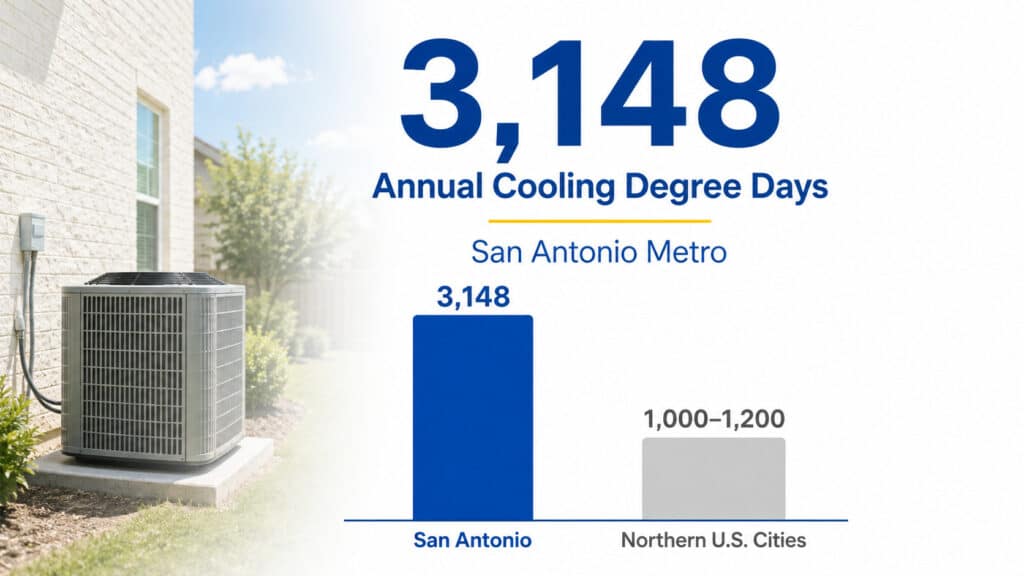
The cooling degree days in the San Antonio metro (NWS EWX forecast area) averages 3,148 annually, compared to roughly 1,000–1,200 for many Northern U.S. cities.
Source: National Weather Service, Austin/San Antonio (EWX) forecast area climatological data
High runtime affects specific components predictably. Capacitors, contactors, and fan motors are wear items—they have finite cycle lives, and those cycles accumulate faster in a 2,000-hour season than in a 1,200-hour one. Attic temperatures in the San Antonio metro regularly exceed 140°F from June through September, which adds thermal stress to ductwork, equipment in or near attic spaces, and refrigerant line insulation.
Humidity is a year-round concern, not just a summer one. Condensate drain pans and lines carry significant water volume throughout the long cooling season. A blocked drain causes water damage, biological growth in the system, and—in many modern units—an automatic shutdown via a float switch that looks like a system failure but is actually a drainage problem.
CPS Energy, which serves the San Antonio metro, recorded a system-wide demand peak of 5,858 MW in August 2024. That figure reflects how heavily households and businesses depend on mechanical cooling. The U.S. Energy Information Administration reports that heating and cooling account for approximately 43% of a typical American home’s energy bills.[2] In a city with San Antonio’s climate profile, that share is often higher—which means a system that is underperforming due to a dirty coil, low refrigerant charge, or duct leakage costs money every hour it runs.
Common AC Problems and What They May Mean
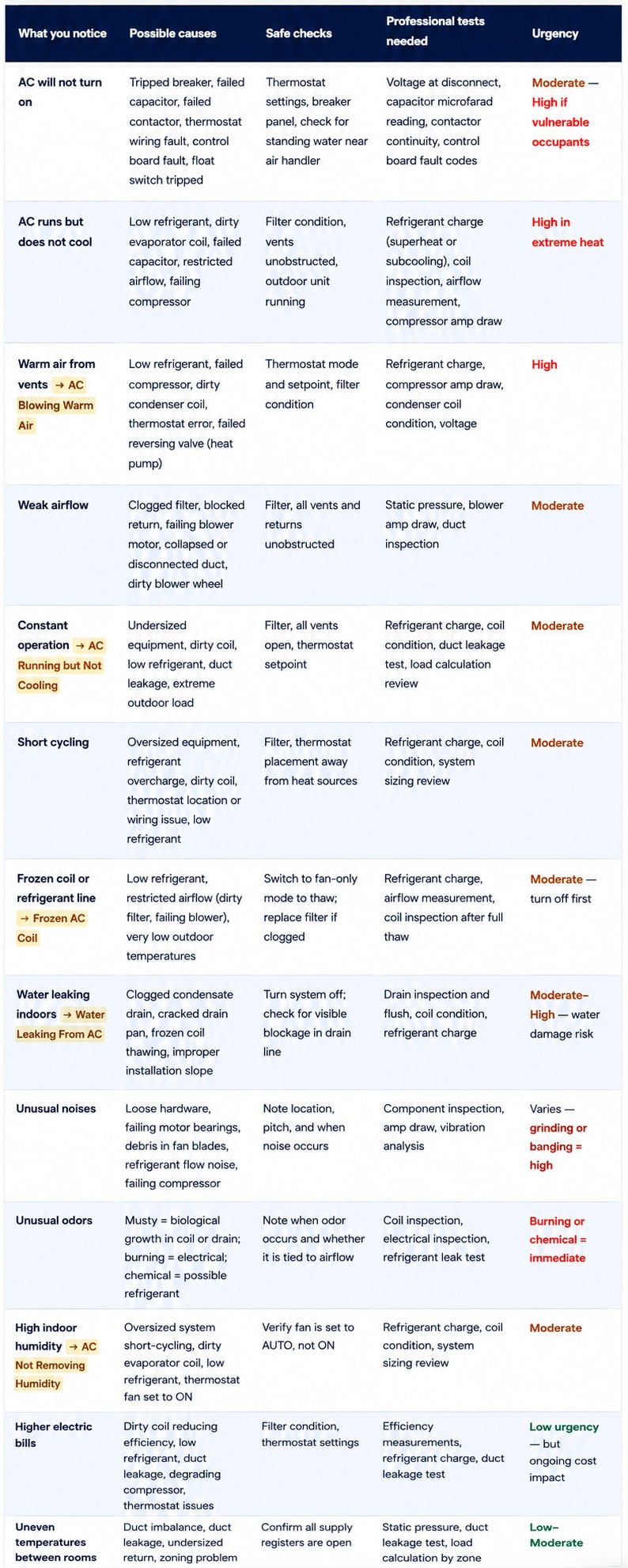
The table below covers the most common AC symptoms, their possible causes, safe homeowner checks, and the professional tests required to confirm a diagnosis. A symptom is the beginning of a diagnosis—not the conclusion. Professional measurement is required before any part is replaced.
Safe AC Troubleshooting Steps
Before calling a technician, these nine checks are safe for any homeowner and take about five minutes. They resolve a significant portion of no-cool calls—and provide useful diagnostic information when they don’t.
- Check thermostat mode and settings. Confirm the system is set to COOL (not HEAT or FAN ONLY), the temperature setpoint is below the current room temperature, and the fan is set to AUTO rather than ON. A thermostat in FAN ON mode blows unconditioned air continuously, which can feel like a cooling failure.
- Check thermostat batteries. A low battery can cause erratic behavior, missed calls, or a blank screen. Replace with fresh batteries if uncertain—this costs less than a service call and takes sixty seconds.
- Inspect the air filter. A clogged filter restricts return airflow and is one of the most common contributors to frozen coils, reduced cooling capacity, and premature motor failure. If the filter is visibly gray or brown and matted, replace it before calling for service.
- Check supply and return vents. Confirm supply registers are open and that return grilles are not blocked by furniture, curtains, or rugs. Closed or obstructed vents create the same effect as a restrictive filter.
- Check the breaker. Find the breaker labeled for the air conditioner or air handler in your electrical panel. If it has tripped to the center position, switch it fully off and then fully on—once. Note whether it trips again.
- Check for outdoor-unit obstructions. Verify the condenser has at least 18–24 inches of clearance on all sides. Remove any vegetation, debris, or covers that may have accumulated. Do not hose down the unit while the system is operating.
- Confirm both indoor and outdoor components are running. The outdoor unit should operate when the system calls for cooling. If the indoor air handler is blowing but the outdoor unit is silent and not running, that is a meaningful diagnostic clue.
- Look for visible water or ice. Check around the indoor air handler for a wet drain pan, standing water, or frost on the refrigerant lines or coil. Visible ice means the system should be switched off at the thermostat and set to FAN ONLY to allow a full thaw before a technician arrives.
- Note sounds, odors, and runtime patterns. Write down when the problem started, what the system sounds like, any odors, and approximately how long the system runs before shutting off. A technician can narrow the diagnosis significantly faster with this information.
⚠ Safety Limits — Stop Here
- Do not repeatedly reset a breaker that keeps tripping. Repeated tripping indicates an electrical fault that resetting will not resolve.
- Do not open electrical panels, disconnect boxes, or the outdoor unit access panel.
- Do not touch capacitors, contactors, wiring, motors, or refrigerant lines. Capacitors retain a lethal charge even when power is off.
- Do not attempt to add refrigerant. EPA Section 608 requires technicians to be certified to purchase and handle regulated refrigerants.
- Turn the system completely off at the thermostat—and at the breaker if needed—if you observe burning, smoke, sparking, flooding, severe vibration, or a breaker that trips immediately after reset.
When AC Repair Is an Emergency
Not every AC problem carries the same urgency. Some require shutting the system down immediately and calling for emergency service. Others can wait for the next available appointment. Use these tiers to decide.
Turn the System Off Immediately — Call for Emergency Service
- Burning smell or visible smoke from any component
- Sparking from the outdoor unit, disconnect, or air handler
- Chemical odor that intensifies when the system runs (possible refrigerant leak)
- Active flooding that cannot be contained with a bucket or towels
- Severe grinding, clanking, or banging that began suddenly
Arrange Same-Day Service
- Complete loss of cooling with infants, elderly residents, or individuals with heat-sensitive medical conditions in the home
- Outdoor temperatures above 95°F and no backup cooling available
- Breaker tripping repeatedly after a single reset
- Significant water leaking beyond what can be managed with towels
Schedule a Standard Diagnostic Appointment
- System running but not reaching setpoint over multiple days
- Reduced airflow after filter replacement
- Gradual decline in cooling performance over the season
- Unusual but non-emergency sounds or odors
- Elevated electric bills without an obvious explanation
Indoor temperatures in an unconditioned San Antonio home can climb rapidly during peak summer hours. Infants, elderly adults, and individuals with certain cardiovascular or respiratory conditions are particularly vulnerable to indoor heat exposure. If professional service cannot be arranged promptly, opening windows after dark to draw in cooler air, running ceiling fans, or accessing a public cooling center can provide a temporary buffer. The City of San Antonio and Bexar County operate cooling centers during heat events; check with Bexar County Emergency Management for current locations.
What a Proper AC Diagnosis Should Include
A diagnosis based on symptoms alone—without documented measurements—is not a diagnosis. A properly conducted AC service visit should produce a written record of specific readings before any part is replaced or condemned.
The Five-Measurement Rule
A thorough AC diagnosis must include at least these five measurements. No single reading confirms the system’s overall health.
- Capacitor microfarad reading under load. Run capacitors account for 31% of all AC repair part orders, according to National HVAC Parts’ 2026 analysis of more than 45,000 service orders—more than the next three failure categories combined.[3] A static capacitor test may pass a weakened capacitor; a reading under operating load is more reliable.
- Refrigerant superheat or subcooling. The appropriate measurement depends on metering device type—fixed-orifice systems use superheat; TXV systems use subcooling. According to Florida Solar Energy Center (FSEC/UCF) research, 50–67% of residential AC systems have improper refrigerant charge or airflow problems, contributing to efficiency losses of up to 20%.[4] Measuring refrigerant charge without first verifying airflow produces an unreliable result.
- Supply and return temperature differential. The temperature split across the evaporator coil confirms the system is removing heat from the air. A low split may indicate a refrigerant, airflow, or coil problem—but the reading alone does not confirm which one is responsible.
- Compressor and motor amp draw. Amp draw compared against the nameplate rated-load amperage (RLA) reveals whether a compressor or fan motor is laboring, overloading, or approaching the end of its operational life. A compressor that draws within spec today may still be declining; this is one measurement, not a complete prognosis.
- Static pressure or verified airflow. Measured against ACCA Manual D standards, external static pressure reveals whether the duct system delivers the airflow the equipment requires. High static pressure is a common underlying cause of premature component failure that often goes undetected if airflow is not tested.
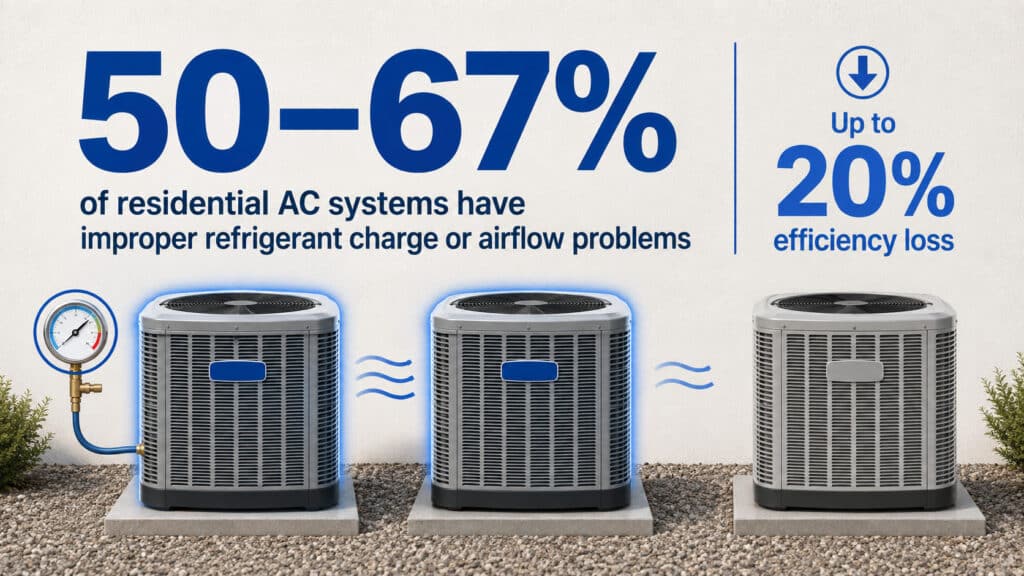
50–67% of residential AC systems have improper refrigerant charge or airflow problems, causing efficiency losses of up to 20%.
Source: Florida Solar Energy Center (FSEC/UCF) field research
A thorough diagnosis should also include:
- Contactor inspection and voltage measurement at the outdoor disconnect
- Visual inspection of evaporator and condenser coils for dirt, debris, or physical damage
- Blower wheel and motor condition
- Condensate drain pan and drain line inspection and flush test
- Ductwork visual inspection at accessible points for disconnected sections or obvious leaks
- Thermostat communication verification across both stages if applicable
- Retrieval of manufacturer fault codes from the control board where supported
Do not attempt electrical testing or refrigerant measurement yourself. Both require specialized calibrated instruments and, for refrigerant work, EPA Section 608 certification.
Common AC Repair Categories
Understanding what each repair involves—and what should be tested before approving it—helps you evaluate a technician’s explanation and ask informed questions.
Capacitors and Contactors
The most frequently replaced components in residential systems. Capacitors start and run compressors and fan motors; contactors switch high-voltage power to the outdoor unit on a call from the thermostat. Both are relatively low-cost parts, but a capacitor or contactor that fails repeatedly may indicate underlying voltage irregularities, excessive heat exposure, or a compressor drawing elevated current that is stressing the component. Replacing the symptom without investigating the cause leads to recurring failures.
Thermostats
A faulty thermostat can mimic almost any system symptom—erratic cycling, no cooling, incorrect temperature readings, or communication faults with variable-speed equipment. Before condemning a thermostat, a technician should verify voltage at the thermostat terminals and confirm correct wiring to the air handler and outdoor unit.
Condensate Drains
Algae, debris, and biofilm accumulate in drain pans and lines, particularly during long cooling seasons. A blocked drain triggers a float switch in many modern units, shutting the system down—a symptom often mistaken for a refrigerant or electrical failure. Clearing and treating the drain is a low-cost repair that prevents significant water damage and biological contamination of the coil.
Blower and Condenser Fan Motors
Motor failures reduce airflow through the system (blower) or heat rejection from the outdoor unit (condenser fan). Before replacing a motor, a technician should confirm whether the run capacitor is the actual failure point—a failed capacitor produces symptoms nearly identical to motor failure. A motor that fails prematurely may also indicate a static pressure or restriction problem that was overloading the motor.
Refrigerant Leaks
Leaks occur at fittings, coil joints, service valves, and in some cases the coil itself. Recharging a system without locating and repairing the leak is a temporary measure that delays the next failure. Leak detection, confirmed repair, and documented recharge should be completed together. As of January 1, 2025, new residential split-system equipment uses R-454B or R-32 rather than R-410A, per EPA Technology Transitions rules.[5] Existing R-410A systems remain fully serviceable—R-410A service refrigerant remains legal with no end date specified—but refrigerant costs have increased 40–70% since 2022 as production allowances are reduced. → AC Repair Cost San Antonio
Evaporator Coils
A dirty or damaged evaporator coil reduces cooling capacity and contributes to frozen lines and humidity problems. Coil cleaning is a maintenance task; coil replacement is a major repair. Before approving coil replacement, confirm whether the failure is physical (damage, corrosion, internal leak) or operational (dirt buildup that cleaning resolves). A new coil installed in a system with airflow or refrigerant problems will not perform to its rated capacity.
Compressors
The most expensive single component in a central AC system. Before approving compressor replacement, a technician should confirm the diagnosis with amp draw, winding resistance tests, and refrigerant charge documentation. A compressor that failed due to low refrigerant, a dirty coil, or chronic high static pressure may fail again under the same conditions if the underlying cause is not corrected alongside the replacement.
Control Boards and Wiring
Board failures can produce nearly any symptom. Wiring problems—corroded terminals, loose connections, rodent damage—are frequently overlooked and can cause intermittent symptoms that are difficult to reproduce during a service call. A technician should inspect wiring and terminals and retrieve fault codes before condemning a control board.
Ductwork and Airflow
ENERGY STAR estimates that 20–30% of conditioned air in a typical home is lost to duct leakage, reducing system efficiency by up to 20%.[6] Ductwork problems rarely announce themselves dramatically, but they consistently increase operating costs and can cause premature equipment failure by forcing the system to run longer to reach setpoint. High static pressure detected during a system diagnostic is often the first indication that ductwork deserves separate inspection. → AC Running but Not Cooling
Repair or Replace? How to Make the Decision
The repair-or-replace decision should rest on documented facts about the specific system—not on a single quoted repair cost, not on age alone, and not on a technician’s general preference. A framework helps, but no formula substitutes for actual system data.
Factors that belong in the decision:
- Confirmed failure. What component has failed, confirmed by measurement? Is this an isolated failure or part of a pattern?
- Overall system condition. What do refrigerant charge, airflow, coil health, and electrical readings show across the whole system?
- Repair history. How many repairs has this system required in the past two to three years? A pattern of multiple failures in a short period is a stronger replacement signal than any single expensive failure.
- Refrigerant type. R-22 systems are no longer serviceable at a reasonable cost—refrigerant is extremely scarce and costly. R-410A systems remain fully serviceable, though refrigerant costs have increased. This is one factor, not an automatic replacement trigger.
- Warranty status. Is the failed component under a manufacturer’s parts warranty? Is labor covered by any existing agreement?
- Airflow and ductwork condition. A new system installed in a duct system with significant leakage, undersized returns, or high static pressure will not perform to its rated SEER efficiency. Duct condition is part of the replacement calculus, not a separate problem.
- Energy cost of the current system. A system that is measurably underperforming relative to its rating adds a daily cost-of-delay argument to the repair-or-replace calculation.
- Complete repair cost. The total cost to return the system to working condition—not just the failed component in isolation. A capacitor plus a refrigerant recharge plus a failing contactor may each seem reasonable individually but total to a significant sum.
Original Heuristic — The Repair Ratio Rule
Compare the complete repair cost—all parts and labor needed to restore the system—with the installed cost of an equivalent, correctly sized replacement system. Use a real replacement quote, not an advertised entry-level price for a different system size. That ratio is your starting point. A 10-year-old system needing a capacitor is a different conversation from a 10-year-old system needing a compressor, an active refrigerant leak repair, and a coil cleaning. Age is one input to the ratio—not the decision itself. A system in good overall condition with an isolated failure may still be worth repairing. A system in poor overall condition may warrant replacement at a lower repair-cost ratio.
Do not apply a universal percentage cutoff. The relevant questions are: what is the confirmed condition of the whole system, what is the realistic remaining service life if the repair is made, and what does the complete repair cost represent relative to a properly sized replacement?
What to Expect During an AC Repair Appointment
A professional AC diagnostic and repair visit should follow a consistent sequence. If a technician recommends a repair before completing the steps below, ask what measurements support the recommendation before approving any work.
- Review of symptoms and repair history.The technician should ask when the problem started, what has changed recently, and what repairs the system has received. Prior repairs—especially refrigerant recharges or part replacements—are relevant to the current diagnosis.
- Reproduce or observe the problem.Whenever possible, the technician should operate the system to observe the failure firsthand, rather than working from a description alone. Intermittent problems are harder to reproduce but worth the effort.
- Inspect the complete system.A proper inspection covers both indoor and outdoor components, the air handler, accessible ductwork, the condensate drain pan and line, and the thermostat—not only the component suspected of failing.
- Record relevant measurements.Capacitor reading, refrigerant charge, temperature differential, amp draw, and static pressure should be documented before any parts are replaced. These readings establish the baseline condition.
- Identify the failed component and any contributing cause.The technician should explain what failed, what measurement confirms it, and whether an underlying condition—high static pressure, low refrigerant, voltage irregularities—may have contributed to the failure and could cause the replacement component to fail as well.
- Explain options and pricing in writing.You should receive a clear scope of work, the cost of parts, the cost of labor, and any conditions that may affect the outcome—before any work begins. Verbal-only estimates are insufficient for significant repairs.
- Complete the approved repair.No work begins without your written approval of the scope and price.
- Retest and document performance after repair.The technician should re-measure the relevant parameters after completing the repair to confirm the system is operating correctly—not simply that the part is installed.
Questions to Ask Before Approving a Repair
- What specific measurement confirms this diagnosis—and what is the normal specification for comparison?
- Is this the failed component, the underlying cause, or both? What caused this part to fail?
- What is included in the quoted price—parts, labor, refrigerant, leak repair?
- What will you retest and document after the repair is complete?
- Is this part covered by a manufacturer warranty? How long, and under what conditions?
- What does the rest of the system show—refrigerant charge, coil condition, airflow, amp draw?
- At what point would you recommend replacement rather than this repair?
- Can I receive the diagnostic findings and measurements in writing before I approve anything?
Frequently Asked Questions
Why is my AC running but not cooling?
An AC that runs without cooling typically has one of four problems: restricted airflow from a clogged filter or failing blower motor, low refrigerant charge from a leak, a dirty or frozen evaporator coil, or a failing compressor. The symptom looks identical across all four causes—professional measurement identifies which one is present. → AC Running but Not Cooling
Should I turn off an AC that is blowing warm air?
Not necessarily. Warm air alone does not require an immediate shutdown—turn the system off only if you see ice on the refrigerant lines or coil, smell burning, hear severe mechanical noises, or the breaker is tripping. Running the system briefly so a technician can observe its behavior is often useful for diagnosis. If you see visible ice, switch to fan-only mode to thaw safely before service. → AC Blowing Warm Air
Can a dirty filter stop an AC from cooling?
Yes. A severely clogged filter restricts return airflow to the point where the evaporator coil cannot absorb heat from the air—and in extreme cases, the coil surface drops below freezing, creating ice that blocks airflow further. Replacing the filter may resolve the problem. If the system ran with a frozen coil for an extended period, a technician should confirm the coil and refrigerant charge are undamaged before returning the system to normal operation.
Why does an AC coil freeze?
Two primary causes: low airflow (dirty filter, blocked return, failing blower) and low refrigerant charge. Both reduce the rate at which the coil absorbs heat, allowing its surface temperature to drop below freezing. If you see ice on the lines or coil, turn the system off and switch to fan-only to allow a full thaw. Running a frozen system can damage the compressor. → Frozen AC Coil
Why is my AC running constantly?
On an extreme-heat day, constant operation may simply mean the system is working at capacity—which is normal. A system that never cycles off even at moderate outdoor temperatures warrants evaluation. Possible causes include low refrigerant charge, a dirty evaporator or condenser coil, significant duct leakage, or a system that was never sized correctly for the home’s actual cooling load. → AC Running but Not Cooling
Is a 10-year-old AC worth repairing?
Age is one input to the decision, not the decision itself. A 10-year-old system with a maintained refrigerant charge, clean coils, functioning ductwork, and one isolated failure may have years of reliable service remaining. A 10-year-old system with a pattern of repeat repairs, an active refrigerant leak, and documented airflow problems is a different situation. The relevant question is: what does the complete system condition show, and how does the complete repair cost compare to a correctly sized replacement?
When should I request a second opinion on an AC repair recommendation?
Request a second opinion when a technician recommends compressor replacement, a full system replacement, or any repair costing several hundred dollars or more without providing documented measurements to support the diagnosis. Any recommendation that cannot be tied to specific readings—capacitor microfarads, superheat or subcooling values, amp draw—deserves independent verification before approval.
Next Step: Request a Measurement-Based Diagnostic
A clear decision path keeps AC problems from becoming expensive guesses. The steps are consistent whether your system is short cycling, blowing warm air, or not turning on at all:
- Identify the symptom and note when it started.
- Perform only the safe checks described above.
- Turn the system off when safety risks are present—burning odors, sparking, flooding, or repeated breaker tripping.
- Request a diagnostic that produces documented measurements, not a symptom-based assumption.
- When repair versus replacement comes up, base the decision on documented system condition and a complete cost comparison—not on age or a single isolated quote.
A major repair or replacement recommendation should always be supported by measurements. If a technician cannot tell you which specific reading confirms the diagnosis and what the normal specification is for comparison, ask before approving.
Schedule an AC Diagnostic with Honeycomb
Honeycomb serves San Antonio, Bulverde, Boerne, and other surrounding areas, with diagnostic appointments that document findings in writing before any repair is recommended.
Available 24/7 for emergency AC repair in San Antonio and surrounding areas
📞 Call or Text (210) 750-6725
Owner · Honeycomb Heating & Cooling
Brandon Caputo founded Honeycomb Heating & Cooling to bring system-driven reliability and customer-first transparency to the San Antonio HVAC market. Grounded in the principle of proactive, preventative care rather than reactive crisis management, Honeycomb specializes in high-efficiency AC and heating installations, advanced diagnostic repairs, and localized indoor air quality solutions. Brandon infuses empathy into every service call, ensuring his team actively listens to homeowners to deliver clear, value-based comfort solutions.
About Honeycomb Heating & Cooling
San Antonio’s trusted specialist in residential air conditioning installation, swift repairs, and energy-saving preventative maintenance. Founded with a commitment to upfront flat-rate pricing and reliable home comfort.
600+ Completed Projects · 5.00-star Google Rating · Open 24/7 for Emergency Support · Founded by Brandon Caputo.
- Upfront Flat-Rate Pricing—No Hidden Fees
- Zero-Pressure Repair & System Options
- Background-Checked & Certified Technicians
- Amana Authorized Elite Partner
- Goodman High-Efficiency System Specialists
- Comprehensive “Comfy Club” Maintenance Programs
- 600+ 5-Star Reviews Across San Antonio
- Fully Licensed & Insured · Texas
- Free estimates & online booking
- Zero Interest with No Monthly Payment financing available
- Office Address: 26995 US Highway 281 Suite C, San Antonio, TX 78260
Sources & Citations
- National Weather Service Austin/San Antonio Forecast Office (EWX). Climatological data for the San Antonio metro area. forecast.weather.gov
- U.S. Energy Information Administration. (2022). How much energy do buildings use? — HVAC accounts for approximately 43% of residential energy use. eia.gov
- National HVAC Parts. (2026). 2026 HVAC Parts Failure Index: Which Parts Break Most, By Brand and Season. Analysis of 45,000+ service orders. nationalhvacparts.com
- Florida Solar Energy Center / University of Central Florida (FSEC/UCF). Evaluation of Air Conditioning Performance Degradation. Field research on refrigerant charge and airflow in residential systems. publications.energyresearch.ucf.edu
- U.S. Environmental Protection Agency. Technology Transitions Program — Refrigerant Transition to Low-GWP Alternatives. New residential split-system manufacturing shifted to refrigerants with GWP ≤700 (R-454B/R-32) effective January 1, 2025. R-410A service refrigerant remains legal indefinitely. epa.gov
- ENERGY STAR / U.S. Department of Energy. Duct Sealing. Estimates 20–30% of conditioned air lost to duct leaks, reducing system efficiency by up to 20%. energystar.gov
- NuWatt Energy. (2026). CPS Energy Rates 2026. CPS Energy all-in residential rate approximately 12.5¢/kWh as of 2026. nuwattenergy.com
- WeatherSpark. Average Weather in San Antonio, Texas. Hot season runs approximately 3.7 months (late May–mid-September); muggy period 6.7 months; average summer highs 92–95°F. weatherspark.com
- U.S. Department of Energy, Federal Energy Management Program. Purchasing Energy-Efficient Residential Central Air Conditioners. ENERGY STAR efficiency data and regional annual energy use for central AC systems. energy.gov
- ACCA (Air Conditioning Contractors of America). Manual D — Residential Duct Systems. Standards for residential duct design and external static pressure measurement. acca.org
- AC Direct Blog. (2026). R-410A Phase-Out Timeline: What Homeowners Need to Know. R-410A refrigerant costs up 40–70% since 2022; service refrigerant remains legal with no end date. acdirect.com


