



 (726) 233-6044
Quick Answer: When to Repair Your AC — What Should You Do?
Repair your AC when the system is under 12 years old, the repair cost is below 50% of a new system’s price, and the problem is a single failed component — a capacitor, refrigerant charge deviation, fouled coil, or blocked drain. Those four issues alone account for the majority of “my AC stopped working” calls, and every one of them is a repair, not a replacement. Knowing when to repair your AC versus replace it is the highest-leverage HVAC decision a San Antonio homeowner can make.
Here’s what most HVAC articles miss: the question isn’t just “repair or replace?” — it’s “which specific failure am I actually looking at?” A system that short-cycles and blows warm air can look like a dying compressor. It’s usually a $30 capacitor. A unit that runs all night without hitting setpoint can look like end-of-life efficiency loss. It’s often a dirty coil or a low refrigerant charge correctable in one visit.
The 7 signs below are drawn from common diagnostic patterns in the San Antonio market, where 3,148 annual cooling degree days (National Weather Service) push AC components harder than almost any metro in the country. Each sign includes what the symptom actually means, what it costs to fix, and the specific measurement a technician should document before you spend a dollar.
Per Bryant, one of North America’s largest AC manufacturers: Most residential central AC systems are designed to last 15 to 20 years. In San Antonio’s extended cooling season, real-world component wear frequently outpaces the age on the nameplate — but that’s an argument for better maintenance, not premature replacement. Source: Bryant Heating & Cooling
The Core Decision Rule Before We Get to the 7 Signs
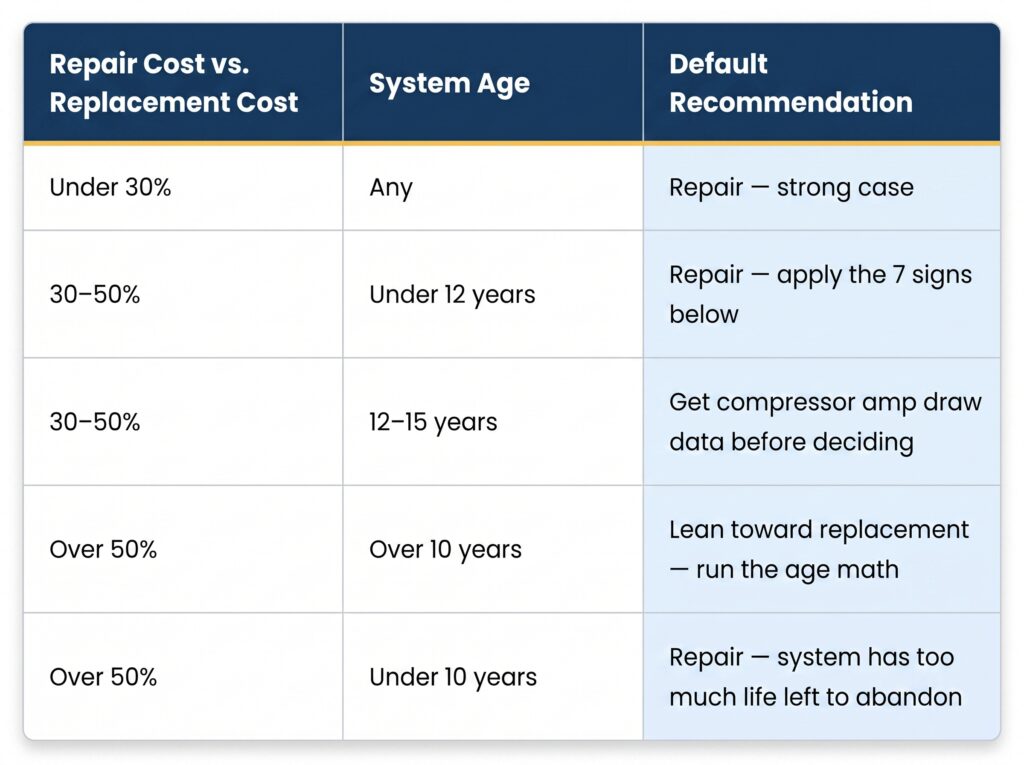
The fastest filter for any repair-or-replace decision is the 50% Rule: if a repair estimate is under 50% of what a new system costs installed, and your unit is under 10 years old, repair almost always wins financially. Use this as a first screen — not a final answer. The 7 signs below tell you when repair wins even if the cost math is close.
To use the 50% Rule, you need two real numbers: the repair quote and the replacement quote — both in writing, on the same visit. A technician who only gives you a replacement quote hasn’t given you a decision framework; they’ve given you a sales pitch.
Sign #1: The Problem Is a Failing Capacitor
What it looks like
The system short-cycles (turns on and off rapidly), struggles to start, runs but doesn’t cool well, or trips the breaker. Symptoms closely mimic what a dying compressor produces — which is exactly why this is the most over-diagnosed “need a new system” call in the industry.
A failing capacitor is a $15–$45 part with a $100–$250 installed cost. It is also one of the most common single-point failures on any AC system. If a technician recommends replacement after a capacitor-symptom call without producing a documented microfarad reading, you have not received a diagnosis.
The capacitor’s job is to give the compressor and fan motors the electrical boost they need to start and run. When it degrades, those motors struggle under load — creating every symptom that looks like a dying compressor. The only way to distinguish the two is to measure the capacitor’s microfarad output under load and compare it to the nameplate spec.
- Diagnostic measurement required: Capacitor microfarad reading under load
- Red flag: Technician recommends replacement without this number on the invoice
- Cost to repair: $100–$250 installed (part + labor)
- When it tips toward replacement: Only if compressor amp draw also shows the compressor is drawing above its rated spec — two separate measurements
According to Bryant and Trane — two of the largest residential AC manufacturers — capacitor failure is one of the most common reasons an AC unit hums but won’t start, shuts down mid-cycle, or short-cycles on a hot day. Industry field data puts capacitor problems at roughly 30% of all AC service calls, more than any other single component. Sources: Bryant Heating & Cooling, Trane
Sign #2: The System Is Under 10 Years Old and This Is the First Repair
What it looks like
A relatively young system with no prior repair history suddenly fails. Homeowners often interpret this as a sign something is fundamentally wrong with the system — a lemon, a bad install, or early failure. Almost without exception, it’s a component issue, not a platform failure.
A single repair on a system under 10 years old with a clean maintenance history defaults to repair — no cost math needed. The system has substantial remaining life. The only exception is a documented compressor failure on a system with no active warranty, where the repair cost alone may tip the 50% Rule.
Age and repair history together are more predictive than age alone. A system that has never needed a service call at 9 years old is not a system “about to fall apart” — it’s a system that had one component fail, which is normal over that runtime. Replacing it would be the equivalent of selling a car because it needed new brake pads at 80,000 miles.
The right question isn’t “how old is this system?” It’s “how many repairs has this system needed, and what did they cost?” That’s the pattern that predicts near-term failure — not calendar age.
According to SmartHQ’s analysis of home service repair patterns, nearly 25% of appliance and HVAC service visits require a follow-up call, and over half (54%) involve needing a part that wasn’t initially diagnosed. Homeowners who defer routine maintenance are statistically most vulnerable to this cycle — when symptoms that a $200 repair could fix escalate into premature replacement pressure. Source: SmartHQ
Sign #3: Your Energy Bills Jumped but the System Is Under 10 Years Old
What it looks like
Monthly electricity bills are noticeably higher than the same period last year. The system seems to run longer cycles than it used to. The house takes longer to reach setpoint. Homeowners often interpret this as the system “losing efficiency with age” and assume a new unit is the only fix.
On a system under 10 years old, a sudden efficiency drop is almost never permanent age-related degradation — it’s almost always a correctable condition: low refrigerant charge, fouled coils, a restricted air filter, or reduced blower airflow. Each of these is fixed in a single service visit. None requires a new system.
Heating and cooling account for approximately 43% of a typical home’s energy bill, per the U.S. Department of Energy. In San Antonio, where the cooling season runs from roughly March through October, the AC’s share of that figure is disproportionately large. A 15% efficiency drop from a fouled coil on a system running 2,200+ hours a year shows up clearly on the bill — and is fixed in a single cleaning visit.
The specific correctable causes of a sudden efficiency drop on a sub-10-year system:
- Low refrigerant charge: Even a 10% deviation from spec can reduce efficiency significantly. Measured via superheat or subcooling — a 15-minute gauge reading, not a guess.
- Dirty evaporator or condenser coils: Coil fouling restricts heat exchange. Professionally cleaned in one visit; can restore meaningful BTU output.
- Reduced blower airflow: A clogged filter, dirty blower wheel, or duct restriction reduces airflow and makes the system work harder. Measured with a manometer, not estimated by sight.
- Refrigerant metering device issue: A partially restricted TXV or orifice tube causes the same symptoms as a refrigerant shortage. Diagnosed via superheat/subcooling delta.
Research published by the Florida Solar Energy Center (FSEC) at the University of Central Florida found that approximately 50–67% of all air conditioners suffer from improper refrigerant charge or airflow problems — causing them to operate 20% less efficiently than a correctly maintained system. Both conditions are corrected in a standard repair visit. Neither requires a new system. Source: Florida Solar Energy Center
Sign #4: The System Blows Warm Air During a Cooling Cycle
What it looks like
The AC is running — the air handler is blowing, the outdoor unit is spinning — but the air coming from the vents isn’t cold. Or the system cools for a while and then gradually loses cold output during a long cycle. This symptom gets a disproportionate number of replacement recommendations.
Warm air from a running AC is one of the most commonly misdiagnosed symptoms in residential HVAC. The most frequent causes — low refrigerant charge, a blocked condenser, a failed reversing valve on a heat pump, or a refrigerant metering issue — are all service-call repairs. The supply/return temperature split measurement is the single fastest tool to confirm which cause is in play.
What a technician should measure when warm air is the complaint:
- Supply/return temperature split: Should be 15–20°F in most systems. A split below 10°F with the system running confirms the AC is not delivering its rated BTU output — and narrows the cause to refrigerant, airflow, or coil issues.
- Refrigerant superheat or subcooling: Confirms whether refrigerant charge is the culprit and by how much.
- Condenser condition: A blocked or dirty condenser forces high discharge pressure that trips system safeties — and is resolved by cleaning, not replacement.
The only scenario where warm air conclusively points toward replacement: a confirmed compressor failure (documented via amp draw outside nameplate spec) on a system 15+ years old running R-22 refrigerant. Everything else is a repair candidate.
Sign #5: Weak Airflow from Vents
What it looks like
Noticeably reduced airflow from supply vents — some rooms don’t feel cool even when the system runs. The problem may affect the whole house or just certain zones. This symptom is frequently (and incorrectly) attributed to a failing blower motor or a worn-out system.
Weak airflow is almost always a duct, filter, or blower issue — not a system failure. A dirty blower wheel, a collapsed duct section, a clogged return grille, or an undersized filter media all produce identical symptoms. According to ASHRAE research, just 0.042 inches of accumulated dirt on an AC coil can reduce system efficiency by 21%. Every one of these is a repair-category fix.
Airflow problems create a cascade of secondary symptoms that make the system look like it’s failing when it’s actually being choked:
- Reduced airflow → longer run times → higher bills
- Reduced airflow → lower evaporator coil temperatures → coil freeze-up → system appears to stop cooling entirely
- Reduced airflow → uneven temperatures room to room → homeowner assumes the system is “too small” for the house
The correct diagnostic is a blower airflow measurement — a duct pressurization test or flow hood reading, depending on access. This costs the price of a service call. Replacing a system because of weak airflow without this measurement first is diagnosing the wrong problem.
Per ASHRAE-referenced research cited by Modern PurAir and Permatron: dirty evaporator coils reduce HVAC system efficiency by 10–25%, and just 0.042 inches of surface fouling can cut efficiency by 21%. A system that “isn’t cooling well” because of coil fouling or a blower restriction will fail any informal assessment — and pass a measurement-based diagnostic once the issue is corrected. Sources: Modern PurAir, Permatron
Sign #6: The System Uses R-410A — Not R-22
What it looks like
The system was installed between roughly 2010 and 2024 and uses R-410A refrigerant. It may need a refrigerant repair or recharge. Many homeowners have heard that “refrigerant is being phased out” and assume this means their system is obsolete — when it usually isn’t.
R-410A is restricted under the EPA’s 2025 Technology Transitions Program — but it is not banned from use in existing equipment. An R-410A system that needs a refrigerant repair in 2026 is still a repair candidate, not a replacement candidate, provided the system is under 15 years old and passes the 50% Rule. The phase-out story that matters for replacement decisions is R-22 — not R-410A.
Here’s the distinction that most coverage misses:
- R-22 (phased out 2020): No longer produced. Recycled stock only, priced at $100–$175 per pound. Even a minor refrigerant repair on an R-22 system runs $400–$1,500 before the leak source is fixed. R-22 systems are strong replacement candidates once they need any refrigerant work.
- R-410A (restricted, not banned): Production allowances are being cut roughly 40% between 2024 and 2028 under the EPA’s Technology Transitions Program, but R-410A is still available for service of existing equipment. A refrigerant repair on an R-410A system under 12 years old is still economically sound in 2026.
- R-454B / R-32 (current standard): Required in new equipment as of January 1, 2025. Lower global warming potential. Not backward-compatible with existing R-410A systems.
If your system is on R-410A and the issue is a refrigerant leak — locate the leak, repair it, and recharge. This is a repair, not a retirement signal. If your system is on R-22, get both a repair quote and a replacement quote side by side before deciding.
Per AC Direct’s 2026 EPA AIM Act breakdown: R-410A manufacturing for new equipment ended January 1, 2025 — but the phase-out targets new system production, not service. Existing R-410A systems can still be serviced and recharged indefinitely. The cost implication is gradual: as R-410A supply tightens, recharge costs will rise, but the refrigerant remains available for service in 2026. Source: AC Direct
Sign #7: The System Has Had Fewer Than 3 Repairs in the Last 24 Months
What it looks like
The system has had one or two service calls in recent memory. Homeowners sometimes use a repair pattern — “I’ve had it worked on twice now” — as the reason to replace. But two repairs in 24 months, for different issues, on a system under 12 years old is not a pattern. It’s normal component attrition.
The repair threshold that predicts near-term major failure is three or more paid service calls for different issues within 24 months, on a system older than 8 years — the “3-in-24 Rule.” Under that threshold, repair history alone is not a replacement signal. The specific nature of each repair matters more than the count.
A single capacitor replacement and a condensate drain flush in the same year are two repairs — but they share nothing mechanically. Neither predicts what happens next. Three compressor-adjacent failures in 24 months on a 12-year-old system tells a completely different story.
What to track in your service history:
- Compressor-related repairs: More predictive of near-term failure than any other category
- Refrigerant leaks: A second leak at a different location suggests the line set or coil is deteriorating
- Repeated electrical failures: Capacitors, contactors, and control boards failing in sequence suggest a power-quality or wiring issue, not a dying platform
- Maintenance-only calls (filter, coil cleaning, tune-up): These don’t count as repairs for the 3-in-24 Rule
A 2025 HVAC customer survey by FIELDBOSS found that poor communication — not price — is the primary driver of homeowner dissatisfaction after service calls. Homeowners who feel pressured into quick replacement decisions without clear diagnostic data consistently report lower trust in the contractor. The antidote is documentation: a contractor who hands you measured values before a recommendation has nothing to hide. Source: FIELDBOSS
What AC Repair Actually Costs in 2026: San Antonio Market Rates
Most AC repairs run $250–$700, with a national average around $375 per Fixr’s 2026 cost data. The most frequently misquoted repair — compressor replacement — averages $1,600 installed (range: $850–$2,400) per This Old House’s 2026 pricing guide. Full system replacement runs $4,500–$12,000 depending on tonnage, efficiency rating, and brand. These numbers are what you need to run the 50% Rule accurately.
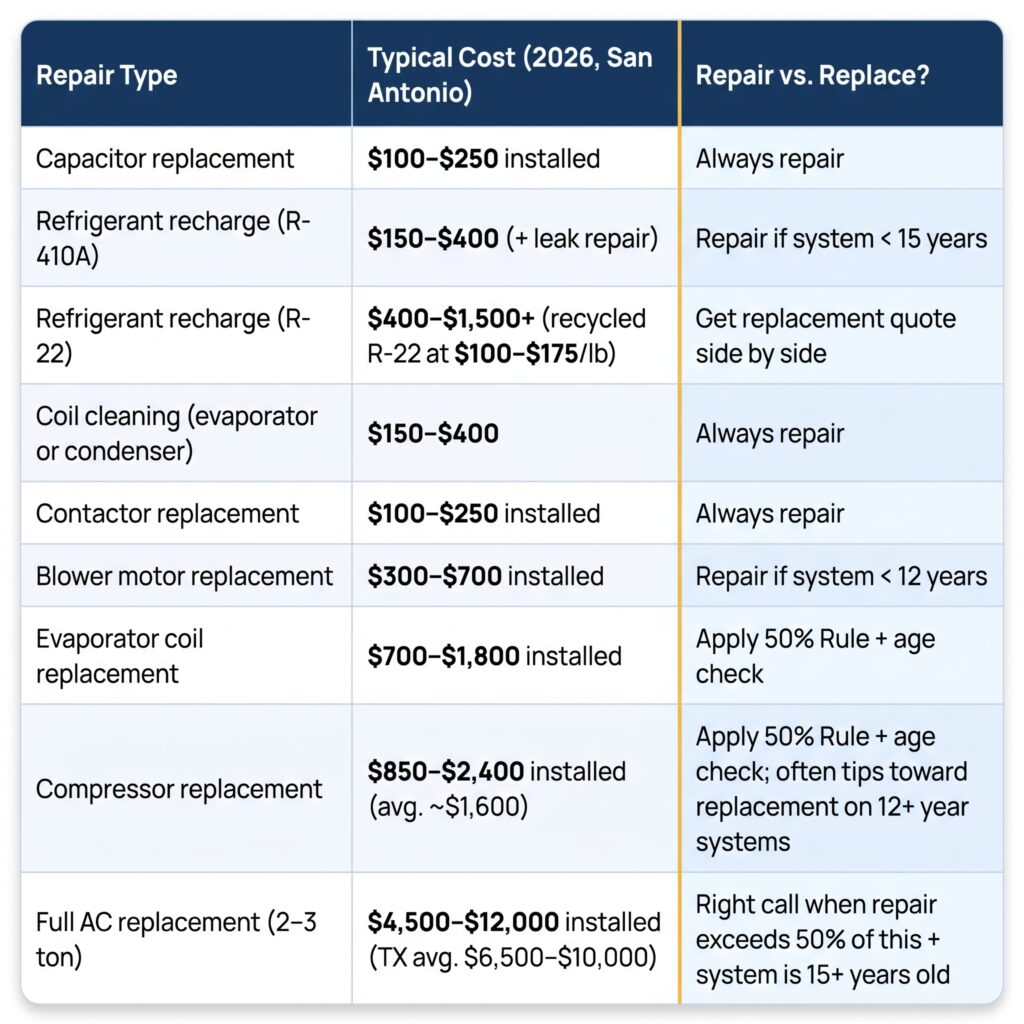
Cost data based on 2026 national and San Antonio-area market rates.
The 5 Measurements That Separate a Real Diagnosis from a Sales Pitch
Any recommendation to replace an AC system — from any technician, any company — should be backed by five documented measurements on the invoice. If those measurements aren’t there, the recommendation is an opinion, not a diagnosis. Knowing when to repair ac systems correctly depends entirely on this data.
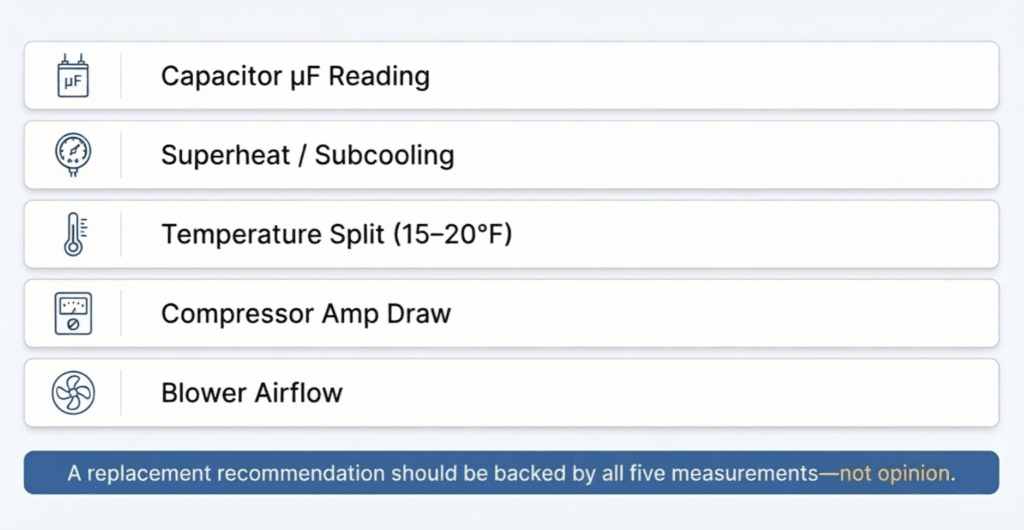
These are the five values a technician should document before recommending any major decision:
- Capacitor microfarad reading under load — confirms whether the capacitor is within tolerance or degraded. A borderline capacitor looks fine at rest.
- Refrigerant superheat or subcooling measurement — confirms whether the system is operating within its designed refrigerant charge. Requires 15+ minutes of runtime before measurement is valid.
- Supply/return temperature split — confirms the system is delivering its rated BTU output. Should be 15–20°F in most residential systems.
- Compressor amp draw under load, compared to nameplate spec — the most revealing single measurement for compressor health. A compressor drawing above its rated amperage is failing. One drawing well below may already be underperforming under San Antonio heat.
- Blower airflow measurement — confirms the system has adequate airflow. This is the measurement most often skipped, and skipping it causes the most unnecessary diagnostics.
A diagnostic visit that produces all five takes 60–90 minutes. A visit that produces a verbal “you need a new system” in 20 minutes has not produced a diagnosis.
San Antonio’s Climate: Why These Signs Matter More Here Than Most Places
San Antonio logs 3,148 annual cooling degree days (National Weather Service, 30-year climate normals) — far more than most U.S. metros. A longer cooling season means AC components cycle more, coils foul faster, and refrigerant systems see more thermal stress per calendar year. This accelerates wear on the specific components covered in the 7 signs above — but it doesn’t accelerate the case for replacement over repair.
What San Antonio’s climate actually means for the repair-or-replace math:
- A 10-year-old system in San Antonio has logged more runtime than a 10-year-old system in Chicago, Dallas, or Denver. Age on the nameplate understates operational wear.
- Capacitors, contactors, and refrigerant seals all fail faster under high-cycle conditions. These are repair-category components.
- Coil fouling from South Texas dust and pollen accumulates faster — making annual maintenance more important and annual coil cleaning more impactful on efficiency.
- CPS Energy set an all-time demand record of 5,858 megawatts during an August 2024 heat wave. A system running long cycles during grid-peak hours — because of a correctable airflow or refrigerant issue — is costing the homeowner real money every hour it runs at reduced efficiency.
The National Weather Service’s Austin/San Antonio Forecast Office (EWX) records 3,148 annual cooling degree days in its 30-year climate normals for the San Antonio metro — one of the highest figures of any major U.S. city. Source: National Weather Service, NOAA
Red Flags: When a Technician Is Pushing Unnecessary Replacement
Unnecessary AC replacement is the most expensive misdiagnosis in residential HVAC — and unlike a missed repair, it can’t be undone. The following red flags warrant a second opinion before signing anything. Understanding AC repair vs. replacement decisions protects you from pressure-based upselling.
- The visit lasted under 30 minutes. A proper diagnostic — compressor amp draw, refrigerant charge, capacitor test under load — takes 60–90 minutes minimum. A 20-minute visit cannot produce five documented measurements.
- The invoice shows no measured values. Checkboxes labeled “inspected” are not measurements. You need specific numbers: microfarads, superheat/subcooling values, amp draw, temperature split.
- “Your refrigerant is low” with no gauge reading shown. Refrigerant level is measured — not estimated visually. Ask for the superheat or subcooling value and what the spec is for your system.
- “This compressor is about to fail” with no amp draw data. Compressor condition is measured via amp draw against nameplate spec. “About to fail” without a number is a prediction, not a diagnosis.
- No written repair estimate before the replacement quote. You cannot apply the 50% Rule without both numbers in writing. A contractor who skips straight to replacement pricing hasn’t given you what you need to make an informed decision.
- Urgency framing in July without data to back it. Heat creates pressure. That pressure is the optimal environment for replacement upselling. The same decision made in March — with time and data — consistently produces better outcomes for the homeowner.
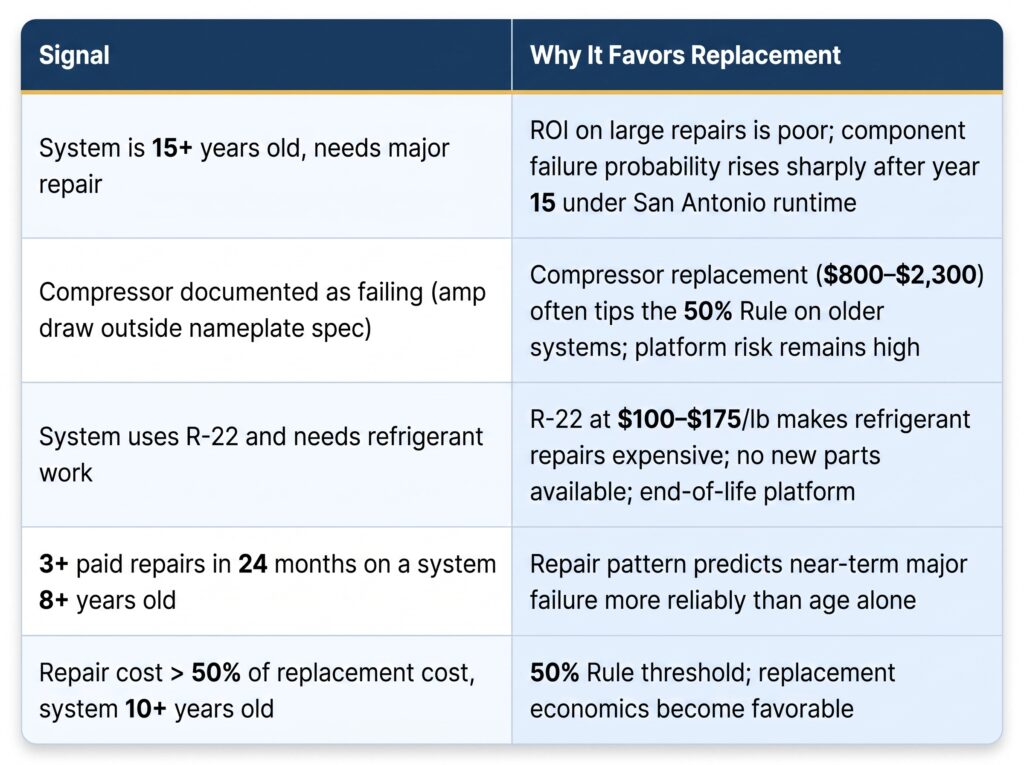
When Repair Isn’t the Right Call: The Signals That Favor Replacement
The 7 signs above define when repair wins. For completeness: repair loses when the system is 15+ years old with a failing compressor, uses R-22 refrigerant and needs any refrigerant work, has hit the 3-in-24 Rule threshold, or the documented repair cost exceeds 50% of replacement cost on a system over 12 years old. Any one of these, backed by measured data, is a legitimate replacement signal.
How Honeycomb Handles the “Repair or Replace?” Call
Honeycomb Heating & Cooling doesn’t recommend replacement without documented diagnostic data. Every service visit produces a written invoice with measured values — not a verbal estimate. The 50% Rule and the 3-in-24 Rule are applied openly, using the system’s actual service record. Both a repair estimate and a replacement estimate are presented in writing, side by side, before any decision is made.
Here’s exactly how a Honeycomb diagnostic visit works when the outcome is unclear:
- System runs for 15+ minutes before any measurement is taken — cold readings are inaccurate
- Capacitor microfarad reading taken under load, recorded on invoice
- Refrigerant superheat or subcooling measured and documented
- Compressor amp draw measured against nameplate rated spec
- Supply/return temperature split recorded
- Blower airflow assessed
- 50% Rule applied using the actual replacement quote for your specific tonnage and system type
- Repair estimate and replacement estimate both presented in writing, simultaneously
Upfront flat-rate pricing. Zero-pressure options. Background-checked technicians. 600+ five-star Google reviews. Texas License # TACLA140435E.
Frequently Asked Questions
When should you repair an AC instead of replacing it?
Repair your AC when the system is under 12 years old, the repair cost is below 50% of a new system’s installed price, and the problem is an isolated component failure — capacitor, refrigerant charge, coil fouling, or condensate drain. Do not repair if the system is on R-22, has failed three or more times in 24 months, or the compressor amp draw is documented outside the nameplate spec.
How much does a typical AC repair cost in San Antonio in 2026?
Common repairs run $125–$600, averaging around $375. A capacitor replacement costs $100–$250 installed. A refrigerant recharge runs $150–$400 depending on refrigerant type. Major repairs like coil replacement run $500–$2,000. Compressor replacement averages around $1,200 installed, per Angi’s 2026 data.
Is a failing capacitor a sign you need a new AC?
No. A failing capacitor is a $15–$45 part ($100–$250 installed) that causes short-cycling and hard-starting — symptoms that mimic compressor failure. It’s one of the most repairable faults on any AC system. Always ask for a documented microfarad reading before agreeing to replacement based on these symptoms.
What is the 50% Rule for AC repair?
If a repair estimate exceeds 50% of what a new system costs installed, and the unit is over 10 years old, replacement is usually the better investment. Under 50%, repair almost always wins. Example: a $2,500 repair against an $8,000 replacement is 31% — repair. A $3,500 repair against a $6,000 replacement is 58% — lean toward replacement.
Does San Antonio’s climate affect how often an AC needs repair?
Yes. The National Weather Service records 3,148 annual cooling degree days for San Antonio — far more than most U.S. metros. A longer, harder cooling season means faster component wear. A 10-year-old unit in San Antonio has logged more runtime than a 10-year-old unit in a northern city — but this accelerates repair frequency for specific components, not the replacement timeline itself.
Can dirty coils cause an AC to stop cooling without needing replacement?
Yes. Fouled evaporator or condenser coils restrict heat exchange and can drop system output significantly, causing the unit to run longer cycles, fail to reach setpoint, or trip on high pressure. A professional coil cleaning restores capacity in a single visit — it’s a repair, not a replacement signal.
How do I know if my AC needs a refrigerant recharge or a new system?
A refrigerant issue on a system under 12 years old running R-410A is a repair — find and fix the leak, recharge the system. The exception is R-22 systems: recycled R-22 costs $100–$175 per pound, making refrigerant repairs expensive enough that replacement often wins on the 50% Rule. R-22 systems with active leaks are strong replacement candidates.
What are signs a technician is pushing an unnecessary AC replacement?
Red flags: the visit was under 30 minutes; the invoice shows no measured values; the technician said “your refrigerant is low” without showing a gauge reading; no written repair estimate was offered before the replacement quote; urgency framing without data to back it. A proper diagnostic takes 60–90 minutes and produces five documented measurements.
When is the cheapest time of year to get an AC repaired in San Antonio?
January through April, before cooling demand ramps up. The same repair booked in July can run 20–40% more once peak-season contractor availability tightens and emergency-rate premiums apply. CPS Energy hit an all-time demand record of 5,858 megawatts in August 2024 — that’s the market condition that inflates repair pricing, not the repair itself.
Need a Measured Diagnostic — Not a Verbal Guess?
Honeycomb Heating & Cooling performs measurement-based diagnostics across San Antonio, Bulverde, Boerne, and the rest of the Hill Country: refrigerant charge verification, capacitor microfarad testing, compressor amp draw, and documented values on every invoice.
Upfront Flat-Rate Pricing · Zero-Pressure Options · Background-Checked Pros · 5.0 Stars on Google (600+ Reviews)
📞 Call or Text (210) 750-6725
Brandon Caputo
Owner · Honeycomb Heating & Cooling
Brandon Caputo founded Honeycomb Heating & Cooling to bring system-driven reliability and customer-first transparency to the San Antonio HVAC market. Grounded in the principle of proactive, preventative care rather than reactive crisis management, Honeycomb specializes in high-efficiency AC and heating installations, advanced diagnostic repairs, and localized indoor air quality solutions. Brandon infuses empathy into every service call, ensuring his team actively listens to homeowners to deliver clear, value-based comfort solutions.
About Honeycomb Heating & Cooling
San Antonio’s trusted specialist in residential air conditioning installation, swift repairs, and energy-saving preventative maintenance. Founded with a commitment to upfront flat-rate pricing and reliable home comfort.
600+ Completed Projects · 5.00-star Google Rating · Open 24/7 for Emergency Support · Founded by Brandon Caputo.
- Upfront Flat-Rate Pricing—No Hidden Fees
- Zero-Pressure Repair & System Options
- Background-Checked & Certified Technicians
- Amana Authorized Elite Partner
- Goodman High-Efficiency System Specialists
- Comprehensive “Comfy Club” Maintenance Programs
- 600+ 5-Star Reviews Across San Antonio
- Fully Licensed & Insured · Texas
- Free estimates & online booking
- Zero Interest with No Monthly Payment financing available
- Office Address: 26995 US Highway 281 Suite C, San Antonio, TX 78260
Sources & Citations
- AC Direct. (2026). R-410A Phase-Out Timeline: Exact 2025–2030 Dates from the EPA AIM Act. https://www.acdirect.com/blog/r410a-phase-out-timeline-dates/
- Bryant Heating & Cooling. (2026). AC Capacitor Replacement Guide: Signs, Costs & Repair Steps. https://www.bryant.com/en/us/products/air-conditioners/ac-capacitor-replacement/
- Bryant Heating & Cooling. (2026). How Long Do AC Units Last? https://www.bryant.com/en/us/products/air-conditioners/how-long-do-ac-units-last/
- FIELDBOSS. (2025). HVAC Customer Preferences: HVAC’s Real Problem Isn’t Price, It’s Poor Communication. https://www.fieldboss.com/blog/hvacs-real-problem-isnt-price-its-poor-communication/
- Fixr.com. (2026). AC Repair Cost in 2026. https://www.fixr.com/costs/air-conditioner-repair
- Florida Solar Energy Center (FSEC), University of Central Florida. (2018). Evaluation of Air Conditioning Performance Degradation. https://publications.energyresearch.ucf.edu/wp-content/uploads/2018/09/FSEC-PF-474-18.pdf
- Modern PurAir. (2026). How Dirty Coils Reduce Capacity and Increase HVAC Costs. https://modernpurair.com/dirty-hvac-coils-reduce-capacity-increase-costs/
- National Weather Service, Austin/San Antonio Forecast Office (EWX). (2026). San Antonio Monthly Climate Normals. NOAA. https://www.weather.gov/media/ewx/climate/SATmonthlynormals.pdf
- Permatron. (2026). How Much Are Dirty Coils Costing You? https://permatron.com/prevent-installs/how-much-are-dirty-coils-costing-you
- San Antonio Report. (2023, August 10). CPS Energy, ERCOT Hit New Demand Records as August Heat Wave Bears Down. https://sanantonioreport.org/cps-energy-ercot-hit-new-demand-records-as-august-heat-wave-bears-down/
- SmartHQ Pro. (2026). The Hidden Costs of Misdiagnosed Appliance Repairs. https://www.smarthqpro.com/blogs/hidden-costs-misdiagnosed-appliance-repairs
- This Old House. (2026). How Much Does an AC Compressor Cost? (2026 Guide). https://www.thisoldhouse.com/heating-cooling/reviews/ac-compressor-cost
- Today’s Homeowner. (2026). How Much Does AC Repair Cost? (2026). https://todayshomeowner.com/hvac/cost/ac-repair-cost/
- Trane Residential. (2026). AC Capacitors: What They Are and Why They Matter. https://www.trane.com/residential/en/resources/blog/air-conditioner-capacitors-what-they-are-and-why-theyre-such-a-big-deal/
- U.S. Department of Energy, Energy Saver. (2026). Why Energy Efficiency Matters. https://www.energy.gov/energysaver/why-energy-efficiency-matters


