



 (726) 233-6044
Quick Answer: What Does Duct Replacement Cost in 2026?
Partial replacement — replacing one or two damaged, crushed, or disconnected runs while the rest of the system stays in place — starts at $400. The ranges below apply to full-home replacement. Full duct replacement in a 1,500–2,500 sq ft home runs $1,600–$5,500 for flex duct and $4,000–$10,000+ for sheet metal. Labor accounts for 60–70% of most invoices. In San Antonio, where attics exceed 140°F from June through September and systems run ~2,000 annual cooling hours, flex duct should be evaluated for replacement at 12–18 years — not the 15–25 year national standard. If a repair quote exceeds 35% of a full replacement estimate on a system already over 15 years old, replacement wins on 10-year total cost. That’s the Repair Ratio Rule, and it applies before material type, zone count, or equipment specs enter the conversation.
The national average figure circulating on most home improvement sites — usually $1,400 to $5,600 — is accurate for the right conditions and actively misleading for almost everyone else. It assumes standard flex duct, moderate attic access, and a single-system home in a climate where HVAC runs ~1,200 hours per year. None of those assumptions apply in San Antonio, Bulverde, or Boerne.
What the averages miss: attics in the San Antonio metro regularly exceed 140°F from June through September. That sustained thermal load accelerates the breakdown of flex duct’s inner metallized liner faster than any national lifespan estimate predicts. A system installed in 2010 that appears intact on a surface attic walkthrough may have inner liner separation across 30–40% of its runs — a failure mode that doesn’t register until a pressure test and camera inspection. By the time utility bills flag the problem, degradation is typically system-wide.
What determines your actual duct replacement cost isn’t your home’s square footage alone. It’s duct material, access difficulty, zone count, whether the existing layout is correctly sized for your equipment, and the specific climate conditions the new system will operate under. Each variable can shift a final quote by $1,000–$3,000, and none are visible from a phone estimate.
This guide separates the variables that actually drive duct replacement pricing from the ones that don’t, gives you a field-derived decision rule for when replacement beats repair, and tells you what a complete replacement scope of work includes so you can verify a quote covers what it claims.
What Actually Drives Duct Replacement Cost
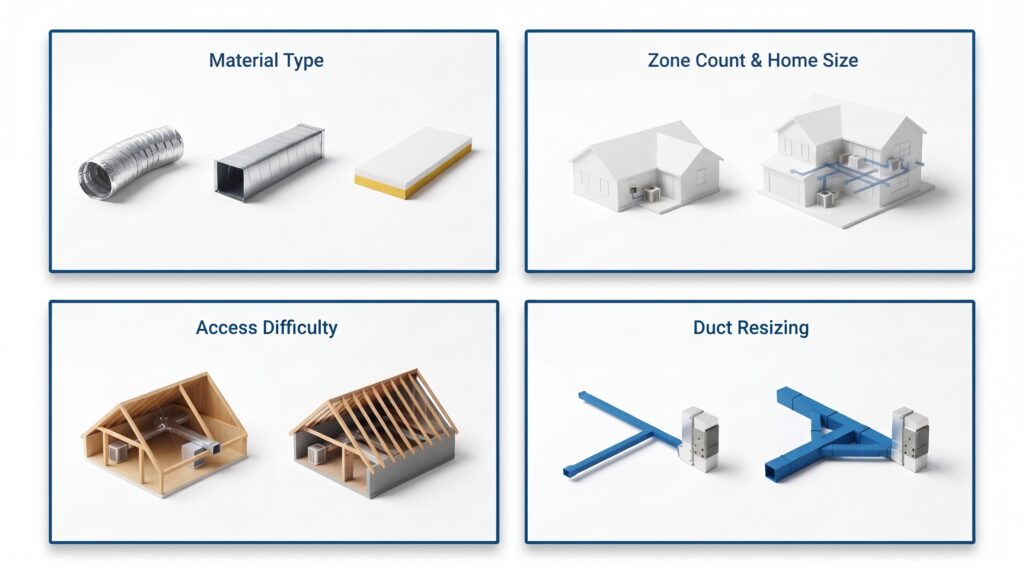
Four variables set duct replacement costs more than any other: material type, zone count and home size, access difficulty, and whether the existing layout requires resizing for the current equipment. Labor accounts for 60–70% of most residential invoices — making installation complexity a larger cost driver than material cost alone. A one-zone flex duct job and a full sheet metal replacement in the same square footage can differ by $5,000–$8,000 based on these variables alone.
Duct material type creates the widest cost spread. Flexible duct — the corrugated tubing in most post-1990 attics — costs $10–$18 per linear foot in materials versus $15–$25 per linear foot for rigid sheet metal. Sheet metal requires fabrication or pre-formed components and more skilled installation time. The correct material is determined by budget, longevity requirements, access conditions, and climate — not homeowner preference alone.
Zone count scales cost roughly linearly. Replacing one zone is priced per job. A full system across 4–6 zones includes some labor efficiency from shared mobilization, but each additional zone still adds 2–4 hours of labor plus materials.
Access difficulty is the variable most homeowners underestimate. A flex duct run 6 feet from the attic hatch costs meaningfully less to replace than the same run 40 feet in, over batt insulation, in a 24-inch clearance section. In San Antonio, that difference is compounded by summer attic temperatures that limit OSHA-compliant work windows from June through September — compressed access time drives up labor cost for any job that runs long in peak summer.
Equipment resizing is the cost variable that doesn’t appear on most competitors’ pricing pages. If the existing duct layout was designed for a 3-ton unit and current equipment is a 4-ton, replacing ducts with the same layout reproduces the original static pressure problem. A correctly scoped replacement includes ACCA Manual D duct sizing verification. If the calculation requires larger trunk sizes or additional return paths, both labor and materials cost shift meaningfully.
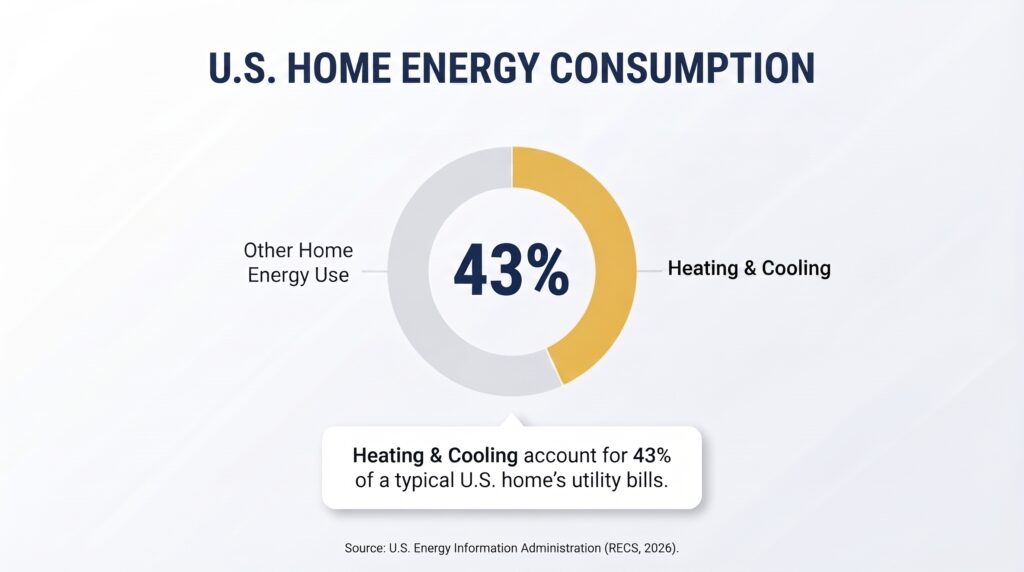
Heating and cooling account for approximately 43% of a typical U.S. home’s utility bills — making the duct system that distributes conditioned air the single largest leverage point on residential energy costs.
Duct Replacement Cost by Material Type — 2026 Price Ranges
Duct replacement costs range from $1,600–$5,500 for flex duct in a 1,500–2,500 sq ft home to $4,000–$10,000+ for sheet metal in the same square footage. Material type is the single largest driver of this spread — but the correct material choice is determined by budget, access conditions, longevity requirements, and local climate conditions, not preference alone.
| Material Type | Cost Per Linear Foot | Typical Total (1,500–2,500 sq ft) | Service Life (National Standard) | Service Life (San Antonio) |
|---|---|---|---|---|
| Flexible Duct (flex) | $10–$18/LF | $1,600–$5,500 | 15–25 years | 12–18 years* |
| Rigid Sheet Metal | $15–$25/LF | $4,000–$10,000+ | 25–50 years | 25–40 years |
| Fiberboard (ductboard) | $4–$7/LF (materials only) | $2,000–$5,000 (installed, estimated) | 10–15 years | 8–12 years* |
| Hybrid (flex trunk + sheet metal branches) | Proportional blend of flex + sheet metal rates | $2,500–$8,000 (estimated by proportion) | Varies by section | Varies by section |
*San Antonio service life estimates are supported by Texas-specific field data: HVAC contractors in Texas consistently report flex duct lifespan of 15–20 years in attic environments where temperatures reach 140–160°F — shorter than the 15–25 year national standard. The 12–18 year evaluation threshold reflects the lower end of that Texas range and should be treated as a proactive inspection trigger, not a firm replacement deadline. Source: AC Repair Expo Heating & Cooling
Fiberboard material cost (materials only, not installed): This Old House / Homewyse, 2026. Flex and sheet metal installed cost ranges: Angi, 2026. Hybrid system costs are estimated based on material proportion; no single per-LF published rate exists for blended systems. National service life ranges: U.S. DOE Energy Saver; This Old House, 2026.
Note on fiberboard duct: Fiberboard (ductboard) is less common in newer construction but still found in many pre-2000 systems. Its interior facing can separate under high-humidity conditions and introduce particulates into the airstream. If your existing system uses fiberboard, any replacement should specify a different material — flex duct or sheet metal — regardless of what the original installation used.
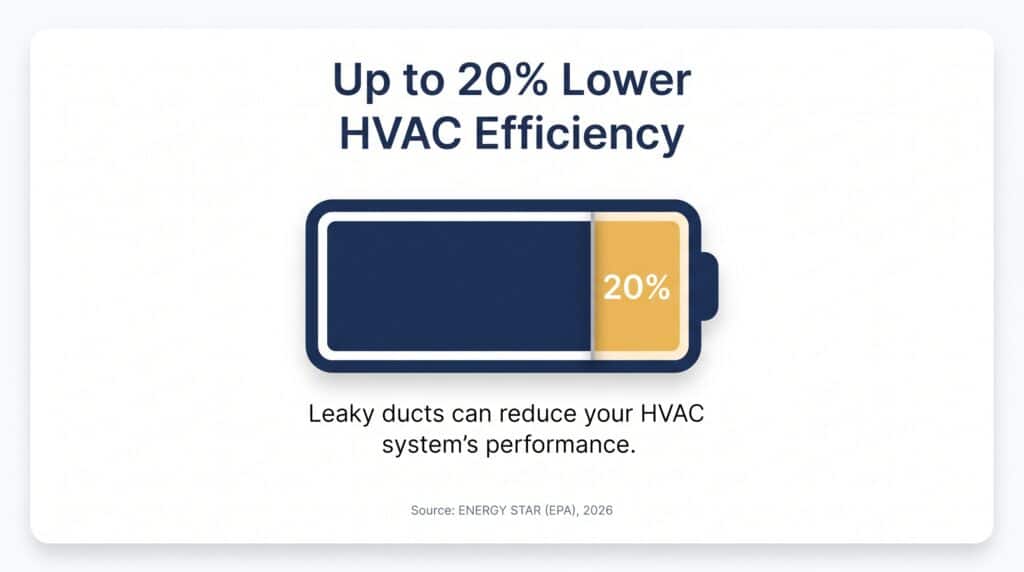
About 20–30% of the air that moves through a typical home’s duct system is lost through leaks, holes, and poor connections — reducing heating and cooling efficiency by as much as 20%.
Duct Replacement Cost by Home Size
Duct replacement cost scales with home size because larger homes have more zones, longer duct runs, and greater total installation labor — not because they cost proportionally more per linear foot. A 3,000 sq ft home doesn’t cost exactly twice a 1,500 sq ft job, but it costs meaningfully more in both labor and materials.
| Home Size (sq ft) | Typical Zones | Flex Duct Replacement | Sheet Metal Replacement | Estimated Timeline |
|---|---|---|---|---|
| Under 1,500 (1,000–1,500) | 1–2 | $1,400–$3,400 | $2,400–$7,200 (est. by LF rate) | 4–8 hours |
| 1,500–2,500 | 2–4 | $1,600–$5,600 | $4,000–$10,000 | 1–2 days |
| 2,500–3,500 | 3–5 | $3,500–$7,800 | $6,000–$14,400 (est. by LF rate) | 1.5–3 days |
| 3,500–4,000 | 4–6+ | $4,900–$9,000 | $8,000–$18,000+ (est. by LF rate) | 2–4 days |
Flex duct replacement costs (under 1,500 and 2,500–4,000 sq ft rows): HomeGuide 2026 duct replacement cost data. Sheet metal costs for edge-size ranges estimated from $20–$60/LF installed rate per hvacprojectcost.com 2026. All ranges reflect national averages; San Antonio attic access adds cost in peak summer months.
In San Antonio, Bulverde, and Boerne, summer attic access conditions add cost pressure that national averages don’t account for. Attic temperatures regularly exceed 140°F from June through September. Under OSHA’s heat exposure guidelines, technician access time in those conditions is physically limited — compressed windows mean jobs that run long in summer cost more than the same scope in October or March. If your replacement timeline has flexibility, scheduling in shoulder seasons reduces both labor cost and total job duration.
Indoor air pollutant levels run two to five times higher than outdoor levels in a typical home — and occasionally more than 100 times higher, according to EPA human-exposure studies. Deteriorating or leaky duct systems are among the primary pathways moving contaminants from attic and wall cavities into living spaces with every blower cycle.
Source: U.S. Environmental Protection Agency, Indoor Air Quality (IAQ), 2026
Full Replacement vs. Partial Replacement — What’s the Real Difference?
Full duct replacement means removing and replacing the entire system — trunks, branch runs, returns, plenums, and boots. Partial replacement addresses one or two zones while leaving the rest in place. Partial replacement costs less upfront but typically performs worse over a 5-year window when the remaining older zones continue to degrade and require additional rounds of intervention.
The cost difference between partial and full replacement isn’t always as large as homeowners expect. Mobilization cost — getting a crew on-site with equipment — is largely fixed regardless of scope. A partial replacement covering two of five zones may run 55–65% of a full job, not 40%, because technicians are working around existing ductwork rather than doing a clean install.
Partial replacement makes sense when:
- Damage or degradation is confirmed to one or two zones by a pressure test, with remaining zones testing below 10–15% leakage of system airflow
- The system is under 10 years old and the failure was caused by a specific event — pest intrusion, construction damage, or moisture — rather than age-related material degradation
- Budget constraints make full replacement impractical this year, with a documented plan for remaining zones within 3–5 years
Full replacement makes sense when:
- Pressure testing shows leakage above 15–20% of system airflow across multiple zones
- The system is over 15 years old (flex) or 25 years old (sheet metal) with no prior zone-specific repairs documented
- Moisture, mold, or pest contamination is present anywhere in the system — partial replacement leaves contaminated sections in the active airstream
- The existing duct layout is incorrectly sized for the current equipment — partial replacement with the same layout doesn’t resolve the static pressure problem driving the core complaint
Construction and remodeling work generates dust and particulates that can be drawn into open duct runs even when the HVAC system isn’t operating. New equipment installation is among the most common events that introduce new leak points into an otherwise intact duct system — ducts should be inspected and vacuumed before any new system’s first startup.
Source: Building America Solution Center, Pacific Northwest National Laboratory (U.S. Department of Energy), 2026
The Zone-and-Age Rule — The Field Heuristic for When Replacement Beats Repair
A Real Replacement, Itemized: $8,500 in Fischer, TX
Ranges are easy to publish and hard to use. Here is one complete job with every line accounted for.
In a single-family home in Fischer, TX, we replaced an entire 3-ton duct system for $8,500. The work took eight hours with a four-person crew led by Service Manager Omar Castilleja. That figure sits above the typical full-home flex range, and the reason is in the scope.
What the $8,500 covered:
- Full removal of the old system — plenums, trunk lines, branch ducts and supports
- New 3-ton duct system with new plenums
- R8 insulation on supply ducts, R6 on returns
- Non-combustible supports replacing the styrofoam blocks found on arrival
- Mastic sealing on all joints and trunk lines, not foil tape
- Manual dampers for room-by-room airflow balancing
- A portable AC unit running during installation so the home stayed livable
- Two follow-up visits after completion
The homeowner’s own assessment of the price, from his public review: the quote came in “a tiny bit higher than I had hoped.” He went ahead because of the quality of the work, and afterwards reported good airflow at every vent for the first time.
We include that line on purpose. A cost guide that pretends nobody is ever surprised by a number is not useful to you. What matters is whether the money bought something real. Full details are in the Fischer duct replacement case study.
Original heuristic: If two or more duct zones show active leakage on a CFM25 pressure test AND the ductwork is over 15 years old (flex) or over 25 years old (sheet metal), full replacement delivers better 10-year total cost than continued zone-by-zone repair. Below either threshold — fewer than two failing zones OR a system under the age limit — zone repair is the cost-optimal path. Moisture damage, mold, or pest findings override the rule entirely: replacement is non-negotiable regardless of zone count or age.
Here is the rule meeting a real attic. On the Fischer job above, the inspection found failing foil tape across the trunk line joints, almost no airflow reaching the smaller vents, and insulation values installed backwards — R8 on the returns and R6 on the supply, the opposite of what the supply side needs. Multiple zones were compromised and the system was well past the age threshold. Repair would have meant re-taping joints that were going to fail again in the same attic heat that killed them the first time. That is what the rule is for: it separates a system with a problem from a system that has run out of road.
This rule is field-derived — not a published NADCA or ACCA formula. It compresses the decision logic experienced technicians apply when a homeowner asks “should I repair or replace?” It produces a concrete yes/no test rather than a range to guess from.
Apply it in four steps:
- Get a CFM25 pressure test before any recommendation. The leakage test establishes baseline leakage rate as a percentage of system airflow and identifies which zones are failing. Any repair or replacement recommendation without pressure test data is a revenue decision, not a diagnostic conclusion.
- Count the failing zones. One failing zone = repair candidate. Two or more = the Zone-and-Age Rule applies. Document which zones by location, not by leak severity — a small leak in a third zone still counts as a third failing zone for the purpose of this rule.
- Apply the age threshold. Flex duct over 15 years in a national climate, or over 12 years in San Antonio’s thermal environment: the rule triggers at two failing zones. Sheet metal over 25 years: same trigger. Below those ages, repair remains cost-optimal even with two failing zones — provided failures are mechanical (disconnected collars, crushed sections) rather than material degradation.
- Check for override conditions. Any moisture finding — even in a non-failing zone — overrides the math. So does mold, active pest activity, or inner liner separation across more than two runs. These make replacement non-negotiable regardless of where the pressure numbers land.
An inspection finding that contradicts the Zone-and-Age Rule — contamination heavier or degradation more extensive than the pressure numbers suggest — takes precedence over the calculated result. The rule sets your starting position; the physical inspection confirms or overrides it.
Sealing and insulating ducts in unconditioned spaces — including attics — can reduce heating and cooling costs by up to 20% in a typical home.
Source: ENERGY STAR, U.S. Environmental Protection Agency, 2026
Why San Antonio Flex Duct Degrades Faster Than National Standards Predict
National flex duct lifespan estimates — 15 to 25 years, per DOE Energy Saver guidance — are derived from moderate-climate conditions. Texas HVAC contractors consistently report shorter practical lifespans: flex duct in Texas attics, where temperatures reach 140–160°F, typically performs to 15–20 years rather than the national upper range. In San Antonio, Bulverde, and Boerne, where that heat is combined with Southwest monsoon-season humidity cycling (July–September), the practical evaluation threshold for inner liner integrity is closer to 12–18 years. That gap changes every replacement decision made in this climate.
Original Insight — Honeycomb Heating & Cooling field observation: Flex duct inner liner separation in San Antonio attics is consistently underdetected on surface inspections. The outer insulation jacket retains its shape and silver appearance even after the inner metallized liner has fully separated and collapsed to one side of the run. The only perceptible indicator on a surface walkthrough is a soft section that deforms under light pressure — but in a 130–140°F attic, technicians spend limited time per linear foot, and soft sections are easy to miss unless specifically probed. The combination of sustained high-temperature cycling, Southwest monsoon-season humidity (typically July–September in the San Antonio area), and repeated blower pressurization breaks down the liner adhesive bond faster than any single variable in isolation. The correct diagnostic for a system approaching 12 years in this climate is a CFM25 pressure test plus camera inspection at suspect sections — not a visual attic walkthrough.
This failure mode also explains why homeowners in San Antonio sometimes find that a pressure test shows 25–35% system leakage on a system that received zone-level repairs 2–3 years prior. Zone repairs on a system with advancing liner degradation buy time — not the full repair interval — because unreplaced zones continue degrading, and repaired zones eventually see liner separation again under the same thermal conditions.
The practical implication: if your flex duct system is approaching 12 years in San Antonio, schedule a pressure test and camera inspection regardless of whether you’re experiencing comfort complaints. Waiting for symptoms means waiting until degradation is system-wide — at which point zone repair is no longer the cost-optimal path regardless of what any heuristic says.
Approximately 20–30% of conditioned air in a typical U.S. home is lost to duct leakage — a figure that rises as duct materials age and joint seals fail.
Source: ENERGY STAR, U.S. Environmental Protection Agency, 2026
The Hidden Compounding Cost of Running Old Ductwork in San Antonio
In San Antonio’s climate, aging ductwork costs more per year in wasted energy than national efficiency figures imply — because systems run more hours. At approximately 2,000 annual cooling hours versus the U.S. average of ~1,200, a duct system losing 25% of conditioned air to leakage runs that efficiency loss for 67% more hours per year than a comparable home in a moderate climate. The math on deferring replacement doesn’t hold up once you run it against actual local cooling hours.
Here’s what that compounding looks like in practice:
A 3-ton HVAC system at full load draws approximately 3,000–3,500 watts. At CPS Energy’s current residential all-in rate of approximately $0.125/kWh as of June 2026 (per NuWatt Energy’s CPS rate tracking), a 25% leakage-driven efficiency loss adds roughly $190–$220 in wasted energy per year on a single-system home — before accounting for added blower wear. Over a 5-year deferral period, that’s $950–$1,100 in pure waste against a flex duct replacement quote that, for a 1,500 sq ft home, runs $1,600–$3,000. The cost crossover point for deferral versus replacement is typically 8–12 years — which is exactly when leakage on a 12–15 year old San Antonio flex duct system becomes system-wide rather than zone-specific.
The compounding factor most pricing guides skip: elevated static pressure from leakage forces the blower motor to operate near its upper load range consistently. That accelerates motor wear and can shorten blower service life by 2–4 years on systems already logging San Antonio’s cooling hour volume. Blower motor replacement averages $560 and ranges $300–$2,400 depending on motor type, horsepower, and access difficulty — a future cost that doesn’t appear on the utility bill but compounds the case for earlier replacement when a pressure test already shows multi-zone leakage. Source: Angi, 2026.
In Bulverde and Boerne, where homes run the same approximate cooling load as San Antonio proper, this efficiency-loss math applies identically. The ~2,000 annual cooling hour figure is derived from National Weather Service climate data for KSAT (San Antonio International Airport) and covers the full metro — not just the city limits.
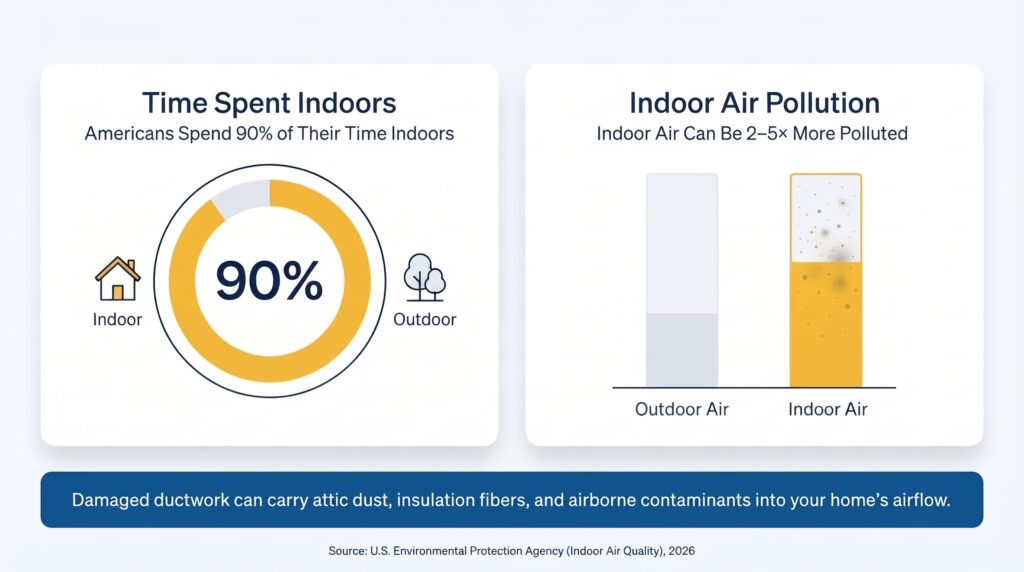
Americans spend approximately 90% of their time indoors, where pollutant concentrations can be 2–5 times higher than outdoor levels. Duct degradation is a direct pathway for attic particulates, insulation fibers, and biological contaminants to enter the conditioned airstream with every blower cycle.
What to Watch Out For When Getting a Duct Replacement Quote
The duct replacement market has a defined set of patterns that inflate costs, misrepresent scope, or both. Knowing them before you request a quote is the most effective protection — not reading reviews afterward.
- “Full system replacement” at a flat low price with no written component list. “Full system” to a company charging $800 often means replacing accessible branch runs near the air handler while leaving return plenums, trunk connections, and inaccessible zones in place. Ask for a written scope listing every component to be replaced by name and location. No written component list = it’s not a full replacement.
- No pressure test before or after. A legitimate duct replacement should include a CFM25 or CFM50 leakage test before work begins (to establish baseline leakage) and after completion (to verify the new installation). Without before-and-after documentation, you have no verified evidence the replacement achieved what it claimed.
- No Manual D sizing review for the current equipment. Replacing ducts with the same layout is only correct if the original layout was properly sized for the current equipment. If equipment has been replaced since the original duct installation, a Manual D calculation should confirm the new layout is correct before work begins. A quote that doesn’t mention sizing review assumes the original design was right without verifying it.
- Scope growth after access is open, with no documentation or approval. Additional degradation that isn’t visible from the hatch is a legitimate finding — but a reputable company documents it, shows you the evidence, and gets written approval before proceeding. A verbal scope addition while a crew is already in the attic is a pattern worth noting.
- Full replacement recommended on a system under 10 years old without pressure test data. Even in San Antonio’s climate, a 10-year-old flex duct system is at or near the early end of its service life — a pressure test finding should precede any replacement recommendation. A recommendation without test data is a revenue decision, not a diagnostic conclusion.
- Unusually short job times quoted for whole-system work. A full replacement across a 2,000 sq ft home — pulling existing ductwork, running new trunks and branch lines, sealing all connections, and running a post-install pressure test — takes 1–2 days minimum. Any company quoting a full system replacement in 4 hours is not performing a complete scope of work.
Three Things an Inspection Should Catch That a Quote Never Mentions
These came out of one real inspection. None are visible from the attic hatch, and none would show up on a quote written without someone going in.
- Combustible duct supports. Styrofoam blocks holding ductwork in an attic. Replaced with non-combustible metal strapping.
- Foil tape on trunk joints. Tape adhesive degrades in attic heat and lets go. Mastic does not. Ask which one a contractor is quoting.
- Reversed R-values. R8 on the returns and R6 on the supply. The supply ducts carry the cooled air and need the better insulation. Installed backwards, it quietly wastes cooling for years and passes a glance.
If you are collecting quotes, ask each contractor what R-value goes on which side and what they seal joints with. The answers separate a scoped quote from a guessed one quickly.
DIY vs. Professional Duct Replacement — Where the Line Is
Single accessible flex duct sections in conditioned spaces are technically DIY-viable for a competent homeowner. Full system replacement — return plenums, supply trunks, Manual D sizing verification, and the post-installation pressure test — requires a licensed HVAC contractor. DIY full replacement risks ACCA Manual D sizing errors that create static pressure problems no amount of sealing will fix after the fact.
| Task | DIY Viable? | Why |
|---|---|---|
| Single accessible flex duct section (conditioned space, same diameter) | Yes | Cut-to-length, clamped, UL 181 foil tape — no sizing calculation required for a direct same-diameter replacement |
| Boot-to-register connection repair (accessible, visible joint) | Yes | Mastic sealant or UL 181-rated foil tape at visible joints in conditioned spaces is DIY-appropriate |
| Attic flex duct replacement (unconditioned) | No | Heat conditions June–September, physical access difficulty, and inner liner separation requiring camera confirmation before any replacement decision |
| Return plenum replacement | No | Sizing and connection geometry must match system static pressure requirements — errors reproduce the original problem |
| Sheet metal trunk fabrication or replacement | No | Requires fabrication tools, proper sealing technique, and Manual D sizing verification to avoid static pressure mismatch |
| Full system replacement | No | Requires a licensed HVAC contractor in Texas; post-installation pressure test required to verify the completed system meets design leakage spec |
| CFM25 leakage test (pre- and post-installation) | No | Requires calibrated test equipment and training; results drive the replacement recommendation and verify completion |
Materials note: The product marketed as “duct tape” — the silver fabric-backed tape in every hardware store — is not rated for HVAC duct applications. It fails at the temperature cycling ducts experience in unconditioned attic spaces, typically within 1–3 years. Use UL 181-rated metal foil tape or mastic sealant for any connection intended to last. This applies equally to flex duct and sheet metal.
Construction and remodeling generates dust and particulates that can be drawn into open duct runs even when the HVAC system isn’t operating — making inspection and cleaning of existing ductwork a recommended step before any new system’s first startup.
Source: Building America Solution Center, U.S. Department of Energy, 2026
How Honeycomb Handles Duct Replacement Assessments
If you’re evaluating duct replacement cost for your home in San Antonio, Bulverde, or Boerne, here’s exactly how Honeycomb Heating & Cooling approaches the assessment — documented, pressure-tested, and scoped before any work begins.
- Pre-assessment system history review: Document duct material type, installation year, prior repairs, equipment changes, and any known events — moisture intrusion, pest activity, renovation work — associated with introducing new failure points, regardless of duct age.
- Visual inspection at the air handler, return plenums, and attic entry: Photographed and documented — check for disconnected collars, visible liner condition, moisture staining at transitions or boots, and any sign of pest or mold activity.
- Camera inspection at suspect sections: In San Antonio’s climate, any flex duct system approaching 12 years receives a camera pass at sections most exposed to sustained heat. Inner liner separation is not visible on a surface walkthrough and requires camera confirmation to diagnose accurately — a visual-only attic walk misses this failure mode on nearly every job.
- CFM25 pressure leakage test (pre-assessment): Establishes baseline leakage rate as a percentage of system airflow. This number drives the replacement versus repair recommendation — not a visual impression, a system age assumption, or a upsell default.
- Apply the Zone-and-Age Rule: Count the failing zones confirmed by pressure test. Cross against system age and material type. Apply moisture or pest override if any contamination finding is present. The result determines whether the written recommendation is zone repair, partial replacement, or full replacement.
- Written scope before scheduling: Every component to be replaced is listed by name, location, and material specification. Manual D sizing verification is included in the written scope on every full replacement job — no verbal scope language, no “we’ll handle everything.”
- Post-installation CFM25 pressure test: Leakage rate documented after replacement with before-and-after numbers on the invoice. The outcome is verified, not assumed.
Any finding that didn’t reach the replacement threshold — liner wear approaching end of service life, a zone testing at 12–13% leakage that fell below the Zone-and-Age trigger — is documented with a recommended follow-up window so the homeowner isn’t surprised 18 months later.
Frequently Asked Questions
How much does duct replacement cost in San Antonio?
Duct replacement in San Antonio runs $1,600–$5,500 for a 1,500–2,500 sq ft home with a flex duct system and $4,000–$10,000+ for sheet metal in the same square footage. Labor accounts for 60–70% of most quotes. Per-linear-foot materials cost $10–$18 for flex duct and $15–$25 for sheet metal, per Angi’s 2026 data. Attic access in summer — where temperatures exceed 140°F from June through September — adds cost pressure not reflected in national averages.
How do I know if I need to replace my air ducts?
Key indicators: the system is over 15 years old (flex) or over 25 years old (sheet metal); two or more zones show active leakage on a CFM25 pressure test; moisture, mold, or pest contamination is present anywhere in the system; or a repair quote exceeds 35% of a full replacement estimate on an aging system. A single symptom — uneven cooling, higher bills — isn’t sufficient. A pressure test is the only objective diagnostic, and any recommendation without one is guesswork.
Is it better to repair or replace air ducts?
Repair wins when damage is localized to one zone and the system is under 15 years old. Replacement wins when two or more zones show active leakage on a system over 15 years old — that’s the Zone-and-Age Rule. Moisture damage, mold, or pest findings make replacement non-negotiable regardless of zone count or age. In San Antonio, the practical decision threshold for flex duct is 12 years rather than 15 due to accelerated thermal degradation in high-heat attics.
What type of ductwork lasts the longest?
Rigid sheet metal ductwork lasts 25–50 years with properly sealed joints. Flexible duct lasts 15–25 years under national standards, but in San Antonio’s climate — sustained attic temps above 140°F, Southwest monsoon humidity cycling — the practical service life of flex duct inner liner material is closer to 12–18 years. Fiberboard duct carries the shortest service life (10–15 years nationally, 8–12 in high-heat climates) and should not be specified for replacement in this region.
How long does duct replacement take?
A single-zone flex duct replacement takes 4–6 hours. Full system replacement in a 1,500–2,500 sq ft home takes 1–2 days. Sheet metal fabrication and installation runs 2–3 days for a comparable system. Summer attic work in San Antonio is compressed by OSHA heat limits from June through September — scheduling in shoulder seasons (September–November or March–May) reduces both timeline and labor cost.
Does homeowners insurance cover duct replacement?
Standard homeowners insurance covers duct replacement when caused by a sudden covered peril — fire, certain water events, or named storms. It does not cover wear and tear, age-related material degradation, pest damage, or gradual leakage. Get a documented inspection report stating the cause of damage before filing any claim. Without a documented cause, an adjuster has no factual basis to approve coverage.
Can I replace air ducts myself?
Single accessible flex duct sections in conditioned spaces are DIY-viable. Full system replacement requires a licensed HVAC contractor in Texas — including ACCA Manual D sizing verification and a post-installation pressure test. DIY full replacement risks sizing errors that create static pressure problems no sealing will fix after the fact. In Texas, HVAC work on systems connected to the air handler is regulated and requires a licensed contractor.
How much does flex duct replacement cost per linear foot?
Flex duct replacement runs $10–$18 per linear foot for materials. Sheet metal runs $15–$25 per linear foot. Per-foot pricing is most useful for estimating partial-zone work — full system replacement is typically quoted by home size and zone count, not by linear footage. Source: Angi 2026 duct replacement cost data.
Does duct replacement improve energy efficiency?
Yes, measurably. ENERGY STAR data shows 20–30% of conditioned air in a typical home is lost to duct leaks, reducing efficiency by up to 20%. In San Antonio’s approximately 2,000 annual cooling hours — 67% more than the U.S. average of ~1,200 — that waste compounds faster than national estimates imply. A properly installed replacement system with post-installation pressure testing eliminates the majority of that loss and reduces blower static pressure, which also extends motor service life.
How often should air ducts be replaced?
Flex duct systems in San Antonio should be evaluated for replacement at 12–18 years — earlier than the 15–25 year national standard — because of accelerated inner liner breakdown from sustained high-temperature attic cycling. Sheet metal systems can last 25–50 years. Any equipment replacement, added zone, or attic renovation warrants a pressure test regardless of system age — these events frequently introduce failure points into otherwise intact systems. Don’t wait for symptoms; schedule the test proactively.
Get a Documented Duct Replacement Assessment for Your Home
Honeycomb Heating & Cooling performs pressure-tested duct replacement assessments across San Antonio, Bulverde, and Boerne — written scope before work begins, before/after leakage documentation on every job, no default upsell to replacement without pressure test data.
📞 Call or Text (210) 750-6725
Upfront Flat-Rate Pricing · Zero-Pressure Options · Background-Checked Pros · 5.0 Stars on Google (600+ Reviews)
Brandon Caputo
Owner · Honeycomb Heating & Cooling
Brandon Caputo founded Honeycomb Heating & Cooling to bring system-driven reliability and customer-first transparency to the San Antonio HVAC market. Grounded in the principle of proactive, preventative care rather than reactive crisis management, Honeycomb specializes in high-efficiency AC and heating installations, advanced diagnostic repairs, and localized indoor air quality solutions. Brandon infuses empathy into every service call, ensuring his team actively listens to homeowners to deliver clear, value-based comfort solutions.
About Honeycomb Heating & Cooling
San Antonio’s trusted specialist in residential air conditioning installation, swift repairs, and energy-saving preventative maintenance. Founded with a commitment to upfront flat-rate pricing and reliable home comfort.
600+ Completed Projects · 5.00-star Google Rating · Open 24/7 for Emergency Support · Founded by Brandon Caputo.
- Upfront Flat-Rate Pricing — No Hidden Fees
- Zero-Pressure Repair & System Options
- Background-Checked & Certified Technicians
- Amana Authorized Elite Partner
- Goodman High-Efficiency System Specialists
- Comprehensive “Comfy Club” Maintenance Programs
- 600+ 5-Star Reviews Across San Antonio
- Fully Licensed & Insured · Texas · License # TACLA140435E
- Free Estimates & Online Booking
- Zero Interest Financing Available
- Office: 26995 US Highway 281 Suite C, San Antonio, TX 78260
Sources & Citations
- ENERGY STAR. (2026). Duct Sealing — Benefits of Duct Sealing. U.S. Environmental Protection Agency. energystar.gov/saveathome/heating-cooling/duct-sealing
- ENERGY STAR. (2026). Duct Sealing and Insulation. U.S. Environmental Protection Agency. energystar.gov/saveathome/seal_and_insulate/duct_sealing
- U.S. Environmental Protection Agency. (2026). Indoor Air Quality (IAQ) — Human Exposure Studies. epa.gov/report-environment/indoor-air-quality
- U.S. Environmental Protection Agency. (2026). Introduction to Indoor Air Quality. epa.gov/indoor-air-quality-iaq/introduction-indoor-air-quality
- U.S. Energy Information Administration. (2026). Residential Energy Consumption Survey (RECS) — End Uses. eia.gov/consumption/residential/
- U.S. Department of Energy. (2026). Ducts — Energy Saver. energy.gov/energysaver/ducts
- Building America Solution Center. (2026). Removing Construction Debris from Ducts. Pacific Northwest National Laboratory, U.S. Department of Energy. basc.pnnl.gov/resource-guides/removing-construction-debris-ducts
- Air Conditioning Contractors of America (ACCA). (2026). Manual D — Residential Duct Systems. acca.org
- National Air Duct Cleaners Association (NADCA). (2026). HVAC System Assessment Standards — Cost & Time Estimates. breathingclean.com/cost-time-estimates
- Angi. (2026). How Much Does Duct Replacement Cost? [2026 Data]; How Much Does Ductwork Repair Cost? [2026 Data]; How Much Does a Blower Motor Replacement Cost? [2026 Data]. angi.com
- NuWatt Energy. (2026). CPS Energy Rates 2026: ~12.5¢/kWh. nuwattenergy.com/en/texas/cps-energy-rates-2026
- National Weather Service. (2026). San Antonio, TX (KSAT) Climate Data — Cooling Degree Days. weather.gov/ewx/climate
- Aeroseal. (2026). How Aeroseal Works. Aeroseal LLC. aeroseal.com/how-it-works/
- AC Repair Expo Heating & Cooling Inc. (2026). What Is the Life Expectancy of HVAC Ductwork in Texas? (Honest Answer). Spring, TX. springacservice.com/hvac-ductwork-life-expectancy-texas
- HVAC Project Cost. (2026). Ductwork Replacement Cost: 2026 Pricing by Home Size. hvacprojectcost.com/ductwork-replacement-cost/
- HomeGuide. (2026). How Much Does It Cost to Install or Replace Ductwork? (2026). homeguide.com/costs/cost-to-replace-ductwork
- This Old House. (2026). How Much Does Air Duct Replacement Cost? (2026 Pricing). thisoldhouse.com/heating-cooling/air-ducts-replacement-cost


