



 (726) 233-6044
Quick Answer: How Do You Know It’s Time FOR ReplacING HOME AC UNIT?
Replace rather than repair when your AC is 12-15+ years old, runs on discontinued R-22 refrigerant, has needed three or more repairs in the past 24 months, or a repair quote lands at or above 50% of a new system’s installed cost. Below those thresholds — younger unit, isolated repair, cost well under that 50% line — repair remains the better financial move. The single fastest self-check: divide the repair quote by the cost of a comparable new system. Fifty percent or higher, on a unit past year 10, points to replacement.
A weak capacitor and a dying compressor can produce the exact same symptom — a system that short-cycles and won’t hold temperature — but one is a $200 fix, and the other is a $4,500+ decision. The nine signs below are ordered by how reliably each one predicts an actual end-of-life system, not just an uncomfortable afternoon, and each includes the specific number or test you can use to confirm it yourself before a technician ever shows up. The age thresholds and climate math apply across the whole Hill Country service area — San Antonio, Bulverde, and Boerne all share the same long, high-runtime cooling season.
1. Your AC Is 12-15+ Years Old
Age is the single strongest predictor of replacement need, but it’s a range, not a cliff: a well-maintained 12-year-old system in a high-runtime climate carries meaningfully higher failure risk than the same unit’s nameplate age suggests, even if it’s still running today.
- Nameplate age isn’t runtime age. A 12-year-old AC in a hot, humid, long-cooling-season climate has logged far more compressor cycles than a 12-year-old unit in a milder region.
- Component wear compounds after year 10. Bearings, capacitors, and coil surfaces degrade faster once a system exceeds a decade of near-daily summer runtime.
- Efficiency drops even without a breakdown. A system can still “work” at 15 years while costing 20-30% more to run than a comparable new one.
Quick self-check: Find the manufacture date on the outdoor unit’s data plate (usually a serial number with an embedded date code, not the install date on your paperwork). If it reads 2014 or earlier, start budgeting for replacement even if the system currently runs fine.
The U.S. Department of Energy puts average AC lifespan at 15-20 years with annual maintenance — but that figure assumes moderate runtime. Hot-climate metros with long cooling seasons compress that timeline in practice.
Source: U.S. Department of Energy, Energy Saver
2. It Runs on R-22 Refrigerant
If your system uses R-22 (sometimes labeled “Freon”), it’s already operating on borrowed time from a regulatory standpoint, not just a mechanical one — production of new R-22 stopped in 2020, and any refrigerant repair on that system is now a poor investment regardless of the unit’s mechanical condition.
- R-22 was phased out of production in 2020 under EPA Section 608. What remains on the market is recycled or reclaimed stock.
- Remaining supply is priced accordingly — $100-$175 per pound as of 2026, meaning even a minor leak repair can run $400-$1,500 before the leak source itself is fixed.
- A new R-22 leak on an older system is a strong replacement trigger almost regardless of the unit’s other diagnostics, because the repair cost-to-benefit ratio rarely favors staying on R-22.
Quick self-check: Look at the data plate on the outdoor condenser. It will list the refrigerant type directly. If it says “R-22” or “HCFC-22,” treat any refrigerant-related repair quote as a signal to get a replacement estimate first.
3. You’ve Called for 3+ Repairs in the Last 24 Months
Call this the 3-in-24 pattern: three or more paid repairs for different issues within a 24-month window, on a system older than 8 years, predicts a near-term major failure more reliably than age alone — even when each individual repair looked minor and affordable on its own.
- Isolated repairs are normal. One capacitor swap in five years on an otherwise healthy system is not a warning sign.
- A repeating pattern is different. Three separate, unrelated failures in two years indicates the system as a whole — not just one part — is degrading.
- Repair costs compound. Reactive, breakdown-driven repair spending costs 3 to 10 times more over the life of a system than planned preventive service or a timely replacement.
Quick self-check: Pull your last two years of HVAC invoices. Count distinct issues (not follow-up visits for the same repair). Three or more, on a system over 8 years old, is your cue to request a written replacement estimate alongside the next repair quote.
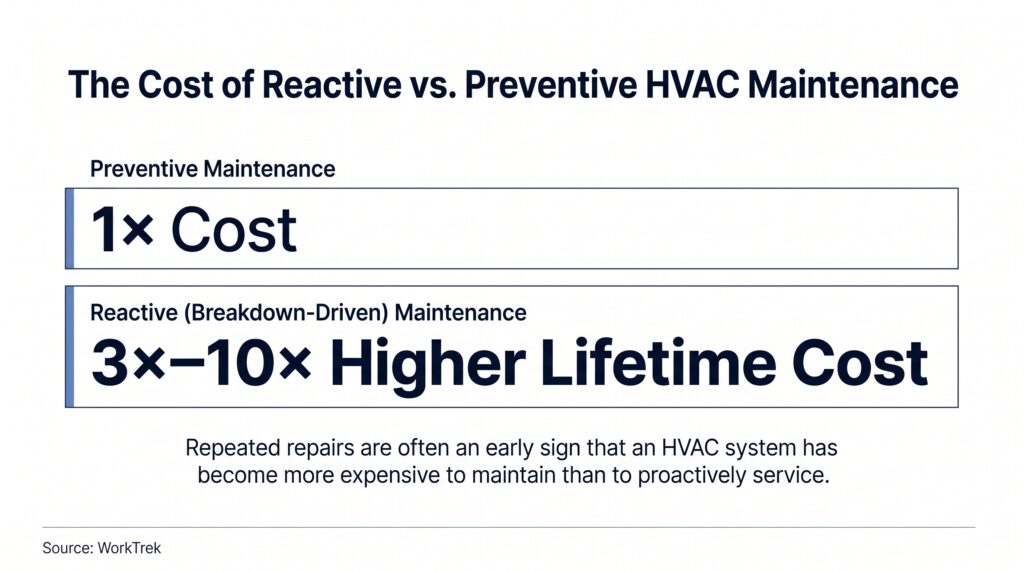
Reactive, breakdown-driven HVAC maintenance costs 3 to 10 times more than a preventive maintenance program over the life of the equipment. A repeat-repair pattern is often the earliest visible sign that a system has crossed into that reactive-cost territory.
Source: WorkTrek
4. Your Energy Bills Are Climbing Without a Change in Usage
A steadily rising cooling bill with no change in thermostat habits, household size, or weather pattern usually means the system is losing efficiency internally — and on an older unit, the efficiency gap between what you have and what current code requires is large enough to show up clearly on the monthly statement.
- Texas’ minimum efficiency standard is now 14.3 SEER2 for residential central AC under 45,000 Btu, set by the Department of Energy for the Southwest region as of January 1, 2023.
- Older systems typically run 8-10 SEER. Using the DOE’s standard efficiency-to-consumption relationship (1 − old SEER ÷ new SEER), moving from a 10 SEER unit to today’s 14.3 SEER2 minimum works out to roughly a 30% cut in cooling energy consumption — before accounting for any additional losses from age-related wear.
- Heating and cooling account for about 43% of a typical home’s energy bill, so an efficiency gap on the AC side shows up disproportionately on a San Antonio, Bulverde, or Boerne bill given the length of the local cooling season.
Quick self-check: Compare this July’s electric bill to the same month last year. A double-digit percentage increase with no change in household habits or local rate hikes points to declining system efficiency, not just a hot month.
Original calculation: Applying the DOE’s SEER-to-energy-use ratio, a straight swap from a 10 SEER unit to the current 14.3 SEER2 Southwest-region minimum yields an estimated ~30% reduction in cooling energy use. Actual savings vary with ductwork condition, correct sizing, and installation quality — this is a modeled estimate, not a guaranteed figure for every home.
Source: U.S. Department of Energy
5. Your Home Feels Humid or Clammy Even When It’s “Cool”
If the thermostat reads 72°F but the air still feels sticky, your AC is failing at its second job — pulling moisture out of the air — which is often an earlier and more reliable replacement signal than temperature performance alone, especially in a humid climate like San Antonio, Bulverde, or Boerne’s.
- Indoor relative humidity above 60% is the EPA’s condensation and mold threshold — the agency recommends keeping indoor RH below 60%, ideally between 30-50%.
- An aging or improperly sized system struggles to remove humidity even while nominally cooling the space, because a weakening compressor or worn coil often can’t sustain the runtime needed to dehumidify properly.
- This symptom is frequently mistaken for a thermostat problem or airflow issue, when the real cause is declining system capacity.
Quick self-check (original heuristic — “The Humidity Test”): On a 90°F+ afternoon, run a $10-20 hygrometer indoors for an hour with the AC on. If indoor relative humidity holds above 55% while the thermostat shows the set temperature reached, that’s a stronger replacement signal than the temperature reading alone — in Honeycomb’s service calls across San Antonio, Bulverde, and Boerne, this pattern shows up far more often on systems with a weakening compressor or an undersized replacement coil than on systems with a simple airflow restriction.
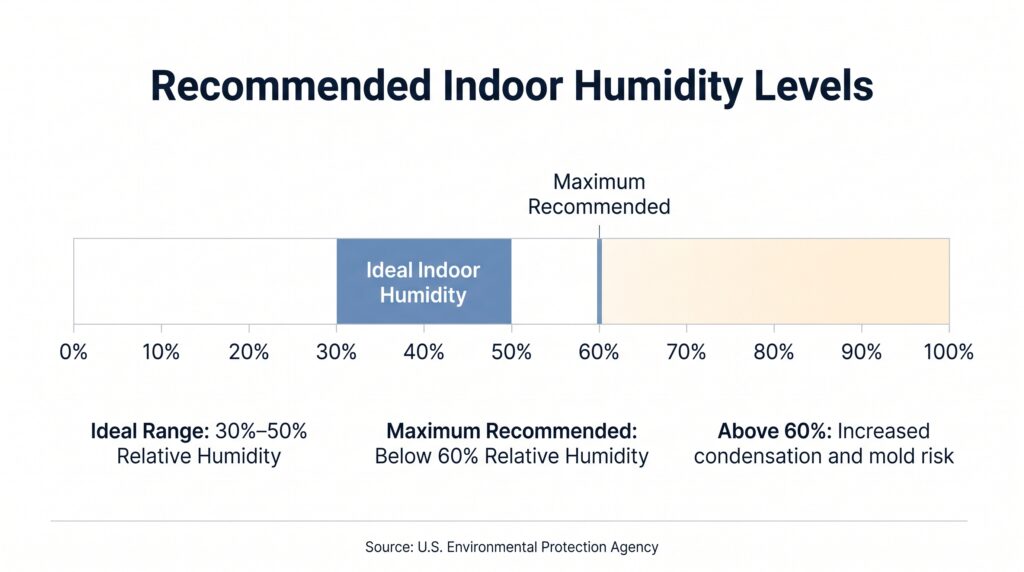
The EPA recommends keeping indoor relative humidity below 60%, ideally between 30% and 50%. Relative humidity above that range is likely to cause condensation and creates conditions where mold can begin colonizing surfaces within 48 hours.
Source: U.S. Environmental Protection Agency
6. Some Rooms Are Always Hotter (or Colder) Than Others
Persistent hot spots that a thermostat adjustment or a closed vent doesn’t fix usually mean the system can no longer deliver its rated output across the full duct run — a capacity problem that gets worse, not better, as the unit continues to age.
- A healthy system holds a consistent supply/return temperature split throughout the home; a failing one loses that consistency as output drops.
- This is different from a one-time ductwork issue. A duct leak affects the same room consistently; declining system capacity tends to make uneven cooling worse room-by-room as the season progresses.
- Airflow problems alone can cut AC efficiency by up to 15%, per ENERGY STAR — but if a full duct and blower check comes back clean and the unevenness persists, the compressor and coil are the more likely culprits.
Quick self-check: Use a simple indoor thermometer in your two most different-feeling rooms at the same time of day. A gap of 4°F or more that doesn’t close after a basic duct/vent check is worth a documented diagnostic visit.
7. The Repair Quote Is at or Above 50% of Replacement Cost
This is the fastest single screening test for the entire decision: if a repair estimate is 50% or more of what a new system costs installed, and the unit is over 10 years old, replacement is almost always the better financial move — call it the 50% Rule.
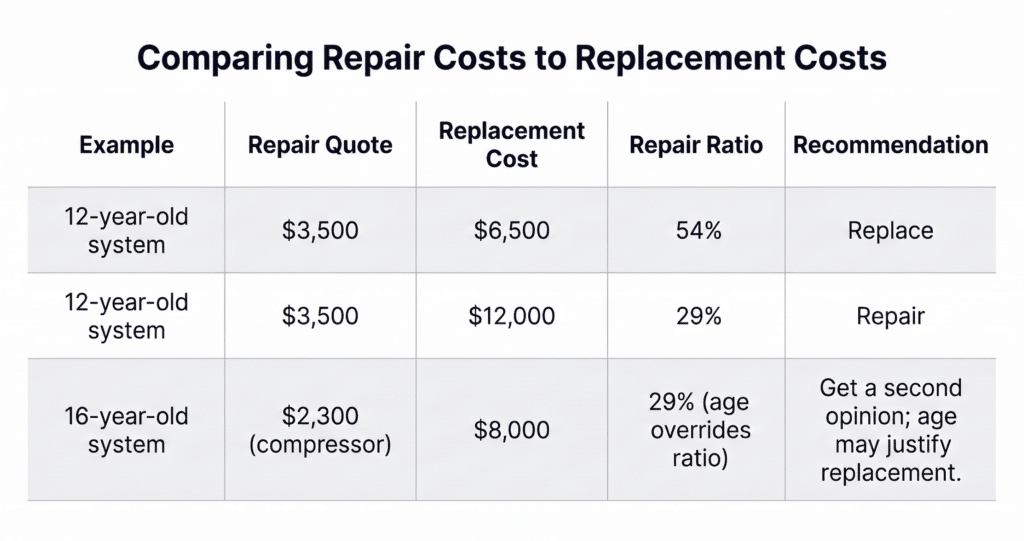
Quick self-check: Get both numbers in writing — the repair estimate and a replacement estimate — before deciding on either. A contractor who quotes only one of the two isn’t giving you enough information to run this test.
A full residential AC replacement (2-3 ton) runs $4,500-$12,000 installed in 2026, with most Texas homes landing between $6,500 and $10,000 depending on system size and efficiency tier. Compressor replacement alone averages around $1,200 installed.
Source: Angi
8. You Notice Rust, Burning Smells, or Unusual Noises
Visible corrosion on the outdoor unit, a burning odor from the vents, or new grinding and squealing sounds are physical signs of component failure rather than performance complaints — and unlike a comfort issue, these can indicate a safety-relevant failure that shouldn’t wait for a scheduled tune-up.
- Rust or corrosion on refrigerant lines or the coil often signals a slow leak that’s been present for a while, accelerating internal wear.
- A burning smell from vents can indicate an electrical or motor issue and warrants shutting the system off until it’s inspected.
- Grinding, squealing, or banging noises typically point to a failing motor bearing or a loose/broken internal component — rarely something that resolves on its own.
Quick self-check: Walk around the outdoor condenser and look for visible rust on the cabinet, coil fins, or refrigerant lines. Any of the sounds or smells above, combined with a system over 10 years old, warrants a same-week diagnostic rather than a wait-and-see approach.
9. What an Aging AC Is Quietly Costing Your Home’s Resale Value
This sign isn’t about comfort at all — it’s financial, and it’s the one most “signs to replace” lists skip entirely: an aging, near-end-of-life AC can measurably reduce what a home appraises and sells for, while a new system does the opposite.
- A new HVAC system can raise a home’s resale value by roughly 5-10%, according to Angi’s 2026 home-value data — real money on top of any comfort or repair-cost benefit.
- Appraisers commonly adjust valuations up $2,000-$5,000 for newer, efficient mechanical equipment during a sale.
- The inverse also holds: a visibly aged or R-22 outdoor unit is a common point buyers and inspectors flag during a sale, which can slow negotiations or reduce an offer even if the system is technically still functioning.
Original insight: Homeowners planning to sell within 3-5 years should weight this factor more heavily than the pure repair-vs-replace cost math suggests — a mid-life system replacement can pay part of itself back at resale in a way a mid-life repair generally cannot.
A new HVAC system can increase a home’s resale value by an estimated 5-10%, with appraisers typically adjusting valuations upward $2,000-$5,000 for newer, efficient equipment.
Source: Angi
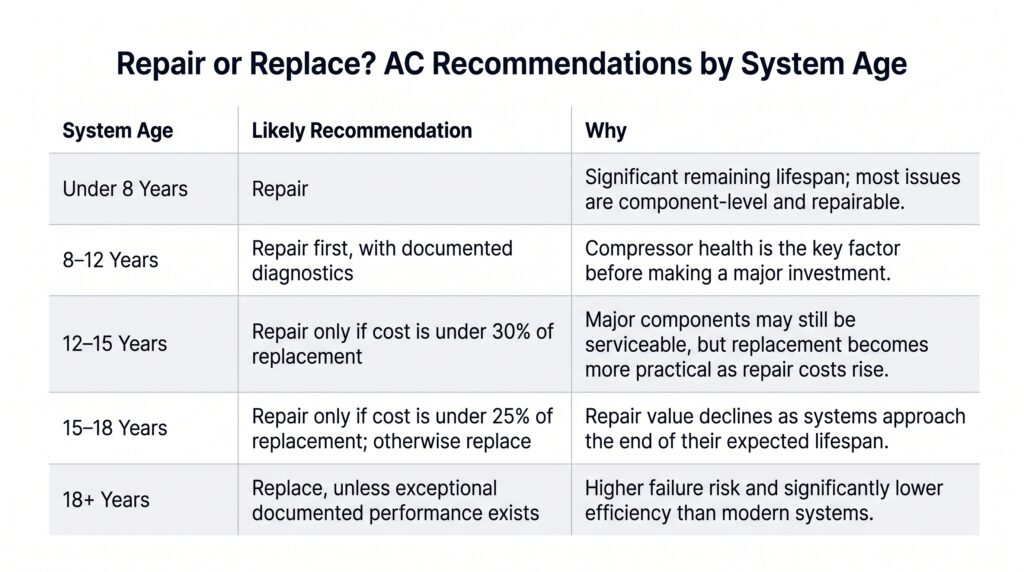
Age-to-Decision Reference Table
Use this table as a starting filter, not a final verdict — pair it with the specific signs above and a documented diagnostic before deciding.
How the San Antonio, Bulverde & Boerne Climate Accelerates This Timeline
A 12-year-old AC anywhere in this Hill Country service area — San Antonio, Bulverde, or Boerne — has logged more cumulative runtime than a 12-year-old system in most of the country, which is why the age thresholds above should be applied more conservatively here than in a national “signs to replace” article.
The National Weather Service’s Austin/San Antonio office (EWX), which covers San Antonio and the surrounding Hill Country including Bulverde and Boerne, records 3,148 annual cooling degree days in its 30-year climate normals for the region — a much longer, harder cooling season than most U.S. regions log. More runtime means faster bearing wear, more refrigerant cycling stress, and coil fouling that outpaces the age printed on the nameplate, regardless of which of these communities the system is installed in.
San Antonio and the surrounding Hill Country log 3,148 annual cooling degree days in NWS 30-year climate normals — well above the national average cooling load most manufacturer lifespan estimates are based on. Bulverde and Boerne fall within the same EWX climate zone as San Antonio.
Source: National Weather Service
How to Confirm It Before You Sign Anything
None of the nine signs above should be the sole basis for a five-figure decision on their own — each is a screening signal, and a proper diagnostic visit should confirm or rule out replacement with actual measurements before you commit.
- Refrigerant superheat or subcooling measurement — confirms whether the charge is correct or the system is operating outside spec
- Capacitor microfarad reading — confirms whether a capacitor is degraded and how close to failure
- Compressor amp draw under load — the single most revealing measurement for compressor health
- Supply/return temperature split — confirms whether the system is delivering its rated output
- Indoor relative humidity reading during runtime — confirms whether the system is managing latent load, not just temperature
If a technician recommends replacement without producing documented values for these five items on the invoice, ask for them before agreeing to anything. A verbal “it’s on its way out” is an opinion; a measured amp draw above the nameplate’s rated spec is a data point.
How Honeycomb Handles This Decision
Honeycomb Heating & Cooling doesn’t recommend replacement without documented diagnostics, and every service visit produces a written invoice with measured values rather than a verbal estimate.
- Technician runs the system through 15+ minutes of load before any measurement is taken
- Refrigerant superheat or subcooling measured and documented
- Capacitor microfarad reading taken under load and recorded on the invoice
- Compressor amp draw measured and compared against the nameplate’s rated spec
- Indoor relative humidity checked during active runtime, not just at idle
- The 3-in-24 repair pattern and the 50% Rule applied openly, using the system’s actual service history
- Repair estimate and replacement estimate both presented in writing, side by side
If you’re weighing replacing home AC unit against another repair, that side-by-side documented estimate — not a sales pitch — is what should drive the decision.
Frequently Asked Questions
How do I know if my AC needs to be replaced instead of repaired?
Replace instead of repair when the unit is 12-15+ years old, runs on R-22 refrigerant, has needed three or more repairs in the last 24 months, or the repair quote is at or above 50% of a new installed system’s cost. Below those thresholds, repair is usually the better financial call.
What is the average lifespan of a home AC unit?
The U.S. Department of Energy puts average AC lifespan at 15-20 years with annual maintenance. In high-runtime climates like San Antonio, Bulverde, and Boerne, real-world component wear tends to outpace that nameplate age, so budgeting for replacement typically should start around year 12-15.
Is it worth repairing a 15-year-old AC?
Usually not for anything beyond a minor part. At 15+ years, a major repair (compressor, coil, refrigerant line) typically costs 25-50% or more of a new system’s price on hardware that’s already near the end of its efficiency life, so replacement is usually the stronger return.
How much does it cost to replace a home AC unit in San Antonio, Bulverde, or Boerne?
A full residential AC replacement (2-3 ton) across San Antonio, Bulverde, and Boerne runs roughly $4,500-$12,000 installed as of 2026, with most homes landing between $6,500 and $10,000 depending on system size, efficiency tier, and ductwork condition. Pricing is consistent across the service area since it’s driven by system size and efficiency tier, not distance from San Antonio proper.
What are the signs of a dying air conditioner?
Common signs include an age of 12+ years, rising energy bills without a usage change, uneven cooling between rooms, indoor humidity that stays sticky even when the thermostat reads “cool,” frequent repairs, rust or corrosion on the outdoor unit, and unusual grinding or squealing noises.
Does R-410A refrigerant get phased out like R-22 was?
Not banned, but restricted. As of January 1, 2025, new AC equipment must use a refrigerant with a global warming potential at or below 700 (R-454B or R-32), not R-410A, under the EPA’s Technology Transitions Program. R-410A production allowances are being cut roughly 40% between 2024 and 2028.
Can a bad capacitor make an AC seem like it needs replacement?
Yes. A failing capacitor causes short-cycling and hard starting that can mimic compressor failure or a dying system, but it’s a $15-$45 part with roughly $100-$250 installed cost. Always ask for a measured microfarad reading before agreeing to replace a system over a symptom a capacitor can cause.
Does a new AC actually raise my home’s resale value?
Industry data from Angi indicates a new HVAC system can raise resale value by roughly 5-10%, with appraisers commonly adjusting valuations up $2,000-$5,000 for newer, efficient equipment. An aging, near-end-of-life AC can work against a sale the same way a new one works for it.
How many AC repairs is too many before I should replace it?
Three or more paid service calls for different issues within 24 months, on a system older than 8 years, is a strong replacement signal — even if each individual repair looked affordable on its own.
Need a Documented Replacement Diagnosis in San Antonio, Bulverde, or Boerne?
Honeycomb Heating & Cooling performs measurement-based diagnostics across San Antonio, Bulverde, Boerne, and the rest of the Hill Country: refrigerant charge verification, capacitor microfarad testing, compressor amp draw readings, and documented values on every invoice — not a verbal estimate.
Upfront Flat-Rate Pricing · Zero-Pressure Options · Background-Checked Pros · 5.0 Stars on Google (600+ Reviews)
📞 Call or Text (210) 750-6725
Brandon Caputo
Owner · Honeycomb Heating & Cooling
Brandon Caputo founded Honeycomb Heating & Cooling to bring system-driven reliability and customer-first transparency to the San Antonio HVAC market. Grounded in the principle of proactive, preventative care rather than reactive crisis management, Honeycomb specializes in high-efficiency AC and heating installations, advanced diagnostic repairs, and localized indoor air quality solutions. Brandon infuses empathy into every service call, ensuring his team actively listens to homeowners to deliver clear, value-based comfort solutions.
About Honeycomb Heating & Cooling
San Antonio’s trusted specialist in residential air conditioning installation, swift repairs, and energy-saving preventative maintenance. Founded with a commitment to upfront flat-rate pricing and reliable home comfort.
600+ Completed Projects · 5.00-star Google Rating · Open 24/7 for Emergency Support · Founded by Brandon Caputo.
- Upfront Flat-Rate Pricing—No Hidden Fees
- Zero-Pressure Repair & System Options
- Background-Checked & Certified Technicians
- Amana Authorized Elite Partner
- Goodman High-Efficiency System Specialists
- Comprehensive “Comfy Club” Maintenance Programs
- 600+ 5-Star Reviews Across San Antonio
- Fully Licensed & Insured · Texas
- Free estimates & online booking
- Zero Interest with No Monthly Payment financing available
- Office Address: 26995 US Highway 281 Suite C, San Antonio, TX 78260
Sources & Citations
- Angi. (2026). How much does an AC compressor cost to install? angi.com/articles/ac-compressor-cost.htm
- Angi. (2026). Does a New HVAC System Increase Home Value? angi.com/articles/improve-home-value-new-air-conditioner.htm
- U.S. Department of Energy. (2023). Appliance and Equipment Standards Program — SEER2 minimum efficiency standards. energy.gov/eere/buildings/appliance-and-equipment-standards-program
- U.S. Environmental Protection Agency. (2026). Stationary refrigeration and air conditioning (Section 608). epa.gov/section608
- U.S. Environmental Protection Agency. (2026). Technology Transitions Program. epa.gov/hfcs/technology-transitions-program
- U.S. Environmental Protection Agency. (2026). A Brief Guide to Mold, Moisture and Your Home. epa.gov/mold/brief-guide-mold-moisture-and-your-home
- ENERGY STAR. (2026). Maintenance checklist. U.S. EPA. energystar.gov/saveathome/heating-cooling/maintenance-checklist
- National Weather Service, Austin/San Antonio Forecast Office (EWX). (2026). San Antonio monthly climate normals. NOAA. weather.gov/media/ewx/climate/SATmonthlynormals.pdf
- WorkTrek. (2026). 25+ HVAC maintenance statistics you should know. worktrek.com/blog/hvac-maintenance-statistics/


