



 (726) 233-6044
Quick Answer: Should You Clean Your Air Ducts After an AC Replacement?
Air conditioning duct cleaning is worth it after an AC replacement only when specific triggers are present: visible mold inside the ducts, dust or debris visibly blowing from supply registers, a rodent or insect infestation, or construction debris left behind from the installation itself. The EPA does not recommend duct cleaning on a routine schedule — only as needed. If your installer protected the ductwork during the swap and none of these signs show up, a new AC unit on its own does not require a duct cleaning to run properly.
A new condenser doesn’t know or care what’s sitting inside your ductwork — it pushes conditioned air through clean ducts and contaminated ones with equal willingness. That’s the detail most “is duct cleaning worth it” articles skip: duct cleaning is a separate decision driven by what’s actually inside the duct run, not by how new the equipment connected to it is. Indoor air pollutant levels run two to five times higher than outdoor levels in a typical home, and occasionally more than 100 times higher, according to EPA human-exposure studies — and installing new equipment does nothing to change what’s already inside the ducts feeding that air into your rooms.
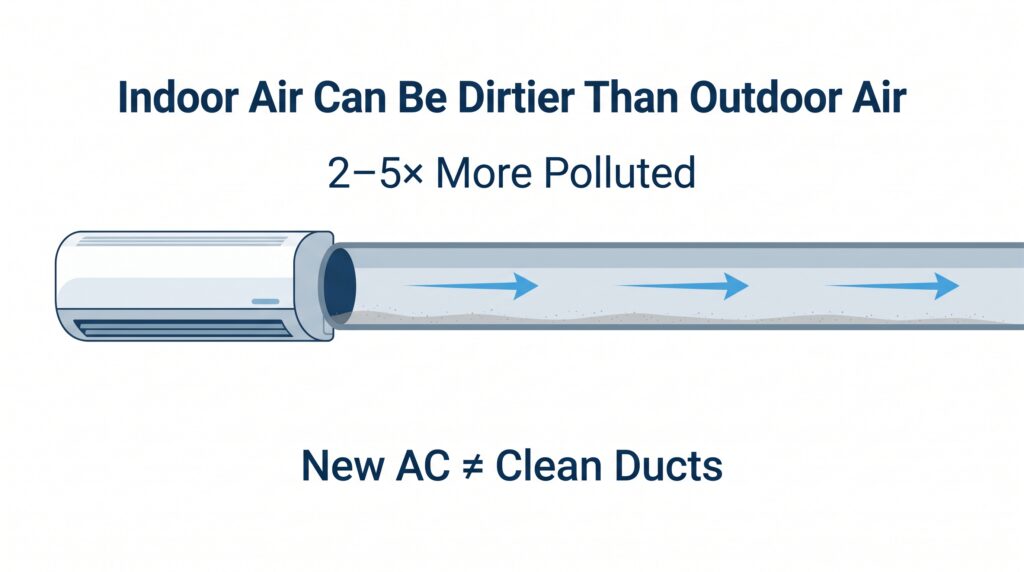
The five points below separate the specific, verifiable signs that make duct cleaning worth the money after a replacement from the far more common case where it’s an unnecessary upsell.
What Actually Happens Inside Your Ducts During an AC Replacement
An AC replacement swaps the outdoor condenser and indoor coil or air handler, then reconnects them to your existing ductwork — it does not clean, inspect, or reseal the duct run itself unless that’s explicitly part of the job. The only points where new material typically enters the ducts are the supply and return connections the installer physically opens to make the swap.
- Cutting and refitting at the plenum and boots can shed metal shavings and insulation fragments directly into the duct interior at the connection points, even on an otherwise clean system.
- Open duct ends left uncovered during the job collect ambient dust from the attic, crawlspace, or garage where the work is happening.
- If the AC swap happens alongside any drywall, insulation, or flooring work, fine particulate from that work can be pulled into open registers and returns even when the HVAC system itself is powered off.
Building America Solution Center — a Department of Energy-funded resource from Pacific Northwest National Laboratory — specifically recommends that ducts be inspected and vacuumed of any debris before a new system’s first startup, precisely because installation work introduces contamination that pre-installation duct condition alone won’t predict.
Construction and remodeling work generates dust and particulates that can be drawn into open ducts and mechanical equipment even when the HVAC system isn’t running — and that debris reduces equipment efficiency and life if it’s not removed before the system goes into regular service.
Source: Building America Solution Center, Pacific Northwest National Laboratory (U.S. Department of Energy)
What the EPA Actually Says About Duct Cleaning
The EPA does not recommend duct cleaning on a fixed schedule and has found no conclusive evidence that dirty ducts alone raise particle levels inside a home — it recommends cleaning only when one of three specific conditions is present. This is the single most-cited — and most-skipped — piece of guidance in the entire “should I clean my ducts” conversation.
- Substantial visible mold growth inside hard-surface ducts or on other heating/cooling system components.
- Ducts clogged with excessive dust and debris, where particles are actually being released into the home through the supply registers.
- Ducts infested with rodents or insects.
Outside those three triggers, the EPA notes that duct cleaning “has never been shown to actually prevent health problems,” and that most household dirt in ducts adheres to duct surfaces rather than circulating into the living space. Everyday indoor pollutant sources — cooking, cleaning products, smoking, foot traffic — typically contribute more to indoor air exposure than a dirty duct run does.
The EPA does not recommend that air ducts be cleaned routinely, only as needed — and specifically flags visible mold, excessive dust and debris being released into the home, and rodent or insect infestation as the conditions that warrant it.
Source: U.S. Environmental Protection Agency, Indoor Air Quality (IAQ)
5 Signs Duct Cleaning Is Worth It After Your AC Replacement
Beyond the EPA’s three general triggers, an AC replacement adds installation-specific signs that make duct cleaning worth scheduling — most of them show up in the first week the new system runs, not months later.
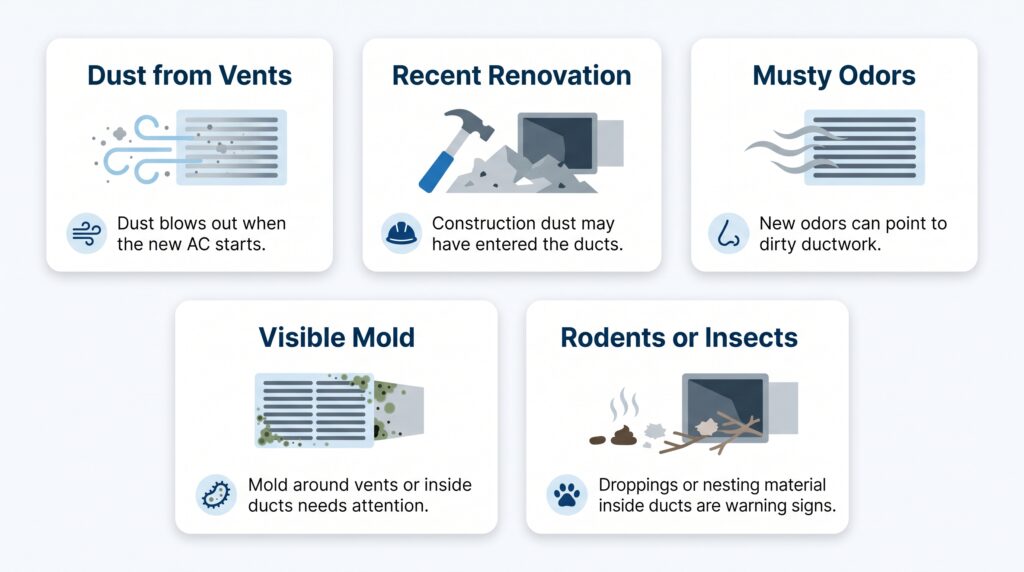
- A visible burst of dust from the vents the first time the new system runs. This is the clearest sign that installation debris — drywall dust, insulation fragments, or existing buildup dislodged by the new blower’s airflow profile — is now circulating.
- Any renovation, drywall, insulation, or flooring work happened at the same time as the AC swap. Open duct runs near active construction work are a documented contamination pathway, independent of whether the ducts were clean beforehand.
- Musty or “dirty sock” odors from the registers that weren’t present before the replacement, which can indicate moisture or microbial growth disturbed during the work.
- Visible mold on a register cover, in the return grille, or anywhere in the accessible duct interior — one of the EPA’s explicit triggers, and one that a technician opening up connection points during installation may newly discover even if it wasn’t previously visible.
- Evidence of rodents or insects — droppings, nesting material, or a chewed duct liner found when the installer accesses the system.
Any one of these on its own is enough to justify scheduling a cleaning alongside — or shortly after — your replacement, rather than waiting for a symptom to develop.
When You Can Skip It
If your ductwork is younger than the EPA’s contamination triggers apply to, the installation was clean, and no renovation dust was introduced, a new AC system does not need a duct cleaning to operate at its rated efficiency. This is the more common outcome, and it’s worth stating plainly since duct cleaning is one of the more frequently oversold add-ons in residential HVAC.
- Ductwork is under roughly 10-15 years old with no history of moisture intrusion, pest activity, or visible contamination.
- The installer covered or capped open duct ends during the job and vacuumed connection points before startup.
- No renovation or remodeling work happened concurrently with the AC swap.
- No dust, debris, or odor showed up in the days after the new system started running.
In this scenario, spending $450-$1,000 on a duct cleaning adds cost without a corresponding air-quality or performance benefit — the EPA’s own guidance backs skipping it here.
The Hidden Cost of Skipping It: How Dirty Ducts Undercut a New System’s Efficiency
Even when duct cleaning isn’t an air-quality issue, existing duct leakage and debris buildup can quietly absorb part of the efficiency gain you just paid for in a new, higher-SEER system — a connection most “signs you need duct cleaning” content doesn’t make.
In a typical home, 20 to 30% of the air moving through the duct system is already lost to leaks, holes, and poorly sealed connections, according to ENERGY STAR — cutting heating and cooling efficiency by as much as 20% before debris is even part of the equation.
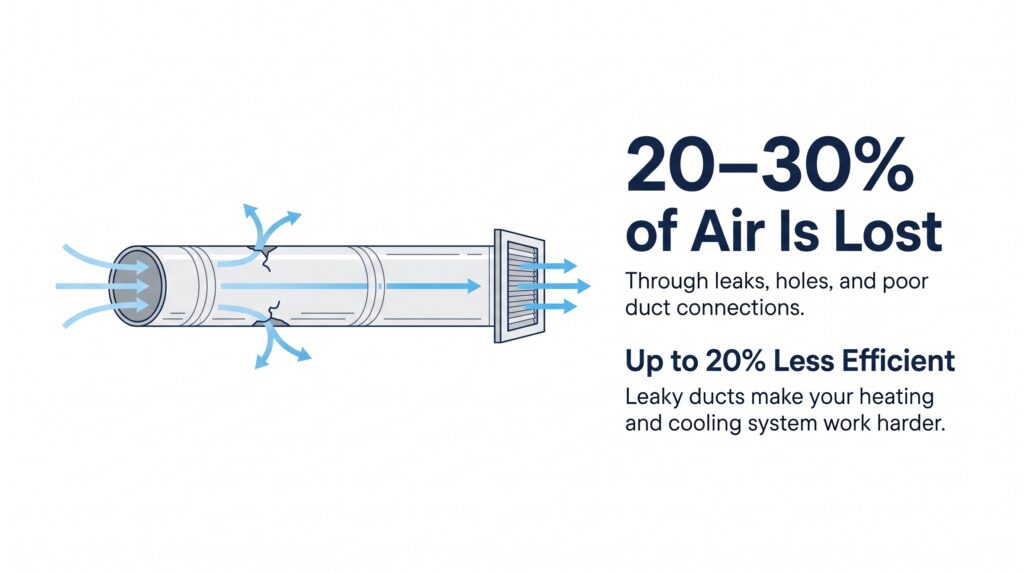
About 20-30% of the air that moves through a typical home’s duct system is lost due to leaks, holes, and poor connections, which can reduce heating and cooling system efficiency by as much as 20%.
Source: ENERGY STAR, U.S. EPA
Original insight: debris buildup doesn’t cause that leakage, but it compounds it. Accumulated dust and construction debris narrows the effective duct cross-section and increases static pressure, forcing the blower on your new system to work harder to move the same volume of air through a resistance-loaded path. In practice, this means a portion of the efficiency upgrade you financed with a new SEER2-rated system can be delivered to the duct system’s inefficiency rather than to the room — not because the new equipment underperforms, but because the delivery path is unchanged. This is a field-observed pattern, not a formally published percentage, and it’s the strongest efficiency-based argument for pairing a duct inspection with a replacement on any system where debris or leakage was already suspected before the swap.
A full residential AC replacement runs $4,500-$12,000 installed in 2026, with most Texas homes landing between $6,500 and $10,000, according to Angi’s 2026 pricing data. Protecting that investment’s promised efficiency gain — not just avoiding a repeat repair — is the financial argument for treating duct condition as part of the replacement decision rather than an unrelated line item.
What Air Duct Cleaning Actually Costs in 2026
NADCA, the industry’s primary certifying body, puts a properly performed residential duct cleaning at $450-$1,000 for an average-sized home, with cost driven by ductwork type, system size, number of systems, and contamination level — not a flat per-home rate.
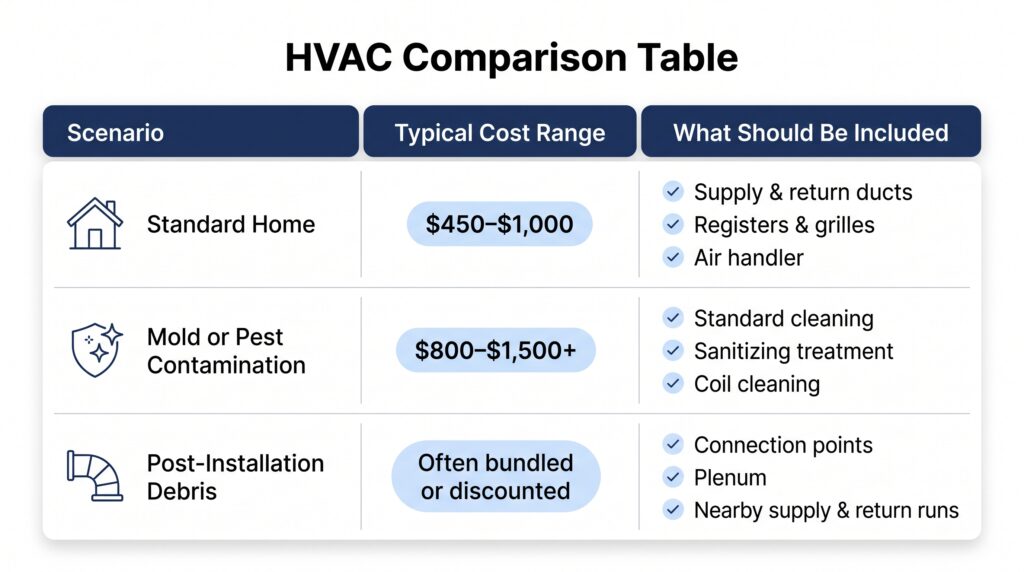
NADCA specifically warns homeowners to be cautious of advertisements for extremely low-cost “whole house” duct cleaning specials — these often cover only a limited portion of the system and exclude components that matter most, including the air handler, blower fan, coils, registers, and necessary access openings. A written scope of work that names each component being cleaned is the simplest way to confirm you’re getting a full service rather than a stripped-down version of one.
Homeowners should be cautious of advertisements promoting extremely low-cost “whole house” air duct cleaning specials, as these offers often include only limited portions of the system and may exclude critical components such as the air handler, blower fans, coils, registers, or necessary access openings.
Source: National Air Duct Cleaners Association (NADCA)
How to Know If Your Installer Already Protected Your Ducts
Before assuming a duct cleaning is needed, check whether your installer followed standard debris-prevention practice during the replacement — this alone resolves the question for a large share of homeowners without spending anything.
- Were open duct ends covered or capped while the old equipment was removed and the new equipment connected?
- Was the work area vacuumed at connection points before the system was started up for the first time?
- Did the technician run the system and check supply registers for dust discharge before leaving the job?
- Is there a written note on the invoice confirming duct protection steps were taken, not just a verbal assurance?
If the answer to these is yes and no dust, odor, or debris shows up after startup, that’s a strong practical indicator the ductwork doesn’t need service on the strength of the AC replacement alone.
The Install Disruption Rule
Original heuristic: treat any AC replacement that involved opening ductwork, cutting new boots, or running concurrently with other construction as a duct-disruption event first and an equipment upgrade second — the same category of risk the DOE’s own construction-debris guidance flags for renovations generally, just triggered by an HVAC swap instead of a remodel. Under this rule, the decision isn’t “is my system new” — it’s “was my duct system physically opened or exposed to construction dust during the process, and if so, was it protected.”
- Ducts opened + protected + no post-startup symptoms → skip cleaning.
- Ducts opened + not protected, or symptoms appear → clean, at minimum, the connection points and nearest runs.
- Concurrent renovation + open ducts nearby → clean regardless of symptoms, since fine particulate contamination isn’t always visible or immediately released into the home.
- No ducts opened (rare, only on systems where boots/plenum weren’t touched) → the EPA’s three general triggers are the only relevant test.
Duct Cleaning Decision At a Glance
| Situation | Clean Ducts? | Why |
|---|---|---|
| Dust visibly blows from vents after new system starts | Yes | EPA trigger: particles released into home |
| Visible mold on register or in duct interior | Yes | EPA trigger: substantial mold growth |
| Rodent/insect evidence found during install | Yes | EPA trigger: pest infestation |
| Renovation/drywall work alongside AC swap | Yes | Construction debris pathway (BASC/PNNL guidance) |
| Clean install, ducts capped, no symptoms | No | No EPA trigger present; cleaning adds cost, not benefit |
| Ducts under ~10-15 yrs, no history of issues | No | Age alone isn’t an EPA or NADCA trigger |
How Honeycomb Handles Post-Replacement Duct Assessment
Honeycomb Heating & Cooling treats duct condition as a documented checklist item on every installation, not an upsell pitched after the sale.
- Duct ends covered or capped before any connection point is opened during the swap
- Connection points and nearest supply/return runs vacuumed before system startup
- New system run for an initial test cycle with registers checked for visible dust discharge
- Any visible mold, pest evidence, or excessive existing debris documented with photos on the invoice
- Duct cleaning recommended only when one of the EPA’s three triggers or a construction-debris condition is actually present — not as a default add-on
- Written scope of work provided before any duct cleaning service, listing every component included
If you’re deciding whether air duct cleaning makes sense around your next AC replacement, that documented, trigger-based assessment — not a flat-rate upsell — is what should drive the decision.
Frequently Asked Questions
Is air duct cleaning worth it after installing a new AC?
Only if specific triggers are present: visible mold inside the ducts, dust or debris visibly blowing from supply registers, a rodent or insect infestation, or construction debris introduced during the installation itself. The EPA does not recommend duct cleaning on a fixed schedule — only when one of these conditions exists. A new AC unit alone, installed cleanly, does not require duct cleaning to perform properly.
Does the EPA recommend routine duct cleaning?
No. The EPA states duct cleaning has never been shown to actually prevent health problems and should not be done on a routine basis, only as needed — specifically when there is visible mold, excessive dust or debris being released into the home, or a pest infestation inside the ductwork.
Do AC installers clean the ducts as part of a normal replacement?
Not automatically. A standard AC replacement swaps the outdoor condenser and indoor air handler or coil and reconnects them to the existing duct system. Unless duct cleaning is explicitly quoted as part of the job, the ductwork itself is untouched except at the connection points, where installation debris can get introduced.
How much does air duct cleaning cost in 2026?
NADCA reports a typical range of $450 to $1,000 for a full, properly performed residential cleaning, with cost driven by ductwork type, home size, number of systems, and level of contamination. Homes with mold or pest contamination can run higher. Be cautious of flat-rate “whole house” specials priced far below this range — they often exclude the air handler, coils, and blower fan.
How often should air ducts be cleaned?
NADCA’s general baseline is every 3 to 5 years for a typical home, tightening to roughly every 2 to 3 years for homes with pets or occupants with allergies or asthma. The EPA does not endorse a fixed interval and instead ties the decision to visible signs of contamination rather than a calendar.
Can construction debris from an AC installation get into the ductwork?
Yes. Cutting, fitting, and reconnecting supply and return boots during an installation can introduce metal shavings, insulation fragments, and dust directly into the duct run at the connection points, even when the rest of the ductwork was previously clean. Building America Solution Center guidance recommends inspecting and vacuuming ducts before system startup for exactly this reason.
Will dirty ducts reduce the efficiency of a brand-new AC system?
Indirectly, yes. ENERGY STAR data shows that in a typical home, 20 to 30% of the air moving through the duct system is already lost to leaks, holes, and poor connections, cutting heating and cooling efficiency by as much as 20%. Debris buildup adds airflow resistance on top of that existing leakage, meaning a portion of the efficiency gain you paid for in a new higher-SEER system can be absorbed by duct-side losses rather than delivered to the room.
What are the warning signs my ducts need cleaning after an AC replacement?
Visible dust or debris blowing from supply registers when the system starts, a burst of dust when the new system first runs, musty odors from vents, any visible mold on register covers or in the duct interior, evidence of rodents or insects, or a home renovation happening alongside the AC swap that generated drywall dust or sawdust near open duct runs.
Is it a scam if a company offers duct cleaning for under $100?
It’s a red flag rather than an automatic scam, but NADCA specifically warns homeowners to be cautious of ultra-low-cost “whole house” duct cleaning ads, since these often cover only a limited portion of the system and exclude the air handler, blower fan, coils, or registers — components that matter most for airflow and air quality.
Need a Documented Duct Assessment With Your Next AC Replacement?
Honeycomb Heating & Cooling evaluates ductwork against the EPA’s actual triggers during every installation across San Antonio, Bulverde, and Boerne — no flat-rate upsell, just a documented checklist and a written scope before any air conditioning duct cleaning is recommended.
Upfront Flat-Rate Pricing · Zero-Pressure Options · Background-Checked Pros · 5.0 Stars on Google (600+ Reviews)
📞 Call or Text (210) 750-6725
Brandon Caputo
Owner · Honeycomb Heating & Cooling
Brandon Caputo founded Honeycomb Heating & Cooling to bring system-driven reliability and customer-first transparency to the San Antonio HVAC market. Grounded in the principle of proactive, preventative care rather than reactive crisis management, Honeycomb specializes in high-efficiency AC and heating installations, advanced diagnostic repairs, and localized indoor air quality solutions. Brandon infuses empathy into every service call, ensuring his team actively listens to homeowners to deliver clear, value-based comfort solutions.
About Honeycomb Heating & Cooling
San Antonio’s trusted specialist in residential air conditioning installation, swift repairs, and energy-saving preventative maintenance. Founded with a commitment to upfront flat-rate pricing and reliable home comfort.
600+ Completed Projects · 5.00-star Google Rating · Open 24/7 for Emergency Support · Founded by Brandon Caputo.
- Upfront Flat-Rate Pricing—No Hidden Fees
- Zero-Pressure Repair & System Options
- Background-Checked & Certified Technicians
- Amana Authorized Elite Partner
- Goodman High-Efficiency System Specialists
- Comprehensive “Comfy Club” Maintenance Programs
- 600+ 5-Star Reviews Across San Antonio
- Fully Licensed & Insured · Texas
- Free estimates & online booking
- Zero Interest with No Monthly Payment financing available
- Office Address: 26995 US Highway 281 Suite C, San Antonio, TX 78260
Sources & Citations
- U.S. Environmental Protection Agency. (2026). Should You Have the Air Ducts in Your Home Cleaned? epa.gov/indoor-air-quality-iaq/should-you-have-air-ducts-your-home-cleaned
- U.S. Environmental Protection Agency. (2026). Indoor Air Quality (IAQ) Backgrounder — indoor pollutant levels 2-5x (occasionally 100x) higher than outdoor. epa.gov/report-environment/indoor-air-quality
- National Air Duct Cleaners Association (NADCA). (2026). Cost & Time Estimates. breathingclean.com/cost-time-estimates (NADCA’s consumer resource, Breathing Clean)
- ENERGY STAR. (2026). Duct Sealing — Benefits of Duct Sealing. U.S. EPA. energystar.gov/saveathome/heating-cooling/duct-sealing
- Building America Solution Center. (2026). Removing Construction Debris from Ducts. Pacific Northwest National Laboratory, U.S. Department of Energy. basc.pnnl.gov/resource-guides/removing-construction-debris-ducts
- Angi. (2026). Does a New HVAC System Increase Home Value? and related 2026 AC replacement cost data. angi.com


