



 (726) 233-6044
Quick Answer: AC Tune-Up vs Replacement — What Should You Do?
If your AC is under 10 years old and your repair cost is below 50% of a new system’s price, a professional tune-up almost always wins. If the system is 15+ years old, uses R-22 refrigerant, or repair cost exceeds that 50% threshold, replacement is the better investment. The decision always hinges on documented measurements — not a tech’s verbal estimate.
Here’s what nobody tells you about the AC tune-up vs replacement decision: most homeowners make it based on the wrong information. They get a verbal quote for a repair, feel the sticker shock, and replace a system that had five good years left in it. Or they keep pouring money into a 17-year-old unit because no one walked them through the actual math.
This guide gives you a decision framework built on three things: documented system data, real cost math, and San Antonio-specific conditions that change the calculus versus national averages. By the end, you’ll know exactly which question to ask your technician — and what answer should trigger replacement versus a properly scoped tune-up.
The cost and performance data below is based on 2026 San Antonio market rates, U.S. Department of Energy benchmarks, and field data from HVAC service calls in the greater Bexar County area.
The AC Tune-Up vs Replacement Decision Framework
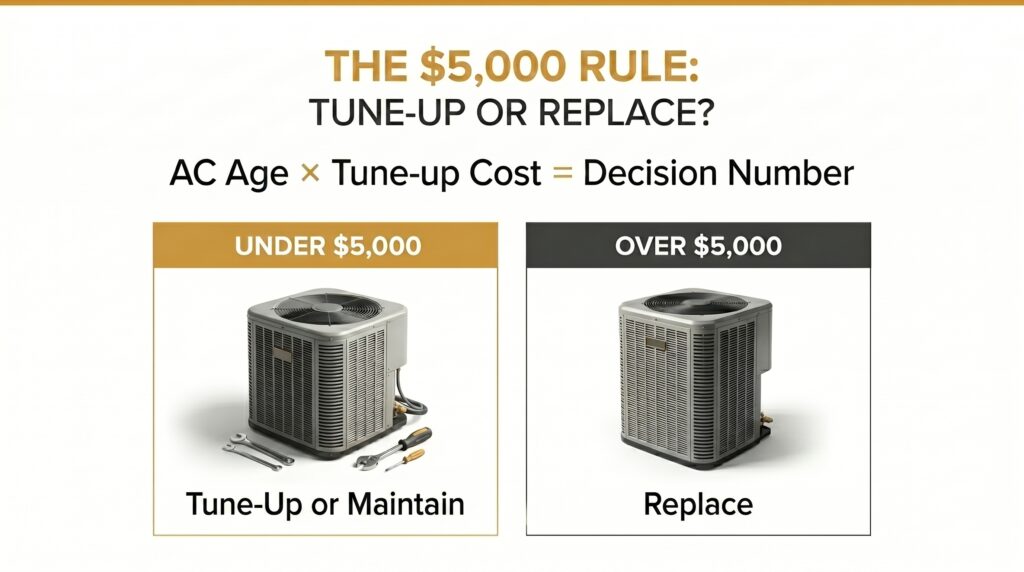
The fastest way to decide between a tune-up and replacement is the “5,000 Rule”: multiply the system’s age (in years) by the estimated repair cost. If the result exceeds $5,000, replacement is likely the smarter financial move. If it’s under $5,000, repair and maintain. This rule, originally popularized by Consumer Reports, gives you a quick filter before running the full math.
But the 5,000 Rule is a starting point, not a verdict. It works best when combined with three additional data points your technician should be able to produce after a proper diagnostic visit:
- System SEER rating — the efficiency score of your current unit versus what a new system would deliver
- Refrigerant type — R-22 (phased out since 2020) vs. R-410A or newer R-32/R-454B systems
- Measured system performance — actual temperature split, capacitor microfarad reading, and refrigerant charge, not a visual estimate
Without those three data points, any replacement recommendation is a guess. A system that “seems old” may still be running at 90% efficiency. A newer system with a fouled coil and a failing capacitor may already be operating like a unit twice its age.
Per the U.S. Department of Energy: a well-maintained AC system should last 15–20 years with annual service. Systems that are skipped on maintenance can degrade to the equivalent performance of a unit 3–5 years older within a single cooling season under heavy load.
Source: U.S. Department of Energy, Energy Saver
Signs You Need a Tune-Up — Not a Replacement
Most AC problems that feel like system failure are actually maintenance deficits: dirty coils, a weak capacitor, a clogged condensate drain, or a mild refrigerant deviation. Each of these is resolved by a properly scoped tune-up — not a $7,000–$14,000 system replacement. The key is knowing which symptoms belong in which category.
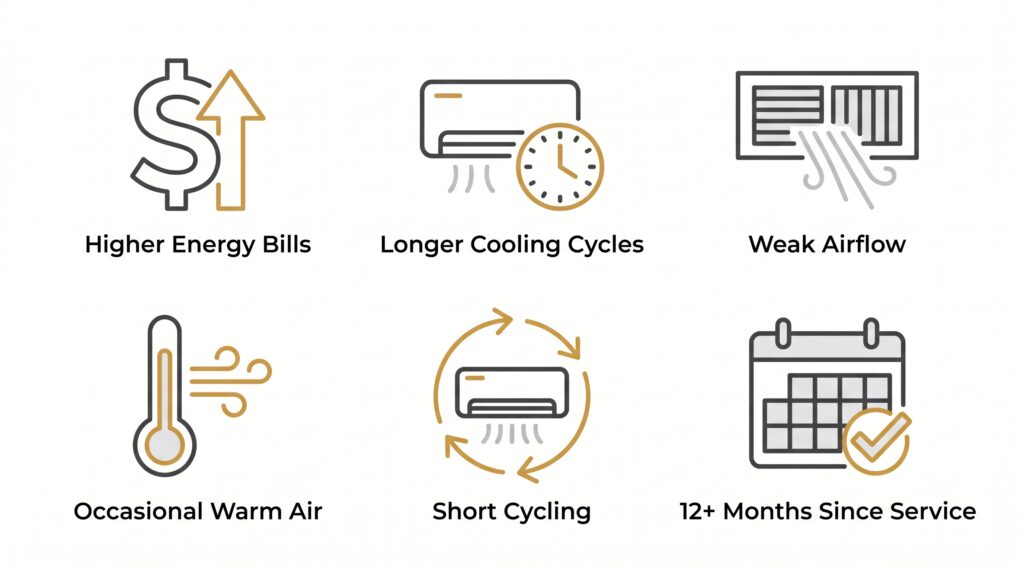
Book a tune-up — not a replacement — when you’re seeing:
- Higher energy bills without a usage change — almost always a coil fouling or airflow issue, both fixable in a single visit
- AC running longer cycles than usual — often a low refrigerant charge or dirty evaporator coil, neither of which requires a new system
- Weak airflow from vents — blower issues or duct restrictions; tune-up catches this with an airflow measurement
- Occasional warm air during an otherwise cooling cycle — could be a refrigerant deviation correctable via charge adjustment
- System short-cycling (turning on and off rapidly) — frequently a failing capacitor; a $15–$45 part with a $100–$200 labor cost, not a new unit
- Unit running fine but hasn’t had service in 12+ months — preventive tune-up before San Antonio’s peak cooling season is cheaper than an emergency call in July
A U.S. Department of Energy review of field studies found that 9 out of 10 HVAC systems have an installation or maintenance issue that could be corrected — with refrigerant charge and airflow the two most common culprits. Both are caught and fixed during a legitimate tune-up. Neither requires a new system.
Source: U.S. Department of Energy, Office of Building Technologies
Signs You Need Replacement — Not a Tune-Up
Replacement becomes the right call when the underlying hardware can no longer be restored to acceptable efficiency through service — typically when the compressor is failing, the system uses discontinued refrigerant, or accumulated repair costs are approaching what a new system would cost. A tune-up on a system in this condition delays the inevitable while adding cost.
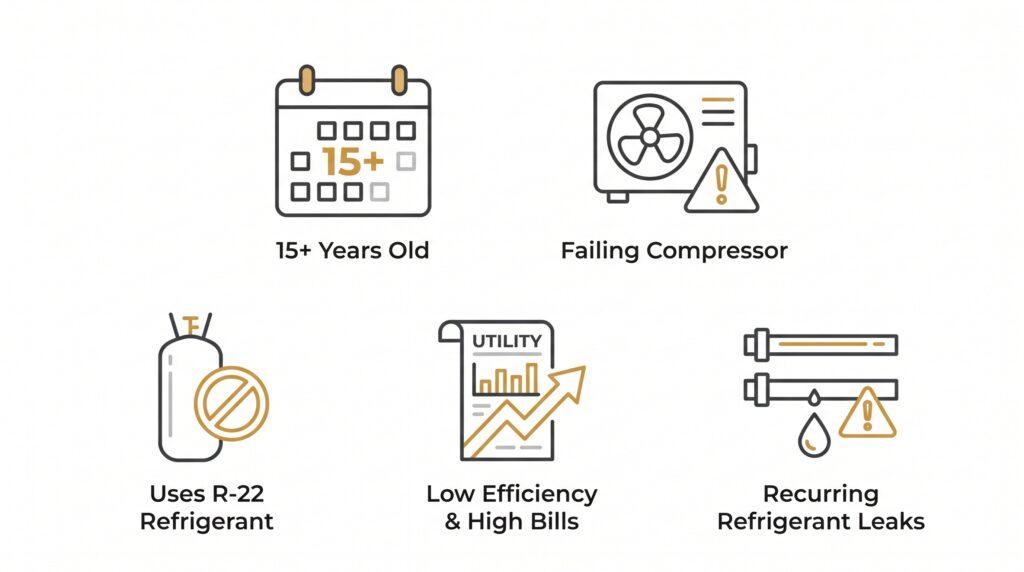
Consider replacement when:
- The system is 15+ years old and has had multiple repairs in the last two seasons. Component failure probability rises sharply after year 15 under San Antonio’s high-runtime conditions (see the age section below).
- The compressor is failing or has already failed. Compressor replacement on an older system costs $850–$2,400 installed (national avg. ~$1,600 per Angi 2026) — often 40%–60% of a new entry-level system’s price. At that spend, you’re buying back into an aging platform.
- The system uses R-22 refrigerant. R-22 was phased out of production in 2020 per EPA Section 608 regulations. What remains in the supply chain is recycled stock priced at $100–$175 per pound. A moderate R-22 leak repair runs $400–$1,500 before you even fix the leak source — and you’re still running a refrigerant with no production future.
- Your current SEER rating is under 14 and your utility bills are significantly above average. Federal minimum efficiency standards for new systems in the Southwest region moved to SEER2 14.3 in 2023. Replacing a 10-SEER unit with a 16-SEER system reduces cooling energy consumption by approximately 37%.
- A documented diagnostic (not a visual estimate) shows compressor efficiency below 85% and refrigerant lines with recurring micro-leaks. This is a system in managed decline, not a tune-up candidate.
Upgrading from a 10 SEER system to a 16 SEER system reduces cooling energy use by approximately 37%. For a San Antonio home running a 3-ton unit through ~2,000 annual cooling hours, that delta translates to a meaningful monthly reduction on a CPS Energy bill. The payback window depends on current system age and local utility rates.
Source: U.S. Department of Energy SEER efficiency standards; SEER2 Southwest minimums per DOE 2023
The Age Factor: How San Antonio’s Climate Changes the Lifespan Math
In San Antonio, a 12-year-old AC system is functionally older than a 12-year-old system in Chicago or Seattle. The reason is runtime hours. San Antonio averages approximately 2,000+ cooling hours per year — nearly double the national average of ~1,200 hours — because the cooling season runs March through October rather than June through August. More runtime hours means faster component wear, more refrigerant cycling stress, and accelerated coil fouling from the city’s documented air quality issues.
Here’s a practical age-to-decision guide calibrated for San Antonio’s climate:
| System Age | Likely Recommendation | Rationale |
|---|---|---|
| Under 8 years | Tune-up and repair | System has significant remaining life; any issue is almost certainly maintenance-correctable |
| 8–12 years | Tune-up first; repair if cost is under 50% of new system | Get documented measurements before deciding; compressor health is the key variable |
| 12–15 years | Tune-up + full diagnostic; start budgeting for replacement | Capacitor and refrigerant integrity still serviceable, but compressor failure risk rising |
| 15–18 years | Repair only if cost is under 25% of replacement; otherwise replace | ROI on major repairs is poor at this age under SA runtime conditions |
| 18+ years | Replace unless system is in exceptional condition with documented performance data | Component failure probability is high; efficiency gap vs. new systems is now substantial |
San Antonio ranked 20th worst in the nation for ozone pollution in the American Lung Association’s 2025 “State of the Air” report, with Bexar County earning an “F” grade and a six-year upward trend. High-ozone, high-particulate outdoor air accelerates the surface chemistry that drives condenser coil fouling — compounding efficiency losses in a market that already logs some of the country’s highest AC runtime hours per year.
Source: Texas Public Radio, reporting on American Lung Association 2025 State of the Air Report
The Actual Cost Math: Tune-Up vs Repair vs Replacement in 2026
The three-way comparison most homeowners never see side by side: what a tune-up costs, what the most common repairs cost, and what full replacement costs — all in 2026 San Antonio market rates. Having these numbers in one place changes the conversation from “is this too expensive?” to “which option has the best ROI?”
| Scenario | Typical Cost (2026, San Antonio) | Best For |
|---|---|---|
| Annual tune-up (preventive) | $58–$150 | Any system under 18 years old; non-negotiable for systems 8–15 years old |
| Capacitor replacement | $100–$250 installed | Any age; one of the highest-ROI repairs in HVAC — cheap part, high failure cost if missed |
| Refrigerant recharge (R-410A) | $150–$350 depending on volume | Systems under 12 years old with no leak history; fix the leak first |
| Refrigerant recharge (R-22) | $400–$1,500+ | Only if system is under 8 years old and leak is minor; otherwise replacement wins |
| Compressor replacement | $850–$2,400 installed (avg. ~$1,600) | Systems under 10 years old in good condition otherwise; apply 5,000 Rule first |
| Full system replacement (2–3 ton) | $4,500–$12,000 installed (Texas avg. $6,500–$10,000 for 2–3 ton) | Systems 15+ years old, R-22 units, or when repair cost exceeds 50% of replacement |
| Emergency repair call (no tune-up history) | Same repair + 50–100% premium | What you pay when you skip the $58–$150 annual tune-up |
The bottom row is the one that matters most for most San Antonio homeowners. According to WorkTrek’s 2026 HVAC maintenance statistics, reactive (breakdown) maintenance costs 3–10 times more than a preventive maintenance program over the life of the equipment. The tune-up isn’t a cost center — it’s the mechanism by which you avoid the emergency-rate column in the table above.
Heating and cooling account for approximately 43% of a typical home’s energy bill, per the U.S. Department of Energy. In San Antonio — where the cooling season is six to eight months long — the AC’s share of that 43% is disproportionately large. A 10% efficiency recovery through tune-up-level interventions (coil cleaning, airflow correction, refrigerant verification) directly reduces one of the largest line items on a household budget.
Source: U.S. Department of Energy, Energy Saver
The “Tune-Up First” Protocol: Why You Should Never Decide Without Data
Before agreeing to any system replacement, get a documented tune-up diagnostic first. This is not standard industry advice — and that’s exactly why it’s worth emphasizing. A verbal diagnosis of “your system is inefficient and should be replaced” from a technician who spent 20 minutes on-site is not a data point. It’s an opinion without measurements.
A proper tune-up diagnostic produces the following documented readings, which are the only legitimate inputs to a replace-or-repair decision:
- Refrigerant superheat or subcooling measurement — tells you whether the refrigerant charge is correct or whether the system is operating outside spec
- Capacitor microfarad reading — tells you whether the capacitor is degraded and within how far of failure
- Supply/return temperature split — tells you whether the system is delivering the BTU output it’s rated for
- Compressor amp draw under load — the single most revealing measurement for compressor health; a compressor drawing more than its rated amperage is failing, one drawing less may already be underperforming
- Blower airflow measurement — per ENERGY STAR, airflow problems reduce AC efficiency by up to 15% and are the second-largest efficiency drain on most residential systems
If a technician recommends replacement without producing all five of the above as documented values on the invoice, you have not received a diagnostic. You’ve received a sales call with a uniform. The Tune-Up First Protocol costs you $58–$150. It can save you $4,500–$9,500.
ENERGY STAR estimates that airflow problems alone can reduce AC system efficiency by up to 15%. A system that “isn’t cooling well” because of a blower restriction or duct blockage will fail any informal eyeball assessment — and pass any measurement-based tune-up diagnostic once the issue is corrected.
Source: ENERGY STAR Maintenance Checklist
How to Spot a Technician Pushing Unnecessary Replacement
Unnecessary replacement is the most expensive misdiagnosis in residential HVAC. Unlike a missed repair, it can’t be reversed. The following red flags indicate a replacement recommendation that warrants a second opinion before you sign anything.
- Replacement recommended after a visit under 30 minutes. A legitimate diagnostic that includes compressor amp draw, refrigerant charge measurement, and capacitor testing under load takes 60–90 minutes minimum. A 20-minute visit cannot have produced those readings.
- Invoice shows no measured values — only “inspected” checkboxes. Visual inspection cannot diagnose refrigerant charge deviation, a borderline capacitor, or early compressor degradation. If there are no numbers, there is no diagnosis.
- “Your refrigerant is low” without a documented charge reading. Refrigerant level must be measured with gauges after 15+ minutes of runtime. “Low” is a number, not a feeling. Ask what the measured superheat or subcooling value was and what the spec is for your system.
- Immediate urgency framing without documented compressor data. “This compressor is about to fail” is a specific claim that requires a specific amp draw reading to support it. Ask for the number.
- No written repair estimate provided before replacement quote. A contractor who skips directly to replacement pricing without a documented repair cost is not giving you the information you need to make a real decision.
The antidote to all of the above is simple: ask for the invoice with numbers before agreeing to anything. Legitimate technicians document every measurement. Technicians who skip documentation are either cutting corners or building toward an upsell.
A 2025 DuraPlas survey reported by ACHR News found that 50% of homeowners planned to skip HVAC maintenance entirely, citing economic pressure. Homeowners who defer the $58–$150 preventive visit are statistically more likely to face the emergency-season replacement pressure scenario — when heat and urgency combine with incomplete information.
Source: ACHR News, reporting on DuraPlas 2025 homeowner survey
Seasonal Timing: When the Tune-Up vs Replacement Decision Gets More Expensive
The same replacement decision made in July costs 20%–40% more than the same decision made in March — not because materials cost more, but because contractor availability collapses during peak season and emergency-rate premiums apply to both service calls and equipment procurement. The best time to make the tune-up vs replacement decision is before you have to make it under heat.
San Antonio’s HVAC demand calendar in practice:
| Month Window | Decision Conditions | Cost Implication |
|---|---|---|
| January–February | Lowest demand; full technician availability; best lead times on equipment orders | Lowest pricing on both tune-ups and replacement installs |
| March–April | Optimal pre-season window; defects found now can be repaired at standard rates before June | Still low pricing; recommended booking window |
| May | Demand beginning to ramp; availability tightening in late May | Standard pricing; book early |
| June–August | Peak demand; same-day availability often gone within hours of first 100°F week; emergency premiums apply | 50%–100% premium on service calls; equipment lead times extend |
| September–October | Demand tapering; good post-season window for replacement if system limped through summer | Pricing returns toward standard; contractors more available |
The practical implication: if you’re on the fence about whether to tune-up or replace a 12–15 year old system, make that decision in March — when you have time, pricing leverage, and no heat urgency. CPS Energy set an all-time demand record of 5,858 megawatts during a 2024 August heat wave and projects annual peak-demand growth of 260 megawatts going forward. An inefficient system running longer cycles during grid-peak hours is the most expensive version of the problem.
Source: San Antonio Report
How Honeycomb Handles the Tune-Up vs Replacement Decision
Honeycomb Heating & Cooling does not recommend replacement without documented diagnostics. Every service visit produces a written invoice with measured values — refrigerant charge reading, capacitor microfarad result, temperature split, and compressor amp draw. If those numbers support repair, we tell you to repair. If they support replacement, we show you the data that says so.
Here’s exactly how a Honeycomb diagnostic visit works when the outcome is unclear:
- Technician arrives and runs the system through a full 15+ minute runtime before any measurements are taken — refrigerant charge readings taken cold are inaccurate
- Refrigerant superheat or subcooling measured and documented
- Capacitor microfarad reading taken under load and recorded on invoice
- Compressor amp draw measured and compared against rated spec on the nameplate
- Supply/return temperature split recorded
- Blower airflow assessed
- Full written report provided with all readings before any recommendation is made
- Repair estimate and replacement estimate both presented in writing, with the 5,000 Rule applied openly
Frequently Asked Questions
When should I replace my AC instead of getting it repaired?
Replace your AC when: (1) the system is 15+ years old, (2) it uses R-22 refrigerant (discontinued in 2020), (3) the estimated repair cost exceeds 50% of a new system’s installed price, or (4) a documented compressor amp draw test shows the compressor is underperforming or drawing above-rated amps. Any single one of these factors warrants a replacement conversation; two or more makes replacement the clear choice.
Is it worth repairing a 10-year-old AC?
Generally yes — if the repair is under 50% of replacement cost and the system uses current refrigerant (R-410A or R-32/R-454B). A 10-year-old system in San Antonio has typically hit about 50%–60% of its useful life under local runtime conditions (~2,000 hours/year). A capacitor replacement, coil cleaning, or refrigerant recharge on a 10-year-old unit is almost always a good investment. Compressor replacement at 10 years warrants closer analysis.
What is the 5,000 Rule for AC repair vs replacement?
The 5,000 Rule: multiply your AC’s age (in years) by the repair cost (in dollars). If the result exceeds $5,000, replacement is typically the better financial decision. Example: a 12-year-old system needing a $450 repair = $5,400 → borderline, but tipping toward replacement especially in a high-runtime climate like San Antonio. Originally popularized by Consumer Reports as a practical screening tool.
Can an AC tune-up fix a system that stops cooling?
Often yes. The most common causes of a system that stops cooling — a tripped capacitor, low refrigerant charge, clogged condensate drain, or dirty evaporator coil — are all resolved during a properly scoped tune-up. If the root cause is compressor failure, a tune-up converts the situation from an emergency replacement decision made under heat to a planned, priced replacement on your timeline.
How much does AC replacement cost in San Antonio in 2026?
Full system replacement (2–3 ton central AC) runs approximately $4,500–$12,000 installed in San Antonio in 2026, with most Texas homeowners paying $6,500–$10,000 for a mid-efficiency 3-ton system with standard installation, per HomeGuide and Angi 2026 pricing data. High-efficiency (18+ SEER2) systems and variable-speed equipment run higher. Under IRS Section 25C (active through 2032), the federal tax credit covers 30% of qualifying equipment costs — capped at $600 for central air conditioners and $2,000 for qualifying heat pumps — for primary residences only. Verify current ENERGY STAR Most Efficient eligibility at energystar.gov before purchasing.
What refrigerant does my AC use and does it matter?
It matters significantly for the replace-or-repair decision. R-22 (Freon) was phased out of production by the EPA in 2020. What remains is recycled stock priced at $100–$175 per pound — meaning even a minor leak repair becomes expensive fast, and you’re investing in a dead-end refrigerant. R-410A is the current standard; R-32 and R-454B (Puron Advance) are the emerging next-generation refrigerants. Check your system’s nameplate — it lists the refrigerant type.
How do I know if my AC needs a tune-up or a new system?
You can’t know without measured data. The process: book a documented tune-up diagnostic ($58–$150), get the technician to record refrigerant charge, capacitor microfarad reading, temperature split, and compressor amp draw in writing. Those four numbers tell you the system’s actual health state. Any recommendation made without those readings is based on appearance, not performance.
How often should I tune-up my AC in San Antonio?
Once per year, minimum. San Antonio’s extended cooling season (~8 months) logs more runtime hours than almost any major U.S. metro. Systems over 10 years old, or systems that experienced a rough summer with extended high-load operation, benefit from twice-yearly service — once in spring (pre-season) and once in fall. The Honeycomb “Comfy Club” maintenance plan covers both visits at a flat annual rate.
Is a tune-up worth it if I’m planning to replace my AC anyway?
Yes — for two reasons. First, a tune-up diagnostic gives you the measured data to time the replacement intelligently (during off-season when pricing is 20%–40% lower). Second, if the replacement gets delayed for any reason, a tuned system running through a San Antonio summer performs significantly better than an unserviced one, reducing the probability of a mid-summer emergency breakdown on a system you were planning to replace anyway.
Need a pre-season AC tune-up in San Antonio?
Honeycomb Heating & Cooling performs measurement-based tune-ups across San Antonio and the Hill Country: refrigerant charge verification, capacitor microfarad testing, condenser coil cleaning, condensate drain service, and documented readings on every invoice. Book now and lock in our spring special. Current special: AC tune-up for as low as $58.
Upfront Flat-Rate Pricing · Zero-Pressure Options · Background-Checked Pros · 5.0 Stars on Google (600+ Reviews)
📞 Call or Text (210) 750-6725
Brandon Caputo
Owner · Honeycomb Heating & Cooling
Brandon Caputo founded Honeycomb Heating & Cooling to bring system-driven reliability and customer-first transparency to the San Antonio HVAC market. Grounded in the principle of proactive, preventative care rather than reactive crisis management, Honeycomb specializes in high-efficiency AC and heating installations, advanced diagnostic repairs, and localized indoor air quality solutions. Brandon infuses empathy into every service call, ensuring his team actively listens to homeowners to deliver clear, value-based comfort solutions.
About Honeycomb Heating & Cooling
San Antonio’s trusted specialist in residential air conditioning installation, swift repairs, and energy-saving preventative maintenance. Founded with a commitment to upfront flat-rate pricing and reliable home comfort.
600+ Completed Projects · 5.00-star Google Rating · Open 24/7 for Emergency Support · Founded by Brandon Caputo.
- Upfront Flat-Rate Pricing—No Hidden Fees
- Zero-Pressure Repair & System Options
- Background-Checked & Certified Technicians
- Amana Authorized Elite Partner
- Goodman High-Efficiency System Specialists
- Comprehensive “Comfy Club” Maintenance Programs
- 600+ 5-Star Reviews Across San Antonio
- Fully Licensed & Insured · Texas
- Free estimates & online booking
- Zero Interest with No Monthly Payment financing available
- Office Address: 26995 US Highway 281 Suite C, San Antonio, TX 78260
Sources & Citations
- ACHR News. (2025). Report: 50% of homeowners avoiding HVAC maintenance. ACHR News. https://www.achrnews.com/articles/166301-report-50-of-homeowners-avoiding-hvac-maintenance
- Energy Star. (2026). Maintenance checklist. U.S. Environmental Protection Agency. https://www.energystar.gov/saveathome/heating-cooling/maintenance-checklist
- San Antonio Report. (2023, August 10). CPS Energy, ERCOT hit new demand records as August heat wave bears down. https://sanantonioreport.org/cps-energy-ercot-hit-new-demand-records-as-august-heat-wave-bears-down/
- Texas Public Radio. (2025, May 12). San Antonio makes list of 25 most polluted cities in the U.S. TPR Environment. https://www.tpr.org/environment/2025-05-12/san-antonio-makes-list-of-25-most-polluted-cities-in-the-u-s
- U.S. Department of Energy. (2026). Air conditioner maintenance. Energy Saver. https://www.energy.gov/energysaver/air-conditioner-maintenance
- U.S. Department of Energy. (2023). SEER2 minimum efficiency standards — Southwest region. Office of Energy Efficiency & Renewable Energy. https://www.energy.gov/eere/buildings/appliance-and-equipment-standards-program
- U.S. Environmental Protection Agency. (2026). Stationary refrigeration and air conditioning (Section 608). https://www.epa.gov/section608
- WorkTrek. (2026). 25+ HVAC maintenance statistics you should know. WorkTrek Operations Blog. https://worktrek.com/blog/hvac-maintenance-statistics/
- Angi. (2026). How much does an AC compressor cost to install? https://www.angi.com/articles/ac-compressor-cost.htm
- HomeGuide. (2026). How much does AC replacement cost? https://homeguide.com/costs/install-ac-unit-cost
- Internal Revenue Service. (2026). Energy efficient home improvement credit (Section 25C). https://www.irs.gov/credits-deductions/energy-efficient-home-improvement-credit


