



 (726) 233-6044
Quick Answer: How Much Does an AC Tune-Up Cost in San Antonio in 2026?
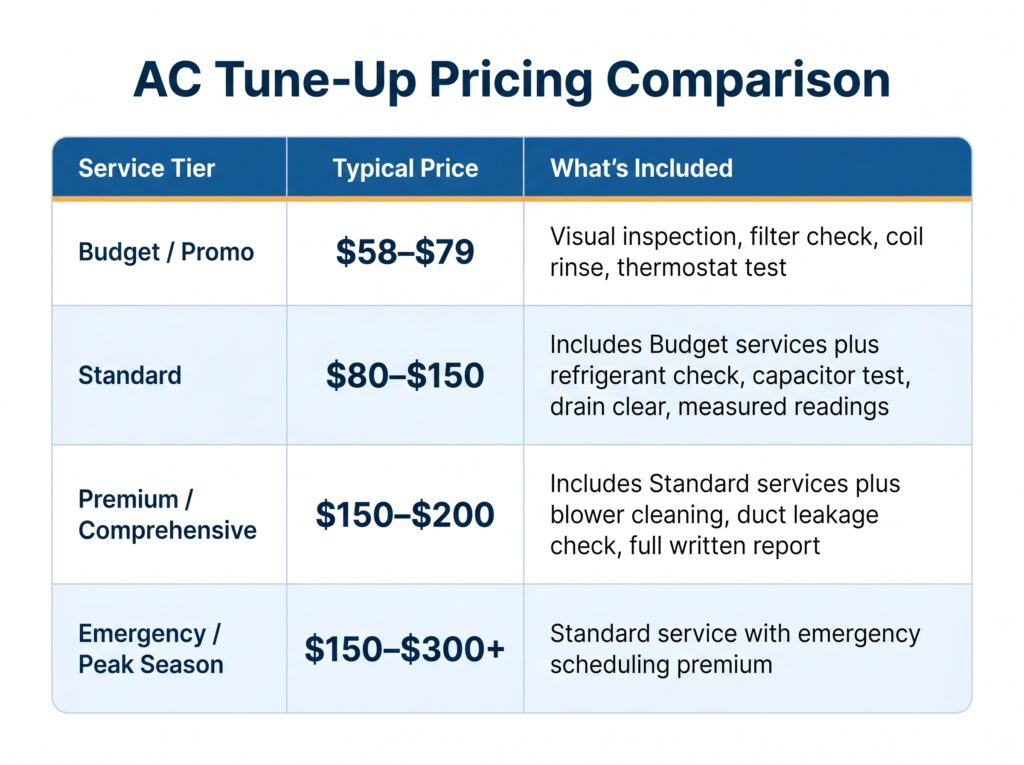
A professional AC tune-up in San Antonio costs $58–$200 in 2026, with most homeowners paying $75–$150 for a standard single-system visit. Emergency-season pricing (June–August) runs 50%–100% higher than the same service booked in spring. The cheapest window is March–April, before peak-demand fills technician schedules across the city.
Here’s what most AC tune-up articles don’t tell you: the price you pay has almost nothing to do with the service you actually receive. A $79 “tune-up” booked in July from a company running a summer blitz and a $79 tune-up booked in April from a measurement-driven technician are not the same transaction — even if the invoice says the same thing.
This guide breaks down exactly what different price points buy, what the math says about skipping service, and the single question you should ask on every invoice to verify you got a real tune-up and not a visual once-over dressed up as maintenance. The AC tune-up cost information below is based on current 2026 San Antonio market rates, cited industry data, and what we actually see on dispatch calls every day.
Average AC Tune-Up Cost in San Antonio in 2026
The average AC tune-up cost in San Antonio in 2026 is $75–$150 for a single-system visit, with a typical range of $58–$200 depending on what’s included, system size, and the time of year. Dual-zone systems or units over 10 years old typically land at the higher end. Specials from local HVAC companies can drop the price to $58 or lower during the shoulder season.
For context on what San Antonio homeowners spend: heating and cooling together account for roughly 43% of a typical household’s energy bill, according to the U.S. Department of Energy. A $100–$150 tune-up that recovers even 5% of cooling efficiency pays for itself inside a single billing cycle for most homes running their AC through a Texas summer.
Source: U.S. Department of Energy
What Drives the Price of an AC Tune-Up Up or Down
AC tune-up prices vary based on system type, equipment age, time of year, whether the company uses flat-rate or hourly pricing, and what the visit actually measures vs. what it only inspects visually. The single biggest price driver most homeowners don’t account for: seasonal demand. The same company can run 2x–3x the call volume during a July heat wave, and pricing follows.
- System type: Single-stage central AC = base price. Variable-speed systems, heat pumps, and dual-zone setups add 15%–30% because calibration takes longer.
- Equipment age: Systems over 10 years require more thorough checks — capacitors degrade, refrigerant connections develop micro-leaks, and coils accumulate years of fouling. Expect the higher end of standard ranges.
- Flat-rate vs. time-and-materials: Flat-rate pricing protects you from “discovery creep” where a 45-minute visual becomes a 2-hour billable visit. Always ask before booking.
- What’s actually measured: A visit that includes refrigerant superheat/subcooling readings, capacitor microfarad testing, and a documented temperature split costs more — because it takes longer and requires calibrated tools. That’s also the version actually worth paying for.
- Seasonal timing: March–April = lowest demand, highest availability, most specials. June–August = peak pricing, longer lead times, same-day availability often gone within hours of the first 100°F week.
- Maintenance plan membership: Plans like Honeycomb’s “Comfy Club” bundle annual tune-ups at a flat annual fee, typically undercutting one-time visit pricing by 20%–40%.
Industry data point: HVAC service call volume during peak summer weeks runs 2x–4x the annual daily average, with the first heat wave of the season driving spikes of 200%–300% above baseline. That demand spike is why the same tune-up costs more in July than in April.
What a $58, $150, and $200 AC Tune-Up Actually Gets You
The difference between a $58 and a $150 tune-up is not quality — it’s scope. A $58 promotional visit can be a legitimate measurement-based service if the company uses it as a lead-in to a full inspection. The red flag is a visit that skips refrigerant verification and capacitor testing, regardless of price.
Here is what each price point should and shouldn’t include, based on ENERGY STAR’s official maintenance checklist:
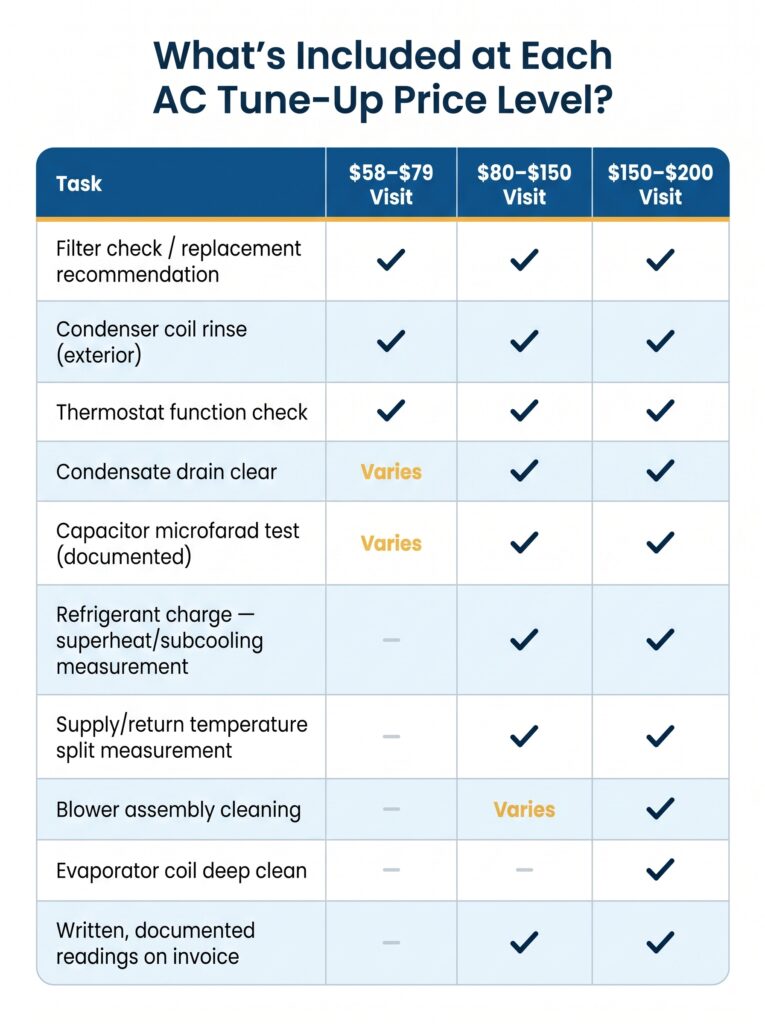
The practical implication: If a tech finishes a tune-up in under 25 minutes and hands you an invoice with no numbers on it — no microfarad reading, no temperature split, no superheat — you did not get a tune-up. You got an inspection-shaped sales visit. Ask for documented readings before the tech leaves.
Per ENERGY STAR: Airflow problems alone — undetected without proper measurement — can reduce AC system efficiency by up to 15%. A tune-up that skips blower and airflow measurement misses the second-largest efficiency drain on most residential systems.
Source: ENERGY STAR
The Hidden Cost of Skipping an AC Tune-Up
Skipping an annual AC tune-up costs San Antonio homeowners an estimated $180–$420 per cooling season in avoidable energy waste, plus exposure to emergency repair premiums that run 50%–100% above standard rates — for the exact same repair, on a worse timeline. The tune-up isn’t a cost. It’s the cheaper version of a transaction you’re going to have anyway.
The math breaks down across three compounding mechanisms:
1. Dirty Filter Efficiency Loss
The U.S. Department of Energy reports that replacing a clogged air filter can reduce AC energy consumption by 5%–15%. For a home running a 3-ton system through a San Antonio summer — roughly 2,000 cooling hours — that filter penalty translates to a measurable line item on every CPS Energy bill from June through September.
2. Coil Fouling Efficiency Loss
Research from Lawrence Berkeley National Laboratory found typical efficiency and capacity degradation of 2%–5% from fouled condenser and evaporator coils, with significantly worse outcomes for older or marginal systems. San Antonio compounds this problem: the American Lung Association’s 2025 “State of the Air” report ranked the San Antonio–New Braunfels metro 20th worst in the nation for ozone pollution, with Bexar County earning an “F” grade and a six-year upward trend. High-ozone, high-particulate outdoor air accelerates the surface chemistry that drives coil fouling — and San Antonio’s extended cooling season means condenser coils log more runtime hours per year than the national average, multiplying cumulative fouling exposure.
3. Emergency Repair Premium
According to WorkTrek’s 2026 HVAC maintenance statistics, reactive (breakdown) maintenance costs 3–10 times more than a preventive maintenance program over the life of equipment. On a single-incident basis, emergency calls during peak summer weeks are priced at 50%–100% above standard service rates for the same labor and parts.
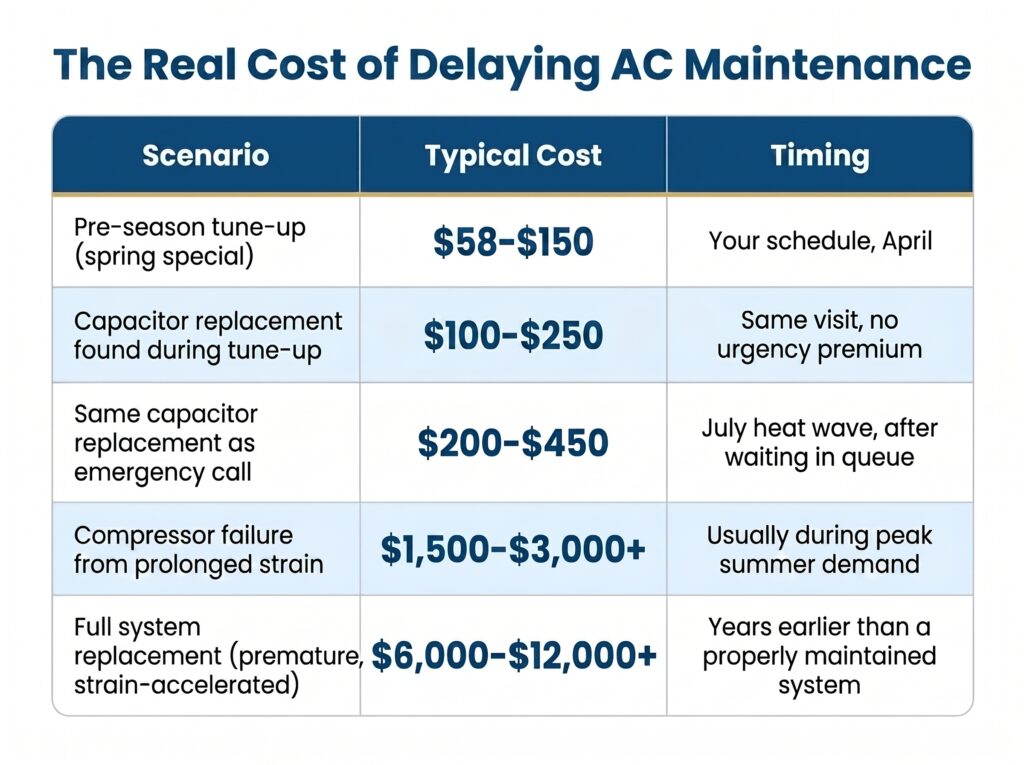
The maintenance gap is widening, not closing. A 2025 DuraPlas survey reported by ACHR News found 50% of homeowners planned to skip HVAC maintenance entirely, citing economic pressure. The homeowners avoiding a $100 service call are statistically the same population funding the emergency-repair premium three months later.
Source: ACHR News
Seasonal Pricing: When Is the Cheapest Time to Book an AC Tune-Up?
The cheapest time to book an AC tune-up in San Antonio is March through early May. This window combines the lowest seasonal demand (lowest pricing), the highest technician availability (no queues), and the correct 60–90-day lead time before peak summer heat — meaning any failures found can be repaired at standard rates before the emergency premium kicks in.
Here’s how pricing and availability shift across the calendar year:
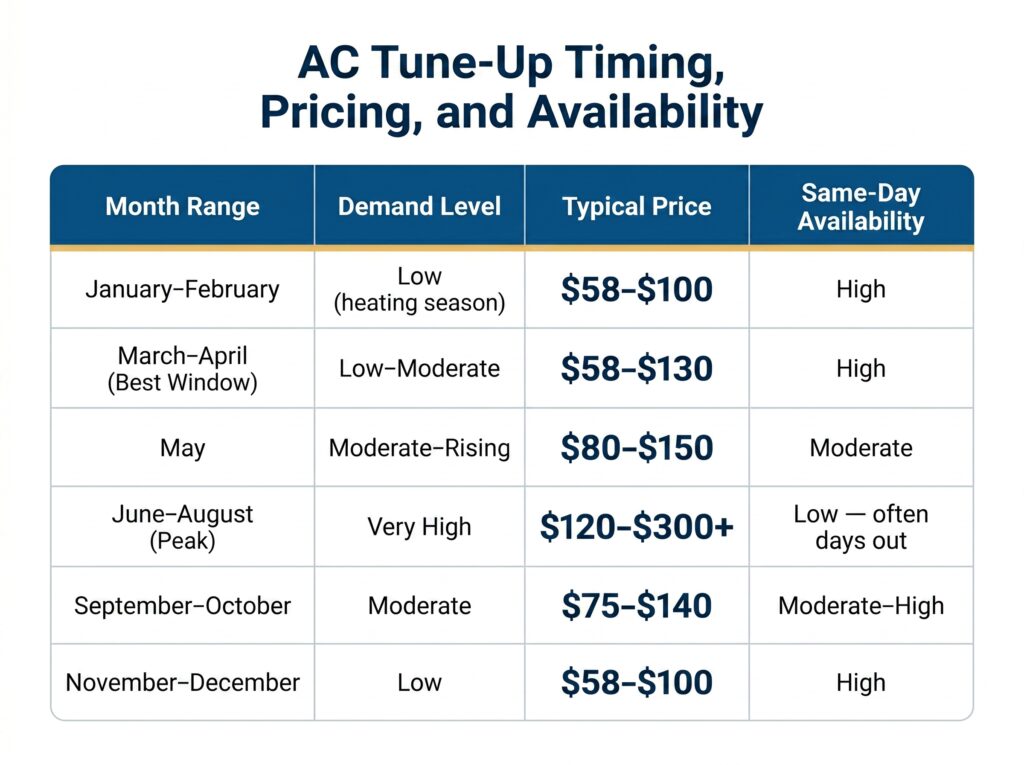
The urgency argument isn’t marketing. San Antonio’s power grid is operating at record stress: CPS Energy set an all-time demand record of 5,858 megawatts during a 2024 August heat wave, and the utility projects annual peak-demand growth of 260 megawatts — more than double its prior forecast.
Source: San Antonio Report
An inefficient AC running longer cycles during grid-peak hours isn’t just expensive in isolation — it’s running at maximum cost exactly when demand charges and exposure are highest.
Already past the ideal window? Book anyway. A June tune-up still catches the same defects. You’ve spent the spring paying the inefficiency penalty, but stopping the breakdown before July is still the better version of the transaction.
How to Tell If You Got a Real AC Tune-Up or a Fake One
A real AC tune-up produces documented, measured numbers on your invoice: capacitor microfarad reading, supply/return temperature split, and refrigerant superheat or subcooling value. If the invoice has no numbers — only a checklist of boxes — the visit was a visual inspection, not a measurement-based tune-up. You cannot catch a failing capacitor or a low refrigerant charge by looking.
This is the single most under-discussed issue in the residential HVAC market. Companies that run $49–$79 seasonal tune-up promos and dispatch a tech for 15–20 minutes are not doing the same service as a company that spends 60–90 minutes with gauges and a multimeter. Both call it a “tune-up.”
Ask These Three Questions Before Booking
- “Will the tech measure and record refrigerant charge?”
Legitimate answer: Yes — superheat for TXV systems or subcooling for fixed orifice, measured after 15+ minutes of runtime. Non-answer: “We check the refrigerant levels.” Checking is not measuring. - “Will capacitor microfarads be tested and written on the invoice?”
Legitimate answer: Yes. Non-answer: “We inspect all electrical components.” Inspection ≠ testing. - “How long does the visit take?”
A real measurement-based tune-up takes 60–90 minutes for one system. A visit quoted at “30 minutes” cannot include all ENERGY STAR-specified measurement tasks. Budget accordingly.
Red Flags on the Invoice
- No measured values — just a checklist of “Inspected” or “OK”
- Refrigerant listed as “checked” with no reading or unit noted
- Visit duration under 30 minutes for a central AC system
- No condensate drain service noted
- Upsell pressure to add refrigerant with no documented charge reading
Why this matters at scale: A U.S. Department of Energy review of residential HVAC field studies found that nine out of ten HVAC systems have an installation or maintenance issue that could be corrected — with most problems related to refrigerant charge and airflow adjustments. Those are exactly the two measurements most often skipped in a visual-only tune-up. If standard service visits were catching these issues, the 90% defect rate wouldn’t exist.
Source: U.S. Department of Energy, Office of Building Technologies
What Honeycomb Charges for an AC Tune-Up — and What’s Actually Included
Honeycomb Heating & Cooling currently offers AC tune-ups starting at $58 for San Antonio homeowners. Every visit is measurement-based: refrigerant charge verification, capacitor microfarad testing, coil cleaning, condensate drain service, and documented readings on every invoice. Flat-rate pricing. No upsell pressure.
Here’s exactly what’s included in a Honeycomb tune-up visit:
- Refrigerant charge measurement (superheat/subcooling) — documented on invoice
- Capacitor microfarad reading — documented on invoice
- Condenser coil inspection and rinse
- Condensate drain clearing
- Electrical connection tightening and contactor inspection
- Blower and airflow assessment
- Thermostat calibration check
- Supply/return temperature split measurement — documented on invoice
- Full written report with readings
Frequently Asked Questions
How much does an AC tune-up cost in San Antonio in 2026?
Most San Antonio homeowners pay $75–$150 for a professional AC tune-up in 2026, with a full range of $58–$200 depending on system type, age, and time of year. Emergency-season visits (June–August) carry a 50%–100% premium over the same service booked in spring.
Is an AC tune-up worth the cost?
Yes — in directly measurable terms. A $75–$150 tune-up that catches a failing capacitor avoids an emergency call billed at $200–$450 for the same part. Recovering the DOE’s minimum 5% efficiency gain from filter and coil service repays most of the cost within the first 30 days of summer runtime. The tune-ups that aren’t worth it are the ones without documented measurements — a 15-minute visual inspection priced at $79 is not the same service.
What is the cheapest time of year to get an AC tune-up in San Antonio?
January–February and March–April offer the lowest prices ($58–$100) and highest availability in San Antonio. The March–April window is the optimal choice because it also hits the 60–90-day lead time before peak summer heat — so any defects found can be repaired at standard rates before June demand spikes.
What does an AC tune-up include?
Per ENERGY STAR’s maintenance checklist, a complete tune-up includes: refrigerant charge verification, coil inspection and cleaning, blower component cleaning and airflow adjustment, electrical connection tightening and component testing, condensate drain clearing, and thermostat calibration. A legitimate visit documents measured readings (superheat/subcooling, capacitor microfarads, temperature split) on the invoice.
How often should I get an AC tune-up?
Once per year for a standard central AC system, ideally 60–90 days before peak summer heat (March through early May in San Antonio). Heat pumps that handle both cooling and heating benefit from twice-yearly service — once in spring and once in fall. Systems over 10 years old also warrant twice-yearly inspection as component failure probability increases with age.
Can an AC tune-up fix a system that’s already not cooling well?
Sometimes. If the cause is a dirty coil, clogged filter, blocked drain, or mild refrigerant deviation, a tune-up resolves it on the spot. If diagnosis reveals a failing compressor or major refrigerant leak, the tune-up converts a future emergency into a planned repair — which is still the cheaper version of that transaction. Either outcome is better than waiting for failure in July.
How long does an AC tune-up take?
A legitimate, measurement-based tune-up takes 60–90 minutes for a single system. Visits that conclude in under 25 minutes cannot have completed refrigerant charge measurement (which requires 15+ minutes of runtime before readings stabilize), capacitor testing under load, and blower assessment. If a tech leaves in 20 minutes, ask what readings were recorded.
Does a tune-up include refrigerant recharge?
No — and be cautious of companies that routinely add refrigerant during every tune-up. A proper tune-up measures refrigerant charge; it does not automatically add refrigerant. If the measured charge is low, that indicates a leak. Adding refrigerant without finding and fixing the leak is a temporary patch that masks an ongoing problem. Refrigerant handling legally requires EPA Section 608 certification.
What’s the difference between a tune-up and an AC inspection?
An inspection is visual — the technician looks at components for obvious damage, dirt, or wear. A tune-up is measurement-based — the technician uses gauges, a multimeter, and a thermometer to record actual system performance values. An inspection can cost $50–$75; a tune-up costs more because it takes longer and uses calibrated tools. If you want to catch a failing capacitor before it strands you in July, you need the measurements, not the visual.
Need a pre-season AC tune-up in San Antonio?
Honeycomb Heating & Cooling performs measurement-based tune-ups across San Antonio and the Hill Country: refrigerant charge verification, capacitor microfarad testing, condenser coil cleaning, condensate drain service, and documented readings on every invoice. Book now and lock in our spring special. Current special: AC tune-up for as low as $58.
Upfront Flat-Rate Pricing · Zero-Pressure Options · Background-Checked Pros · 5.0 Stars on Google (600+ Reviews)
📞 Call or Text (210) 750-6725
Brandon Caputo
Owner · Honeycomb Heating & Cooling
Brandon Caputo founded Honeycomb Heating & Cooling to bring system-driven reliability and customer-first transparency to the San Antonio HVAC market. Grounded in the principle of proactive, preventative care rather than reactive crisis management, Honeycomb specializes in high-efficiency AC and heating installations, advanced diagnostic repairs, and localized indoor air quality solutions. Brandon infuses empathy into every service call, ensuring his team actively listens to homeowners to deliver clear, value-based comfort solutions.
About Honeycomb Heating & Cooling
San Antonio’s trusted specialist in residential air conditioning installation, swift repairs, and energy-saving preventative maintenance. Founded with a commitment to upfront flat-rate pricing and reliable home comfort.
600+ Completed Projects · 5.00-star Google Rating · Open 24/7 for Emergency Support · Founded by Brandon Caputo.
- Upfront Flat-Rate Pricing—No Hidden Fees
- Zero-Pressure Repair & System Options
- Background-Checked & Certified Technicians
- Amana Authorized Elite Partner
- Goodman High-Efficiency System Specialists
- Comprehensive “Comfy Club” Maintenance Programs
- 600+ 5-Star Reviews Across San Antonio
- Fully Licensed & Insured · Texas
- Free estimates & online booking
- Zero Interest with No Monthly Payment financing available
- Office Address: 26995 US Highway 281 Suite C, San Antonio, TX 78260
Sources & Citations
- Current Results. (2026). Houston weather averages: Temperature and precipitation climate data. Current Results Weather and Science. https://www.currentresults.com/Weather/Texas/Places/houston-weather-averages.php
- Energy Star. (2026). Maintenance checklist. Save at Home. https://www.energystar.gov/saveathome/heating-cooling/maintenance-checklist
- HomeGuide. (2026). How much does an AC maintenance tune-up service cost? HomeGuide. https://homeguide.com/costs/ac-maintenance-tune-up-service-cost
- San Antonio Report. (2023, August 10). CPS Energy, ERCOT hit new demand records as August heat wave bears down. San Antonio Report. https://sanantonioreport.org/cps-energy-ercot-hit-new-demand-records-as-august-heat-wave-bears-down/
- Siegel, J., Walker, I., & Sherman, M. (2002). Dirty air conditioners: Energy implications of coil fouling. In ACEEE Summer Study on Energy Efficiency in Buildings (pp. 1.293–1.305). American Council for an Energy-Efficient Economy. https://www.aceee.org/files/proceedings/2002/data/papers/SS02_Panel1_Paper23.pdf
- Texas Public Radio. (2025, May 12). San Antonio makes list of 25 most polluted cities in the U.S. TPR Environment. https://www.tpr.org/environment/2025-05-12/san-antonio-makes-list-of-25-most-polluted-cities-in-the-u-s
- U.S. Department of Energy. (2026). Air conditioner maintenance. Energy Saver. https://www.energy.gov/energysaver/air-conditioner-maintenance
- U.S. Environmental Protection Agency. (2026). Stationary refrigeration and air conditioning (Section 608). U.S. Environmental Protection Agency. https://www.epa.gov/section608
- WorkTrek. (2024, April 17). 25+ HVAC maintenance statistics you should know. WorkTrek Operations Blog. https://worktrek.com/blog/hvac-maintenance-statistics/


