



 (726) 233-6044
Quick Answer: How Often Should You Clean Your Air Ducts?
The NADCA baseline is every 3 to 5 years for a standard home with no pets, no occupants with allergies or asthma, and no recent construction or renovation. That interval shortens to every 2 to 3 years for homes with shedding pets or occupants with respiratory conditions, and to immediately after completion for any home that has undergone construction or renovation with open duct runs nearby. No fixed calendar replaces a household-specific assessment — but the variables below, not a generic schedule, are what actually determine when to clean air ducts.
The “every 3 to 5 years” answer you find on every HVAC website is accurate for one specific type of household: single-system home, no shedding pets, no occupants with respiratory conditions, no recent construction, ductwork in good structural condition. That household is the exception in most real neighborhoods — not the norm.
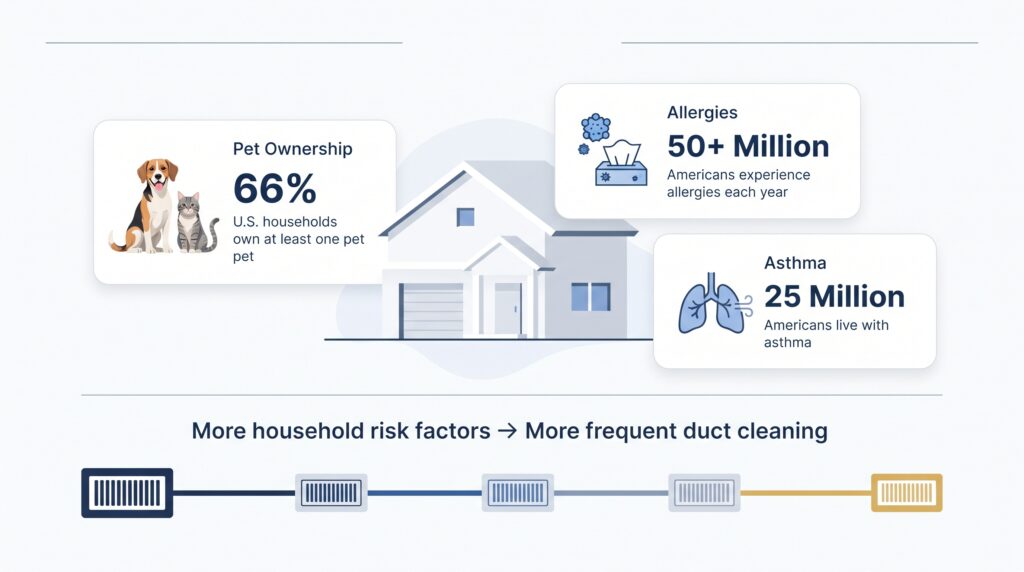
More than 66% of U.S. households own at least one pet, according to the American Pet Products Association’s 2023–2024 National Pet Owners Survey. More than 50 million Americans experience allergies each year, per the Asthma and Allergy Foundation of America — with an additional 25 million Americans living with asthma, per the CDC. That means the majority of U.S. homes have at least one household variable that shortens the generic baseline — and most homeowners have never been told that.
The sections below separate the specific, verifiable factors that shorten or reset your cleaning interval from the far more common case where the generic baseline applies — and gives you a single calculated number to work with rather than a range to guess at.
What Actually Builds Up Inside Your Ductwork Between Cleanings
A duct system isn’t a sealed pipe — it’s a dynamic pathway that pulls air from every room in the house, passes it through a filter and air handler, and distributes it back through the living space on every blower cycle. The filter captures the largest particles. Everything smaller than the filter media — ultrafine dust, skin cell fragments, pet dander, mold spores, pollen, tobacco particulate — passes through and deposits on duct walls, coil fins, and blower wheel blades.
- At every bend, register boot, and flex duct transition, airflow slows and particulates drop out of the airstream and onto duct surfaces — the same physics that causes sediment to settle in river bends rather than straight channels.
- The evaporator coil’s wet surface — always slightly damp during cooling season — is the most hospitable environment in the entire system for mold and microbial growth. Any particulate that reaches the coil has a substrate to adhere to and a moisture supply to grow on.
- The blower wheel re-suspends whatever coats its blades into the airstream on every startup — meaning contaminated blower blades don’t just sit there, they actively distribute debris into the duct run with each cycle.
The rate at which that contamination builds to a level that matters — either for airflow resistance or indoor air quality — is driven by what the duct system is pulling in every day. That’s the variable the generic 3-to-5-year answer ignores.
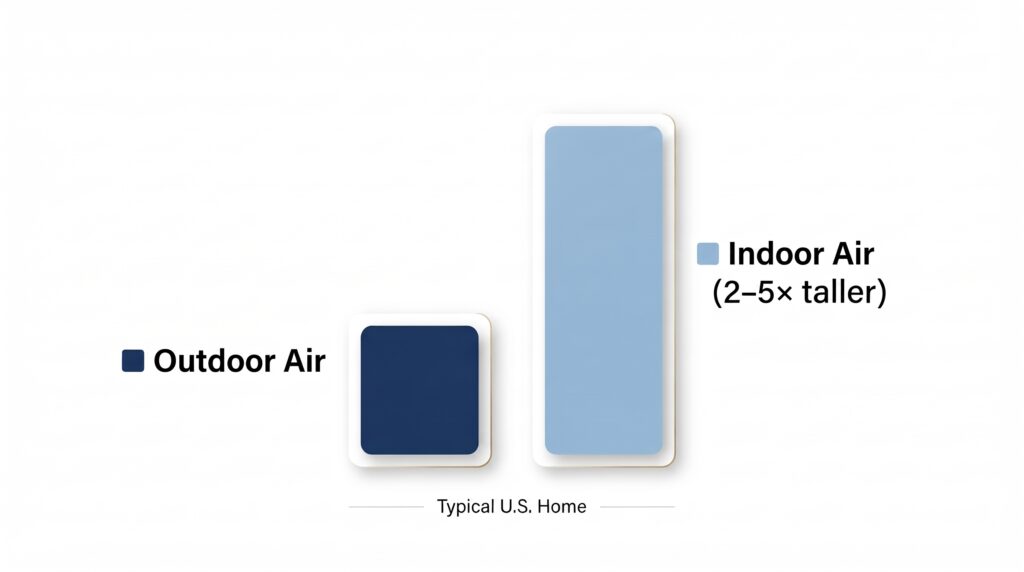
Indoor air pollutant levels run two to five times higher than outdoor levels in a typical home — and occasionally more than 100 times higher, according to EPA human-exposure studies. The duct system is the primary pathway that moves those pollutants from accumulation surfaces into living spaces.Source: U.S. Environmental Protection Agency, Indoor Air Quality (IAQ)
What NADCA and the EPA Say About Cleaning Frequency
NADCA — the National Air Duct Cleaners Association, the industry’s primary certifying and standards body — and the EPA both publish specific cleaning frequency guidance. They’re cited together constantly and misread together almost as often, because they’re answering slightly different questions.
NADCA’s guidance is the proactive maintenance standard: how often to clean before contamination builds to a level that affects IAQ or system performance. The EPA’s guidance is the reactive trigger standard: the conditions under which cleaning is non-negotiable regardless of schedule.
NADCA’s tiered recommendations by household type:
- Standard home, no pets, no respiratory conditions: every 3 to 5 years
- Homes with shedding pets: every 2 to 3 years
- Homes where an occupant has allergies or asthma: every 2 to 3 years
- Post-construction or post-renovation: before or immediately after project completion, regardless of last cleaning date
EPA’s three conditions that make cleaning non-negotiable:
- Substantial visible mold growth inside hard-surface ducts or on other heating/cooling system components
- Ducts infested with rodents or insects
- Ducts clogged with excessive dust and debris where particles are actively being released into the home through supply registers
The EPA does not recommend that air ducts be cleaned routinely, but only as needed — and specifically flags visible mold, excessive dust and debris being released into the home, and rodent or insect infestation as the conditions that warrant it.Source: U.S. Environmental Protection Agency, Indoor Air Quality (IAQ)
Read together: NADCA tells you when to clean proactively so you never reach an EPA-trigger condition. The EPA tells you the conditions where cleaning is overdue regardless of the NADCA calendar. Use NADCA’s tier table to set your interval; use the EPA’s triggers to know when to move regardless of where you are in that interval.
How Often to Clean Air Ducts: By Household Type
Beyond the EPA’s three general triggers, household-specific variables determine the actual interval that applies to your home. Each scenario below maps to a specific cleaning frequency with the source behind it.
- Standard home, no pets, no occupants with respiratory conditions, ductwork in good condition. The NADCA 3-to-5-year baseline applies here. Within that range, closer to 3 years fits homes with higher occupancy, older flex duct systems, or location in a high-pollen city. Closer to 5 years fits newer sheet-metal ductwork in a low-traffic household with consistent filter changes. San Antonio ranks 37th most challenging city for pollen allergies among the 100 largest U.S. metro areas in AAFA’s 2026 Allergy Capitals report — 21st worst nationally for tree pollen and 17th worst for grass pollen — placing it well above the national average for seasonal filter pressure even in an otherwise standard household.
- Homes with one or two shedding pets. Clean every 2 to 3 years, per NADCA. Pet dander — microscopic flakes of skin shed by cats, dogs, and other animals — is among the most common indoor allergens, affecting an estimated 10 to 20% of the world’s population, according to the Asthma and Allergy Foundation of America. Dander bypasses standard 1-inch HVAC filters, especially as the filter loads and airflow begins bypassing the media edges. What passes through deposits on duct walls and coil surfaces, building to a heavier contamination profile faster than a no-pet household at the same system age.
- Homes with three or more pets, or heavy-shedding breeds. Target the 2-year end of the NADCA range rather than 3. At this volume, the dander and hair load passing through the system is high enough that 3 years between cleanings allows contamination to build on coil and blower wheel surfaces to a level that measurably affects airflow resistance.
- Homes where at least one occupant has allergies or asthma. Clean every 2 to 3 years, per NADCA — and for severe or poorly controlled cases, schedule an annual inspection with cleaning when the inspection warrants it. More than 50 million Americans experience allergies each year, per the Asthma and Allergy Foundation of America, and 25 million have asthma, per the CDC. For these households, the duct system is a direct allergen delivery mechanism: dust mite debris, mold spores, pollen, and pet dander accumulate inside duct runs and are re-distributed into sleeping and living spaces with every blower cycle.
- New construction move-in or post-renovation home. Clean before first system startup or within 30 days of move-in — regardless of when the ducts were last serviced. Builder-grade duct protection during construction is inconsistent. Drywall dust from finishing, sawdust from trim work, and insulation fragments from attic framing enter open registers and return grilles throughout the build even when the HVAC isn’t running. The Building America Solution Center (U.S. Department of Energy) specifically recommends inspecting and vacuuming ducts before a new system’s first startup for exactly this reason. Don’t assume a new home equals clean ducts — it frequently doesn’t.
- Home with an indoor smoker. Clean every 2 to 3 years, per NADCA. Tobacco smoke byproducts — tar, nicotine residue, and fine particulate — deposit on duct surfaces and coil fins with every HVAC cycle. Standard filters don’t capture these compounds effectively, so they accumulate faster than typical household dust and coat internal surfaces with a residue that also traps subsequent particulate more readily than a clean duct wall does.
Construction and remodeling work generates dust and particulates that can be drawn into open ducts and mechanical equipment even when the HVAC system isn’t running — and that debris reduces equipment efficiency and life if it’s not removed before the system goes into regular service. Source: Building America Solution Center, Pacific Northwest National Laboratory (U.S. Department of Energy)
When You Can Skip It
If your ductwork is in good structural condition, the installation was clean, no renovation work introduced dust into open ducts, and none of the household risk factors above apply, your home fits the baseline — and the generic 3-to-5-year window is an accurate guide. This is worth stating plainly because duct cleaning is one of the more frequently oversold services in residential HVAC.
- Ductwork is under roughly 10 to 15 years old with no history of moisture intrusion, pest activity, or visible contamination
- No pets, no occupants with allergies or asthma, no indoor smoking
- No renovation or construction work happened near open duct runs in the period since the last cleaning
- Filters have been changed consistently — at or before the manufacturer’s recommended interval for your filter type and household
- No dust discharge, no musty odors, no visible contamination at registers or in accessible duct sections
In this scenario, spending $450 to $1,000 on a duct cleaning before the baseline interval justifies it adds cost without a corresponding IAQ or performance benefit. The EPA’s own guidance backs skipping it here — the standard isn’t “clean regularly,” it’s “clean when warranted.”
The Hidden Cost of Waiting Too Long: How Contamination Compounds Between Cleanings
Even when duct cleaning isn’t a current IAQ issue, there’s an efficiency argument for not extending the interval beyond what your household profile actually warrants — a connection most “how often should I clean my ducts” content doesn’t make.
In a typical home, 20 to 30% of the air moving through the duct system is already lost to leaks, holes, and poorly sealed connections, according to ENERGY STAR — cutting heating and cooling efficiency by as much as 20% before debris is even part of the equation.
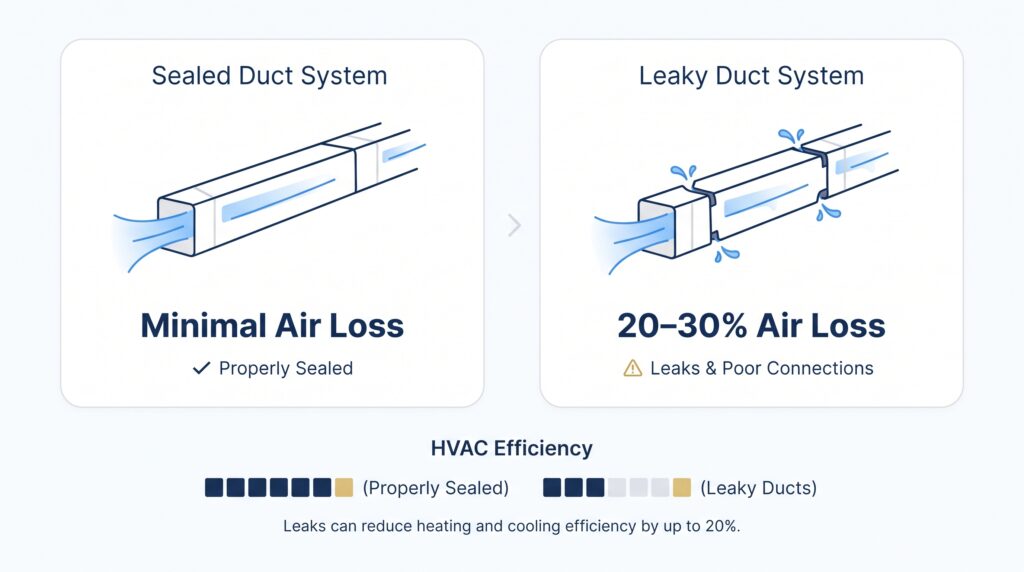
About 20 to 30% of the air that moves through a typical home’s duct system is lost due to leaks, holes, and poor connections — reducing heating and cooling efficiency by as much as 20%. Source: ENERGY STAR, U.S. EPA
Original insight: debris buildup doesn’t cause that leakage, but it compounds it. Accumulated dust and construction debris narrows the effective duct cross-section and increases static pressure, forcing the blower to work harder to move the same volume of air through a resistance-loaded path. On a system where the blower has already been running at elevated static pressure due to existing duct leakage, adding debris resistance on top means the motor is operating consistently near its upper load range — which shortens its service life and increases energy draw simultaneously.
This is a field-observed pattern, not a published percentage, and it’s the strongest non-IAQ argument for respecting your household-specific interval rather than defaulting to the 5-year ceiling. In San Antonio, Bulverde, and Boerne, where systems run near-continuously from May through September and average over 2,000 annual cooling hours versus roughly 1,200 nationally, that blower workload compounds faster than the national baseline implies.
What Air Duct Cleaning Actually Costs in 2026
NADCA, the industry’s primary certifying body, puts a properly performed residential duct cleaning at $450 to $1,000 for an average-sized home, with cost driven by ductwork type, system size, number of systems, and contamination level — not a flat per-home rate.
NADCA specifically warns homeowners to be cautious of advertisements for extremely low-cost “whole house” duct cleaning specials — these often cover only a limited portion of the system and exclude components that matter most, including the air handler, blower fan, coils, registers, and necessary access openings. A properly performed cleaning should include all of the following — and a written scope of work listing each component is the simplest way to confirm you’re getting a full service:
- All supply and return duct runs (main trunk lines and branch runs)
- All supply and return registers and grilles
- Air handler cabinet and blower wheel
- Evaporator coil and drain pan
- Supply and return plenums
- Any accessible air handler access openings cut for vacuum contact
Homeowners should be cautious of advertisements promoting extremely low-cost “whole house” air duct cleaning specials, as these offers often include only limited portions of the system and may exclude critical components such as the air handler, blower fans, coils, registers, or necessary access openings. Source: National Air Duct Cleaners Association (NADCA)
The cost range also correlates with time: a full, properly performed residential cleaning takes 2 to 4 hours for an average home with one system, per NADCA. Be skeptical of any company quoting a whole-house cleaning in under an hour — that timeline is physically incompatible with the vacuum contact time required to actually clean the duct run rather than just access it.
How to Know If Your Interval Should Be Shorter Than You Think
Before setting a cleaning schedule based on the generic baseline, check whether your actual household conditions put you in a shortened-interval category. These four questions resolve the issue for most homeowners without requiring a paid inspection:
- Have you owned a shedding pet for more than 12 months in a home where ducts haven’t been cleaned in over 3 years? If yes, you’re likely already past the NADCA pet-household interval.
- Does anyone in the home have diagnosed allergies, asthma, or a chronic respiratory condition? If yes and your last cleaning was more than 2 years ago, you’re at the edge of NADCA’s recommended window for your household type.
- Has any construction, renovation, or flooring work happened in the home since the last cleaning? If open duct runs or return grilles were nearby — even in adjacent rooms — construction debris is a documented contamination pathway regardless of when the ducts were last serviced.
- Did your last HVAC system startup produce a visible puff of dust from supply registers, or are you noticing musty odors or faster-than-normal dust buildup on register covers? Both are signs that contamination is at a level where it’s actively circulating rather than adhering to duct surfaces.
- Is your thermostat miscalibrated, short-cycling, or running the system past its setpoint? A thermostat reading the room 3–5°F warmer than actual conditions keeps the blower running past where it should have already stopped — moving more air through the duct system, loading the filter faster, and depositing particulate at a higher rate than a properly calibrated unit would. A thermostat that short-cycles (turning on and off every 2–5 minutes) creates repeated startup surges that dislodge settled duct deposits with each cycle. Either fault quietly accelerates contamination buildup independent of your household risk profile. If your thermostat is behaving erratically, resolving that issue first gives you a more accurate read on your actual duct cleaning interval. See Olive Air and Heating’s breakdown of the five signs a thermostat is failing for how to identify whether an equipment issue — not household conditions alone — is driving faster-than-expected buildup.
If the answer to any of these is yes, an inspection — not a speculative cleaning — is the right next step. A physical inspection at the return grille, air handler cabinet, and at least one accessible supply boot will confirm whether contamination is at a level that warrants a full cleaning or whether you have time remaining in your interval.
The Risk Factor Countdown Rule
Original heuristic: start at 5 years (the NADCA upper baseline). Subtract 1 year for each active risk factor present in your home. The result is your recommended cleaning interval. Below 1 year, switch to an annual inspection schedule and clean when inspection findings warrant it rather than on a fixed calendar.
Risk factors that each subtract 1 year: (1) at least one shedding pet in the home, (2) at least one occupant with diagnosed allergies or asthma, (3) at least one indoor smoker, (4) flex duct system with documented sagging or liner wear, (5) high-pollen geography with a multi-season pollen window, (6) any construction or renovation near open duct runs since the last cleaning.
- 0 risk factors → 5-year ceiling. The NADCA baseline applies; skip cleaning until you reach the 3-to-5-year window or an EPA trigger appears.
- 1–2 risk factors → 3-year interval. One shedding dog and a household member with seasonal allergies lands you here. Clean proactively at year 3 rather than waiting for a symptom.
- 3–4 risk factors → 2-year interval. Two dogs, an asthmatic child, and a recent kitchen renovation lands you here. Schedule cleaning at 2 years regardless of whether symptoms have appeared — at this contamination accumulation rate, waiting for a visible trigger is waiting longer than your household profile warrants.
- 5+ risk factors → annual inspection schedule. Clean when inspection findings warrant it rather than on a fixed calendar. At this level, the interval is too short to set automatically — what the inspection shows after year 1 should drive the decision for year 2.
This rule is not a published NADCA formula — it’s a field-derived shortcut that maps to the same outcomes their household-tiered guidance produces when you apply it to real homes. It gives a single number instead of a range, which is more useful for scheduling. An inspection finding that contradicts the countdown (contamination lighter or heavier than expected) takes precedence over the calculated result.
Duct Cleaning Frequency — At a Glance
| Household Situation | Recommended Interval | Why |
|---|---|---|
| Standard home, no pets, no respiratory conditions, no recent construction | Every 3–5 years | NADCA baseline for typical household |
| 1–2 shedding pets | Every 2–3 years | NADCA pet household recommendation |
| 3+ pets or heavy-shedding breeds | Every 2 years | Higher dander/hair load; accelerated buildup at coil and blower |
| Occupant with allergies or mild asthma | Every 2–3 years | NADCA respiratory-condition household recommendation |
| Occupant with severe or poorly controlled asthma | Annual inspection; clean when warranted | Duct system is primary allergen delivery path; AAFA/NADCA guidance |
| Indoor smoker in the home | Every 2–3 years | Tar and fine particulate deposit on surfaces; not captured by standard filters |
| Post-construction or post-renovation (open ducts nearby) | Before or immediately after project completion | Construction debris pathway; BASC/DOE guidance |
| New construction move-in | Before first system startup or within 30 days of move-in | Builder-grade duct protection is inconsistent; BASC/DOE guidance |
| Clean install, no risk factors, no symptoms | 5-year ceiling; skip if no EPA triggers present | No trigger present; cleaning adds cost without corresponding benefit |
How Honeycomb Handles Duct Cleaning Interval Assessments
Honeycomb Heating & Cooling treats the question of when to clean air ducts as a documented, household-specific assessment — not a default upsell or a fixed-interval service reminder.
- Document the household risk profile: pets (count, breed, shedding level), occupant respiratory conditions, smoking history, ductwork type and age, and any construction or renovation since the last cleaning
- Apply the Risk Factor Countdown to generate a starting interval recommendation before the physical inspection
- Conduct a physical inspection at the return grille, air handler cabinet, and at least one accessible supply boot — photographed and documented on the invoice
- Check against the EPA’s three non-negotiable triggers: visible mold, active dust discharge at registers, pest evidence — any one of which overrides the countdown result
- Deliver a written interval recommendation: if inspection shows no trigger and countdown puts the next cleaning 12+ months out, that recommendation is put in writing and no cleaning is scheduled
- If cleaning is warranted, provide a written scope of work listing every component to be cleaned before scheduling — no verbal assurances, no “we’ll handle everything” scope language
- After cleaning: photo documentation of components serviced, note of any findings (mold, pest evidence, duct damage) that require follow-up, and an updated interval recommendation based on the post-cleaning household profile
If you’re deciding whether duct cleaning makes sense for your home across San Antonio, Bulverde, or Boerne, that documented, trigger-based assessment — not a calendar-driven upsell — is what should drive the decision.
Frequently Asked Questions
How often should air ducts be cleaned?
NADCA recommends every 3 to 5 years for a standard home with no pets, no occupants with allergies or asthma, and no recent construction. That shortens to every 2 to 3 years for homes with shedding pets or occupants with respiratory conditions, and to immediately after completion for any home that has undergone renovation or construction with open duct runs nearby. The EPA does not recommend a fixed schedule — it ties cleaning to visible conditions: mold, dust discharge, or pests.
How often should you clean air ducts if you have pets?
Homes with one or two shedding pets should clean every 2 to 3 years. Homes with three or more pets or heavy-shedding breeds should target every 2 years. Pet dander bypasses standard HVAC filters, deposits on duct walls and coil surfaces, and re-circulates with every blower cycle — building to a heavier contamination profile faster than a no-pet household at the same system age.
Should you clean air ducts more often if someone has allergies?
Yes. NADCA specifically recommends the 2-to-3-year interval for households where an occupant has allergies or asthma. For severe or poorly controlled cases, an annual inspection — with cleaning when the inspection warrants it — is more appropriate. The duct system delivers conditioned air directly into sleeping and living spaces, making it the primary pathway for the allergens that trigger symptoms.
Does a new home need duct cleaning?
Often yes. Construction generates drywall dust, sawdust, and insulation fragments that enter open duct runs throughout the build even when the HVAC isn’t running. The Building America Solution Center (DOE) specifically recommends inspecting and vacuuming ducts before the new system’s first startup. A new home does not equal clean ducts — builder-grade duct protection during construction is inconsistent at best.
How much does air duct cleaning cost?
NADCA puts a properly performed full residential cleaning at $450 to $1,000, depending on home size, duct type, number of systems, and contamination level. Be cautious of prices far below this range — NADCA warns that low-cost specials typically exclude the air handler, coils, and blower fan, which are the components where contamination most affects both air quality and system performance. Get a written component list before scheduling.
What are the signs air ducts need cleaning?
The EPA’s three non-negotiable triggers: visible mold inside the duct system or on HVAC components, dust or debris visibly discharging from supply registers, and a pest infestation inside the ductwork. Additional warning signs: musty odors from vents, a visible puff of dust when the system first starts, unexplained increases in allergy or asthma symptoms when the HVAC runs, and faster-than-normal dust accumulation on register covers between cleanings.
Does duct cleaning improve HVAC efficiency?
It reduces static pressure caused by debris buildup on the blower wheel, coil fins, and duct interior — meaning the blower works less hard to move the same air volume. But it doesn’t address duct leakage, the larger efficiency factor. ENERGY STAR data shows 20 to 30% of conditioned air in a typical home is lost to duct leaks before debris enters the equation. Cleaning and sealing address different problems in the same duct system; for meaningful efficiency gains, both are worth evaluating together.
Do smokers need to clean their air ducts more often?
Yes. Tobacco smoke byproducts — tar, nicotine residue, and fine particulate — deposit on duct surfaces and coil fins with every HVAC cycle and are not captured by standard filters. NADCA recommends more frequent cleaning for homes where smoking occurs indoors, consistent with the 2-to-3-year interval for pet and allergy households rather than the 3-to-5-year baseline.
Is air duct cleaning a scam?
Legitimate duct cleaning performed by a NADCA-certified company is a real service with documented benefits in the right circumstances. The EPA does not recommend routine cleaning and notes it has never been shown to prevent health problems on its own. The risk is in the delivery: ultra-low-cost specials that exclude the air handler and coils, or companies that use cleaning as a hook to upsell unwarranted mold treatments. Verify scope of work in writing before scheduling — that’s the simplest filter.
How long does air duct cleaning take?
A properly performed full residential cleaning takes 2 to 4 hours for an average-sized home with one system, per NADCA. Larger homes, multi-system setups, or heavily contaminated systems can run 6 or more hours. Any company quoting a whole-house cleaning in under an hour is not performing a cleaning in any technically meaningful sense — the vacuum contact time required to actually clean the duct run takes longer than that by itself.
Need a Documented Interval Assessment for Your Home?
Honeycomb Heating & Cooling evaluates ductwork against NADCA’s actual tier guidelines and the EPA’s specific triggers during every assessment across San Antonio, Bulverde, and Boerne — no flat-rate upsell, just a documented household profile, a physical inspection, and a written interval recommendation.
Upfront Flat-Rate Pricing · Zero-Pressure Options · Background-Checked Pros · 5.0 Stars on Google (600+ Reviews)
📞 Call or Text (210) 750-6725
Brandon Caputo
Owner · Honeycomb Heating & Cooling
Brandon Caputo founded Honeycomb Heating & Cooling to bring system-driven reliability and customer-first transparency to the San Antonio HVAC market. Grounded in the principle of proactive, preventative care rather than reactive crisis management, Honeycomb specializes in high-efficiency AC and heating installations, advanced diagnostic repairs, and localized indoor air quality solutions. Brandon infuses empathy into every service call, ensuring his team actively listens to homeowners to deliver clear, value-based comfort solutions.
About Honeycomb Heating & Cooling
San Antonio’s trusted specialist in residential air conditioning installation, swift repairs, and energy-saving preventative maintenance. Founded with a commitment to upfront flat-rate pricing and reliable home comfort.
600+ Completed Projects · 5.00-star Google Rating · Open 24/7 for Emergency Support · Founded by Brandon Caputo.
- Upfront Flat-Rate Pricing—No Hidden Fees
- Zero-Pressure Repair & System Options
- Background-Checked & Certified Technicians
- Amana Authorized Elite Partner
- Goodman High-Efficiency System Specialists
- Comprehensive “Comfy Club” Maintenance Programs
- 600+ 5-Star Reviews Across San Antonio
- Fully Licensed & Insured · Texas
- Free estimates & online booking
- Zero Interest with No Monthly Payment financing available
- Office Address: 26995 US Highway 281 Suite C, San Antonio, TX 78260
Sources & Citations
- National Air Duct Cleaners Association (NADCA). (2026). Cost & Time Estimates. breathingclean.com/cost-time-estimates
- U.S. Environmental Protection Agency. (2026). Should You Have the Air Ducts in Your Home Cleaned? epa.gov/indoor-air-quality-iaq/should-you-have-air-ducts-your-home-cleaned
- U.S. Environmental Protection Agency. (2026). Indoor Air Quality (IAQ) — Human Exposure Studies. epa.gov/report-environment/indoor-air-quality
- Building America Solution Center. (2026). Removing Construction Debris from Ducts. Pacific Northwest National Laboratory, U.S. Department of Energy. basc.pnnl.gov/resource-guides/removing-construction-debris-ducts
- ENERGY STAR. (2026). Duct Sealing — Benefits of Duct Sealing. U.S. EPA. energystar.gov/saveathome/heating-cooling/duct-sealing
- Asthma and Allergy Foundation of America (AAFA). (2026). Allergy Facts and Figures. aafa.org/allergy-facts/
- U.S. Centers for Disease Control and Prevention (CDC). (2026). Asthma — Data and Statistics. cdc.gov/asthma/data/
- American Pet Products Association (APPA). (2023–2024). National Pet Owners Survey. americanpetproducts.org/research
- U.S. Environmental Protection Agency. (2026). Controlling Indoor Humidity and Mold — IAQ Guidance. epa.gov/mold/brief-guide-mold-moisture-and-your-home
- Asthma and Allergy Foundation of America (AAFA). (2026). Pet Allergy — Allergic to Your Pet? Learn About Dog and Cat Allergies. aafa.org/allergies/types-of-allergies/pet-dog-cat-allergies/
- Asthma and Allergy Foundation of America (AAFA). (2026). 2026 Allergy Capitals® — The Most Challenging Places to Live with Allergies. aafa.org/asthma-allergy-research/allergy-capitals/
- Olive Air and Heating. (2026). 5 Signs Your AC Thermostat Is Broken (And What to Do First). oliveairandheating.com/blog/5-signs-ac-thermostat-broken/


