(726) 233-6044

5.0 RATING (715+ Reviews)
Indoor Air Quality China Grove
Honeycomb Heating and Cooling installs whole-home dehumidifiers, MERV-13 filtration systems, and UV-C air purification for China Grove homeowners dealing with humidity-driven biological growth, caliche dust infiltration, and allergen accumulation through aging HVAC systems. IAQ systems $700 to $1,500 installed. Free in-home evaluation. Licensed TACLA140435E. 622+ five-star Google reviews. Call (726) 233-6044.


Great company. Got the work done quickly and neatly. Angel and Sergio were super helpful and kind. They did amazing work. Thank you for the great service guys!

Aaron was amazing. I learned a lot about my AC he also helped me put the air duct on my dryer. Very professional great customer service.

Great experience from start to finish and kept me informed each step of the way.

start with a
no pressure visit
We’ll Inspect your system, explain what we see, and let you decide what’s best for your home.
Call Now: (726) 233-6044
REPAIR | INSTALLATION | TUNE-UP: We’ll provide the facts, then you pick the fix that fits your budget.



100% Satisfaction Guarantee

Responsive & Timely Service

Licensed TACLA140435E
What Does Eastern Bexar County’s Summer Humidity Actually Do to the Air Inside a China Grove Home?
The Dew Point Threshold That Changes Everything
Outdoor dew points in the China Grove area regularly exceed 65 degrees Fahrenheit from June through September. At this threshold, humid outdoor air entering through building envelope gaps, HVAC fresh air intakes, and door openings carries enough moisture to condense on cool surfaces inside the home, specifically on metal duct surfaces in attic-adjacent sections and on the evaporator coil interior.
China Grove homes built in the 1990s and early 2000s, which represent the majority of the housing stock in the area, typically have original R-19 or lower attic insulation. Duct systems running through these attics experience surface temperatures significantly warmer than the conditioned supply air inside them. When humid air contacts the cooler outer surface of supply ducts, condensation forms on the exterior and on any organic dust accumulated on interior duct liner surfaces, creating exactly the substrate biological growth requires.
This process is what makes humidity management a prerequisite to effective IAQ improvement, not just a comfort upgrade. Filtration alone addresses particles already in the airstream. Dehumidification addresses the moisture conditions that allow biological sources to establish and regenerate. The Texas Commission on Environmental Quality publishes real-time Bexar County air quality and humidity monitoring data that Honeycomb references during China Grove evaluations.
At what indoor relative humidity do mold populations begin growing significantly?
The EPA identifies 60 percent relative humidity as the threshold above which mold and dust mite populations accelerate meaningfully. Many China Grove homes with single-stage AC systems that cycle on and off in short intervals see indoor relative humidity rise above 60 percent between cooling cycles, even when the thermostat set point is met. Maintaining 45 to 50 percent indoor relative humidity eliminates the primary growth driver without requiring ongoing chemical treatment.
Indoor Relative Humidity and Biological Risk
30–45%
EPA Optimal Range
Mold and dust mite populations minimized. Respiratory comfort maintained. This is the target range for China Grove homes with whole-home dehumidification.
45–50%
Acceptable Upper Limit
Still within EPA recommendations for mold prevention. Standard target for whole-home dehumidistat settings in China Grove’s climate.
50–60%
Caution Zone
Dust mite populations begin increasing. Condensation risk on duct surfaces in attic-adjacent runs. Most common range in China Grove homes with single-stage AC systems cycling short intervals.
60%+
Biological Growth Threshold
Active mold growth accelerates on duct liner, drain pan, and organic building materials. Musty odors at AC startup are the most common indicator that indoor humidity is regularly exceeding this threshold.
Which Airborne Contaminants Are Specifically Elevated in China Grove and Eastern Bexar County Homes?
Eastern Bexar County’s agricultural corridor, prevailing wind patterns, and housing stock age create a distinct set of IAQ concerns that differ from other China Grove neighborhoods. Understanding which contaminants are elevated in your area determines which IAQ system addresses the actual problem.
Source: Agricultural and Road Corridor East of FM 1346
Caliche and Limestone Fine Dust
China Grove and the FM 1346 corridor east toward the Bexar-Wilson county line sit adjacent to active agricultural land where caliche soil disturbance from farm equipment and unpaved roads generates fine particulates regularly. During high-wind events from March through May, outdoor particle concentrations increase significantly. Standard MERV-4 fiberglass filters capture particles above 10 microns but miss caliche fines in the 1 to 5 micron range that deposit on respiratory surfaces. These fines accumulate in duct systems over seasons and become resuspended in airflow during blower operation.
Primary Solution: MERV-13 media filter upgrade with return air pathway assessment
Source: Eastern Bexar County Summer Humidity and Duct System Age
Biological Particles from Duct Surface Growth
HVAC systems in China Grove homes built between 1995 and 2010 typically have fiberglass-lined metal ductwork in attic spaces. The combination of outdoor summer humidity, imperfect duct sealing, and warm attic temperatures creates conditions where biological growth establishes on interior duct liner surfaces. Once established, every blower cycle sends biological particles from the duct system into living spaces. Standard air filter upgrades slow recontamination but do not address the source. UV-C lamp installation at the coil surface prevents growth reestablishment after professional cleaning.
Primary Solution: UV-C coil treatment plus whole-home dehumidifier for humidity control at source
Source: Mountain Cedar Season November through March
Cedar Pollen and Seasonal Allergen Accumulation
China Grove and the FM 1346 corridor east toward the Bexar-Wilson county line sit adjacent to active agricultural land where caliche soil disturbance from farm equipment and unpaved roads generates fine particulates regularly. During high-wind events from March through May, outdoor particle concentrations increase significantly. Standard MERV-4 fiberglass filters capture particles above 10 microns but miss caliche fines in the 1 to 5 micron range that deposit on respiratory surfaces. These fines accumulate in duct systems over seasons and become resuspended in airflow during blower operation.
Primary Solution: MERV-13 filtration plus duct vacuuming to remove seasonal accumulation
Source: Summer Ozone Season May through September
Secondary Ozone Particles and Ground-Level Ozone
Bexar County experiences ground-level ozone accumulation during summer months when vehicle and industrial emissions react with sunlight. The Texas Commission on Environmental Quality reports Code Orange conditions for the San Antonio metro area during peak ozone periods. Secondary particles formed by ozone chemistry are typically in the 0.1 to 1 micron range, too small for MERV-4 and MERV-8 filters to capture effectively. MERV-13 media captures a significantly higher fraction of these particles. China Grove homes with high fresh air ventilation rates during summer ozone season deliver more outdoor secondary particles to occupants than homes with better filtered recirculation. See TCEQ air quality index data for Bexar County to check current ozone conditions before scheduling outdoor activities.
Primary Solution: MERV-13 filtration with blower airflow verification
Three Whole-Home IAQ Systems Honeycomb Installs in China Grove, and Which IAQ Problem Each Solves
Every China Grove installation is evaluated on-site. The right system depends on your specific home age, HVAC configuration, and the contaminant driving the problem, not a one-size approach.
Whole-Home Dehumidifier
$700–$1,500
Installed, transparent pricing
Integrates into the existing air handler and treats all conditioned air volume simultaneously. Operates independently of the AC compressor to maintain 45 to 50 percent indoor relative humidity even during shoulder season when AC cycles are infrequent. Most effective for China Grove homes where single-stage AC short-cycling is the root cause of elevated humidity between cooling cycles.
- Treats all conditioned spaces, not just one room
- Operates independently of AC compressor
- Dehumidistat control for precise RH target
- Addresses root cause of biological growth cycles
- Eliminates portable unit reservoir emptying
Best For: Homes with musty smells or visible humidity effects
MERV-13 Filtration Upgrade
$700–$1,500
Installed with blower airflow verification
Replaces standard builder-grade MERV-4 fiberglass filters with MERV-13 media that captures particles down to 0.3 microns. Installation includes blower airflow verification at supply registers before and after to confirm filter resistance does not reduce system airflow below specifications. Also includes return air pathway assessment to identify unfiltered entry points. Most effective for China Grove homes where dust accumulation and allergen exposure are the primary complaints.
- Captures mold spores, pollen, and fine dust mite allergens
- Blower airflow verified to protect system performance
- Return air pathway inspection included
- Cedar pollen and caliche fines addressed
- Can combine with UV-C for comprehensive coverage
Best For: Allergy symptoms, dust complaints, cedar season impact
UV-C Air Purification System
$700–$1,500
Installed at evaporator coil, transparent pricing
UV-C lamps installed at the evaporator coil continuously emit 200 to 280 nanometer ultraviolet light that disrupts DNA replication in biological organisms on the coil surface and in passing airflow. Prevents biological growth reestablishment on coil and drain pan surfaces after professional cleaning. Does not address humidity conditions that drive growth, so most effective in combination with whole-home dehumidification for China Grove homes with confirmed biological growth. Free Air Scrubber included with qualifying installs per current Honeycomb specials.
- Continuous biological surface treatment at coil
- Effective against mold spores, bacteria, and bioaerosols
- No filter media to replace, annual lamp replacement only
- Can combine with MERV-13 for particle and biological coverage
- Annual replacement coordinated with spring AC tune-up
Best For: Confirmed biological growth, coil contamination, odors
Can multiple IAQ systems be installed together in a China Grove home?
Yes, and many China Grove homes benefit from combined systems. A dehumidifier addresses moisture conditions while UV-C prevents biological growth reestablishment, and MERV-13 captures the particles that both biological and external sources introduce to the airstream. Honeycomb evaluates which combination addresses the specific contaminants identified during the in-home assessment and quotes each component individually so homeowners can choose the scope that fits their budget. Financing options including zero-interest plans are available for qualifying IAQ system purchases.
Why Does MERV Rating Matter for China Grove Homes, and What Does a MERV-13 Filter Actually Capture That a Standard Filter Misses?
MERV stands for Minimum Efficiency Reporting Value, a standardized rating that describes what fraction of particles in specific size ranges a filter captures in a single pass through the filter media. The rating runs from 1 to 20, with higher numbers indicating finer particle capture. The important insight for China Grove homeowners is that the particles most associated with respiratory symptoms, biological growth reproduction, and fine dust accumulation fall in the 0.3 to 10 micron range, exactly where standard MERV-4 filters perform poorly.
Builder-grade fiberglass filters installed in most China Grove homes from the 1990s and 2000s were selected for low resistance and low cost, not filtration effectiveness. They protect the HVAC equipment from large debris but provide minimal IAQ benefit. MERV-13 media filters capture the full spectrum of contaminants that actually affect human respiratory health and duct system cleanliness, at a filter resistance level that most modern China Grove HVAC systems can handle after airflow verification.
For homeowners considering financing options for IAQ improvements, MERV-13 upgrades typically represent the lowest-cost intervention with the broadest contaminant coverage, making them the common starting point before evaluating UV-C or dehumidification additions.
Does a MERV-13 filter capture COVID-19 and respiratory viruses?
MERV-13 media captures particles down to 0.3 microns, which includes respiratory droplets and droplet nuclei in the 0.5 to 10 micron range that carry respiratory viruses. The filter captures a significant fraction of these particles per pass through the system. However, MERV-13 filtration is not a substitute for other respiratory precautions, and capture efficiency depends on air volume passing through the filter rather than direct room air cleaning. Combined with higher air exchange rates through the central system, MERV-13 filtration reduces indoor respiratory aerosol concentration meaningfully over time.
Filter Capture Efficiency by Particle Type
| Large Dust & Lint (10+ µm) | All Ratings |
| Cedar Pollen (15–35 µm) | MERV 8+ |
| Mold Spores (1–20 µm) | MERV 13 |
| Dust Mite Allergens (1–10 µm) | MERV 13 |
| Caliche Fines (1–5 µm) | MERV 13 |
| Combustion Particles (0.1–1 µm) | MERV 13 |
| Bacteria (0.3–10 µm) | MERV 13 |

Why Do Some China Grove Homes Have High Indoor Humidity Even When the AC System Is Less Than 10 Years Old?
AC system sizing in the residential construction market has historically followed the rule of thumb that bigger systems provide better comfort. Systems sized 20 to 30 percent above calculated cooling load reach thermostat set temperature quickly, which satisfies buyers during summer home tours. The IAQ problem emerges from what happens between those fast cooling cycles.
Dehumidification occurs while the AC compressor runs and refrigerant circulates through the evaporator coil. A properly sized system runs longer cycles, removing more moisture per hour. An oversized system in a China Grove home reaches set temperature in 8 to 12 minutes, cycles off, and allows indoor relative humidity to recover before the next cycle begins. During the off period, warm humid air continues infiltrating through the building envelope. The result is a home that feels comfortable at the thermostat reading but maintains 58 to 65 percent relative humidity, above the biological growth threshold.
Honeycomb IAQ evaluations for China Grove homes include indoor humidity measurement over time to determine whether short-cycling is contributing to IAQ complaints. View why homeowners have trusted Honeycomb for this type of diagnostic evaluation.
Signs a China Grove Home Has an Short-Cycling Humidity Problem
Indoor relative humidity above 55 percent despite the thermostat reaching set temperature. Condensation on window glass or window frames in air-conditioned rooms. Musty odors that appear seasonally and worsen when the AC runs. Rooms that feel clammy or sticky at 74 degrees Fahrenheit. These symptoms often appear in newer China Grove homes where occupants assume the system is functioning correctly because the temperature set point is met.
How a Whole-Home Dehumidifier Solves What the AC Cannot
A whole-home dehumidifier installed at the air handler operates on a separate dehumidistat control, running the blower and dehumidifier coil independently of the AC compressor. When outdoor humidity is high but indoor temperature is already at set point, the dehumidifier cycles on to remove moisture without calling for additional cooling. This fills the dehumidification gap left by short-cycling AC systems and maintains consistent indoor relative humidity without requiring AC system replacement.
Variable-Speed and Two-Stage Systems Partially Address Short Cycling
Homeowners upgrading to two-stage or variable-speed heat pump or AC systems in China Grove gain improved dehumidification through longer low-stage runtime cycles. However, even these systems may require supplemental dehumidification during extended high-humidity periods when outdoor dew points remain above 65 degrees Fahrenheit continuously for days. A whole-home dehumidifier complements variable-speed systems during these peak periods and provides humidity control during fall and spring when the system runs minimal cooling cycles.
What Does Eastern Bexar County’s Summer Humidity Actually Do to the Air Inside a China Grove Home?
Honeycomb’s IAQ evaluations are conducted by service technicians with diagnostic training in humidity measurement, particle assessment, and duct system inspection. All evaluations operate under license TACLA140435E held by Omar Castilleja, Honeycomb’s master technician with 27 years of San Antonio HVAC experience and EPA 608 certification.
Aaron Botts and Steven Leon are Honeycomb’s primary service technicians for evaluation and service work in the China Grove area. Installation of IAQ equipment including whole-home dehumidifiers and UV-C systems is handled by Sergio Alfaro and Angel Alfaro, both Amana and Goodman certified. Alejandra Sotelo, Honeycomb’s bilingual customer service representative, schedules all China Grove appointments and can confirm same-week availability when you call. See the full Honeycomb team with credentials.
Every Honeycomb technician entering a China Grove home is background-checked. All IAQ work is photographed and documented before the technician leaves. Financing options are available for qualifying IAQ system installations.
Aaron Botts
Service Technician · 5 Years
Conducts IAQ evaluations including humidity measurement, drain pan inspection, coil condition assessment, and return air pathway review for China Grove area homes. Aaron handles the diagnostic work that determines which IAQ system addresses each home’s specific contaminant pattern. When not on a service call, Aaron paints murals around San Antonio.
Steven Leon
Service Technician · 8 Years
Eight years of San Antonio HVAC diagnostics with particular skill in identifying IAQ problems in older systems where capacitor degradation, drain pan fouling, and biological growth develop gradually. Steven’s thorough documentation approach is reflected in the written IAQ evaluation reports every China Grove homeowner receives before a system recommendation is made.
Omar Castilleja
License Holder · 27 Years · EPA 608
Holds TACLA140435E and EPA 608 certification. Omar’s 27 years of San Antonio HVAC experience provides the technical oversight for all Honeycomb IAQ evaluations. He is particularly familiar with the north and east San Antonio areas including China Grove, Converse, Valley Ranch, and Shavano Park where he has observed IAQ patterns across multiple housing eras.
Urgent IAQ Situations
Suspected Mold Growth or Visible Biological Contamination on Vents in China Grove? Honeycomb Responds 24/7.
Visible biological growth on supply vents, black discoloration around return air grilles, or musty odors that intensify suddenly after a leak event warrant prompt professional evaluation. Honeycomb’s 24/7 emergency HVAC response service covers China Grove for urgent situations involving suspected contamination or water intrusion into HVAC systems. Non-emergency IAQ evaluations typically schedule within one to two business days. CPS Energy rebate programs may offset costs for qualifying high-efficiency HVAC upgrades installed alongside IAQ systems.
Complimentary in-home evaluation. Written findings and recommendations before any commitment. Same-week appointments available.

What Our Customers Say

I was really stressed about our AC issue today, but they took care of everything from diagnosis to repair in one visit. The technician was incredibly thorough, explained everything clearly, and spent nearly five hours working on our unit to make sure it was properly fixed.
I truly appreciate the professionalism, dedication, and attention to detail. Especially thankful to the technician ( Javier Almarza ) for not rushing the job and for taking the time to get everything right. We’re so grateful for the help, especially in this heat!
I used the tune up service offered by Honeycomb. So far my experience has been great! Stephen was on time, they have a nifty feature where you can track your driver! You receive text alerts that keep with every step of the service! Awesome concierge service! Stephen L. explained every detail of maintenance clearly and concisely. He gave me the best options to resolve my problem according to my budget. Later a manager called and doubled checked to make sure all was up to my satisfaction.
Fast, friendly, and extremely knowledgeable. Aaron B. arrived at my home within an hour of my call and quickly had my AC running again. He took the time to clearly explain everything, answered all of my questions, and provided helpful insight into my system. I was so impressed that I signed up for their membership program, which will help extend the life of my unit. Before leaving, Aaron performed a full walkthrough and showed me the recommended repairs, clearly outlining what was urgent and what could wait. Excellent service from start to finish.
Deals & Specials

FINANCING AVAILABLE VIA GREENSKY
Flexible payment options to fit your budget. Contact us today to see if you qualify for GreenSky financing.
Free Nuve Thermostat with Install
Control your home temperature from anywhere. Can’t be combined with other offers.
Zero Interest with No Monthly Payment
Call for more details. Can’t be combined with other offers.
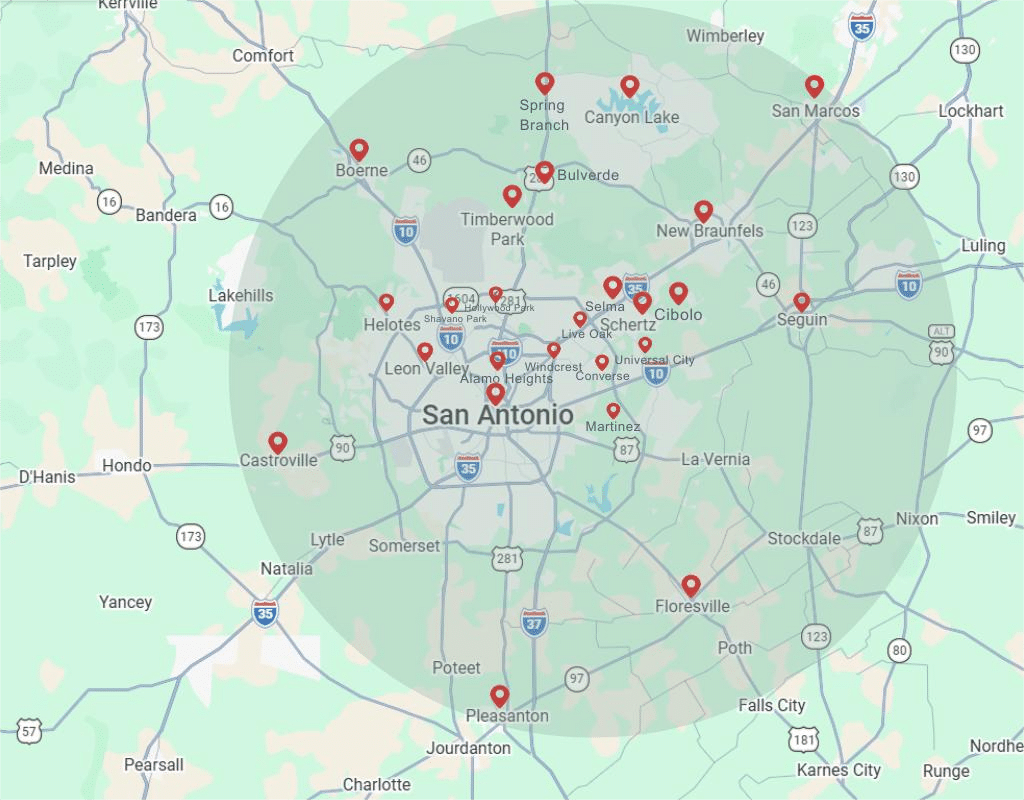
China Grove and East SA Metro Neighborhoods We Serve
Honeycomb provides expert indoor air quality solutions across China Grove, TX. Below are some of the China Grove neighborhoods and districts we regularly serve, each with its own unique home construction styles, ventilation setups, and specific humidity or allergen challenges.
- China Grove
- Cibolo
- Northeast SA
- Converse
- Selma
- Martinez
- Universal City
- Live Oak
- Floresville
- Schertz
- Windcrest
- New Braunfels
Full Coverage, Every Zip Code. Not listed? We still serve it. Call (726) 233-6044 to confirm availability.
Indoor Air Quality Questions from China Grove Homeowners
What causes musty smells in China Grove homes when the AC turns on?
Musty odors when the AC starts are almost always caused by biological growth on the evaporator coil, drain pan, or interior duct surfaces. In China Grove, eastern Bexar County’s summer humidity creates conditions where HVAC systems that run continuously from April through October accumulate moisture on coil surfaces. When the blower starts, air passes over these surfaces and carries biological particles into the living space. A $58 AC tune-up often identifies the specific source through drain pan inspection and coil examination. Remediation typically involves drain pan treatment, UV-C installation on the coil surface, and in more advanced cases, a whole-home dehumidifier to prevent recurring moisture accumulation.
How much does indoor air quality service cost in China Grove, TX?
IAQ systems installed in China Grove homes range from $700 to $1,500 depending on the system type and home configuration. Whole-home dehumidifiers, MERV-13 filtration upgrades with blower airflow verification, and UV-C air purification systems all fall within this range. The in-home evaluation that identifies which system fits a specific China Grove home is complimentary with no obligation. Honeycomb provides written quotes before any installation begins. Financing options including zero-interest plans are available for qualifying IAQ system purchases.
What is the difference between a MERV-13 filter and a standard MERV-4 fiberglass filter?
MERV-4 fiberglass filters capture particles larger than 10 microns, which includes large dust and lint but misses mold spores (1 to 20 microns), most pollen (10 to 100 microns at fine end), and virtually all bacteria and fine particulates. MERV-13 media filters capture particles down to 0.3 microns, which includes mold spores, most pollen, fine dust mite allergen fragments, combustion byproducts, and a significant fraction of respiratory aerosols. For China Grove homes with occupants experiencing allergy symptoms, a MERV-13 upgrade is typically the first and most cost-effective IAQ intervention before evaluating UV-C or dehumidification.
Does a whole-home dehumidifier need to be installed separately from the AC system in China Grove?
A whole-home dehumidifier integrates directly into the existing central HVAC system at the air handler, treating all conditioned air volume rather than just one room. It operates independently of the AC compressor, which means it continues removing moisture during cooler periods when the AC cycles off but humidity remains high. This is particularly important in China Grove during spring and fall shoulder seasons when outdoor humidity is elevated but temperatures don’t require active cooling. Installation adds a dehumidistat control and drain connection to the air handler. The system does not require a separate dedicated outdoor unit.
Why do China Grove homes accumulate more dust than homes in other areas?
China Grove’s location in eastern Bexar County places homes downwind of caliche and limestone dust generated by FM 1346 corridor traffic and agricultural activities east of the city. Caliche particles range from 1 to 50 microns and pass through standard MERV-4 fiberglass filters without resistance. During high-wind events, outdoor infiltration through building envelope gaps significantly increases. Homes in the area also frequently have original builder-grade return air grilles without filter media on secondary returns, creating unfiltered air pathways. MERV-13 filtration combined with return air pathway sealing addresses both the filtration gap and the infiltration issue.
What is the EPA-recommended indoor relative humidity range and why does it matter?
The EPA recommends maintaining indoor relative humidity between 30 and 50 percent to prevent biological growth while avoiding conditions that cause respiratory dryness. In China Grove, the concern is almost always the upper limit. Summer outdoor dew points regularly exceed 65 degrees Fahrenheit from June through September, and indoor relative humidity in homes with standard AC systems running short cycles frequently rises above 60 percent between cooling cycles. At relative humidity above 60 percent, mold and dust mite populations grow significantly faster on duct surfaces, carpet fibers, and organic building materials. Maintaining 45 to 50 percent indoor relative humidity through whole-home dehumidification eliminates the primary driver of biological growth in most homes.
Can a UV-C air purifier eliminate mold growth in an HVAC system?
UV-C light at 200 to 280 nanometers wavelength disrupts DNA replication in biological organisms, inactivating mold spores, bacteria, and viruses that pass through or accumulate on the lamp’s target surface. A UV-C lamp installed at the evaporator coil continuously treats the coil surface, preventing biological growth reestablishment after initial cleaning. UV-C does not remove existing growth or address the humidity conditions that caused it. For China Grove homes where mold is present, UV-C is most effective as part of a remediation approach that also includes drain pan cleaning, coil cleaning, and in homes with recurring moisture issues, a whole-home dehumidifier to address the root cause.
Why do some China Grove homes have IAQ problems even with relatively new HVAC systems?
Newer HVAC systems installed in China Grove homes over the past 10 to 15 years are often sized to cool quickly rather than dehumidify effectively. A system that reaches set temperature quickly cycles off before completing a full dehumidification cycle. Short-cycle systems in high-humidity climates can actually perform worse for indoor air quality than properly sized older systems because each cooling cycle removes less moisture per runtime hour. This is often called the short-cycling humidity problem. Variable-speed and two-stage systems address it through longer low-stage runtime, but single-stage systems in China Grove homes frequently require supplemental dehumidification even when the AC equipment itself is relatively new.
Does outdoor air quality in China Grove affect what IAQ system a home needs?
Yes. China Grove is in eastern Bexar County, where summer ozone season from May through September and high-wind caliche dust events from March through May create periods of elevated outdoor air quality concern. When the Texas Commission on Environmental Quality reports Code Orange or Code Red Air Quality Index conditions for Bexar County, outdoor air entering through HVAC fresh air intakes, building envelope gaps, and door openings becomes a significant particulate source. During these periods, MERV-13 filtration captures a substantially higher fraction of ozone-generated secondary particles and fine dust than standard MERV-4 filters. Homes that rely on fresh air ventilation for indoor air exchange during elevated AQI periods benefit most from MERV-13 media upgrades.
Is a return air sealing assessment included with a Honeycomb IAQ evaluation in China Grove?
Yes. The Honeycomb IAQ evaluation for China Grove homes includes inspection of return air pathways for unfiltered air entry points, which are one of the most common and overlooked IAQ issues in the area. Many China Grove homes have secondary return grilles in hallways or utility areas that lack filter media, or return duct connections with gaps that pull unconditioned attic or wall cavity air into the system. Identifying and sealing these pathways often produces immediate particulate reduction without any equipment installation. This inspection is part of the complimentary no-pressure evaluation.
When is the best time to schedule an IAQ evaluation in China Grove?
April and May are the optimal months for an IAQ evaluation in China Grove before summer humidity drives dew points above 65 degrees Fahrenheit in June. A spring evaluation identifies moisture risk on duct surfaces and drain pans before humidity conditions promote biological growth. It also establishes a baseline indoor humidity measurement before the high-demand June through September period when scheduling typically extends to one to two weeks. For China Grove families with children experiencing springtime allergy symptoms, evaluations after the March through May caliche dust season also provide useful data on particulate sources.
How does a whole-home dehumidifier differ from a portable room dehumidifier for China Grove homeowners?
Portable room dehumidifiers treat a single room at a time, require manual emptying or hose setup, and are typically rated for 50 to 70 pints per day. A whole-home dehumidifier integrated with the central air handler treats all conditioned spaces simultaneously, including bedrooms at the end of long duct runs and attic-adjacent areas where condensation forms first. In China Grove homes where the concern is duct surface biological growth in attic-adjacent sections, portable units placed in living areas cannot reach the location where moisture accumulates. Whole-home units also maintain consistent 45 to 50 percent indoor relative humidity across all rooms regardless of whether anyone is present to empty a portable reservoir
Can MERV-13 filters cause airflow problems in older China Grove HVAC systems?
Yes, and this is why Honeycomb verifies blower airflow before recommending MERV-13 upgrades. MERV-13 media has higher filter resistance than MERV-4 fiberglass, which means the blower must work harder to move the same air volume. In HVAC systems with blower motors operating near their performance limits, adding MERV-13 filtration can reduce airflow below minimum specifications, increasing static pressure and reducing system efficiency. During the IAQ evaluation, Honeycomb measures airflow at supply registers before and after filter installation to confirm the upgrade does not compromise system performance. Some older China Grove systems require a blower motor assessment before MERV-13 is appropriate.
What IAQ problems are most common in China Grove homes built in the 1990s and early 2000s?
China Grove’s residential development concentrated heavily from the late 1990s through the mid-2000s, making this era the most common housing stock in the area. These homes typically have original single-pane or early double-pane windows with higher infiltration rates than modern construction, builder-grade MERV-4 return air grilles that have never been upgraded, and attic spaces with R-19 or lower insulation values that allow heat transfer to duct surfaces during summer months. The resulting warm duct surface temperatures combined with high outdoor humidity create ideal conditions for biological growth on interior duct liner materials. MERV-13 filtration and UV-C coil treatment are the most frequently recommended interventions for this construction era in China Grove.
“Honeycomb Heating & Cooling (TACLA140435E) is a San Antonio-based, locally owned HVAC company. We are not affiliated with Honeywell or any national brand.”
Buzz us today for reliable HVAC solutions!
 Request Service